
The Rise of AI Coding and What It Means for Your Business
AI has made it possible for non-coders to build real software, and the early movers win. Here is what is happening, with an auto repair shop tool as a worked example.

Eight things the rise of AI coding actually means for your business
I am Madhuranjan Kumar, and over the past year I have watched people with zero programming background build working apps, put them online, and earn real money from them. They describe what they want in plain language and let an AI model write the code. A year ago that would have sounded impossible. Today it is simply how a growing group of builders work, and the gap between the people who understand this and the people who do not is where the opportunity sits. Below are the eight points I would want any business owner to hold in their head, each one concrete and each one actionable.
1. Non-coders are already shipping and selling real software
Start with the fact, because it is the one people still resist. This is not a demo or a promise about next year. People with no engineering training are building websites and applications, publishing them, and getting paid. The reason this matters to you is that the barrier which used to protect software, the need to be a programmer, has fallen. If the ability to build a tool for your industry no longer requires a computer science degree, then the person best positioned to build it is whoever understands the industry best, and that might be you.
2. Even prominent experts are underestimating it
Some of the most respected voices in technology are still saying that non-technical founders cannot build a real product yet. Meanwhile, non-technical people are quietly doing exactly that. I do not point this out to mock anyone. I point it out because a gap between what experts say is possible and what is actually happening is the single most valuable situation a business owner can find. When the crowd believes something cannot be done and a few people are doing it anyway, the early movers get a window before everyone else catches on. That window is open right now.
3. Scaling laws mean the tools keep improving on their own
Here is the part that makes this a trend and not a fad. The models improve in a predictable way. Add more data and more compute, and they get better. This pattern has held far longer than skeptics expected, and the practical consequence for you is enormous: the tool you use to build today will be stronger next year without you doing anything. You are not betting on a fixed capability. You are stepping onto an escalator that keeps rising under your feet. A tool you build now will quietly get smarter as the models behind it improve, better at reading messy input and producing clean output, without a rebuild.
4. The technology is here, but the everyday uses are still being discovered
Capability and adoption are two different clocks. Think about the transistor. It was a genuine breakthrough, and yet it took years before it showed up in the everyday products ordinary people used. AI is on the same path. The core technology exists now, but the specific, boring, valuable business uses are still being found one at a time. That is precisely why being early matters. The first wave of any platform looks like gimmicks, and then the useful tools arrive and become part of daily life. The businesses that experiment during the gimmick phase are the ones holding the useful tools when the rest of the market wakes up.
5. Being non-technical is an advantage, not a handicap
This is the point people find hardest to believe, so let me be blunt about it. If you have spent years inside a business, you know the real problems, the exact words customers use, and the steps that frustrate everyone involved. A pure programmer often misses all of that because they live in a coding bubble, solving interesting technical problems that no customer actually cares about. People want very simple products that solve one clear problem, and you already know which problem matters most in your world. Pair that hard-won knowledge with an AI that writes the code, and you can build something people genuinely want, which is the hard part that no amount of coding skill guarantees.
6. Pick a vertical you know deeply
The strategic move is to aim narrow. Every industry has tasks that a personalized, always-on tool could handle better than the generic software on the market. A local accountant, a car wash, a clinic, a contractor, each of them has workflows that waste time and could be smoothed by a tool built for that specific niche. The best builder for a vertical is usually the person who knows the vertical, not the person with the most coding experience. So do not try to build for everyone. Build for the corner of the world you already understand, where you can tell in five minutes whether a tool is right because you have lived the problem it solves.
7. Guard simplicity like it is the product, because it is
There is a trap waiting on the other side of how easy building has become. When adding features costs almost nothing, the temptation is to keep adding them, and every extra option makes a tool harder to use and easier to abandon. The strongest products do one obvious thing well. Start with the single most painful task in your vertical, build a tool that removes it, and resist the urge to bolt on everything else until people are actually using and loving the first version. Restraint is a competitive advantage here, because most people will not have it, and their bloated tools will lose to your simple one.
8. The edge belongs to whoever starts the loop first
The final point ties the rest together. While the skeptics wait for the technology to feel finished, early builders are gaining two things that compound: skill with the tools, and real customers. Both get harder to catch the longer you wait. Treat your first build as practice rather than a finished product. Ship something small, watch how real people use it, and let what you learn shape the next version. Each round teaches you both the tool and your own customers, and that compounding knowledge is the part competitors cannot copy. Think about what an army of tireless workers could produce for your business, and design for that, not just for today's limits.
A worked example: the auto repair shop
Let me put all eight into one concrete build, because the points only matter when they touch a real business. Take an auto repair shop, where time and trust leak out of the same place: quoting and status updates.
Picture the tool. A customer describes a problem or uploads a photo of a dashboard warning light. The tool uses AI to suggest likely causes and a rough estimate range, then logs the job. As the shop works, the customer gets simple status updates, parts ordered, repair in progress, ready for pickup, without anyone playing phone tag. Here is how I would set it up for the owner. I would describe the tool in plain language, build the quote intake and the status tracker through prompts, test it on a few real jobs, and ship it. The shop spends less time on the phone, quotes more jobs per day, and customers feel informed instead of left guessing.
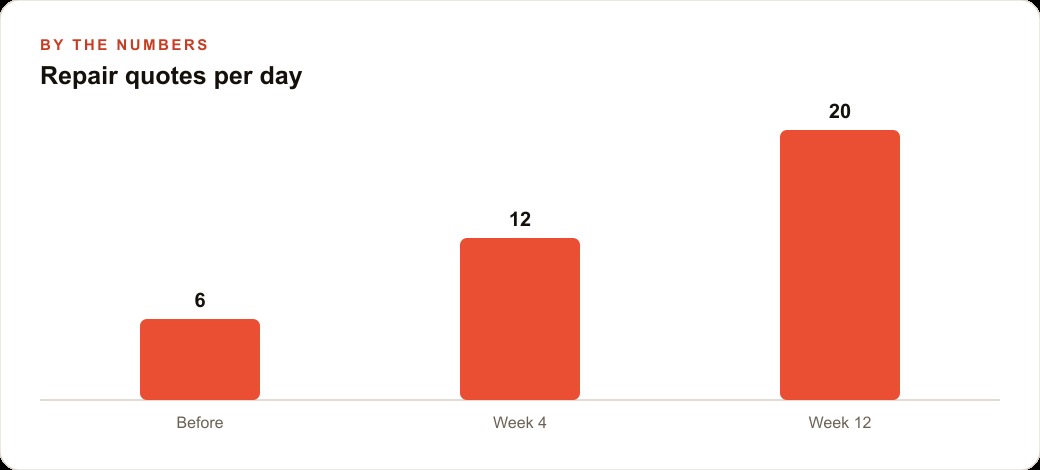
Put illustrative numbers on it. Say the shop starts at six quotes a day when everything runs through phone tag. With the intake tool absorbing the first pass, that could realistically climb to twelve within a month and twenty within a quarter as the process tightens and word gets around that quotes come back fast. Because the models keep improving, the same tool gets sharper over time at reading symptoms and tightening estimates, without a rebuild. The leads the shop generates from its ads land in the CRM and website stack where the status tracker keeps every customer updated automatically, and the clean record of jobs and common repairs the tool builds up becomes raw material for SEO and organic search so the shop starts ranking for the exact problems it fixes. The owner never learned to code. They knew how a repair shop actually runs, which they already did.
Notice how every one of the eight points shows up in that single build. The owner used their vertical knowledge, the deep understanding of how quotes and trust actually work in a repair shop, which is point five and point six. They kept the first version simple, just intake and status, resisting the urge to bolt on inventory management and scheduling and payroll, which is point seven. They shipped it as practice and let real customer use shape the next version, which is point eight. And because scaling laws keep the underlying model improving, the tool they shipped keeps getting better on its own, which is point three. The strategy is not eight separate ideas. It is one coherent way of building that a non-technical owner is often better positioned to execute than a career programmer, because the programmer tends to over-engineer and the owner knows exactly where to stop.
The compounding advantage of moving first
There is one more thing worth making explicit, because it is the reason I keep urging people to start now rather than wait for the tools to feel finished. The advantage here is not a one-time head start. It compounds. The owner who ships their first rough tool this month is not just ahead by one tool. They are learning the workflow, building a feel for what AI does well and badly, and accumulating a relationship with customers who now expect that fast, informed experience. Six months later, when a competitor finally decides to try, they are not six months behind on a single tool. They are six months behind on the skill, the customer expectations, and the accumulated knowledge of what actually works in that specific business.
That gap is the part competitors cannot simply buy their way past, because it lives in the thousands of small lessons you only get by shipping and watching. The skeptics who insist this cannot work are not neutral bystanders. They are actively handing that compounding edge to whoever ignores them and builds. The learning curve has never been easier to climb, which is precisely why the people who climb it now will be so hard to catch later. Every week you wait is a week of compounding you hand to someone else.
How to start this week
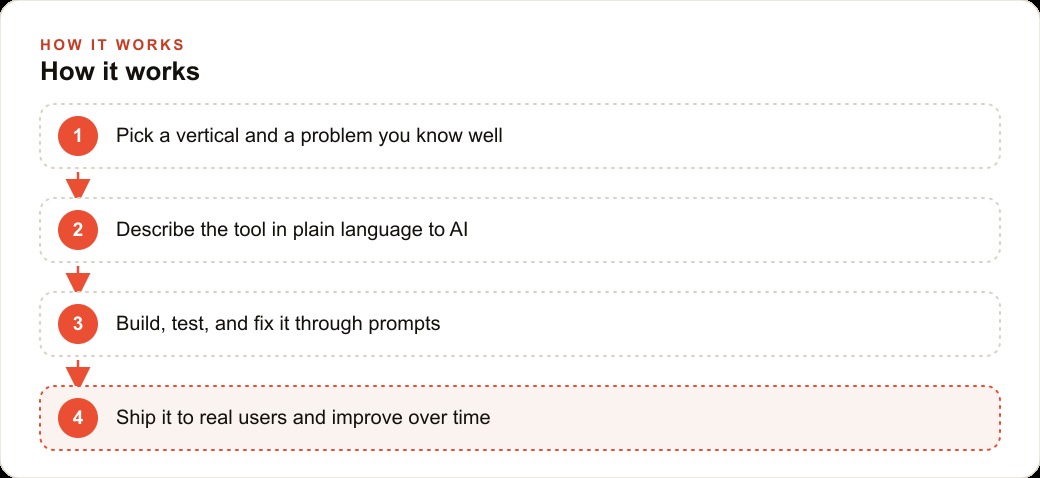
Follow the four moves in order. First, pick a real problem you know well, the task that wastes the most time in your specific business, not a generic idea you read about somewhere. Second, describe the tool in plain language to an AI builder, exactly the way you would explain it to a new hire on their first day. Third, build, test, and fix it through prompts, pasting back any errors you hit and telling the AI plainly what looked wrong. Fourth, ship it to a handful of real users, watch how they actually use it, and keep improving it as the models get stronger underneath you. Do not wait for the technology to feel finished, because it never will feel finished, and the skeptics who insist it cannot work are handing the early edge to the people who simply try. As the tool proves itself, that same efficiency frees up budget and attention for the Facebook and Instagram ad campaigns that bring the customers in to use it.
You can build a tool like this yourself if you are willing to learn and iterate, and I would genuinely encourage you to start small this week. If you would rather have a working, branded tool built for your business without the trial and error, that is exactly the kind of work I do for clients, and you can bring me in to build and ship it while you keep running the business.
That is exactly what we do at AI DOERS. Book a private 30-minute call with Madhuranjan Kumar and we will map the fastest path to it for your specific business.
Book your call →
Madhuranjan Kumar
Madhuranjan Kumar brings 20 years of performance-marketing experience and has managed over $200 million in Facebook ad spend for brands across the United States and beyond. His expertise spans the full modern marketing stack: Meta, Google Ads, TikTok, email automation, CRM, and the websites that hold it together. At AI DOERS he turns that track record into lead-generation systems for businesses across every industry.