
The Real Cost Of AI And How To Cut Your Bill By 78% Or More
Model costs grow with every user and can spike without warning. Two levers, smarter model choice and fewer tokens, can routinely cut that bill by 70% or more while keeping quality high.

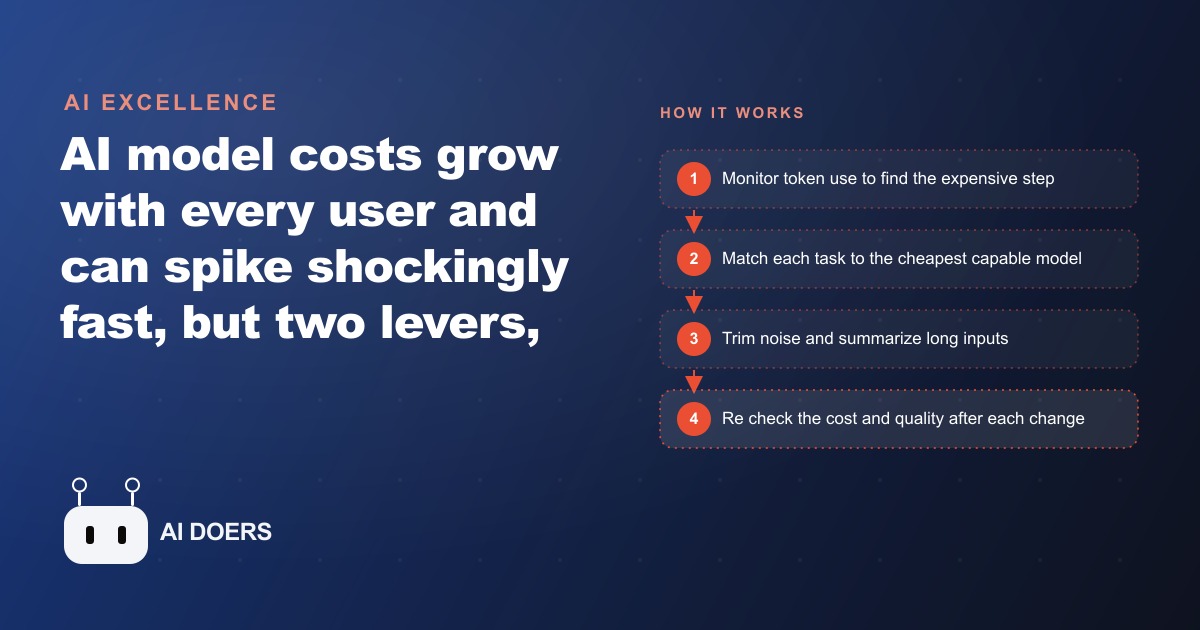
The AI cost trap nobody warns you about, and the two dials that fix it
One Friday afternoon a team burned five thousand dollars because two of their agents got stuck talking to each other in a loop, replying back and forth with nobody watching the meter. I am Madhuranjan Kumar, and that story captures the strangest thing about building with AI: it has a cost that traditional software never had, one that grows with every user and every action and can spike without warning. The good news is that the same expense is unusually controllable. Take it apart and it comes down to two dials, and turning them well routinely cuts an AI bill by seventy percent or more without making the product worse.
Why AI cost behaves nothing like software cost
Traditional software has mostly fixed costs. You build it once and serving one more user is nearly free, which is why flat monthly pricing works so well. AI breaks that assumption. Every message a user sends and every answer the model writes consumes tokens, and tokens cost money, so your cost scales directly with usage. Charge a flat monthly price on top of that and the math turns dangerous, because a heavy user can quietly cost you more than they pay.
The runaway loop from that Friday is the extreme version of the same problem. When cost scales with activity, a process with no brakes can drain an account in an afternoon. So the first thing to internalize is not a trick, it is a mindset. Treat model cost as a core part of your product economics, monitor it like you monitor revenue, and put alerts and hard boundaries in place so no runaway process can ever silently empty your budget. Everything else is optimization. This is survival.
Dial one: choosing the right model for each task
The single biggest lever is model choice, because the price gaps between models are enormous. The most powerful model can cost roughly two hundred times a small one. Sit with that number. A single paragraph from the frontier model can cost the same as an entire book from the small one. Most teams default to the strongest model for everything out of caution, and that default is usually where the money leaks.
There are three ways to work this dial. The cheapest to try, and the one I reach for first, is simply swapping a top-tier model for a faster, cheaper version of it and checking whether quality holds. That single move often saves around thirty percent for free. The second is routing. A light, cheap classifier reads each incoming request and decides whether it is simple or complex, sending easy questions to a small model and reserving the expensive one for the rare hard case. Since most real traffic is easy, this shifts the bulk of your volume onto cheap infrastructure. The third, for a narrow high-volume task, is to launch on a powerful model, save all the results, then use that data to fine-tune a small specialized model that matches the frontier quality on your specific job. Done well, that can cut cost by well over ninety percent for that task.
Dial two: sending fewer tokens
The second dial is reducing the tokens you send and generate, and it hides more savings than most people expect because most prompts are bloated. A large share of the text in a typical prompt is redundant filler that does not change the answer. You can use a small cheap model to strip that noise, shrinking a long input dramatically while keeping, and sometimes improving, the result. Less clutter often means a sharper answer, so this is one of the rare optimizations that helps quality and cost at once.
The same logic applies to anything the model reads from tools. A web scrape returns a pile of junk, menus, footers, navigation, cookie banners, so summarize it before it enters the agent's memory rather than paying to process all of it. And memory itself needs active management. If you keep every word of a long conversation, the token count grows forever and every new message gets more expensive than the last. The fix is to keep the most recent stretch word for word, where precision matters, and replace older history with a running summary. Above all, monitor token use per step, because you cannot fix an expensive step you cannot see.
The order the dials come in
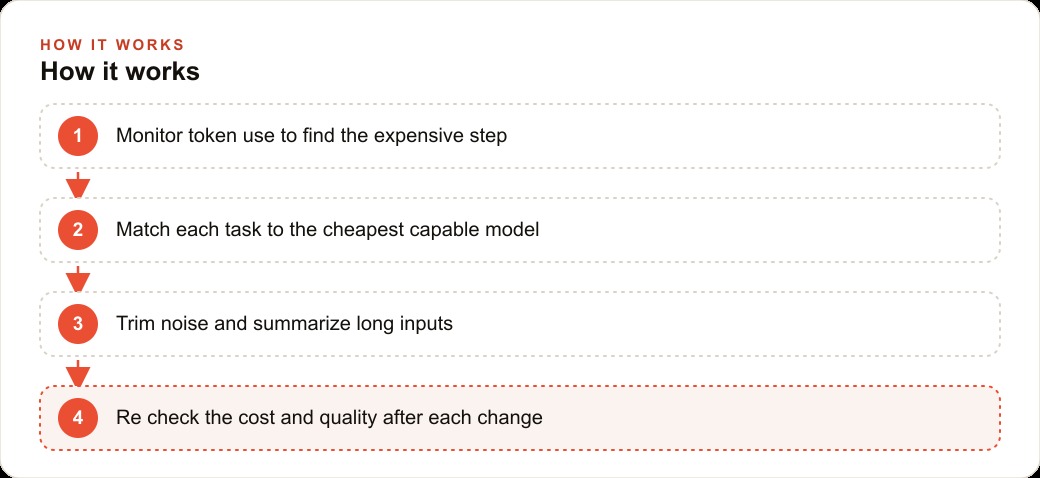
There is a right sequence, and it starts with visibility. Add a monitoring tool that logs how many tokens each step consumes, then look at where the cost concentrates. It is almost always two culprits: huge blocks of text stuffed into every prompt, and long histories carried word for word. Only once you can see the expensive step do you apply the dials, model choice first because it is the biggest lever, then token trimming to squeeze what remains. After each change, recheck cost and quality together, so you keep the savings without quietly degrading the answers.
A worked example: an online retailer's support assistant
Let me run the dials on one business. Picture an online retailer with an AI support assistant that answers questions about orders, returns, and products. These assistants get hammered with volume, and most of that volume is simple: where is my order, what is your return policy, is this in stock. Paying frontier prices for every one of those is a slow, steady leak.
First, monitoring. I would log token use per conversation and find where the cost concentrates, which here is usually the entire help center stuffed into every prompt plus long chat histories carried in full. Then the dials. A light classifier routes the easy questions, the order-status and policy lookups, to a small cheap model, and reserves the powerful model for the rare complex complaint that genuinely needs careful handling. I would trim the context so the assistant receives only the relevant policy snippet, not the whole help center, and summarize older parts of long chats while keeping the last few messages exact. For the product knowledge the assistant leans on most, I would save real answers and fine-tune a small model on them, so common questions get handled cheaply at near frontier quality.
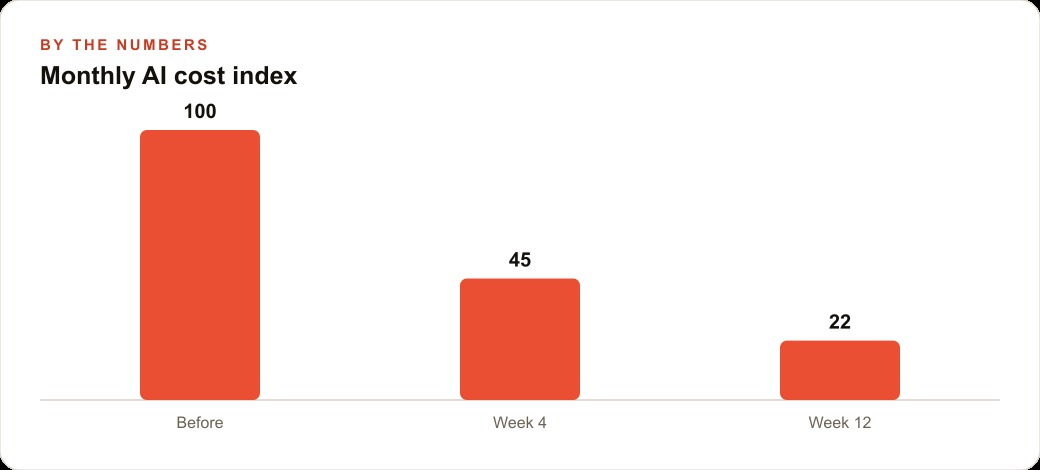
Put numbers on it. Say the assistant handles 20,000 conversations a month at an average of 20 cents each, which is 4,000 dollars. If eighty percent of that volume is simple and routes to a model that costs a tenth as much, and trimming context and memory shaves the rest, the blended cost can land near 1,000 to 1,200 dollars, a cut of roughly seventy percent, while replies actually get faster because the small model is quicker. That saved 2,800 dollars a month is not a rounding error. It is margin that can fund the Facebook and Instagram ad campaigns that bring the next wave of customers, or subsidize better pricing, and the cleaner support data can even feed SEO and organic search by revealing the exact questions buyers ask.
Who should care about this
Any business running an AI feature should, from SaaS apps with chat assistants to support automation, content tools, and sales outreach. The principle is universal. Cost scales with usage, so the businesses with the most traffic have the most to save, and even a single afternoon of optimization can turn an unprofitable feature into a healthy one. Those savings drop straight to the bottom line, and the leaner your AI runs, the more room you have to grow without your costs running away from you. When the assistant, the site, and the customer records all live in one connected CRM and website stack, you can also see which conversations lead to sales, so you optimize cost without cutting the interactions that actually earn money.
The mistake that makes every other optimization pointless
There is one error that quietly undoes all the careful work above, and it is skipping the boundaries. You can route models perfectly, trim every prompt, and manage memory beautifully, and none of it protects you from a runaway process with no ceiling. The five thousand dollar Friday did not happen because someone chose the wrong model. It happened because two agents had no stop condition and no spending cap, so a small logic loop turned into a large bill while everyone was at lunch. Optimization lowers your cost per action. Boundaries stop a broken action from repeating ten thousand times.
So before you tune anything, put hard limits in place. Set a spending cap that halts activity past a threshold. Add alerts that fire when usage jumps unexpectedly rather than when the invoice arrives. Give every automated loop a maximum number of steps and a clear exit condition. These guardrails feel like overhead until the one afternoon they save your month, and unlike the fine-tuning work, they take an hour to set up and never need touching again. Treat them as the floor you build everything else on top of.
A simple monthly ritual to keep the bill honest
Costs do not stay optimized on their own, because usage patterns drift, traffic grows, and new features quietly reintroduce old waste. The fix is a short recurring ritual rather than a one-time cleanup. Once a month, open your monitoring, sort by cost, and look at the single most expensive step. Ask whether it still needs the model it is using, whether its prompts have crept back up in size, and whether any memory is growing without a summary. Fix the biggest offender, recheck quality, and stop. One targeted pass a month keeps the bill from silently climbing back to where it started.
This ritual matters most as you grow, because the businesses with the most traffic have the most to save and the most to lose. A feature that was lean at a thousand users a day can quietly turn expensive at ten thousand, not because anything broke, but because volume magnifies every inefficiency. A monthly look keeps the lean setup lean, protects the margin you fought for, and means you never rediscover a leak the painful way. The discipline is small. The compounding effect on your bottom line, month after month, is not.
Fine-tuning a small model is the lever people skip
Of all the moves available, the one owners most often overlook is training a small specialized model on their own data, and it is frequently the biggest win for a narrow, high-volume task. The pattern is straightforward. You launch on a powerful model so quality is high from day one, you save all the real results it produces, and then you use that accumulated data to fine-tune a small model that matches the frontier quality on your specific job. For a task the business does thousands of times, the savings can exceed ninety percent, because you are no longer paying frontier prices for work a specialized small model handles just as well.
The reason people skip it is that it feels advanced, and the routing and trimming levers are easier to reach first. But for the right task, a support assistant answering the same categories of question all day, a classifier sorting the same kinds of documents, fine-tuning is where the largest and most durable savings live. It takes more setup than swapping a model or trimming a prompt, yet once it is in place it keeps paying every single day at scale. If your AI feature has a narrow, repetitive core that runs constantly, this is the lever worth the extra effort, and it is the one that most reliably turns an unprofitable feature into a healthy one.
The honest close
None of this is exotic. Measure first, cut the model down to the cheapest one that does each job well, and send fewer tokens by trimming noise and managing memory. Recheck after every change so you keep both the savings and the quality. You can absolutely do this yourself if you enjoy the optimization work and have the patience to instrument every step. Or you can have an expert set up the monitoring, the routing, and the token trimming so your AI feature simply runs lean from the start, which is usually cheaper than discovering the leak the way that team did, five thousand dollars at a time.
That is exactly what we do at AI DOERS. Book a private 30-minute call with Madhuranjan Kumar and we will map the fastest path to it for your specific business.
Book your call →
Madhuranjan Kumar
Madhuranjan Kumar brings 20 years of performance-marketing experience and has managed over $200 million in Facebook ad spend for brands across the United States and beyond. His expertise spans the full modern marketing stack: Meta, Google Ads, TikTok, email automation, CRM, and the websites that hold it together. At AI DOERS he turns that track record into lead-generation systems for businesses across every industry.