
The AI Trends That Actually Matter in 2026, Read Through a Business Lens
After spending years inside this field, here are the patterns I watch, why the bubble talk misses the point, and how I would turn each trend into a real advantage for a working business.

I have been spending the majority of my working hours inside AI tools for long enough now that the early excitement has fully metabolized into something more useful: a set of patterns I watch because they actually matter for running a business, separate from the noise that gets coverage because it is dramatic. I am Madhuranjan Kumar, and this is my honest reading of the AI trends in 2026 and what a business that wants to act on them, rather than just be informed by them, should actually do.
The bubble question comes first because it comes up in every conversation about AI right now, and I want to dispense with it before moving to what matters. The concern is legitimate: more money is going into AI infrastructure than is currently being earned back from it, and some of the valuations in the category are built on expected future earnings rather than current cash flow. That is a definition of a bubble. What does not follow from that observation is that the technology is about to stop working, or that the tools available today are going to become unavailable, or that building workflows around AI is a bad bet.
The comparison that matters is not to any previous market bubble in general. It is to the specific structure of the dot-com crash. That crash was devastating partly because the infrastructure was premature: the pipes were not fast enough, consumer behavior had not changed yet, and the demand that justified the infrastructure did not materialize on the expected timeline. AI is different in a structural way. Hundreds of millions of people are using these tools every day in ways that demonstrably change what they can accomplish and how long it takes. The demand is real and current. The infrastructure is being built to meet existing demand, not projected demand. A correction in valuations is possible and possibly overdue. The disappearance of the underlying value is a different claim, and the evidence does not support it.
What I want to focus on is the three patterns that actually change business decisions, separate from the bubble conversation.
The first pattern is the shift in where AI progress comes from. For the past several years, the primary driver of model improvement was training on more data: more text, more images, more code from the internet. That resource is largely exhausted. The internet's available training data has been substantially used. Progress now comes from a different source: training agents in task environments, where the model practices doing real work, receives feedback on the result, and improves from that feedback loop. This is reinforcement learning applied to tasks rather than to static text, and it is why coding and mathematical reasoning keep improving fast even as the text-training gains have slowed. It is also why long-horizon agentic tasks, tasks where the model operates for an extended period without human direction, are improving at a rate that was not predicted by the earlier training paradigm.
For a business, this matters because the category of things AI can do reliably is expanding into territory that was previously inaccessible. Two years ago, an AI agent running a multi-step business workflow for two hours unattended had a low success rate. The models were not optimized for the kind of sustained reasoning that long-horizon tasks require. Reinforcement learning in task environments is specifically training for that capability, and the improvement rate is rapid enough that assumptions about what AI can reliably do should be revisited every quarter rather than every year.
The second pattern is the closing gap between open-source and closed commercial models. This trend has been talked about for several years, but the gap has typically remained meaningful enough that businesses needing reliable performance at scale stayed on closed models. That is changing. Models like the current generation of lightweight open-source alternatives now rival the best closed models on many coding and reasoning benchmarks. The labs that produce and market the leading closed models have obvious commercial incentives to de-emphasize this development. But for a business evaluating its AI tool stack, the performance comparison across the cost differential is the relevant analysis, not the marketing narrative. The cost structure of open models, often an order of magnitude cheaper per token than the flagship closed models, is now competitive with an output quality level that covers most business use cases. That is a meaningful change in the build-vs-buy calculus for any business doing significant AI work at scale.
The third pattern is the emergence of single-job replacement agents, and I want to be precise about what this means because the casual version of it is both more alarming and less useful than the accurate version. The claim is not that AI is about to eliminate all customer service jobs or all data entry roles simultaneously. The claim is that the next category of AI product being built is agents designed to perform one specific repetitive job role end to end, not to assist a person doing that role. Customer support agents, outbound outreach agents, first-pass review agents for standard documents. These are appearing, and they are being deployed at businesses with the specific intent of replacing headcount for the targeted role.
For a small business owner, the productive response to this development is not primarily defensive. It is opportunity-oriented. The roles most vulnerable to single-job replacement agents are the ones that consume significant payroll for work that is highly standardized and repetitive. If any of those roles exist in your business right now, you have two options: automate them yourself before a competitor does it first, or invest the savings into the roles that actually require human judgment and cannot be automated. Both options beat the third option of waiting to see what happens.
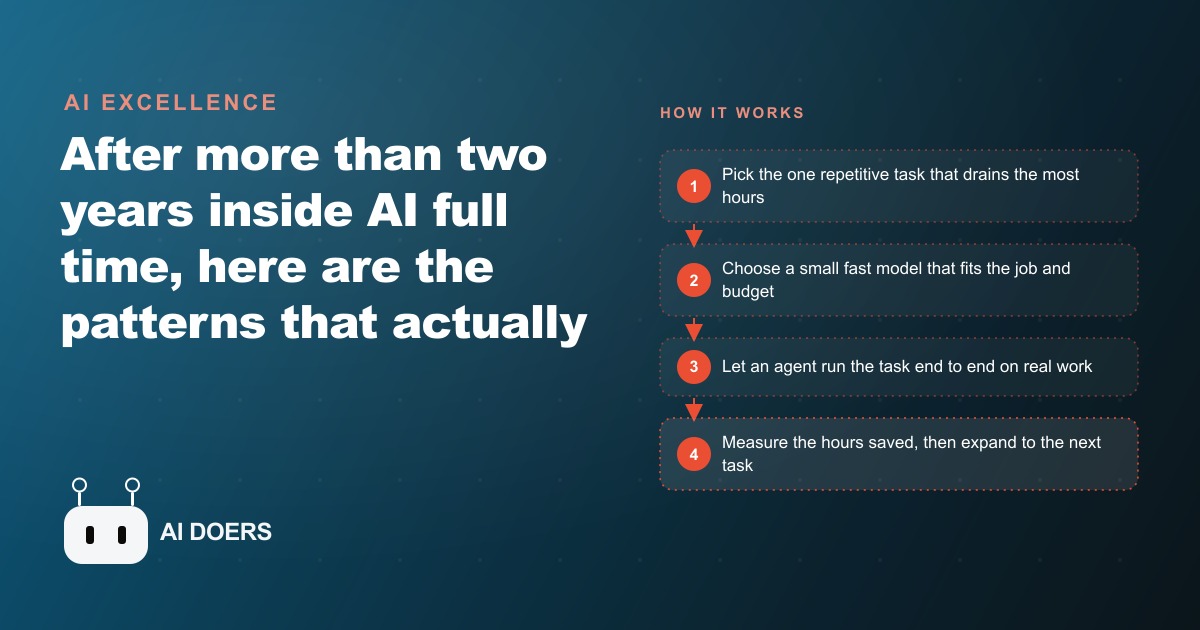
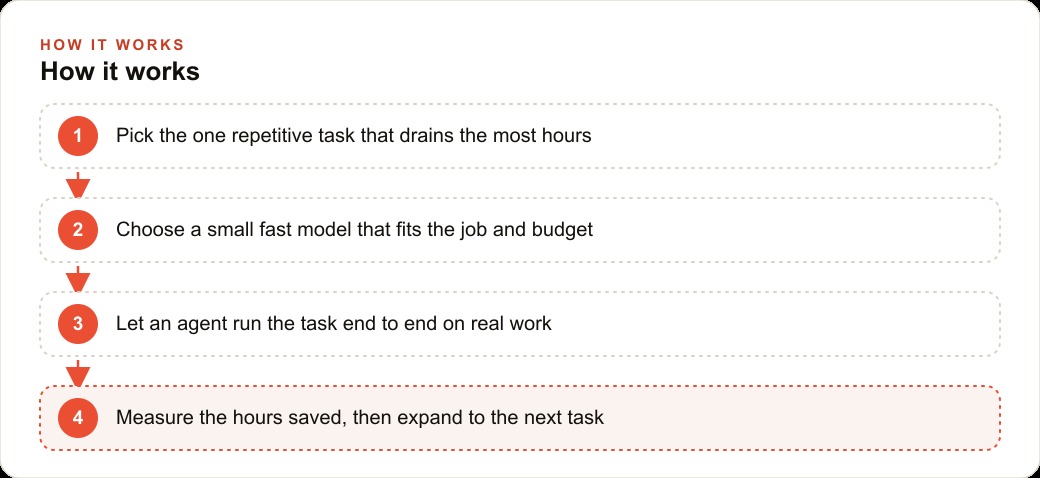
The practical action that emerges from all three patterns is the same one it has been for the past year, but the urgency is higher because the pace of change is faster. Pick one standardized, repetitive task in your business that consumes meaningful time. Test a current AI tool on that task this week. Measure the time saved versus the cost of the tool. If the math is positive, deploy it. Then pick the next task. The business that moves through this cycle consistently and methodically over the next twelve months will have automated a meaningful share of its repetitive work by the time the single-job replacement agents become standard products that everyone uses. At that point, the business that already automated will be using those agents for tasks it has not yet addressed, while the business that waited is just starting the cycle the early adopters are completing.
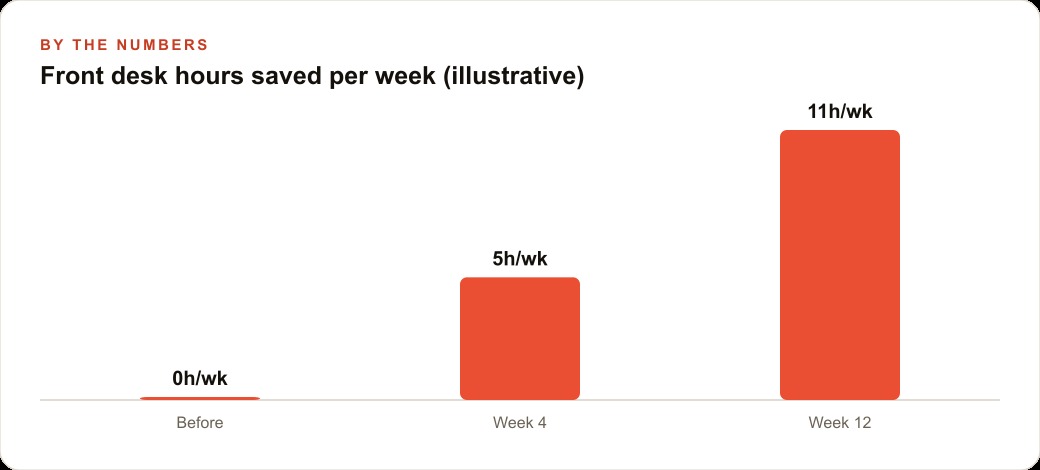
A med spa illustrates the concrete version of this well. The front desk at a typical med spa handles several categories of standardized communication: booking confirmations, pre-appointment instructions, post-appointment care reminders, follow-up messages for rebooking, and review requests. Every one of those is a standardized message with variable fields: the client's name, the appointment date and time, the specific treatment, and the next available appointment. An AI tool trained on the spa's voice and formats can produce drafts for every one of those message types from a structured input with the right variable fields. The front desk role shifts from drafting messages to reviewing and sending them, with the review taking a small fraction of the drafting time.
What the med spa gains is not just speed, though it is that. It is consistency. A message drafted by the front desk person who is having a difficult afternoon may be shorter, less warm, or less complete than the same message drafted on a good day. An AI draft that the front desk reviews and adjusts maintains a baseline quality floor regardless of who is reviewing it or what their day has been like. Over a year of consistent communication at a higher baseline quality, the effect on client retention and rebooking rates is measurable. The compound return on one correctly configured AI communication workflow, measured in retained clients and increased rebooking frequency, typically covers a year's worth of tool costs in the first quarter.
The AI trends that matter in 2026 are the ones that change the math on decisions you are already making. Where do new capabilities come from now, and does that change what AI can do for my specific business? Is the cost differential between open and closed models large enough to change my tool selection? Is my business at risk from a single-job replacement agent, or can I deploy that same type of agent to automate a role in my operation before a competitor does? Those are the questions that connect the pattern level to the decision level. The rest is commentary.
That is exactly what we do at AI DOERS. Book a private 30-minute call with Madhuranjan Kumar and we will map the fastest path to it for your specific business.
Book your call →
Madhuranjan Kumar
Madhuranjan Kumar brings 20 years of performance-marketing experience and has managed over $200 million in Facebook ad spend for brands across the United States and beyond. His expertise spans the full modern marketing stack: Meta, Google Ads, TikTok, email automation, CRM, and the websites that hold it together. At AI DOERS he turns that track record into lead-generation systems for businesses across every industry.