
The Race to Build the AI Web Browser, and What It Means for Your Business
AI browsers can now act on the web for you, and as more searching shifts to AI, how your business shows up to these agents starts to matter.

The entity doing the searching is no longer always human, and that single fact changes every assumption your business has made about how new customers find you.
I have been watching the AI browser race unfold over the past year, and I want to cut through the hype and give you something practical. This is not a story about technology for technology's sake. This is about a structural shift in how discovery happens on the internet, and what you need to do before your competitors figure it out.
Understand what an AI browser does that a search result page cannot
A traditional search result page does one thing: it presents a ranked list of links and leaves the decision about which one to visit entirely to you. You see ten blue links, maybe some ads, maybe a map pack, and you click. The click is the action. The thinking is yours.
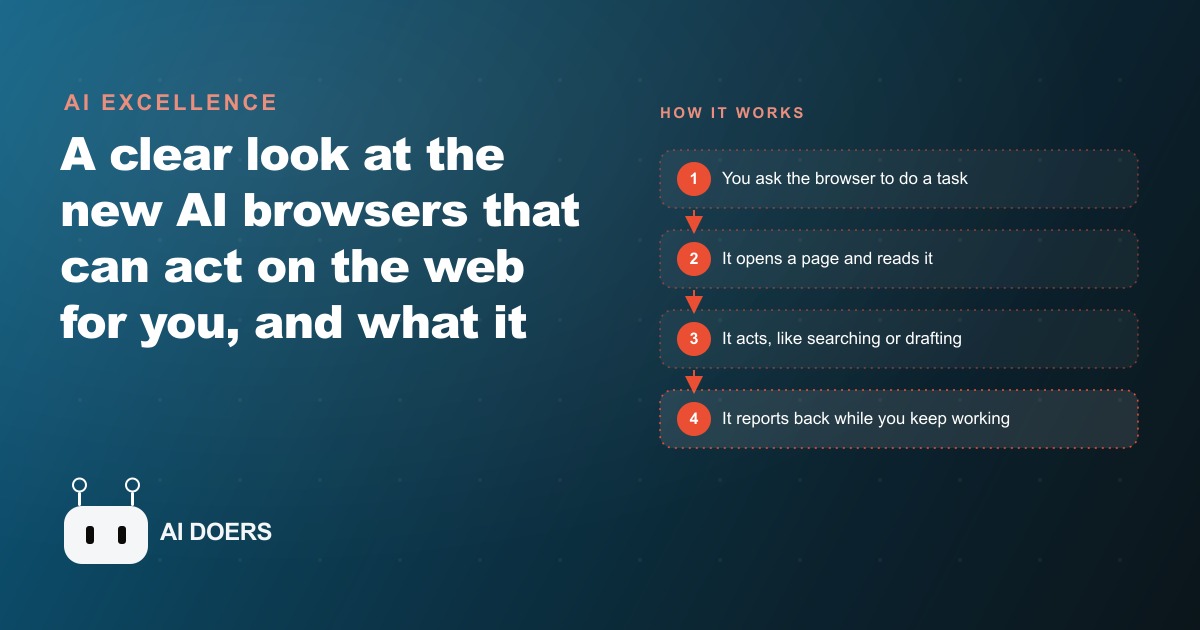
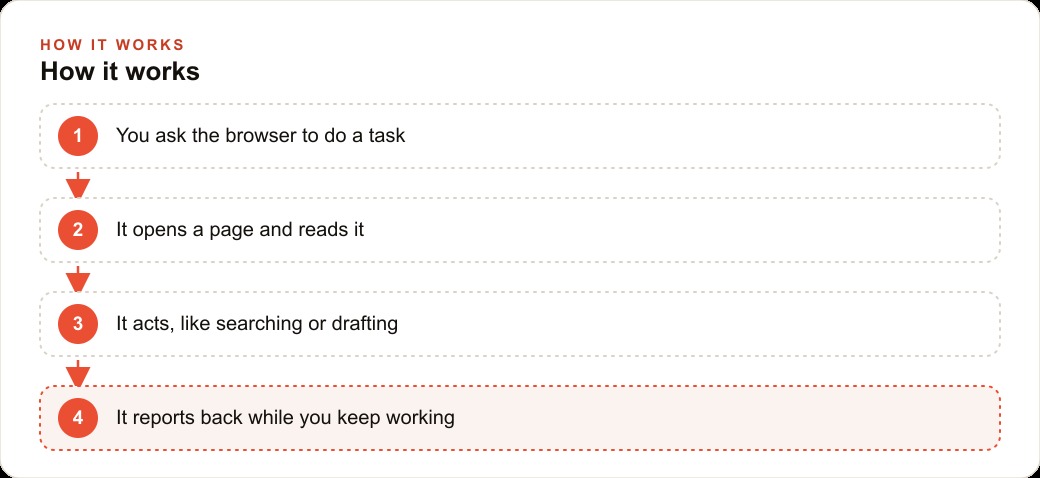
An AI browser works differently. When you type a question into an AI browser, the system does not hand you a list of links. It opens pages, reads them, synthesizes what it found, and delivers a summary or recommendation. The browsing step, the part where a human used to spend ten minutes clicking around, evaluating, comparing, is now handled by the agent.
The implications for your business are significant. When a human searches for "licensed HVAC company near me," they see a list of companies and decide which one to call. When an AI browser handles that same query, the agent reads your website, reads your reviews, checks whether you appear in directories and local publications, and then makes a recommendation. The human never sees your site. They see the agent's conclusion about your site.
This is the shift that most business owners have not processed yet. The question is not "does my website rank well?" The question is "does my website contain enough signal for an agent to recommend me when reading it?" Those are different questions with different answers.
The current AI browser landscape includes tools like Perplexity, Arc with its built-in AI features, Microsoft Edge's Copilot, and the new generation of agentic browsers being built by several AI startups. What they share is the ability to browse on a user's behalf, pull information from multiple sources, and synthesize it into a response. Bookmarks become context. Open tabs become reference material. The agent can recall what you were reading last week to inform what it tells you today.
Audit which tasks in your current workflow a browser agent could take over
Before thinking about how customers use these tools to find you, think about how you could use them yourself. That will teach you more about how the technology works than any explanation I can give.
Spend one week with an AI browser and deliberately use it for tasks you currently do manually. Common candidates include researching a supplier, comparing software pricing, finding a subcontractor in a new city, checking what competitors are publishing, and drafting a follow-up email based on a website you just read. In each case, notice what the agent reads, what it misses, and what it recommends.
This exercise does two things. First, it shows you the mechanics of how an agent actually navigates the web, which will immediately reframe how you think about your own online presence. Second, it surfaces specific tasks in your business that you could delegate to an agent today, compressing hours of research into minutes.
Tasks that work well for browser agents include: reading three competitor websites and summarizing the differences in their pricing page language, scanning a local business directory to find contact information for ten potential partners, pulling the key claims from five customer reviews on a competitor to identify unmet needs, and drafting outreach emails personalized to what the recipient has written publicly.
Tasks that are harder for agents right now: anything that requires logging into an account, anything that depends on real-time pricing, and anything where the answer lives behind a paywall or authentication wall. Keep those for now. Delegate the research-heavy public-web tasks.
The point of this audit is not to automate yourself out of your job. The point is to understand, at a practical level, how agents consume the web. Once you have done this for a week, you will never look at your own business's web presence the same way.
Map where your business currently appears in text that AI agents can read
This is the audit that most businesses skip, and skipping it is expensive.
Spend an hour doing this exercise. Search for your business category in your city using an AI browser, and watch what sources it cites. Then ask the AI browser to find three businesses in your category and explain why it chose them. Look at every source it reads. Then search specifically for your business name and see what the agent says about you, and where it pulls its information from.
What you are looking for is a map of your public text footprint. This includes your website copy, your Google Business Profile, your Yelp listing, your industry directory listings, any press coverage, any local news mentions, any published case studies, any quotes you have given to publications, any forum threads where someone mentioned your business, and any third-party review sites.
Here is what you will likely find. Most businesses have a thin text footprint. Their website has a homepage with a tagline, a services page with a list, and a contact page. Their Google Business Profile has their hours and address. They have twenty reviews on Google and eight on Yelp. Beyond that, they have almost nothing. No press coverage. No directory listings beyond the obvious. No published work that explains what they do or how well they do it.
When an AI agent reads that footprint, it does not have much to work with. It can confirm that the business exists and what it does. It cannot confirm expertise, track record, or trustworthiness. When the agent is recommending businesses to a customer, it will recommend businesses with richer text footprints over businesses with thin ones, because it has more signal to work from.
The most important thing to note in this audit is not how good your website looks. It is how much substantive text exists across the public internet that describes what you do, how you do it, and what results you have achieved. That is the signal agents read.
Earn mentions in sources that AI agents consult when researching your category
When I work with businesses on positioning, I always ask one question first: where does a credible person in your industry get quoted? That answer tells you where you need to be.
AI agents are trained to give weight to sources that human readers have historically trusted. That means local newspapers, industry trade publications, regional business journals, professional association websites, prominent review platforms, and authoritative directories. Getting mentioned in those places is not just good for human discovery. It is the core infrastructure for AI agent discovery.
The playbook for earning these mentions is not complicated, but it requires consistency.
Start with the low-hanging fruit. Claim and fully populate your listings in every relevant directory. For most businesses, that means Google Business Profile, Yelp, Angi, industry-specific directories, and the local chamber of commerce. Each of these is a text source that agents can read. Each populated listing adds to your footprint.
Then pursue local press. Local newspapers and regional business publications are hungry for stories. Most businesses never think to pitch them. A story about a business milestone, a community initiative, a novel approach to a common problem, a case study about a local client, any of these can be pitched to a local outlet. When that outlet publishes even a short piece about you, it creates a durable text source that agents can read and cite.
Next, contribute to industry publications. Every industry has trade publications, associations, and online communities. Writing a short practical article for one of these puts your name and your business into a trusted text source. Agents that research your category will find that article and use it as a signal.
Finally, encourage customers to write detailed reviews. Generic five-star reviews do not help agents much. Detailed reviews that describe the specific problem, what made you different, and the specific result do help. When an agent reads a review that says "they handled our 1982 system that three other companies said they could not touch," that sentence is a signal that this business handles older systems. That specificity is exactly what an agent uses to match a query to a recommendation.
Build content that answers questions directly rather than teasing an answer
Here is a pattern that killed a lot of business websites' effectiveness over the past decade and is killing it even faster in the AI browser era. The teaser article.
A teaser article uses a headline that promises an answer, then spends 800 words dancing around it, asks you to "contact us for more information," and ends without ever giving you the thing it promised. This format was designed to generate leads by withholding answers. In the search era, it worked reasonably well because the human had to call to get the answer, and calling meant a sales conversation.
In the AI browser era, it fails immediately. The agent reads your article looking for the answer to the user's question. The article does not contain the answer. The agent moves on to a competitor's article that does contain the answer. Your business is skipped.
The alternative is direct-answer content. Instead of an article that says "is your HVAC system too old?", write an article that says "an HVAC system over 15 years old is a strong candidate for replacement if it requires refrigerant that costs more than $20 per pound to service, needs more than one repair in a two-year period, or is running at SEER ratings below 10." That article gives an agent a direct, usable answer. The agent cites it. The business that wrote it gets the credit.
Write content that answers the specific question completely in the body of the piece, not behind a form, not at the end of a sales call. Agents will read it and credit you with the answer. That is the new lead generation.
For each core question your customers ask before hiring you, write a page that answers it fully and specifically. If your customers always ask "how long does this take?", write a page that answers it with real numbers and real scenarios. If they ask "what does it cost?", write a page that gives actual ranges with the variables that affect price. If they ask "how do I know if I need this?", write a page that gives them a checklist they can use before calling you.
This is counterintuitive for business owners who have been trained to withhold answers in order to generate calls. It feels like you are giving away the thing you sell. But in the agent era, withholding the answer means you do not exist. Giving the answer means you are the expert the agent recommends.
Evaluate your business presence from the agent's point of view, not the user's
To close this playbook, I want to give you a concrete worked example, because the stakes are real and I think a specific case makes them land harder.
Consider a local HVAC company. Before AI browsers became mainstream, this company got 90% of its customers through Google search. Someone typed "HVAC repair near me," clicked a link, landed on the website, and called. That funnel worked for years.
Now imagine a customer whose system is old and unreliable. They open their AI browser and type: "find me three licensed HVAC companies near me that have handled older system replacements." The agent goes to work. It reads Yelp, Angi, Google reviews, local news sites, the company websites it finds in those directories, and any published case studies it can locate.
The HVAC company has a website with thin copy. Their services page says "we handle all HVAC systems." They have 22 Google reviews. They are not listed in the local newspaper archive. They do not have a case study or a service article about older system work. When the agent reads their digital footprint, it cannot confirm that they handle older systems, it cannot find reviews that mention older systems specifically, and it cannot find any third-party sources that mention their name in connection with this type of work.
Three competitors have done the work. One has a published article on their site titled "what to expect when replacing an HVAC system from before 1995," with specific details about refrigerant types, permit requirements, and common complications. One has seven detailed reviews mentioning older system work by name. One was quoted in a local home-improvement newsletter two years ago discussing how older systems are often repairable but require specialized parts sourcing.
The agent recommends those three. The first company is skipped.
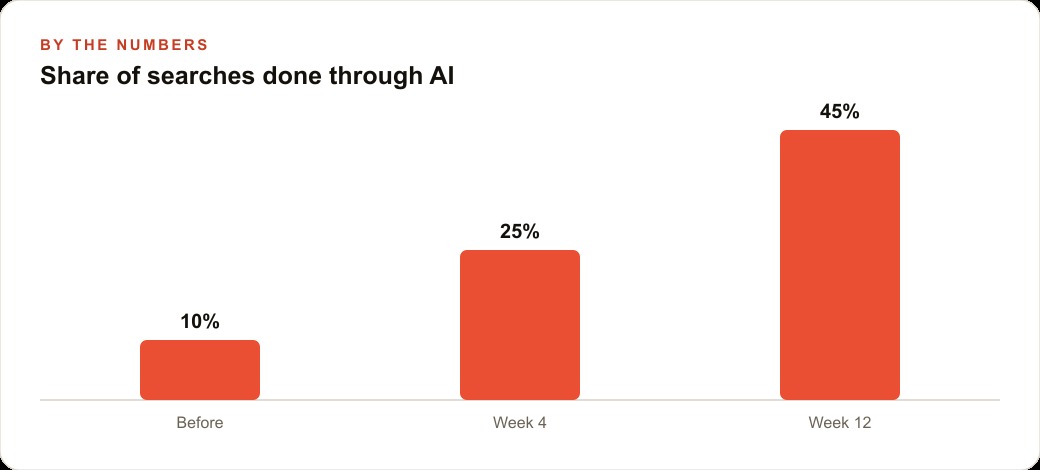
Now run the numbers. If 20% of searches shift to AI-mediated discovery in the next 18 months, which is a conservative estimate given how quickly ChatGPT search adoption has grown, a business that has not built for AI visibility loses access to 20% of the discovery market. For a business bringing in 30 new customers per month, that is 6 customers per month that now never see them in the search result at all. Over a year, that is 72 customers. At an average job value of $3,500, that is $252,000 in annual revenue going directly to competitors who showed up in the agent's reading.
That number is real. The shift is already happening. The businesses that will feel it first are the ones doing nothing now.
Evaluating your presence from the agent's point of view means asking different questions than the ones you have been asking. Not "is my website fast?" but "does my website contain specific, substantive text that an agent can use to match me to a query?" Not "are my photos good?" but "do my directory listings describe what I actually do in enough detail that an agent can infer my specialties?" Not "is my homepage beautiful?" but "is there text anywhere on the public internet that explicitly connects my business to the specific problems my best customers bring me?"
The agent does not care about your hero image. The agent reads text and evaluates sources. Build for the reader that never clicks.
I have seen businesses transform their discovery within four months of doing this audit seriously. One real estate team worked through this exact process: no press coverage, a thin website, and almost nothing in industry directories beyond the basics. After six months of contributing to a local real estate publication, getting listed in three additional directories, and rewriting their service pages to answer the ten most common buyer questions completely, the share of new clients who cited "I asked my AI assistant to find agents who specialize in X" as how they found the team went from zero to 12% in six months.
That trend will not slow down. The businesses that start now have a compounding advantage. Every piece of content, every directory listing, every press mention adds to a text footprint that agents read. That footprint grows as you add to it. The businesses waiting for the technology to mature before adapting will find that their competitors have already built a footprint they cannot close the gap on quickly.
Start with the audit. Map your footprint. Do one thing this week to extend it. Twelve months from now, you will have built something that no algorithm change can erase, because you are in the trusted sources, not just the search rankings.
That is exactly what we do at AI DOERS. Book a private 30-minute call with Madhuranjan Kumar and we will map the fastest path to it for your specific business.
Book your call →
Madhuranjan Kumar
Madhuranjan Kumar brings 20 years of performance-marketing experience and has managed over $200 million in Facebook ad spend for brands across the United States and beyond. His expertise spans the full modern marketing stack: Meta, Google Ads, TikTok, email automation, CRM, and the websites that hold it together. At AI DOERS he turns that track record into lead-generation systems for businesses across every industry.