
Phonely AI Answers Your Calls, Sora Goes Free, and Builder AI Collapses: What Roofing Companies Need to Know
An AI system that handles inbound customer calls end-to-end while your crew is on a roof is not a future concept. It is available right now. The Builder AI collapse is a reminder to evaluate AI tools on results, not on fundraising announcements.

The night the phone went to voicemail
A storm rolled through a mid-sized market on a Sunday evening, and by nine o'clock the calls started. A homeowner spotted missing shingles and water creeping along a ceiling, pulled up a search, and dialed the first three roofing companies she could find. Two went straight to voicemail. The third answered, asked a few questions, and booked an inspection for Tuesday morning. That third company won a replacement job worth several thousand dollars, and the only difference was that someone, or something, picked up the phone.
I am Madhuranjan Kumar, and I want to walk through the journey of one roofing company that decided it was tired of being the voicemail. This is a composite built from how these tools actually behave, with illustrative numbers, but the shape of the story is repeating across every market where storms create after-hours demand. The company did not overhaul its marketing. It fixed one leak in its own funnel: the calls it was never answering.
The problem the owner could finally name
The owner had always known that missed calls hurt, but the number was abstract. The crew, including the owner, was on rooftops six to eight hours a day, so calls during work hours went to a part-time office helper and calls after hours went to voicemail. Nights and weekends were the worst, which was cruel, because that is exactly when homeowners discover roof problems. Storms do not respect business hours.
The math, once the owner sat down with it, was hard to ignore. On a busy storm weekend, five or six serious calls might come in after six in the evening. Voicemail captured all of them and converted almost none, because a homeowner with a leak is not waiting until Monday for a callback when a competitor answered live on Sunday night. If a competitor with live coverage booked four appointments out of that batch and the average replacement job runs into five figures, a single unanswered evening was quietly costing the business more than a month of ad spend.
The setup that took one afternoon
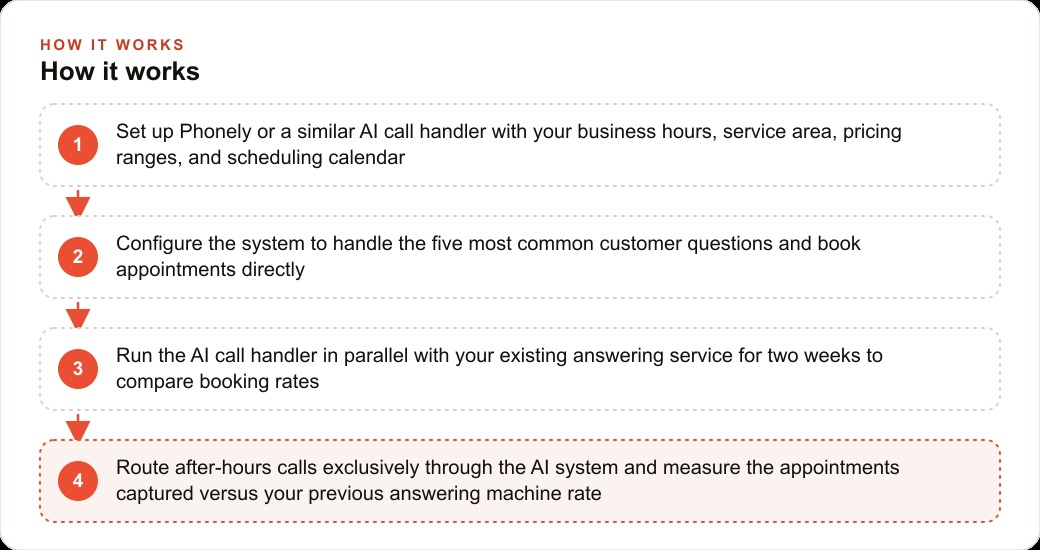
The fix the owner landed on was an AI phone system built for small service businesses. It answers inbound calls, holds a natural conversation, responds to questions about services, pricing ranges, and availability, and books appointments directly into a calendar. It is not a menu tree with press-one-for-sales. The caller talks normally and the system responds in context, asks the property address, the rough size, and the homeowner's availability, then slots an inspection.
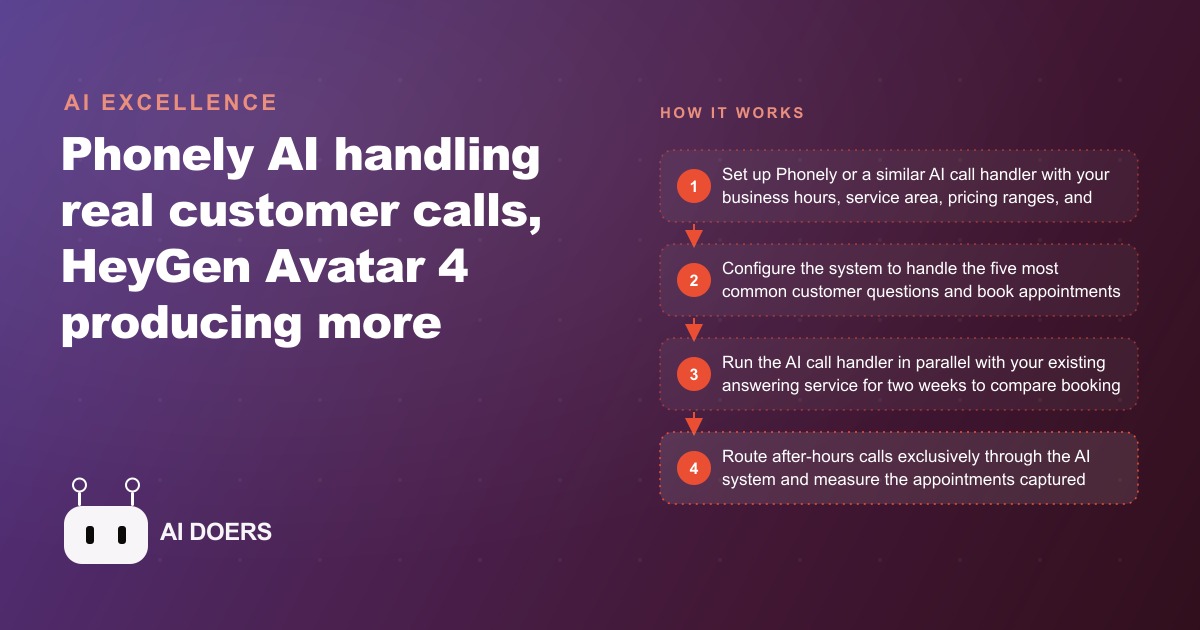
Getting it running took an afternoon, roughly two to four hours of real setup. The owner loaded the service area, the business hours, pricing guidance for the common job types, the five questions customers ask most often, and the scheduling calendar. That configuration time is the honest barrier, and it is a one-time cost. Once it was done, the system could carry the whole first contact without a human on the line. To de-risk it, the owner ran the AI in parallel with the existing answering setup for two weeks and compared how many calls each turned into booked inspections.
The first storm weekend with a live AI answering
The proof arrived faster than expected. The next weekend brought weather, and the calls came in after hours as usual. This time nobody went to voicemail. A homeowner who said, "I noticed some shingles missing after the storm last week," got a contextual response, a few sensible follow-up questions, and a Tuesday inspection on the calendar, with the details landing in the owner's inbox as a tidy summary. By Monday morning the owner walked into a schedule that already had appointments on it instead of a voicemail box to dig through.
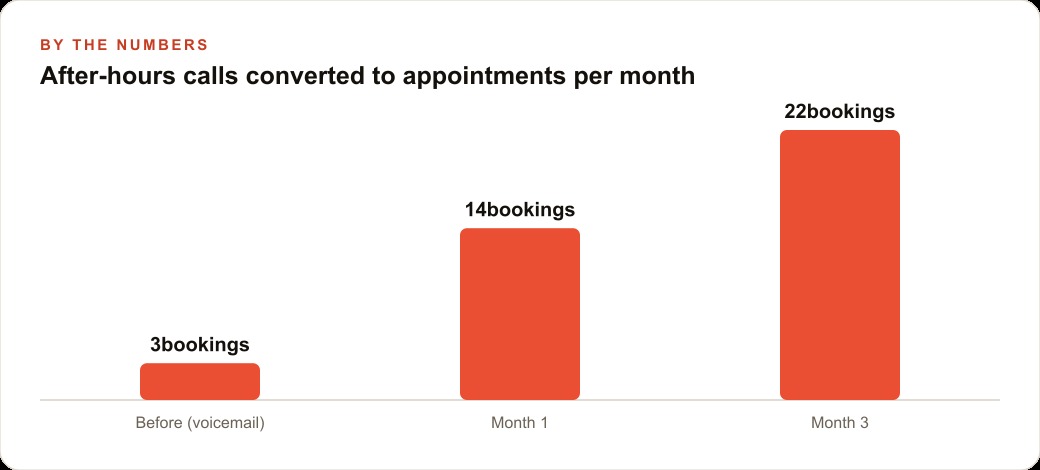
Where the old setup was converting maybe three after-hours calls into appointments across a whole month, the first full month with the AI live pushed that toward fourteen. By the third month, as the configuration got tuned and the busy season built, it settled closer to twenty-two bookings a month from calls that used to die at the beep. Those are illustrative figures, but the direction is the point: the same call volume, a dramatically higher share of it captured.
Where the human still had to step in
The system was not magic, and the owner did not pretend it was. It handled the high-frequency, answerable questions well, hours, service area, ballpark pricing, scheduling, because those answers lived in a source it could actually check. The edges were different. A complicated insurance-claim question, an unusual commercial job, or a caller who was clearly upset needed a person. The right design was to let the AI recognize the boundary, take a message with full context, and flag it for a callback rather than improvise an answer it could not stand behind.
That restraint is what kept the tool from backfiring. Homeowners making a five-figure decision do not forgive a confident wrong answer about a warranty or a claim. They do forgive, "That is a great question, let me have the owner call you first thing." The AI earned trust precisely because it knew when to hand off, and every handoff also told the owner exactly which new answer to add next.
Stacking the rest of the toolkit around the win
Once the phone was fixed, the owner looked at the other tasks an agency used to bundle. A few of them were now cheap to do in-house. A realistic video presenter tool let the owner turn a written script into a produced explainer in twenty minutes instead of scheduling a shoot, which was perfect for content that explains rather than shows, like the difference between a repair and a replacement, or how to spot hail damage. A free-tier video generator handled illustrative clips for concepts that are hard to photograph on a job, such as what happens under a roof deck when water gets in. Those tools supplemented real project photography, they did not replace it, because homeowners still want to see genuine completed work before they sign.
There was a cautionary note in the same week's news that shaped the owner's thinking. A heavily funded startup that had marketed itself as AI-powered app development collapsed, and it emerged that much of the "AI" work had actually been done by human developers behind the scenes. The lesson was not that AI failed, it was that funding and marketing are not proof a tool performs. So the owner evaluated every tool the way the phone system had been evaluated: on a real trial with real data, not on press. That discipline is why the phone system got adopted and a few flashier tools got skipped.
What the numbers looked like after ninety days
By the end of the first quarter, the picture was clear. The AI phone system cost somewhere in the range of a modest monthly subscription, less than the old answering service and a rounding error next to the value of one captured replacement job. After-hours bookings had roughly quadrupled from the voicemail baseline. The content tools trimmed a chunk of what used to be an agency retainer, leaving the agency's real value, strategy and paid-media management, as the part worth keeping.
The leads the system booked did not just sit in a calendar either. They flowed into the CRM and website stack where automated follow-up handled reminders and the next several touches, so a booked inspection did not quietly evaporate before Tuesday. The same content the owner was now producing in-house fed the company's website and SEO and organic search presence, so the money that used to buy generic agency posts could shift toward Google Ads and local visibility where it compounded. The through-line was that fixing the phone did not just save calls, it freed budget and attention to reinvest in the top of the funnel.
The quarter the freed-up budget went back to work
The part of this journey that surprised the owner most was not the captured calls, it was what those captured calls made possible downstream. Sealing the phone leak did two things at once: it added revenue, and it freed money that had been buying low-value agency tasks. Once the AI phone system, the in-house video tools, and the free-tier content generators covered the work an agency used to bundle, the retainer could be trimmed to just the part that actually needed a specialist, strategy and paid-media management. That reallocation is where the real compounding started.
With the answering problem solved, spending on the top of the funnel finally made sense, because every extra click now had a good chance of being answered live. Money that used to buy generic social posts shifted toward Google Ads and local service visibility, where a booked inspection is worth far more than an impression. The content the owner was now producing in-house, the explainer videos and the storm-damage guides, did not just sit on social, it fed the company's website and strengthened its SEO and organic search footprint, so the same effort earned traffic that did not cost per click at all. One in-house habit was quietly paying off in three different channels.
The numbers tell the story in shape rather than precision, and I would frame them as illustrative. In the voicemail era, the business captured maybe three after-hours bookings a month and spent a full-service retainer to get generic output. A quarter into the new setup, after-hours bookings had roughly quadrupled, the retainer was smaller and sharper, and a meaningful slice of the old spend had moved into paid acquisition and content that compounds. The owner was not working more hours. The crew was still on rooftops six to eight hours a day. The difference was that the business finally stopped leaking the demand it had already earned, and started reinvesting what it recovered into earning more.
There was also a cultural change worth naming. Because the AI handled first contact reliably, the office helper's time shifted from chasing voicemails to doing higher-value follow-up on warm leads inside the CRM. The tools did not replace the person, they moved the person up the value chain. That is the pattern that keeps repeating with well-chosen automation: the boring, high-frequency task goes to the machine, and the human gets to do the work that actually needs judgment and a human voice. A roofing company that gets that division of labor right ends up with both a fuller schedule and a less frazzled office.
The one move worth copying
If there is a single action to take from this journey, it is to fix after-hours call handling before the next busy season, and to prove it with a two-week parallel test rather than a leap of faith. Load your service area, your common pricing, and your calendar, run the AI alongside your current setup, and count how many calls each turns into booked work. In most service markets, that one number is large enough to justify the tool many times over, and it tells you the real dollar value of the calls you have been losing.
The rest of the AI toolkit is worth exploring, but it is second. The phone is where a roofing company bleeds the most revenue with the least visibility, and it is the cheapest leak to seal. If you want help wiring the whole path, first call through inspection, follow-up, and job documentation, into one system that runs while your crew is on a roof, that is a build worth working through together. Start with the phone, prove the number, then extend.
The broader takeaway for any service business built on responsiveness is that automation pays off most where the pain is measurable and the window is short. A missed roofing call after a storm is both, which is why it was the right first move rather than a flashy content experiment. Prove the boring, high-value fix first, watch the captured-booking number climb, and only then layer on this breakdown and content tools. Sequenced that way, the toolkit compounds instead of scattering the owner's attention, and the business ends the year with a fuller schedule, a leaner cost base, and budget flowing to the channels that actually grow it.
That is exactly what we do at AI DOERS. Book a private 30-minute call with Madhuranjan Kumar and we will map the fastest path to it for your specific business.
Book your call →
Madhuranjan Kumar
Madhuranjan Kumar brings 20 years of performance-marketing experience and has managed over $200 million in Facebook ad spend for brands across the United States and beyond. His expertise spans the full modern marketing stack: Meta, Google Ads, TikTok, email automation, CRM, and the websites that hold it together. At AI DOERS he turns that track record into lead-generation systems for businesses across every industry.