
OpenClaw Hype: Real App Store Moment or Shiny Object?
OpenClaw is a real signal and arguably the strongest App Store moment AI has had. But for most business owners it is something to study, not chase, because the durable money is still in helping companies that do not understand AI yet.

I, Madhuranjan Kumar, have watched enough AI hype cycles to know the difference between a signal worth studying and a platform worth building your business on, and OpenClaw is clearly the former while being, for most business owners, not yet the latter.
When something explodes with this much velocity, the right response is not to dismiss it and not to chase it. It is to understand precisely what it is telling you about the market and then decide deliberately whether the signal is actionable for you, right now, given your actual capabilities.
Skills Are a Genuinely Smarter Architecture Than MCP
The most technically important thing about OpenClaw is not the agent itself. It is the skills architecture underneath it, and this is worth understanding even if you never build a skill yourself.
Most current AI agent frameworks load all available tools into the context window at once. Every tool the agent has access to, whether you are about to use it or not, consumes token space from the beginning of every conversation. That is expensive, it slows responses on long conversations, and it degrades the agent's performance because the working context gets cluttered with tool definitions the current task does not need.
Skills solve this with a different model. A skill is a lightweight bundle of text files and folders. At the top of each skill sits a short description that lives in the system prompt. When your message relates to that skill's domain, the agent loads the full skill context. When your message has nothing to do with that skill, the agent ignores the full content entirely. Only the description sits in the system prompt, not the full skill. That lazy-loading approach keeps the context lean and the agent's attention focused on what the current task actually requires.
This is a genuine architectural improvement, not just a marketing claim about efficiency. The quality ceiling for an agent rises when its context window is not being consumed by tool definitions it is not using. A well-written skill that triggers precisely when needed and stays silent otherwise is a better user experience than a fully loaded context that makes the agent slower and noisier. Whether OpenClaw specifically wins the market or not, the lazy-loading skills model is likely to spread because it is structurally sounder than the alternative.
The App Store Analogy Holds Up Better Than Any Previous Attempt
People have been calling things the App Store moment for AI for years. Most of those comparisons did not hold up because the distribution mechanism was missing. A marketplace without a platform has no gravity.
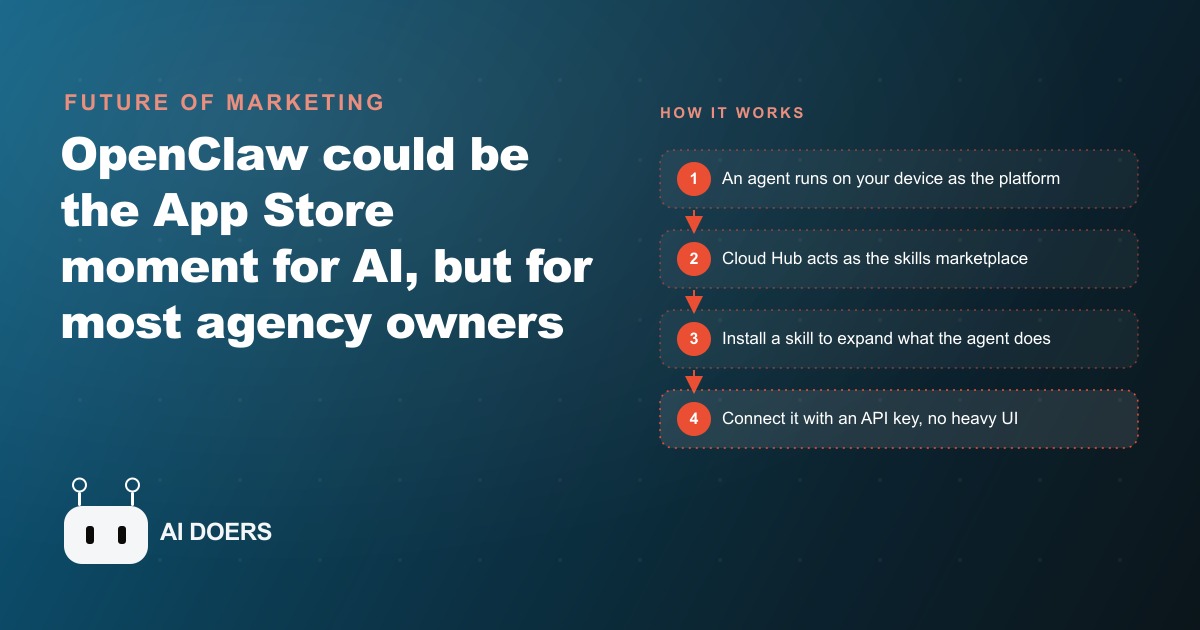
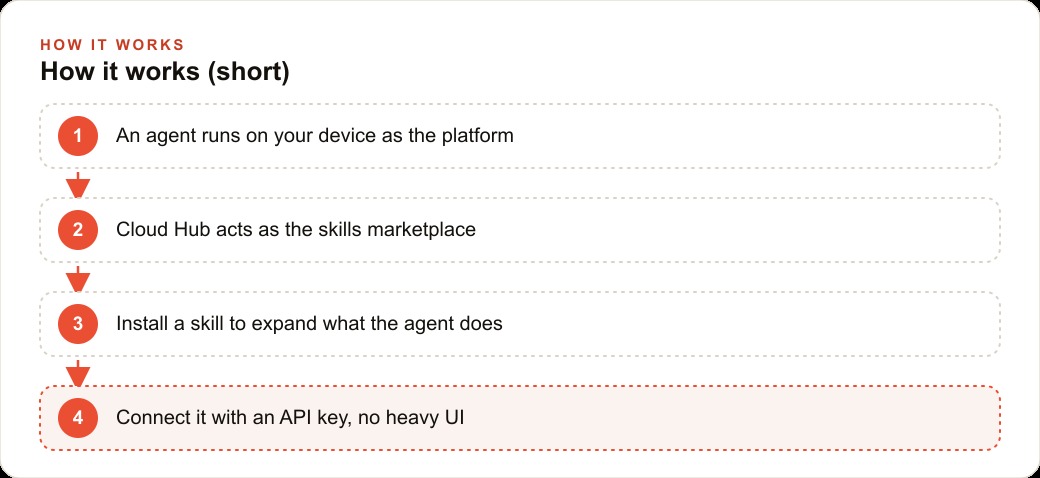
OpenClaw's structure makes the analogy actually work. The agent running on your device is the platform, equivalent to the iPhone. Cloud Hub is the marketplace, equivalent to the App Store. Skills are the installable applications. The key thing the iPhone added was not just a touchscreen but a single, authoritative place where users went to find, install, and pay for software. Before the App Store, software distribution for mobile was fragmented and hard to find. After it, distribution became trivially easy if you were listed in the store.
OpenClaw offers the same promise for agent capabilities. If you build a skill that solves a specific problem well, listing it on Cloud Hub gives you access to everyone looking for that kind of capability in one place. The marketplace creates a discovery mechanism that individual tool builders previously had to purchase through advertising or build through content. That distribution lever is genuinely new and genuinely valuable for technical builders who can ship a good skill but lack a marketing budget.
The reason I describe this as the strongest App Store contender yet is that previous attempts, various AI tool marketplaces, prompt libraries, and agent directories, lacked the direct integration between the marketplace and the runtime. Installing an app from the App Store actually runs on your iPhone. Installing a skill from Cloud Hub actually runs in your agent. That tight integration is what creates the platform dynamic, and it is what was missing from earlier marketplace attempts.
The SaaS Barrier Just Got Meaningfully Lower for Technical Builders
One of the most underappreciated implications of the skills model is what it does to the economics of shipping a software product. For most of the SaaS era, building a software product meant building a full application: a front-end user interface, authentication, user management, a database, hosting, a billing system, customer support infrastructure, and ongoing maintenance across all of those layers. That is a significant investment before a single customer pays you anything.
Skills strip most of that away. You build the back-end functionality that actually delivers the value. You write the skill description that triggers it correctly. You put up a basic landing page that explains what the skill does. You integrate a payment system and hand users an API key. The user connects the skill to their agent. That is the entire product distribution loop.
The example that has circulated is a YouTube transcription skill built on Whisper, the open-source transcription model. You build the service that takes a YouTube URL and returns a high-quality transcript. You wrap it as a skill with the right trigger description. You charge nine dollars a month and hand users an API key. They install the skill in their agent. Cloud Hub surfaces the skill to people searching for transcription capabilities. You earn recurring revenue from a product that required no front-end design, no user dashboard, and no customer authentication system.
For technical builders who can ship a back-end service but have always been bottlenecked by the front-end and infrastructure work that SaaS requires, this is a genuine opening. The barrier to a paying product just dropped significantly. That does not mean success is guaranteed or easy. Competition in the skills marketplace will be intense and fast-moving. But the barrier to entering the market at all is materially lower than it was.
Listing on Cloud Hub Solves the Distribution Problem Every Solo Builder Faces
Distribution has always been the part of building a software product that pure technical skill does not solve. You can ship an excellent tool and still have no users because you had no way to reach the people who needed it. The historical options were paid acquisition, content marketing that compounds over years, or a viral product with inherent network effects. None of those options are fast or cheap.
Cloud Hub changes the calculus for skills. Listing a skill on the marketplace puts it in front of people who are already inside the OpenClaw ecosystem specifically looking for capabilities to add to their agent. They are not browsing casually. They have a specific type of task they want their agent to handle, and they are searching for the skill that covers it. The intent is as high as a Google search for a specific product.
Upvotes and ratings within the marketplace create compounding distribution over time. A skill that earns a few strong upvotes in the first weeks surfaces higher in search results within Cloud Hub, which drives more installs, which drives more reviews, which drives higher placement. That compounding is the same dynamic that made the App Store's top charts self-reinforcing once you got into them. Getting early traction in Cloud Hub is more valuable than getting early traction on a standalone product page with no inherent traffic.
For technical builders, this means the launch strategy for a skill is different from the launch strategy for a standalone SaaS tool. Optimizing the skill description for discoverability within Cloud Hub, designing for upvotes and positive word of mouth from the first installs, and choosing a problem domain where the marketplace search volume is high all matter more than they would for a product relying on external marketing.
Lazy Context Loading Is the Right Direction for Agent Performance at Scale
As agents take on more complex, multi-step tasks, context management becomes one of the primary bottlenecks on quality. An agent that has to hold a large number of tool definitions in its working context while also tracking the state of a long task is dividing its effective attention. The more cluttered the context, the more prone the agent is to losing track of earlier decisions or generating inconsistent outputs late in a task.
The lazy-loading skill model is the right architectural response to this problem. By keeping only skill descriptions in the system prompt and loading full skill context only when the current message triggers it, the agent's working context stays proportional to what the task actually requires. A transcription task loads the transcription skill context. A code review task loads a different skill. A scheduling task loads another. At no point is the agent holding the full context of every skill it has access to.
This matters for business owners evaluating AI tools even if they are not building skills themselves. An agent platform built on this architecture will perform better at complex, multi-step tasks than one that loads all tool definitions upfront. Understanding why helps you evaluate vendors and consultants more accurately. An AI service provider who builds on architecturally sound platforms is making better decisions for your business than one chasing the newest tool without understanding the underlying tradeoffs.
The Non-Technical Majority Will Get Eaten for Lunch in That Marketplace
Here is where I want to be direct about something the hype coverage tends to skip: the OpenClaw skills marketplace is a competition environment, and the people who win competitions in a new technical marketplace are technical builders who can ship fast, price low, and iterate in real time.
The barrier to entry for selling a skill is lower than the barrier to building traditional SaaS. But the barrier to winning in the marketplace once competition arrives is extremely high for someone who is not deeply technical. The cracked AI engineers who will flood Cloud Hub with skills in the first months are people who build production-quality back-end services in days. They understand context windows, API design, rate limiting, and the skill description optimization that determines marketplace visibility. They will dominate the early marketplace the same way technical founders dominated the early App Store.
A roofing company owner or a physical therapy practice manager who hears about OpenClaw and decides to build a skill to generate passive income is going to be competing against people who have been building software products for years and who can move ten times faster. That is not a competition the non-technical business owner wins. It is one they get frustrated in and eventually exit, having spent time and money that could have gone toward the opportunity that is actually theirs.
For the non-technical majority, the right response to OpenClaw is to understand it well enough to have an informed conversation about it with vendors and advisors, not to enter the marketplace. Knowing that skills are a smarter architecture than MCP helps you evaluate whether an AI service provider you are considering is building on durable, sound tools or chasing hype. That evaluation capability is valuable. Trying to compete in the marketplace itself is not the right move.
The Unchanging Opportunity Sits Outside the Marketplace Entirely
The most important fact about the business landscape right now is that tens of millions of businesses still do not understand AI well enough to use it meaningfully. They are not looking at OpenClaw or Cloud Hub or skills marketplaces. They are trying to figure out whether AI can help them respond to leads faster, write client reports more efficiently, or manage their scheduling without adding headcount. The gap between those businesses and the tools that could actually help them is enormous, and it is not closing as fast as the technology is advancing.
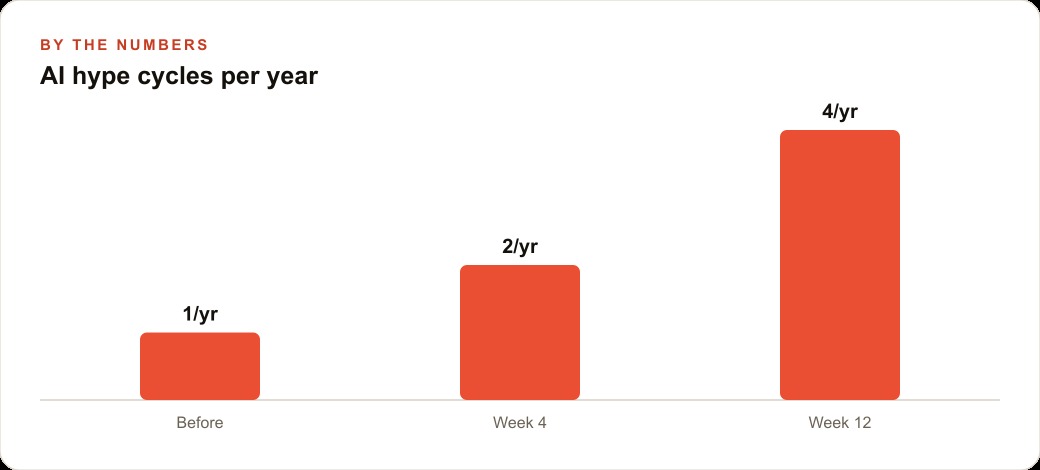
That gap is the durable opportunity, and it does not move with the hype cycle. New AI platforms arrive every three to six months. The businesses that need help with their lead capture and follow-up processes or their CRM and client communication systems needed that help six months ago and will need it six months from now, regardless of whether the hot platform is OpenClaw or the next thing after it.
Service providers who stay anchored to this unchanging demand build businesses that compound regardless of which AI tool is making headlines. They do not have to rebuild their expertise every time a new platform launches. They have to stay current enough to pick the right tools, but the core of their business, finding real use cases for real businesses and implementing them reliably, is stable in a way that building on any specific new platform is not.
Illustratively, consider a physical therapy practice with three clinicians and a front desk person who manually follows up on every missed appointment and every new patient inquiry. That practice is losing a measurable number of reactivations and new bookings every month because the follow-up volume exceeds what one person can handle reliably. The service provider who walks in and builds a working automated follow-up system on stable, proven tools generates real and measurable value for that practice. Whether the system is built on OpenClaw skills or a HighLevel integration is irrelevant to the practice. They are paying for fewer missed patients and a fuller schedule, and that outcome does not depend on which platform was used to create it.
Change Management Is the Real Product, and No Skills Store Can Sell It
The data point that should anchor every discussion about AI adoption in business is this: AI projects fail at an estimated rate of around 95 percent. That failure rate is not primarily a technology problem. The technology works. The failure is in implementation, adoption, and the human change that is required for a new system to actually stick.
Change management and team training are human problems. They require someone to understand the specific business, map how work actually gets done versus how it is supposed to get done on paper, identify the resistance points where new tools will meet friction, and stay present through the adoption curve. No skills marketplace can package and sell that capability. It is inherently relationship-based, context-specific, and labor-intensive in the right ways.
This is where AI service providers who focus on implementation and adoption rather than tool-building retain durable value even as the tools themselves become more commoditized. A skilled provider who knows how to bring AI into a business, train the team effectively, and troubleshoot the inevitable adoption problems is solving a problem that does not become easier as the tools improve. In some ways it becomes harder, because better tools create higher expectations and more complex integrations.
The practical implication is straightforward. If you are a technical builder with the skills to ship back-end services fast, OpenClaw is worth serious attention and early action. If you are an agency owner or service provider who brings AI to businesses that cannot do it themselves, the right move is to study OpenClaw enough to understand the architecture, stay anchored to the businesses that still need your help regardless of what the current hot platform is, and keep building the change management and training capabilities that no marketplace will ever be able to replace.
That is exactly what we do at AI DOERS. Book a private 30-minute call with Madhuranjan Kumar and we will map the fastest path to it for your specific business.
Book your call →
Madhuranjan Kumar
Madhuranjan Kumar brings 20 years of performance-marketing experience and has managed over $200 million in Facebook ad spend for brands across the United States and beyond. His expertise spans the full modern marketing stack: Meta, Google Ads, TikTok, email automation, CRM, and the websites that hold it together. At AI DOERS he turns that track record into lead-generation systems for businesses across every industry.