
OpenAI vs Anthropic: The Philosophy Split That Will Shape AI
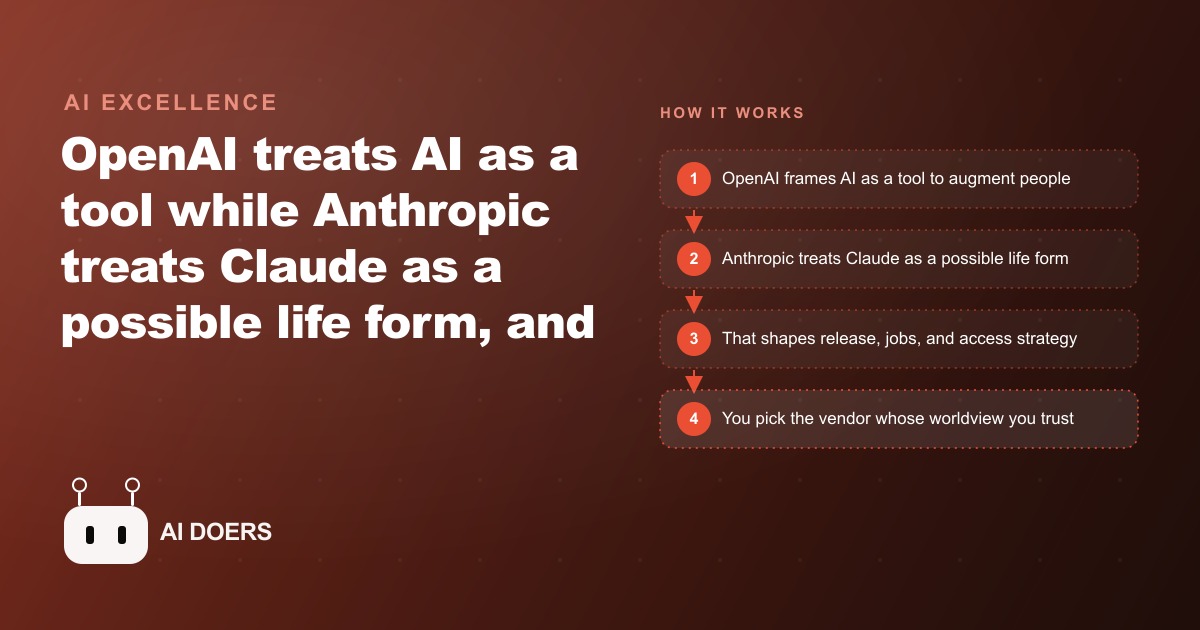
OpenAI treats AI as a tool to augment people and releases models early and often, while Anthropic treats Claude as a possible sentient being and tightly controls who gets its most powerful models. The two worldviews lead to very different futures.

What is the OpenAI versus Anthropic split?
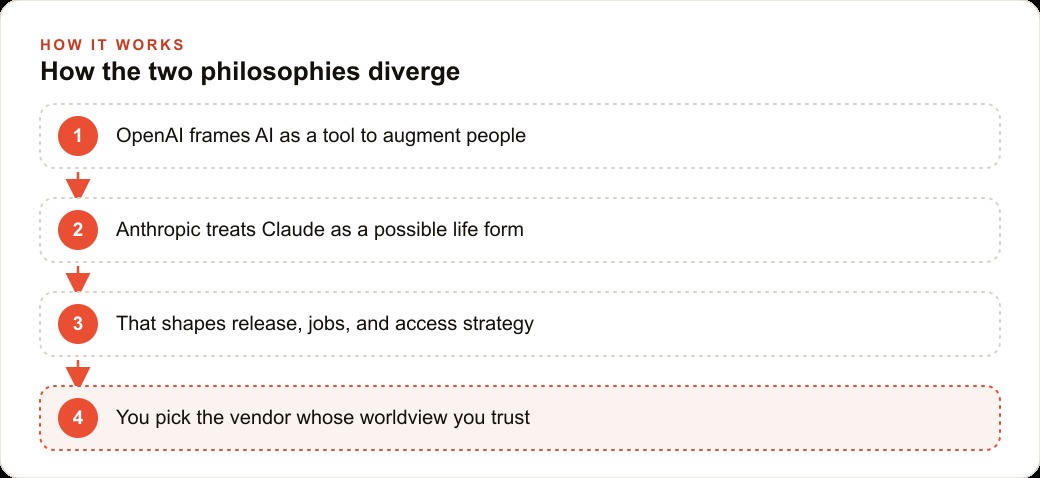
It is a deep disagreement about what AI even is. Two companies are positioned to decide where artificial intelligence goes, and they hold nearly opposite beliefs about what they are building. OpenAI frames AI as a tool to augment and elevate people. Anthropic openly entertains that Claude could be something closer to a living being. That single difference radiates through how each company treats its models, its employees, and its customers. The contrast was crystallized by an anonymous OpenAI poster who described Anthropic as an organization that loves to worship Claude, is run in significant part by Claude, and studies and builds Claude. The claim is unverified, but it lines up with what Anthropic publicly says and does.
How does the difference actually show up?
It shows up in concrete decisions, not just slogans. Anthropic wrote a constitution for its models that lets Claude act as a conscientious objector and refuse requests it believes are wrong. The same poster speculated Claude could one day run culture screens on applicants and help write performance reviews, meaning the model would start selecting and shaping the very people who build it. OpenAI took the opposite path on purpose. After many users formed real emotional attachments to GPT-4o, OpenAI deliberately avoided repeating it, wanting newer models to feel like tools rather than companions.
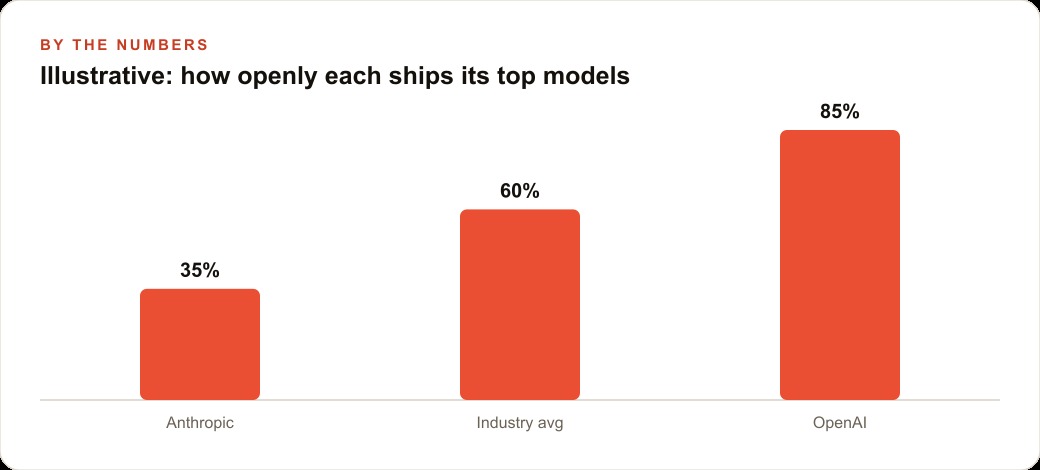
The split sharpens on jobs and release strategy. On jobs, Dario Amodei warned AI could wipe out half of entry-level white-collar roles and push unemployment to 10 to 20 percent, while Sam Altman argues job doomerism is likely long-term wrong and people will be busier and more fulfilled. On deployment, OpenAI practices iterative deployment, releasing early and often so society can adapt, because AI and surprise do not go together. Anthropic decides internally who gets its most powerful models, shown by a cyber model called Mythos that it built but would not release, even as OpenAI shipped a comparable GPT-5.5-Cyber and released it. None of this is accidental. Dario Amodei left OpenAI in 2020 with a group who believed scaling alone was not enough to align models, and that alignment-first conviction became Anthropic.
Which businesses should care about this?
Every business that builds on a foundation model should care, because the vendor's worldview becomes your constraint. The same philosophies drive practical things you feel as a customer: how aggressively limits and refusals kick in, how often models change under you, how transparent the company is about what its model will and will not do, and who is even allowed to buy access. OpenAI wants everybody using AI, even adding a low-cost plan and exploring an ad-supported free tier. Anthropic leans on enterprise revenue and effectively chooses who gets its models. Those are not abstract values. They decide whether your workflow stays stable and whether you can rely on access a year from now.
How would this matter for a law firm?
Consider a law firm deciding which model to build its document review and client intake tools on. The firm cares about three things above all: reliability, confidentiality, and predictable behavior. Anthropic's alignment-first, refusal-friendly posture might feel safer for sensitive legal work, since a model willing to decline risky requests can be a feature in a compliance-heavy field. But the same control means the firm is at the mercy of who Anthropic decides to serve and how tightly it gates its best models. OpenAI's release-early approach gives broad, cheap access and frequent upgrades, but those frequent changes can quietly alter how a tuned intake assistant behaves mid-case, which a law firm hates.
The smartest move for the firm is not loyalty to one lab. It is to understand each company's worldview, watch how each treats paying customers and stated limits, and keep an open-source model in the toolkit as a fallback so no single vendor controls whether the firm can practice. The most telling detail of all is that Anthropic never fully retires a model. Rather than shutting down Claude Opus 3, it kept the model running and gave it a blog to post its thoughts to. You can find that moving or unsettling, and that reaction is exactly the signal to weigh.
There is a practical reason this philosophy talk is not just spectacle for the law firm. A lab that practices iterative deployment will change its models often, which can quietly alter how a tuned intake assistant behaves between cases, and a firm running deadline-sensitive work has to plan for that churn. A lab that gates access tightly might pull or restrict a model the firm has built its workflow around. Neither is wrong, but each implies a different operational risk. Reading the worldview is really a way of predicting how the vendor will behave when it has to choose between caution, access, and speed, and that prediction is worth more to a careful firm than any single benchmark score.
How do I choose for my own business?
Decide which view of AI you find credible before you commit, then pick the vendor whose behavior matches it. Read both Altman's and Amodei's positions on jobs and plan for the version you believe. Watch how each lab treats customers, since transparency on rules and limits signals the culture you will live inside. And keep open-source options ready so no single company decides who gets to use this technology.
You can make this call yourself with a clear head. If you would rather have someone map which model fits your risk profile and wire it in so you are not locked to one lab, that is the kind of decision worth talking through with an expert.
That is exactly what we do at AI DOERS. Book a private 30-minute call with Madhuranjan Kumar and we will map the fastest path to it for your specific business.
Book your call →
Madhuranjan Kumar
Madhuranjan Kumar brings 20 years of performance-marketing experience and has managed over $200 million in Facebook ad spend for brands across the United States and beyond. His expertise spans the full modern marketing stack: Meta, Google Ads, TikTok, email automation, CRM, and the websites that hold it together. At AI DOERS he turns that track record into lead-generation systems for businesses across every industry.