
OpenAI's Value-Sharing Idea and Who Really Owns What You Build With AI
OpenAI floated a model where it takes a cut of what gets discovered using its AI. The scare was overblown, but the real lesson for every business is to know who owns your data, your assets, and your work.

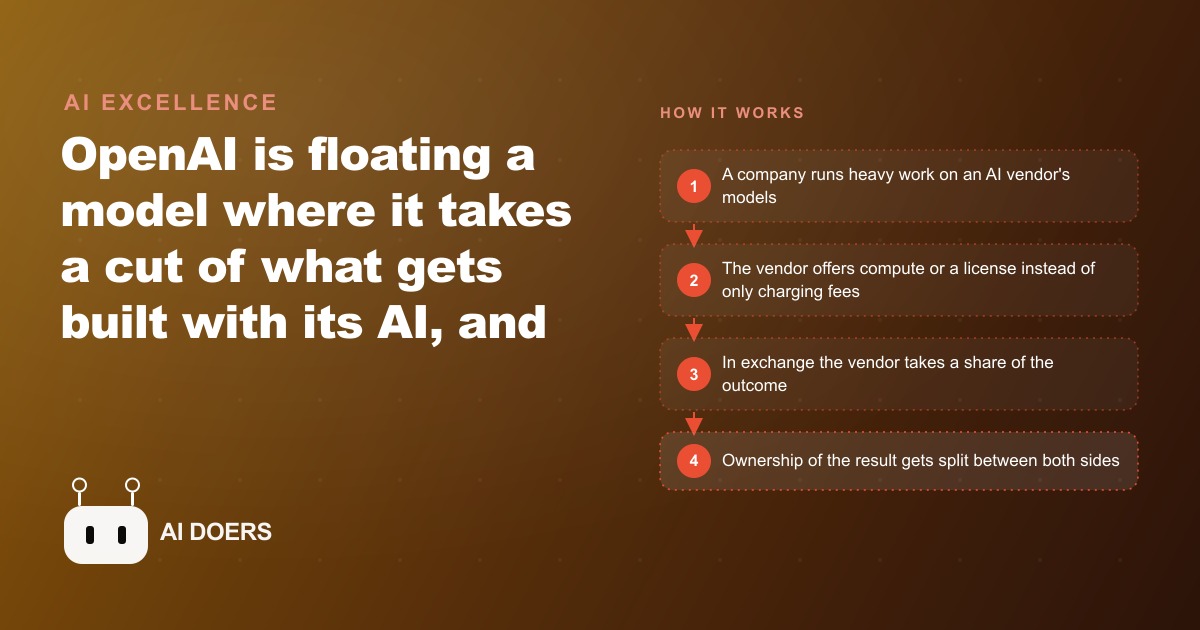
Earlier this year, OpenAI's chief financial officer said at a panel discussion that the company was exploring a value-sharing model where it could take a license or a percentage of drugs discovered using its AI systems, rather than simply billing for compute consumed. The comment was aimed specifically at pharma and biotech companies running extremely large AI workloads. Within hours it had spread across social media as something far more alarming: that OpenAI was planning to take a stake in any company that used its models, or claim ownership over anything built with its tools. Madhuranjan Kumar tracked the story as it spread and wants to be direct about what was actually said, what it means for ordinary businesses, and what the real lesson is for any owner whose operation now depends on AI tools.
OpenAI's CFO described a partnership structure aimed at drug discovery, not at software builders
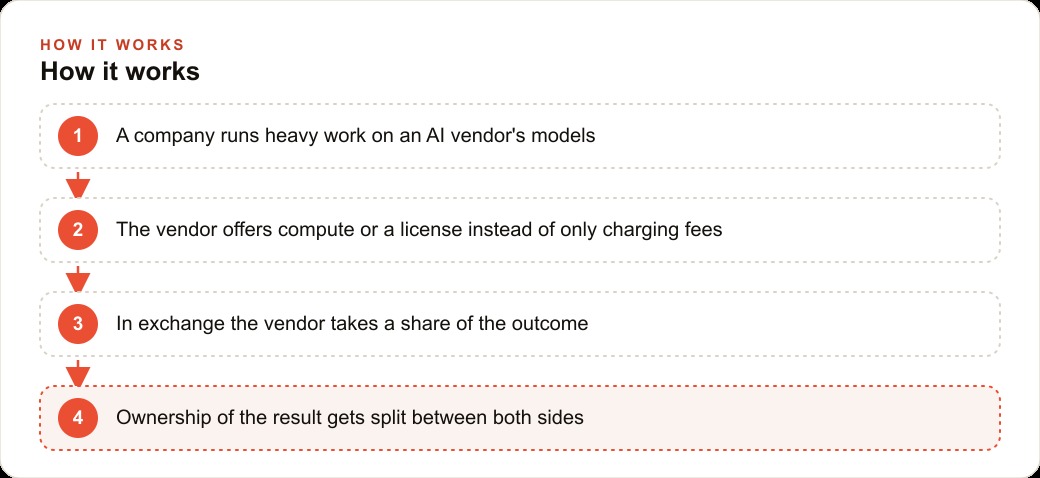
The value-sharing idea is narrow in its stated target. Drug discovery companies that run large-scale AI experiments need enormous compute resources, in some cases running millions of simultaneous agents around the clock to test molecular hypotheses. Paying for that compute requires substantial capital, which most biotech startups raise by giving up equity in their company to investors. What the proposal suggests is a structural alternative: instead of a company raising cash from investors and using that cash to pay OpenAI for compute, OpenAI could supply the compute directly and take a percentage of the upside if a drug gets discovered and eventually commercialized. The investor step gets cut out. OpenAI becomes a compute supplier and equity partner simultaneously.
The reason this is being called value sharing rather than a pricing model is that the lab would not be billing per token consumed. It would be billing as a percentage of a future commercial outcome. That is a fundamentally different economic relationship, and it is one that only makes sense when the outcome is large enough, specific enough, and separable enough to be worth structuring formally. A drug that takes a decade to discover and several billion dollars to commercialize fits every one of those criteria. A marketing app built in an afternoon for a small business does not come close.
If you use Google Ads or run Facebook and Instagram ad campaigns and you are building workflow tools with OpenAI's API to automate your marketing, you are not in scope for this kind of arrangement under any reading of what was described. The structure requires a massive long-term compute commitment, a specific discoverable output that can be licensed or patented and that generates outsized commercial returns, and a negotiated partnership agreement signed before any work begins. It is not a clause buried in the standard API terms of service that activates retroactively when you ship something useful.
Labs are increasingly interested in owning a piece of outcomes rather than billing per token
The wider observation behind the OpenAI story is worth separating from the specific pharma proposal because it reflects something real about where the leading AI labs are heading commercially. When you provide the tool that discovers a billion-dollar drug or enables a breakthrough clinical application, billing per API call for compute that materially contributed to that outcome feels like leaving most of the created value on the table. Owning a percentage of the outcome feels more proportional to the contribution. That logic is internally coherent from the lab's perspective, and it is not unique to OpenAI.
Anthropic, Google DeepMind, and Isomorphic Labs have all reportedly had conversations with biotech and pharmaceutical companies about structurally similar arrangements, ranging from data licensing to equity partnerships tied to compute provision. The pattern is consistent across the major labs. As AI becomes genuinely productive in high-stakes research and discovery contexts, the labs want exposure to the upside they help generate rather than a fixed fee for the compute that made it possible.
The precedent for this kind of arrangement exists entirely outside of AI. Universities have claimed ownership of inventions created using their resources for decades. Stanford's intellectual property policy covers inventions made with more than incidental use of university facilities or funding, even when the inventor was working at home. Pharmaceutical licensing partnerships where one party provides a research resource or technology platform and another provides the discovery and commercialization pathway, with both sharing the resulting IP and economics, are standard structures in the industry. Value sharing in high-stakes research is not a new idea. It is being applied to a new kind of resource: AI compute and model access, in a context where that resource is genuinely contributing to the discovery being valued rather than just passively facilitating it.
The panic overstated the news, but the underlying question is real for every business
The version of this story that spread online claimed that using AI tools to build anything, writing code, generating images, creating marketing content, planning a product roadmap, meant surrendering partial ownership of the output to the AI vendor. That reading is wrong in the specifics but points to a question every business owner should be able to answer clearly: have you read the terms of the AI tools you use, and do you know what those terms say about your data, your inputs, and your outputs?
For most of the tools businesses use routinely, including the major model APIs and commercial products built on top of them, the standard terms assign ownership of the outputs to the user, prohibit the provider from using your specific inputs to train future models without explicit consent, and do not claim any stake in what you build or sell using the tool. Those are the terms Madhuranjan Kumar reviews with clients before recommending any deep tool integration. But the existence of clear current terms does not mean those terms stay fixed indefinitely. Vendor agreements change as the commercial context shifts, pricing models evolve as labs discover new ways to capture more of the value they help create, and a lab that starts by charging per token may later want something more complex as its models become central to high-value operations.
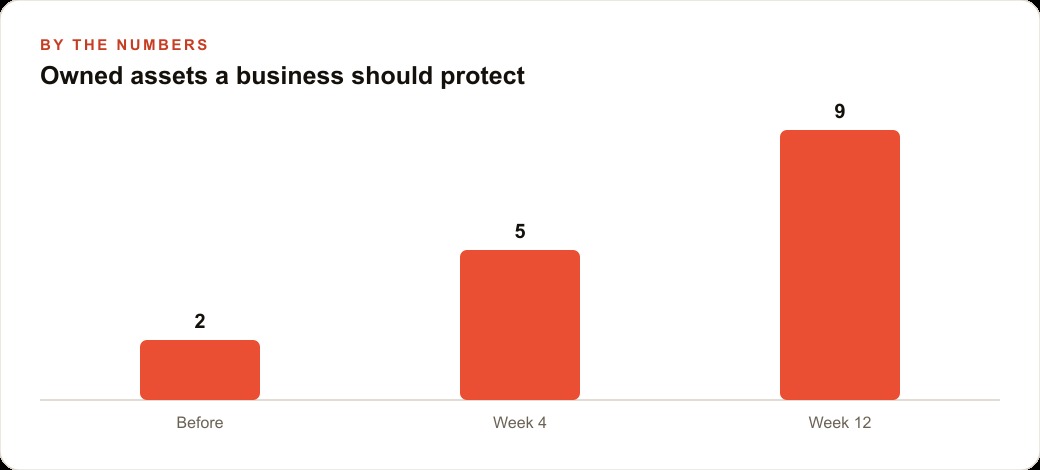
The practical response is not anxiety about what the labs might do next year. It is a set of habits that protect your business regardless of how vendor terms evolve. Keep your data portable. Store your customer lists, your content library, your operational records, and your trained model configurations in systems you own and can export from on demand. Read the terms of any new tool before integrating it deeply into your workflow. Understand what any platform says about the data you feed it before that data becomes load-bearing for your business. Review your critical vendor terms at least once a year, because the version you agreed to when you signed up may not be the version in force today.
These habits cost nothing and eliminate the scenarios where a vendor policy change causes a business disruption you were not prepared for. They also make your operation more resilient in general, because data portability and system independence are valuable regardless of what any specific vendor does.
What this means for a med spa running AI tools across its marketing and operations
A med spa is a useful case because it sits on two categories of assets that carry different risk profiles. The first is patient and client data, including booking history, treatment records, consultation notes, and before-and-after photography, which is regulated, sensitive, and carries real legal exposure if mishandled. The second is brand and marketing content, including ad copy, promotional graphics, consultation materials, and the voice of the business across its SEO and organic content presence, which the business wants to own outright and use freely across any platform.
For the regulated category, the relevant question is not whether the AI vendor might take a future equity share. It is whether the vendor's terms permit patient data to be used in ways that conflict with applicable privacy regulations, and whether the vendor's infrastructure meets the compliance standards required for storing or processing health information. Before connecting any AI tool to intake forms, booking systems, treatment note workflows, or anything that touches client health information, the terms need to be reviewed for data handling, retention, and use policies. That review takes an afternoon and should happen before integration, not after the data has already flowed through the system.
For the marketing and content category, the relevant question is whether the business can freely use, modify, license, and commercialize everything it creates with the tool. For most standard AI content generation tools and image generators, the answer is yes. Confirming it takes five minutes of reading the terms. Assuming it without reading is the risk the OpenAI story is actually pointing to, even if the headline scare was about something narrower.
A practical setup for a med spa that wants to use AI tools confidently looks like this. Patient data lives in a practice management system the clinic controls, with an export function they have tested at least once. Marketing assets created with AI tools are saved to local storage and backed up to a system the clinic owns, not stored exclusively within the tool that generated them. Every tool integrated into client-facing workflows, whether for booking, communication, or content, has been checked for its data handling terms before connection. When a vendor updates their terms, someone at the clinic notices, because there is a named person responsible for reviewing tool agreements annually. That setup does not require a legal team for a small practice. It requires one deliberate habit applied consistently.
The timing argument for getting clear on data ownership right now
The reason this question matters more today than it did two years ago is that AI tools have moved from optional supplements to operational dependencies for a growing number of businesses. A business that used an AI tool occasionally to draft a subject line had low exposure if the vendor changed its terms. A business that now routes its intake flow, its client communications, its content production, and its ad creative through AI tools has substantial exposure if any of those vendors change their policies in ways that affect how the business uses or accesses its outputs.
The shift from low to high dependency happened gradually, which is why many businesses have not done a formal review of what their AI vendors claim. The OpenAI value-sharing discussion, whatever you think about the specific pharma application, is a useful prompt to do that review now rather than after a policy change forces the question. List the AI tools your business depends on. Find the current terms for each. Confirm what each says about your inputs, your outputs, and your data. Note the date of each review. Set a calendar reminder to check again next year. Businesses that treat their data as a protected asset rather than a default input for vendor systems will be better positioned as the AI tool landscape continues to change. The ones that assume favorable terms without verifying them are the ones who get surprised when those terms evolve. The OpenAI story was significantly overblown as a scare for ordinary businesses. The underlying lesson is practical, immediate, and costs nothing to act on.
The businesses that build durable advantages in the current AI landscape are the ones that treat tool selection and data governance as strategic decisions rather than administrative ones. Every AI tool you depend on is a vendor relationship that could change. Every dataset you build inside a vendor's system is an asset you may not fully own. Treating those realities with the same seriousness you bring to any other supplier relationship is not paranoia. It is the same discipline that protects you in any business context where a single dependency carries outsized risk. The OpenAI value-sharing story was mostly noise for ordinary businesses. The signal underneath it, that labs are thinking carefully about how to capture more value from the outcomes their tools contribute to, is worth taking seriously as the tools become more central to more operations.
That is exactly what we do at AI DOERS. Book a private 30-minute call with Madhuranjan Kumar and we will map the fastest path to it for your specific business.
Book your call →
Madhuranjan Kumar
Madhuranjan Kumar brings 20 years of performance-marketing experience and has managed over $200 million in Facebook ad spend for brands across the United States and beyond. His expertise spans the full modern marketing stack: Meta, Google Ads, TikTok, email automation, CRM, and the websites that hold it together. At AI DOERS he turns that track record into lead-generation systems for businesses across every industry.