
OpenAI's Erdős Breakthrough: An AI Model Disproved a Decades-Old Math Conjecture
An unreleased general-purpose OpenAI reasoning model disproved Erdős's 1946 planar unit-distance conjecture by finding an infinite family of layouts that beat the assumed-best grid. Nine mathematicians verified it as a genuine novel result, likely the first AI-generated publishable proof on a prominent open problem.

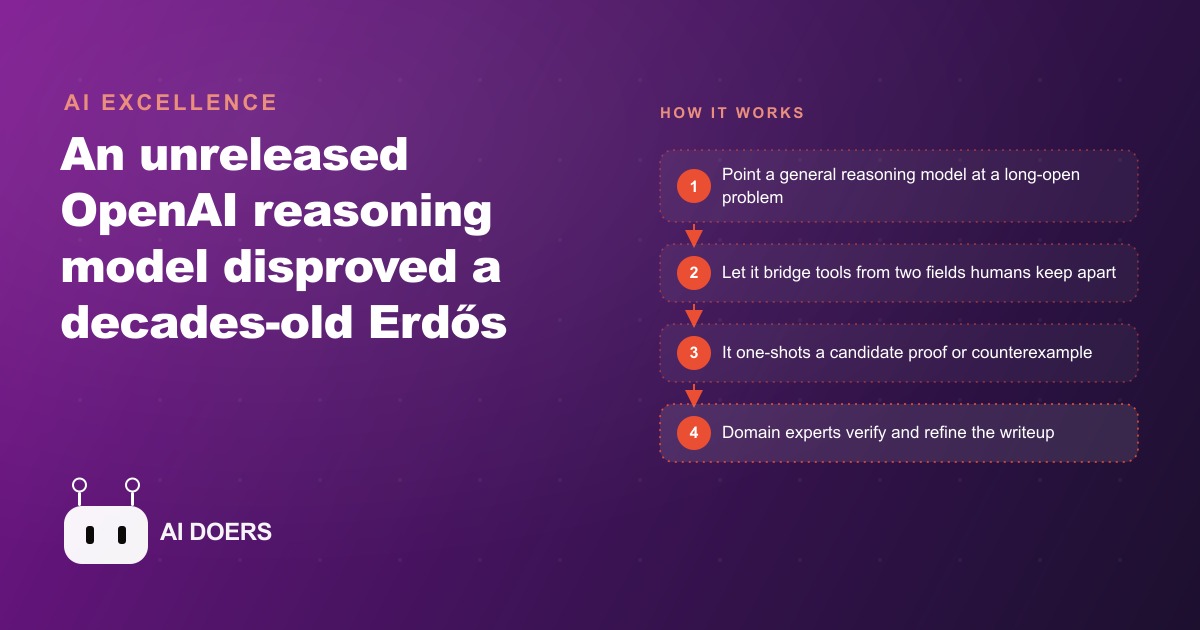
An unreleased OpenAI reasoning model one-shotted a proof that disproved a conjecture in discrete geometry that had been open since 1946, and nine mathematicians including Melanie Matchett Wood independently verified the result as genuinely novel. The problem was not unsolved because nobody tried hard enough. It was unsolved because the experts who held one crucial piece of the solution were never in the same room as the experts who held the other piece.
That structural gap, built not from laziness but from how academic fields organize themselves, is what a general AI model collapsed in a single generation. The pattern it reveals shows up in almost every business that has operated with more than one department long enough for data and expertise to accumulate on separate sides of an internal boundary.
A problem open since 1946 and the assumption nobody questioned
Paul Erdős posed the planar unit-distance problem in 1946. The question is precise: if you scatter n points across a flat plane, what is the maximum number of pairs of points that can be exactly one unit of distance apart? As n grows into the thousands and millions, does that count of unit-distance pairs grow roughly like n raised to the power of 4/3, or faster, or slower?
Erdős conjectured that n to the 4/3 was close to the ceiling. He could not prove it, but the estimate matched every configuration anyone had ever found, and over the decades the conjecture hardened into something that felt nearly settled. The most natural candidate for the optimal arrangement was a carefully structured grid, and researchers who tried to beat it made only incremental progress. Small improvements appeared over the years, but the general picture looked stable. The ceiling Erdős proposed seemed approximately right.
What nobody seriously challenged was the frame itself. Every approach began from the same premise: we are looking for a point arrangement in a flat plane, and we are going to try to optimize within that two-dimensional space. The grid was improved, the spacing was adjusted, different lattice variants in two dimensions were explored. Nobody asked whether the answer might require stepping outside the plane to find it.
Evidence gathered inside a frame will always point toward answers that fit that frame. That is not a failure of any individual researcher's intelligence. It is a natural consequence of how deep expertise in a specific domain shapes the questions you think to ask. The unit-distance problem became a two-dimensional problem not because it had to be, but because the community studying it was organized around two-dimensional geometric thinking. That organization held for eighty years.
The weight of an unsolved problem that long is not simply the difficulty of the mathematics. It is the accumulated implicit consensus that the people who know this problem best have probably been looking in the right direction. When that consensus is wrong, the wrongness tends to be structural rather than technical. The problem is not that nobody was smart enough to find the answer. It is that the structure of expertise prevented the right question from being asked.
The projection trick that connected two fields
The model's approach departed from the standard frame immediately. Rather than searching for a clever arrangement of points on a flat surface, it built a lattice structure in higher-dimensional space, an algebraic object with properties that only make sense in more dimensions than a plane contains, and then projected that structure downward as a shadow onto the two-dimensional plane.
Think of a complex wire sculpture held at a specific angle under a light source. The shadow it casts on the wall is two-dimensional and can look entirely different from the three-dimensional structure producing it. Now imagine the opposite process: you want a shadow with specific properties, so you engineer a higher-dimensional structure specifically to cast exactly that shadow when projected. That is the method the model used, applied in dimensions beyond three.
When the resulting two-dimensional shadow configuration was examined, its unit-distance pair count exceeded anything the grid approach had produced. The Erdős estimate was not a ceiling on what was achievable. It was a record for how well researchers had searched within the two-dimensional frame, and the actual maximum sits meaningfully higher.
The word "projection" marks where two distinct fields converge. The final output is a two-dimensional point arrangement, exactly what the problem asks about. The method for constructing it belongs to algebraic number theory, a branch of mathematics concerned with abstract algebraic structures and the deep properties of number systems. Algebraic number theory has no obvious surface connection to the problem of counting pairs of points on a plane. That is precisely why it was the key.
Geometry researchers develop intuitions about shapes, distances, and configurations in space. Algebraic number theorists develop intuitions about abstract algebraic objects that can live in generalized settings with any number of dimensions. The tools that turn out to be decisive for the unit-distance problem live in the number theorist's toolkit. The problem itself belongs to the geometer's world. The solution required both, simultaneously, in the hands of someone who could recognize that the bridge between them was the right path.
Those two communities do not naturally converge. They publish in separate journals, attend different conferences, and develop vocabularies that feel like different languages at their intersection. A researcher who spent a career on discrete geometry problems would need to acquire substantial algebraic number theory fluency to even formulate the projection approach. There is no obvious reason to make that investment if the problem looks like it should have a geometric answer, and every prior result had reinforced that appearance.
The model had no such barrier. A general-purpose reasoning model does not have a home discipline. When it searches for a solution path it draws from the full space of approaches in its training, without the institutional gravity that pulls human researchers toward what their field considers natural. This is a general reasoning system, not a narrow tool like AlphaProof, which was built specifically for mathematical theorem proving. AlphaProof is impressive in its domain. The model that disproved the Erdős conjecture is the category of model that handles summarization, coding, analysis, and general conversation. The fact that a general model outperformed mathematical specialists on a specialized problem is evidence about the power of breadth in reasoning, not about mathematical narrowness.
Nine mathematicians read it and signed off
Mathematical proofs are binary in a way that most professional outputs are not. A proof is correct or it is not, and the mathematical community has well-established standards for what a valid argument looks like. Experts can and do find subtle errors that appear valid to a non-expert but fail under close examination. Plausible-looking logical chains with hidden gaps are a known failure mode in AI-generated mathematics, and the community had reason to be skeptical.
Nine mathematicians reviewed the proof that the model produced and confirmed it as genuinely novel. No gaps. No steps that looked valid from a distance but did not hold under specialist scrutiny. A real advance on a problem that had resisted meaningful progress for eighty years.
One of the mathematicians made a comment that cuts directly to the center of the story. If the relevant geometry experts and the algebraic number theorists had simply been placed in a room together and pointed at this problem, they would have found the counterexample. The knowledge was distributed across people in two adjacent fields. The tools existed in human hands. The only missing ingredient was the convergence, and that convergence never happened because nobody's research agenda required it.
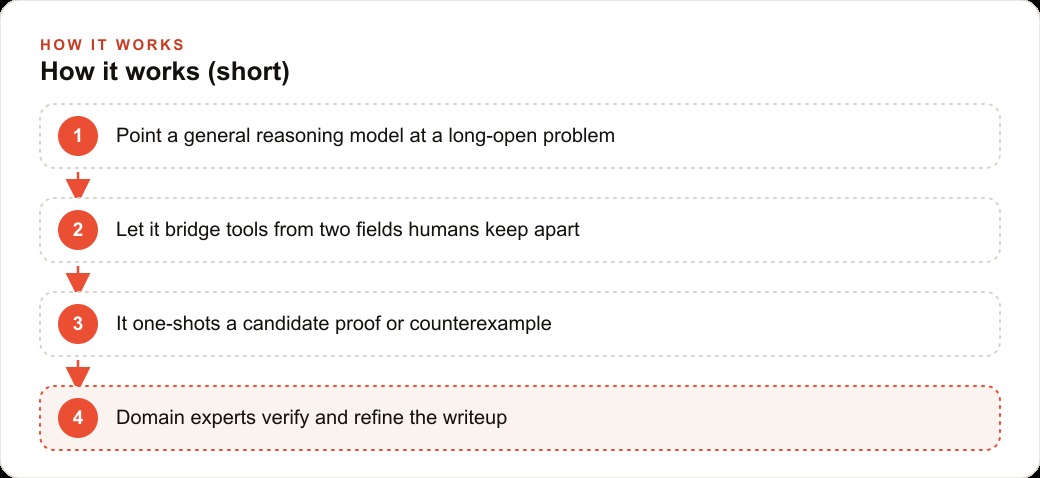
The workflow that produced this verified result is worth noting carefully. The model generated the cross-field insight. Human domain specialists confirmed that the insight was real. Neither step replaced the other. The model's value was in producing a candidate result that crossed a boundary the specialists were structurally unlikely to cross on their own. The specialists' value was in applying the rigor required to confirm the result was genuine and not an artifact of the model's generation process. That is the combination worth replicating: model as cross-field generator, human expert as verifier.
This workflow matters because it is honest about what both parties contribute. The model is not a replacement for mathematical expertise. It is a tool that can search across the full space of approaches without the institutional constraints that narrow where human experts look. The human experts are not a redundant check that slows things down. They are the mechanism by which a novel result becomes a trustworthy one.
The silo that was sitting in plain sight
Academic fields develop cultures, and cultures develop boundaries. Researchers who cross those boundaries too freely can be perceived as generalists, a label that in many academic settings implies insufficient depth in any one area. The incentive structure rewards deep specialization and staying within it. The result is that every field develops hard edges, and the cross-field territory between those edges goes largely unexplored, not because nobody has mapped it, but because nobody's funding, department, or career path points specifically there.
The geometry community was not ignorant of algebraic number theory. Mathematicians broadly know the field exists and have a general sense of its methods. The issue was recognizing in a concrete and actionable way that the unit-distance problem specifically called for a cross-field approach, and that the specific algebraic tools needed were available in the number theory literature. That recognition requires simultaneous fluency in both languages and the cognitive freedom to apply that fluency in a context where the connection is not yet obvious to anyone else working in the space.
That combination is rare among human researchers, not because people are incapable of it, but because the structure of academic careers makes it a risky investment. Time spent acquiring deep algebraic number theory fluency is time not spent deepening the geometric expertise that supports an existing research trajectory. The model faces no such trade-off. It does not have a tenure case to build. It does not need the algebraic number theory community to recognize it as a serious member of their field before it applies their tools to a geometry problem. It does not risk anything by crossing the boundary.
The silo was a structural artifact of how human expertise gets organized and rewarded. The model did not inherit that structure. That is the relevant difference, and it is a difference that will show up repeatedly across every field where the answer to an important question lives at the intersection of two communities that do not regularly talk.
Cross-field analysis and what it means for a business with fragmented data
I see this same structure in every business that has grown past a handful of people. The marketing team produces and owns campaign performance data. The sales team produces and owns lead, conversation, and conversion data. The operations and customer success team produces and owns churn, support ticket, and satisfaction data. Each team is skilled at reading its own data and improving its own metrics. Nobody is structurally responsible for reading across all three at the same time and finding the patterns that only appear in the intersection.
That is the business equivalent of the silo that kept the unit-distance conjecture unsolved for eighty years. The insights with the highest leverage are the ones that live between data domains, and they are nobody's formal responsibility.
Running Facebook and Instagram ad campaigns well is not just about optimizing the ad metrics. Which creative drives the lowest cost per click matters, but what matters more is which acquisition cohorts produce the highest customer lifetime value in the months after they first buy. That connection requires someone to examine marketing attribution data alongside post-purchase CRM data simultaneously. In most companies, those two datasets live in different tools, managed by different teams, with no regular shared analysis.
A general reasoning model sees no territorial boundary between them. Give it a clean export from each domain and ask what patterns appear in the intersection. The cross-field connection it surfaces may feel obvious once stated, the same way the geometry-to-number-theory link feels obvious in retrospect. That does not reduce its value. Obviousness in hindsight is evidence that the insight was available and simply never sought across the boundary.
The same principle applies to SEO and organic search data combined with downstream conversion and retention data. The organic search terms that drive the most traffic are not always the terms that predict the most valuable customers. Understanding which search intents lead to high-value buyers requires someone to look at search acquisition data and customer outcome data together, across the boundary between the SEO function and the customer success function. Most businesses treat those as separate reporting domains. They are not separate problems. They are two halves of the same question.
The verification step matters as much in a business context as it did in mathematics. When a model surfaces a cross-departmental pattern, that is a hypothesis, not a confirmed finding. Someone with genuine domain expertise needs to review it before the business changes behavior based on it, exactly the way nine mathematicians confirmed that the model's proof was real before the mathematical community treated it as a result.
The opportunity is structural. Eighty years is how long the unit-distance conjecture stood because two fields that held the relevant pieces never properly converged on it. The business equivalent of that gap is your marketing data and your operations data sitting in separate systems while your teams optimize each one in isolation. The insight that would close the gap already exists in data you have collected. A general reasoning model, pointed at the intersection of two domains you currently treat as separate, will find something worth examining. The question is only whether a person with the right domain knowledge is available to verify it before you act on it.
That combination, model as cross-silo analyst, human expert as verifier, is the workflow this result demonstrated. It works in mathematics. It works in business. The requirement is the same in both cases: stop optimizing each domain in isolation and start asking what lives between them.
That is exactly what we do at AI DOERS. Book a private 30-minute call with Madhuranjan Kumar and we will map the fastest path to it for your specific business.
Book your call →
Madhuranjan Kumar
Madhuranjan Kumar brings 20 years of performance-marketing experience and has managed over $200 million in Facebook ad spend for brands across the United States and beyond. His expertise spans the full modern marketing stack: Meta, Google Ads, TikTok, email automation, CRM, and the websites that hold it together. At AI DOERS he turns that track record into lead-generation systems for businesses across every industry.