
OpenAI Poached Cline's Best People: The Quiet Playbook Killing Open Source
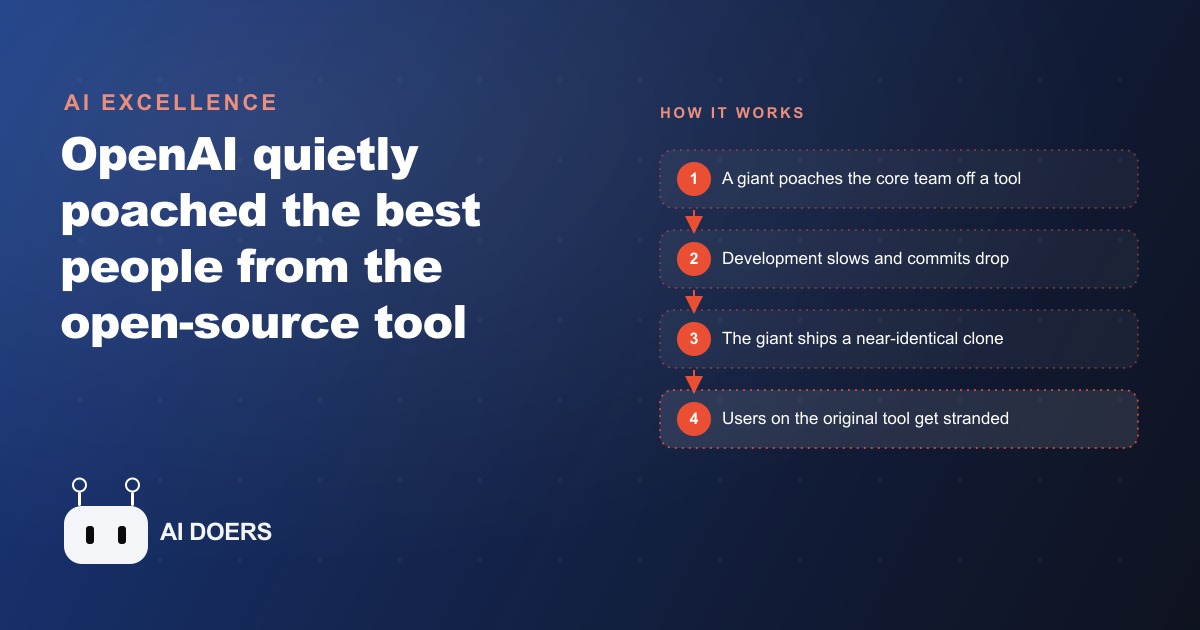
OpenAI pulled at least five of Cline's strongest engineers onto its Codex team without buying the company, and Cline's commits have since fallen to a multi-year low, repeating the same talent-poach-and-clone move other labs ran on Scale AI and Windsurf.

Why a talent raid on one tool is your problem too
A large AI lab just pulled at least five of the strongest engineers off Cline, one of the most popular open source AI coding tools, and moved them onto its own Codex team, without buying the company. Since then Cline's public commit activity has fallen to a multi year low, which is the visible signature of a project losing its core team. This is not gossip about a coding tool. It is the second or third time this exact move has run in the last year, and if your business depends on any third party software, the pattern is a direct threat to your operations. I am Madhuranjan Kumar, and this is a practical playbook for protecting your stack against it, laid out as steps you can actually run.
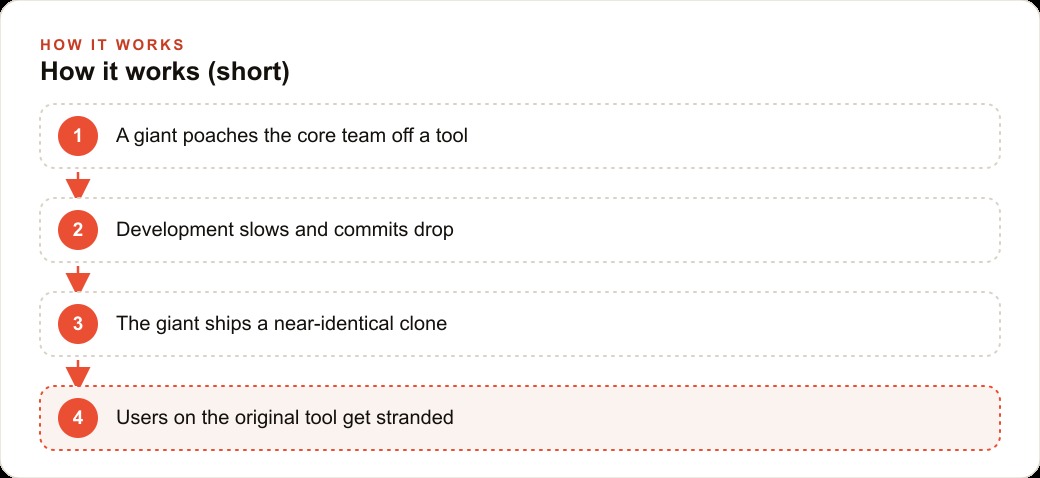
The shape of the move is worth naming clearly, because you need to recognize it in progress. Absorb the expertise that made a tool great. Skip the cost and obligations of actually acquiring the company. Let the original product fade while you ship your own version. One lab did it by paying billions for a minority stake in a data labeling firm mainly to land its chief executive, after which rivals pulled their contracts and the firm got called a zombie company. Another paid billions to poach a rival editor's chief executive and forty senior engineers, then launched a near identical tool months later. Take the talent, clone the product, leave the corpse. That is the pattern you are defending against.
Step 1: List the tools your business cannot survive without
Before you can protect a stack, you have to know what is actually load bearing. Sit down and write out every piece of software the business genuinely cannot run without for more than a day or two. Not the nice to haves, the essentials. The systems that hold your customer data, your money, your scheduling, your communications, and your core delivery.
Be honest about dependency depth. Some tools are easy to swap in an afternoon. Others hold years of history, custom configuration, or integrations that would take weeks to rebuild elsewhere. Mark each one by how painful a sudden failure would be, because that pain score is what tells you where to spend your defensive effort. A tool you could replace by lunchtime does not need a contingency plan. The one that would freeze your operation for a week does.
Step 2: Check the health of every critical tool
Once you have the list, assess which tools are healthy and well resourced, and which are small projects that could lose their team overnight. For commercial vendors, that means looking at funding, ownership, and whether the company has the resilience to survive a founder or a lead engineer walking out the door.
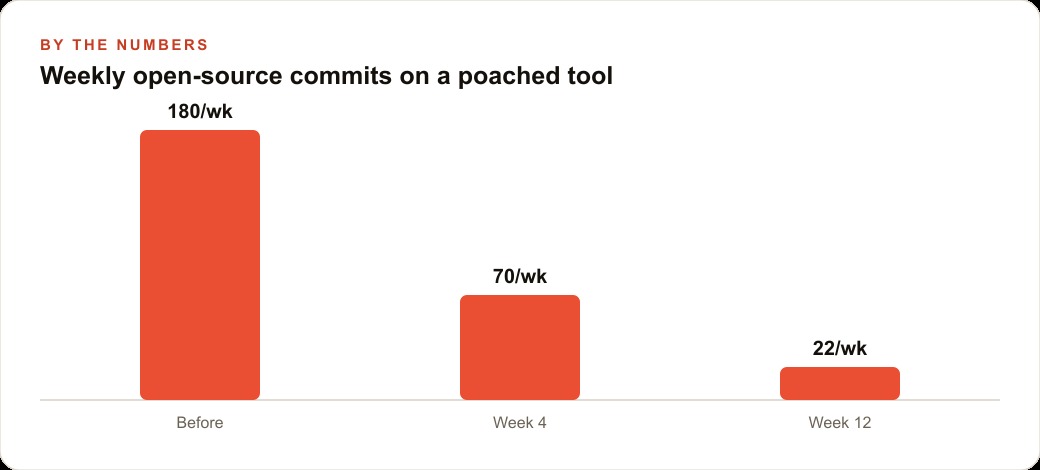
For open source tools, you have a free and unusually honest signal: the public commit history. Because the work happens in the open, a decline is easy to read. Cline's commits hitting their lowest level since 2024 was a flashing warning light for anyone watching, and it told the story well before any announcement. Fewer commits means fewer features, fewer bug fixes, and a clear downtrend. Make a habit of glancing at the activity on the open projects you depend on. A sudden, sustained drop is your cue to start looking around, not a month later when the decline is undeniable.
Step 3: Learn the poach and clone shape so you spot it early
The single most useful defensive skill is pattern recognition, because this move telegraphs itself if you know what to watch for. The first visible sign is usually a talent raid: a giant hires away the core people from a smaller team, often the chief executive plus a cluster of senior engineers, without buying the company outright. That specific structure, the talent without the acquisition, is the tell.
What follows is predictable. Development on the original slows because the people who drove it are gone. Then, months later, the giant ships a near identical product of its own. The original company technically still exists, the lights stay on for a while, and then the activity drops off a cliff that anyone watching could have seen coming. Once you have seen the shape a couple of times, you start noticing it in the news the moment the talent raid is announced, which buys you months of lead time to react calmly instead of scrambling later.
Step 4: Favor tools with a real open license
For anything critical, weight your choices toward foundations that cannot be quietly pulled out from under you. Where a tool is open source, a real license like Apache 2.0 makes the open and free commitment legally binding rather than a verbal promise from a company that might get acquired next quarter. That legal durability is the difference between a promise and a hope.
This is exactly why, in the Cline story, the alternative that keeps coming up is Kilo Code. It is a superset of Cline and Roo Code, so it carries their features and more, it ships under Apache 2.0, and its team is publicly committed to staying open. The point for you is not that specific tool. It is the principle behind it: when a foundation is legally open, no talent raid can convert it into a proprietary product overnight, because the license does not allow the rug to be pulled. Prefer that kind of foundation for the systems you cannot afford to lose.
Step 5: Choose and test a backup before you need it
The mistake that actually hurts is discovering your tool is dying in the middle of a deadline and having no alternative ready. For each critical, at risk tool, pick a replacement now, and actually test it on a small slice of real work while there is no pressure. A backup you have never run is not a backup, it is a guess.
Testing early does two things. It tells you whether the alternative genuinely fits your workflow, and it surfaces the migration friction while you have time to deal with it calmly. When the day comes that your primary tool stalls, switching becomes a decision you already validated rather than an emergency you are improvising through. The momentum in the market often backs this up: in the Cline case, Kilo Code is number one on OpenRouter by tokens spent, approaching a hundred billion total, with over a million active users in 2026, which is a healthy sign for a tool you are considering as a landing spot. But the discipline matters more than any single option. Test the alternative before your current tool's development stalls.
A worked example: the law firm running on vendor software
Consider a modern law firm. It runs on a stack of vendor tools: the practice management system, the document automation engine, the e-discovery platform, the AI research assistant, and the billing software. Each one holds client data and case history the whole operation depends on, so a single vendor quietly collapsing is not a minor inconvenience, it is an operational and ethical exposure.
Running the playbook, the firm first lists every tool it cannot work without and scores each by how badly a sudden failure would hurt. Next it checks health: which vendors are well funded and stable, and which are small projects that could lose their team overnight. For the critical, at risk ones, it favors vendors built on durable foundations, and where a tool is open source, a real Apache 2.0 style license. It sets a simple early warning habit of watching the public activity on any open project it leans on, the way Cline's commit drop telegraphed its decline. And for each essential tool, it picks and tests a backup during a quiet week, not during a filing deadline.
The same discipline applies to the marketing and client side of the firm. The systems that hold intake and follow up in the CRM and website stack, and the platforms behind the firm's Google Ads and its SEO and organic search, all deserve the same vendor health check, because a client acquisition tool going dark quietly starves the pipeline just as surely as a case tool freezing a matter. The point is not to panic about any of it. It is to have the backups chosen and tested before you are forced to switch.
Turning the playbook into a standing habit
Run this once and you have a snapshot. Run it as a quarterly habit and you have real resilience. Treat tool health as a metric you actually monitor rather than an afterthought you remember only when something breaks. Glance at commit activity on your open source dependencies. Keep an eye on the news for the talent raid shape. Re confirm that your critical tools still sit on durable foundations, and that your tested backups are still current.
The lesson from Cline is not that open source is fragile. It is that the health of the tools you depend on is knowable, often for free, if you bother to look. The businesses that get stranded are the ones that never looked until the tool had already gone dark. ## Why open source is not the villain in this story
It would be easy to read the Cline situation as proof that open source tools are too fragile to rely on, but that reading gets the lesson backwards. The tool that lost its team is not the cautionary example. The cautionary example is depending on any tool, open or closed, without watching its health. What open source actually gave everyone here was visibility. The commit history made the decline readable in public, months before any announcement, which is a warning signal you simply do not get from a closed vendor that can go quiet without a trace.
Closed vendors get poached and cloned too, and when they do, you often find out only when a renewal notice arrives or the roadmap stalls with no explanation. A proprietary tool can be hollowed out just as thoroughly, but privately, so you lose the early warning. Seen that way, the open license is a strength, not a weakness. The right conclusion is not to avoid open source, it is to prefer open tools with durable licenses and to actually watch the health signals that open development hands you for free.
Building the switch cost into the decision from the start
There is one more habit that separates resilient businesses from stranded ones, and it is choosing tools partly on how hard they are to leave. A tool that locks your data in a proprietary format, or that makes export deliberately painful, raises your switching cost and quietly increases your exposure if that vendor gets raided. A tool that lets you export cleanly, or that stores your work in an open, portable format, keeps your options alive.
When you evaluate a critical tool, ask the exit question before you commit: if this vendor went dark tomorrow, how would I get my data out, and how long would migrating take? The answer should shape the decision as much as the feature list does. This is doubly true for the systems that hold your customers and your revenue. The CRM and website stack that runs your follow up, and the platforms behind your SEO and organic search, are exactly the tools where a painful lock in turns a vendor problem into a business emergency. Choosing for portability up front is cheap insurance against the poach and clone move landing on a tool you cannot easily leave.
You can absolutely run this risk check yourself, and I would tell any owner to start by listing the tools the business cannot live without this week. If you would rather have someone audit your full software stack, flag the vendors quietly going dark, and stand up tested alternatives so nothing leaves you stranded, that is exactly the kind of work I do, and you can bring me in to handle it.
That is exactly what we do at AI DOERS. Book a private 30-minute call with Madhuranjan Kumar and we will map the fastest path to it for your specific business.
Book your call →
Madhuranjan Kumar
Madhuranjan Kumar brings 20 years of performance-marketing experience and has managed over $200 million in Facebook ad spend for brands across the United States and beyond. His expertise spans the full modern marketing stack: Meta, Google Ads, TikTok, email automation, CRM, and the websites that hold it together. At AI DOERS he turns that track record into lead-generation systems for businesses across every industry.