
Which OpenAI Model Should You Use, Nvidia's One-Second Transcription, and What It All Means for Flooring Businesses
Using the wrong AI model for a task is like using a sledgehammer to hang a picture frame. The right model choice cuts costs and improves results simultaneously. Here is the complete map.

Most Businesses Are Defaulting to the Most Expensive Model for Tasks That Do Not Need It
The most widespread AI mistake businesses are making right now is not choosing the wrong tool. It is choosing the right tool but using its most expensive configuration for every single task, including the tasks where a model that costs a tenth as much would produce an equal or better result. A flooring showroom using its top-tier reasoning model to draft a thank-you email to a customer who just placed an order is the AI equivalent of hiring a structural engineer to tighten a loose door hinge. The credential is real. The application is wrong and expensive.
Madhuranjan Kumar has been watching this pattern repeat across small businesses that have started using AI tools seriously in the past 12 months. They default to the most powerful model they have access to because it feels safer: if the most capable model can handle a task, there is no risk of inadequate output. The flaw in that logic is that task type and model capability are not a linear match. More powerful models are not universally better. They are optimized for a specific kind of work, and sending them work they are not optimized for produces slower, more mechanical output at a higher cost. The flooring company detailed later in this piece dropped its monthly AI spend from $280 to $90 and saw output quality improve at the same time. That outcome is not an anomaly. It is what happens when the right model is matched to the right task.
The Wrong Model Does Not Just Cost More, It Produces Worse Output for the Wrong Task Type
This is the claim that surprises most people, so it deserves a concrete example before anything else.
The flooring company in this walkthrough needed to send a follow-up email to a customer who had received an installation quote and had not responded in three days. The task was straightforward: a warm, conversational message that acknowledged the quote, addressed the most common hesitation customers have about installation timeline, and offered a simple path to ask questions. It required good language quality and a conversational tone. It did not require multi-step reasoning, extended analysis, or complex problem decomposition.
The team sent this task through their standard setup, which defaulted to a high-end reasoning model. What came back was technically correct but felt like a business memo. The sentences were precise. The structure was logical. The warmth was absent. It read like a follow-up written by someone who had read a description of what a warm follow-up should contain rather than by someone who actually cared about the customer's decision.
The same task sent through a conversation-optimized model at roughly one-fifteenth the cost produced a message that sounded like a person writing to another person. It acknowledged the customer's likely hesitation about disruption during installation and ended with a question that made replying easy. Better output, lower cost.
This happens because reasoning-tier models are built and fine-tuned for a different kind of work. They are optimized to work through multi-step logical chains, hold many variables in consideration simultaneously, and produce carefully constructed conclusions. For tasks that require exactly that, they are excellent. For tasks that require sounding like a person talking to another person, that optimization works against the output quality. The model over-reasons a conversational task and produces something that is correct but cold.
A Model Hierarchy Exists Precisely Because Different Task Types Need Different Reasoning Styles
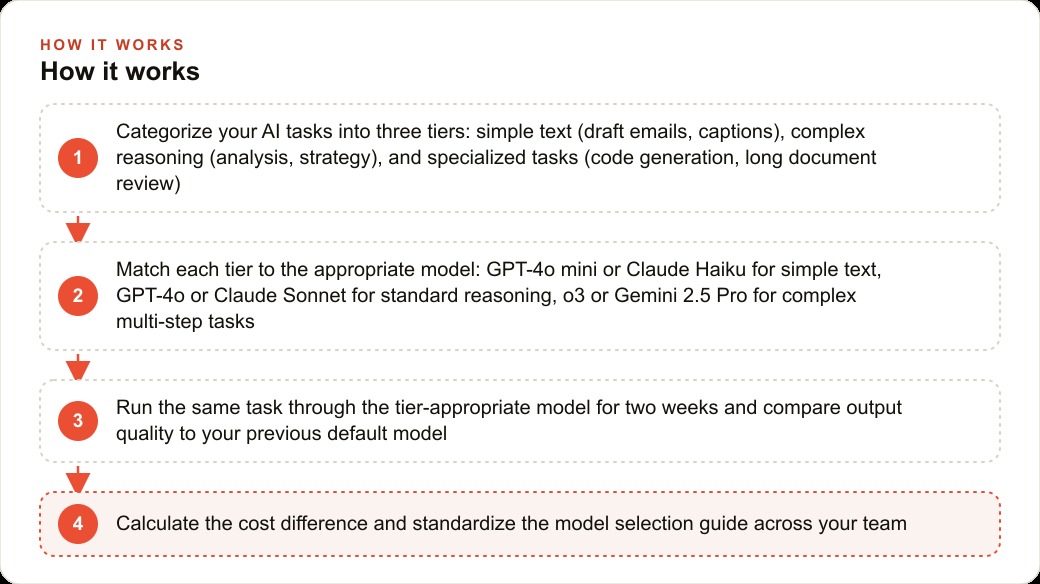
The practical hierarchy for business use, stripped of marketing language, has three tiers.
The first tier covers tasks that require good language quality but no complex reasoning: writing a response to a standard customer inquiry, generating a caption for a product post, producing a draft appointment reminder, translating a product description into simpler language for a customer who asked. These tasks need fluent writing and tonal awareness. They do not need deep reasoning. The right models here are the mini and haiku tiers. They are fast, cost roughly 10 to 20 times less per task than the next tier, and produce output that is indistinguishable from the more expensive options on these specific task types.
The second tier covers tasks that require reasoning over multiple pieces of information simultaneously: summarizing a 30-minute sales call transcript and extracting next steps, writing a product description that references installation requirements and substrate compatibility, comparing supplier quotes across multiple variables, drafting a proposal for a complex residential project. These tasks need the standard tier, which combines strong language quality with solid reasoning at a reasonable cost per task. This tier handles the largest share of daily business AI work correctly.
The third tier covers tasks where getting the reasoning precisely right matters more than getting a fast response: a complex pricing analysis that involves multiple product categories, margin targets, competitor pricing, and regional demand variations; evaluating a subcontractor proposal across a dozen criteria and producing a recommendation that holds up under scrutiny; drafting a response to a formal business dispute that anticipates multiple counterarguments. These tasks belong in the reasoning models. They are slower and more expensive. For the tasks that actually belong in this tier, they are worth it.
The cost difference between routing a task to the wrong tier and the right tier is not marginal. On a per-task basis, the difference between the mini tier and the reasoning tier can be 50 to 100 times the cost per token depending on which specific models are compared. At real business volumes, that arithmetic accumulates into a meaningful monthly number.
Nvidia's One-Second Transcription Proves the Broader Point: Match the Compute to the Problem
Nvidia demonstrated GPU-accelerated audio transcription that converts 60 minutes of recorded audio to text in under one second. Current transcription tools process audio at roughly real-time speed or faster-than-real-time for short files, but nothing approaching one second for a full hour of audio. The demonstration represents a roughly 60-fold speed improvement over what standard cloud transcription delivers today.
The relevance here is not the transcription speed itself. It is what the demonstration illustrates about the principle this article is arguing. Nvidia did not get to one-second transcription by using a general-purpose compute approach and hoping it would be fast enough. They matched the specific computation required for audio-to-text conversion to the hardware architecture best suited to it. GPU parallelism is what that task needs. CPU-based sequential processing is technically capable of doing the same work, but at the wrong order of magnitude for the application.
The model selection problem for businesses follows the same logic. Every AI model is an architecture optimized for a specific class of tasks. When you send the wrong task type to the wrong model architecture, you are doing the CPU version of a GPU problem. The tool is technically capable. The performance is the wrong order of magnitude for the application.
For a flooring company that conducts sales consultations and wants transcripts of those conversations: once one-second transcription speed reaches commercial APIs, the transcript will be ready before the customer has driven home. The analytical step that currently requires a half-day turnaround becomes part of the same-day follow-up workflow. But even then, the tool selection still applies: transcription belongs in a transcription-specialized model, not in a general reasoning model asked to "summarize this audio." Task type and model type are separate decisions, and both matter.
Gemini's Video-to-Code Removes the Communication Bottleneck That Was Never About Code
Gemini 2.5 Pro demonstrated the ability to watch a screen recording of a software interface and generate working code that implements the same functionality. You show the model what you want the software to do. It builds the software.
For a flooring company, the specific opportunity is custom tooling that has always been too expensive to commission from a developer. The owner has a quoting process that lives in a spreadsheet: product type, room dimensions, material cost per square foot, installation labor rate based on surface complexity, waste factor. That spreadsheet works but it is fragile, easy to break, and produces output that has to be manually reformatted before it goes to the customer.
The owner records a two-minute screen walkthrough explaining how the spreadsheet works and what each column calculates. The model watches this breakdown and generates a web-based quoting tool that does the same calculation in a cleaner interface. The resulting code still needs someone with basic technical literacy to deploy and test, but that is a much lower bar than hiring a professional developer to build a bespoke quoting tool from a written description with multiple revision cycles.
The reason this capability matters for the model-selection argument is that it demonstrates a broader pattern: the most useful AI advances in this period are not about making general models more powerful. They are about matching specialized capabilities to specific problem types. Video-to-code is specialized. It is very good at one specific thing. That specificity is why it works, and it is the same principle that makes model routing across tiers produce better results than defaulting to the most general and powerful option for everything.
The Windsurf Acquisition Is the Vendor Lock-In Warning You Should Have Taken Seriously Earlier
Windsurf, an AI coding assistant that competed directly with Cursor in the developer workflow space, was acquired. The specific acquirer and terms matter less than the pattern the acquisition represents: independent AI tool companies are being consolidated into larger platforms, and every consolidation event changes the pricing, the product direction, or both.
For businesses that have built operational workflows on independent AI tools, a consolidation event is a risk they accepted when they chose the tool. This is not a reason to avoid startup AI tools. The most capable and innovative tools are often from startups. It is a reason to maintain workflow portability from the start.
For every AI tool that has become load-bearing in your operation, ensure that the same task can be routed to an alternative within a few days of switching. If the task is customer email drafting, the leading standard-tier models produce sufficiently comparable output that switching between them is a workflow adjustment, not a capability loss. If the task is complex agent workflows or custom automation, the switching cost is higher and the contingency planning needs to start before an acquisition creates urgency.
Vendor lock-in is not only an enterprise concern. A small flooring company that has routed its entire quoting process and customer communication workflow through a single tool that gets acquired and doubles its pricing in six months has an operational problem on a short timeline. The same model-selection discipline that protects cost also protects portability: when you are routing tasks to tiers based on task type, no single provider owns your entire workflow.
The Flooring Company That Halved Its AI Spend and Improved Its Output Quality Simultaneously
Here is the complete picture of what model routing optimization looked like for the flooring company in this example.
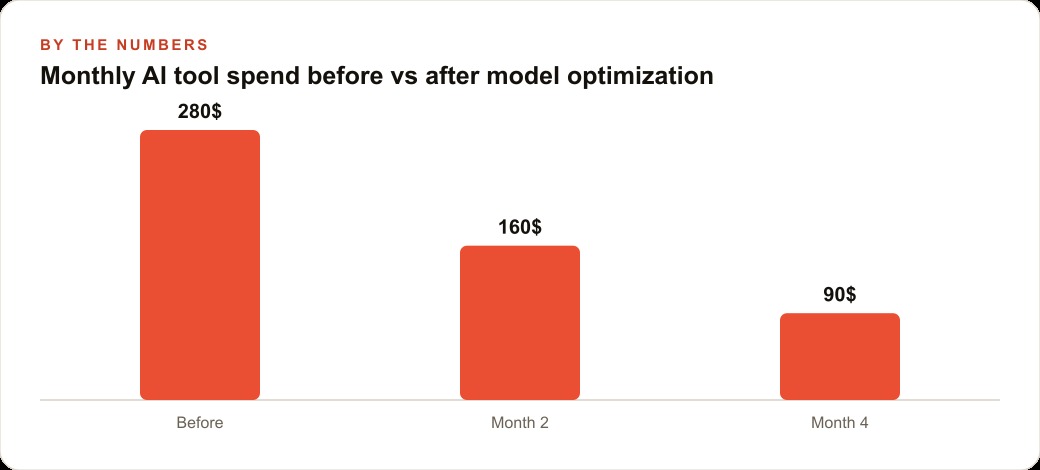
Before optimization, the company used a single subscription tool that defaulted all tasks to a high-capability model. The monthly spend across the four-person sales team using direct API access was approximately $280 per month. The tasks being processed each week were a mix: customer inquiry responses, quote follow-ups, product descriptions, social captions, consultation summaries, and occasional complex pricing analyses.
The audit took 90 minutes. Every task category was listed, assessed for reasoning complexity, and assigned to the appropriate tier. The mapping was as follows.
Customer inquiry responses and appointment follow-ups: mini tier. Equivalent quality at roughly one-twelfth the cost per task. The tone was actually better because the model was not over-reasoning a conversational task.
Product descriptions and consultation summaries: standard tier. Appropriate for the level of reasoning complexity involved, producing thorough output that covered substrate compatibility and installation requirements without missing variables.
Complex pricing analyses and proposal drafts for unusual or high-value installations: reasoning tier. Worth the additional cost because getting these wrong in one direction means underpricing a job and losing margin on a project that might run $15,000 to $25,000.
Long technical specification documents and warranty reviews exceeding 30 pages: the long-context model. The only option in the stack that handled that volume of text without truncation artifacts affecting output quality.
After the routing change, the monthly API spend dropped from $280 to approximately $90. More importantly, the quality of the customer-facing outputs improved. The follow-up emails that previously felt like business memos now sounded like the owner writing them personally. The product descriptions retained the depth appropriate for their complexity. The complex proposals were sharper because the reasoning model was being used only for work that actually required it, rather than being diluted across 40 simple email tasks per day.
The shift from $280 to $90 is the cost number. The quality improvement is the more important result. For a flooring company where a single job can be worth $8,000 to $25,000, one additional close per month from better follow-up emails pays for a year of optimized AI spend in a single transaction. The optimization took 90 minutes to design and one afternoon to implement. Few other changes a small business makes in an afternoon have that return profile.
That is exactly what we do at AI DOERS. Book a private 30-minute call with Madhuranjan Kumar and we will map the fastest path to it for your specific business.
Book your call →
Madhuranjan Kumar
Madhuranjan Kumar brings 20 years of performance-marketing experience and has managed over $200 million in Facebook ad spend for brands across the United States and beyond. His expertise spans the full modern marketing stack: Meta, Google Ads, TikTok, email automation, CRM, and the websites that hold it together. At AI DOERS he turns that track record into lead-generation systems for businesses across every industry.