
OpenAI Just Released a Free AI You Can Run on Your Own Computer: Here Is What It Means
GPT-OSS is a free, open-weight AI model from OpenAI that you can download and run completely offline. It performs close to their best paid models and costs nothing after setup.

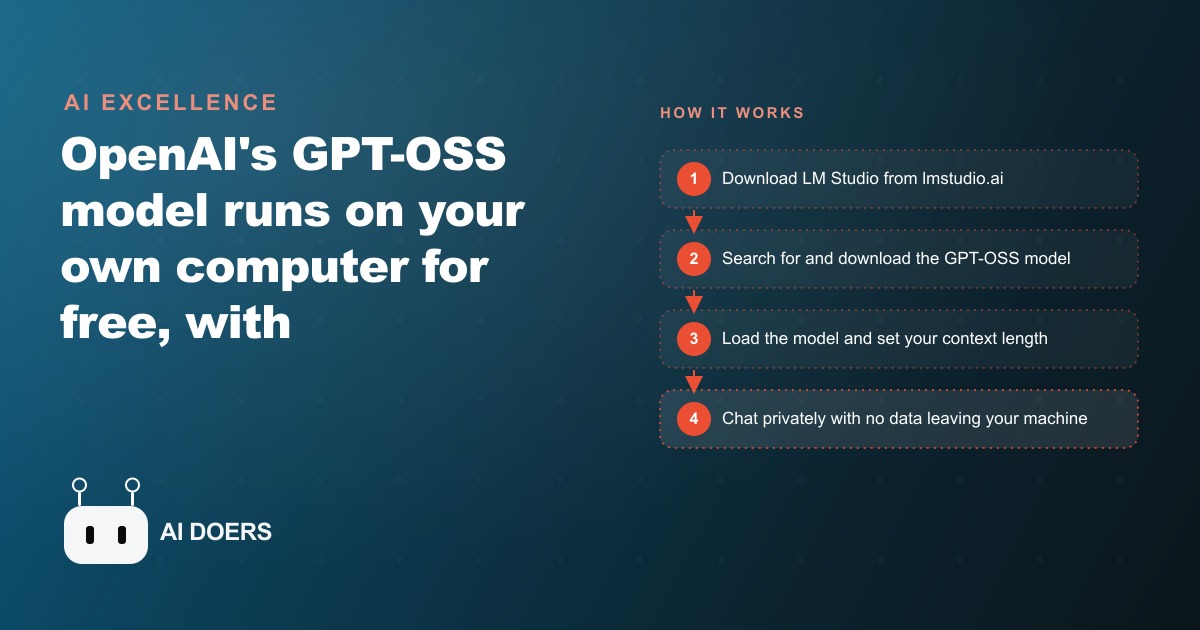
OpenAI just released a model you can run on your own hardware, offline, permanently, for free. The 120-billion-parameter version scores near o3 and o4 Mini on math, coding, and reasoning benchmarks. There is no subscription. There is no API call. After the initial hardware setup, the only ongoing cost is electricity.
This is not a story about the most powerful AI ever released. It is a story about who can now access serious AI capability, under what cost structure, and with what control over their own data. Those three things changed this week in a way that has concrete implications for anyone paying a recurring AI bill.
OpenAI Released Two Open-Weight Models Under Apache 2.0 with No Per-Usage Cost
The release includes two models, both licensed under Apache 2.0, the most permissive standard open-source license in widespread use. Apache 2.0 permits commercial use, modification, and fine-tuning on your own data. There is no usage fee, no royalty, and no required attribution in the output. Once the model weights are downloaded, the license places no ongoing obligations on the user.
The 20-billion-parameter version is designed for consumer hardware. A machine with 16GB of GPU VRAM can run it at useful inference speeds. This covers a significant portion of the desktop GPU market from the past three years: the RTX 3090, the RTX 4080, the RTX 4090, and Mac Studio configurations with 32GB or more of unified memory. For organizations that already own this hardware for other purposes, the marginal cost to run the 20B model for AI tasks is effectively zero after initial download.
The 120-billion-parameter version requires approximately 80GB of total GPU memory. This puts it out of reach for single consumer GPUs, but within range for Mac Studio configurations at 192GB of unified memory, multi-GPU workstations pairing two high-end cards, or cloud GPU instances rented for periodic workloads. For organizations currently spending $200 or more per month in API costs for access to high-capability models, the hardware investment calculation becomes worth doing.
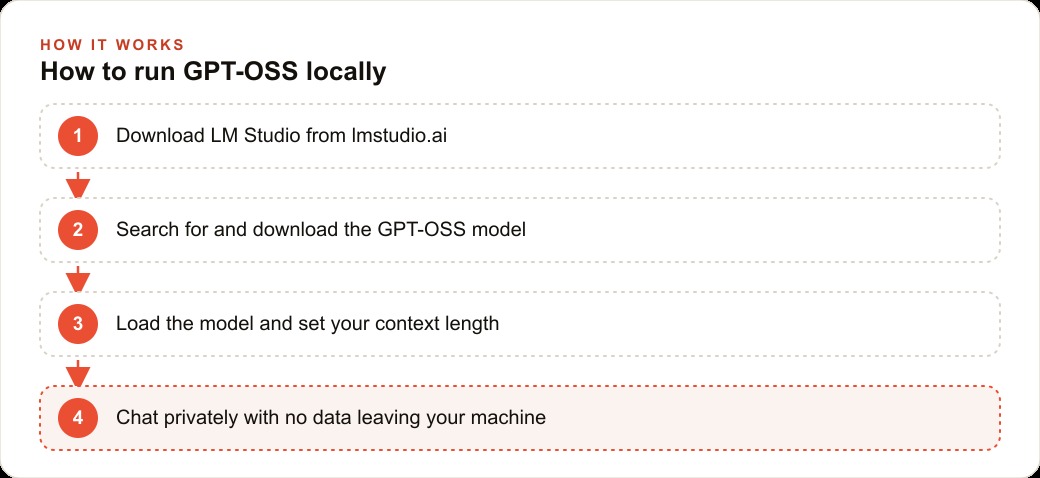
Both models support chain-of-thought reasoning that is visible in real time as the model generates its response. Reasoning effort is adjustable from low to high depending on the complexity of the task, allowing the user to balance speed against depth without paying more for higher reasoning, because there is no per-token cost. The context window is 128,000 tokens, sufficient for processing long documents, full codebases, or extended multi-turn conversations without losing earlier context. Setup via LM Studio, a free desktop application, requires no command-line work. LM Studio also includes a JavaScript sandbox for running and testing generated code without leaving the application.
The 120B Version's Performance Closes the Gap That Previously Justified Subscription Costs
Performance benchmarks are imperfect proxies for real-world usefulness, but the specific comparison here is relevant to professional users. Scoring near o3 and o4 Mini on math, coding, and reasoning benchmarks means the 120B model is operating in the range of what professionals have been paying OpenAI API prices to access. That changes the decision calculus for a specific class of user: the one who uses AI consistently for high-value professional tasks and has been paying monthly because there was no capable local alternative.
This is not a claim that the open model is equivalent to the closed API model on every task. There are task categories and fine-tuning details where the API model maintains an edge. But for the large subset of professional use cases that drive the majority of organizational AI spend (drafting, reviewing, summarizing, generating and debugging code, analyzing documents, answering domain-specific questions), the performance gap between the 120B open model and the API models it benchmarks against is now small enough that it does not justify the cost difference for most high-frequency users.
The chain-of-thought visibility is meaningful specifically for professional and regulated use cases. In a legal or financial context, an AI response that shows its reasoning process in real time is more auditable than one that delivers a conclusion with no visible path. The ability to observe the model's deliberation as it happens, and to interrupt or redirect it before the final output is produced, gives practitioners a level of process visibility that most API-served models do not expose in their standard interfaces.
Adjustable reasoning effort is a practical production feature. For routine summarization tasks, low effort produces faster output without quality loss. For complex analytical tasks requiring the integration of multiple documents or the identification of subtle inconsistencies, high reasoning effort lets the model apply more of its inference capacity to the problem before committing to an answer. Being able to tune this locally, without paying more per token for deeper reasoning, changes the economics of using the model across the variable workloads that characterize most professional environments.
Local Deployment Gives Organizations Privacy and Fine-Tuning That Subscriptions Cannot Replicate
When data goes to a cloud API, it leaves the organization's network. For most consumer use cases, this is an acceptable tradeoff. For organizations handling client financial records, protected health information, legal discovery documents, proprietary research, personnel data, or any category of information governed by regulatory or contractual obligations, sending that data to an external API is either prohibited outright or requires agreements that add cost and administrative friction.
A locally running model eliminates this exposure structurally. The data never leaves the machine. There is no API transmission log at the provider level. There is no data retention policy to audit or explain to clients. The compliance conversation is simpler because the technical architecture does not create the risk that would otherwise need to be managed.
Fine-tuning is the second advantage that cloud subscriptions cannot replicate. Apache 2.0 allows fine-tuning the open model on your own domain-specific data. An accounting firm could fine-tune on its own workpapers, correspondence templates, and tax research documents, producing a model that generates output reflecting the firm's specific terminology, document structure, and analytical conventions rather than the general-purpose style of the base model. A law firm could fine-tune on its own contract language, pleadings, and client communication style. A healthcare organization could fine-tune on its own clinical protocols and documentation standards.
Fine-tuning on cloud models is either unavailable for the most capable versions or restricted in terms of what training data can be used and how the resulting model can be deployed. Fine-tuning an open-weight model you run locally is limited only by your hardware and your training dataset. The proprietary knowledge an organization has been accumulating for years can become part of the model's behavior, creating a capability advantage that is not available to competitors who rely on generic cloud access.
The Real Disruption Is the Elimination of the Recurring Cost Structure for High-Capability AI
Cloud AI pricing is structured as a recurring cost that scales with usage. Every increase in adoption, every new team member who integrates AI into their daily workflow, every additional use case added to the organization's AI practice, increases the monthly bill. This creates a specific tension for organizations trying to scale their AI use: the value increases with adoption, but so does the cost, and at some point the cost requires active management that limits further adoption.
The local model inverts this. The cost is front-loaded into hardware, which is a capital expenditure that amortizes over the life of the equipment. After the hardware purchase, there is no incremental cost for additional usage. The 100th AI query of the month costs the organization exactly the same as the first query. A team that doubles its AI usage in a given month pays nothing more for that doubling.
The LM Studio interface lowers the barrier to this model significantly. Non-technical staff can set up and use the locally hosted model through a desktop application, without command-line work, without developer involvement in routine usage. The organization does not need a dedicated AI engineer to run locally hosted models at this level of capability. That change in the setup barrier is as significant as the change in cost structure, because it extends the local model option to organizations that previously would have found self-hosting impractical.
An Accounting Firm Eliminating $300 Per Month in Cloud AI Costs: What the Math Looks Like
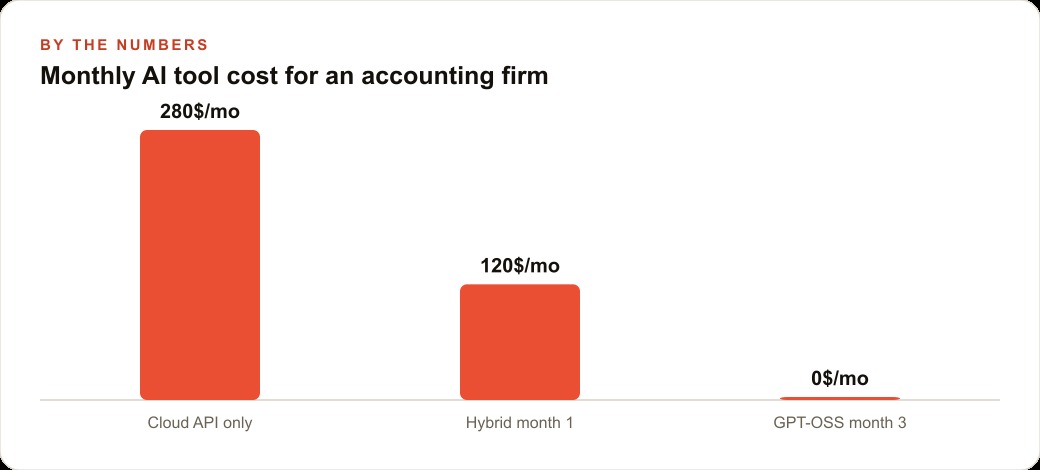
Consider a 12-person accounting firm that has integrated AI into its daily workflow over 18 months. The team uses cloud AI for drafting client communications, reviewing tax research documents, summarizing lengthy IRS guidance publications, generating first-draft responses to client questions, and reviewing code in the firm's internal reporting tools. Current API usage runs to approximately $300 per month, spread across staff members who access the tool individually for their own workflows.
The firm handles tax documents, financial statements, and personal financial information for its clients. Sending this data to an external API is permitted under the firm's current engagement agreements, but two clients have raised questions about data handling in the past year, requiring explanation of the cloud provider's data retention and processing policies. The managing partner has been looking for an alternative that removes this friction.
The 120B model requires a workstation with approximately 80GB of GPU memory. A configuration using two current-generation high-performance GPUs at 48GB each covers this requirement. Including the workstation itself, the total hardware cost runs approximately $6,000. Installation via LM Studio for a non-technical staff member familiar with desktop software takes two to three hours following current setup documentation.
At $300 per month in current API costs, the hardware investment pays back in 20 months. After that point, the firm's AI infrastructure cost drops to near zero, adjusted only for electricity consumption and eventual hardware refresh.
The fine-tuning opportunity adds a compounding advantage. After the first year of local operation, the firm fine-tunes the model on its own workpaper formats, client communication templates, and frequently used tax research summaries. The resulting model produces output that requires substantially less editing than the base model, reducing the average time a staff member spends processing AI output from approximately eight minutes per task to approximately four minutes per task. Across ten staff members using the tool for an average of three tasks daily, that four-minute reduction represents two hours of recovered staff capacity per day. At a billing rate of $150 per staff hour, the capacity recovery is worth $300 per day, or roughly $75,000 per year, for an organization where that time goes toward billable client work.
The firm's response to the two clients who raised data handling questions also becomes straightforward. The answer is now a single sentence: the firm runs its own AI model on its own hardware, and no client data is transmitted to any external service for AI processing. That answer closes the conversation. It also represents a meaningful differentiator when prospective clients in regulated industries compare service providers.
The release of GPT-OSS is significant not primarily as a performance story but as a structural one. The question of whether serious AI capability requires a cloud subscription just received a definitive answer. For organizations that have already demonstrated consistent high-value use of AI tools, the economics of running that capability locally are worth calculating this week. The accounting firm scenario illustrates a principle that applies across regulated industries. When the primary value of AI comes from analysis of proprietary internal data, and when that data carries confidentiality obligations that create friction with cloud transmission, local deployment is not just a cost decision. It is a quality decision. The model that sees the complete, unredacted document produces better analysis than the model that sees the sanitized version. Local deployment is what makes the complete document available without the confidentiality friction.
GPT-OSS did not change what AI is capable of. It changed who owns the infrastructure that delivers that capability. Organizations that choose to own that infrastructure now, while the setup cost is declining and the model quality is competitive with leading paid alternatives, will find the decision increasingly easy to justify as usage scales. The calculus is simpler than it first appears. The scale of the open-weight model release makes that calculus worth running now.
That is exactly what we do at AI DOERS. Book a private 30-minute call with Madhuranjan Kumar and we will map the fastest path to it for your specific business.
Book your call →
Madhuranjan Kumar
Madhuranjan Kumar brings 20 years of performance-marketing experience and has managed over $200 million in Facebook ad spend for brands across the United States and beyond. His expertise spans the full modern marketing stack: Meta, Google Ads, TikTok, email automation, CRM, and the websites that hold it together. At AI DOERS he turns that track record into lead-generation systems for businesses across every industry.