
Deep Research Goes Free, Descript Edits Video Autonomously, and Argil Creates Your AI Avatar: What Tutoring Centers Need to Know
Deep research that previously required a subscription is now free. An AI that creates your video avatar from a two-minute recording is now accessible. For a tutoring center that needs to produce educational content at scale, these announcements change the economics.

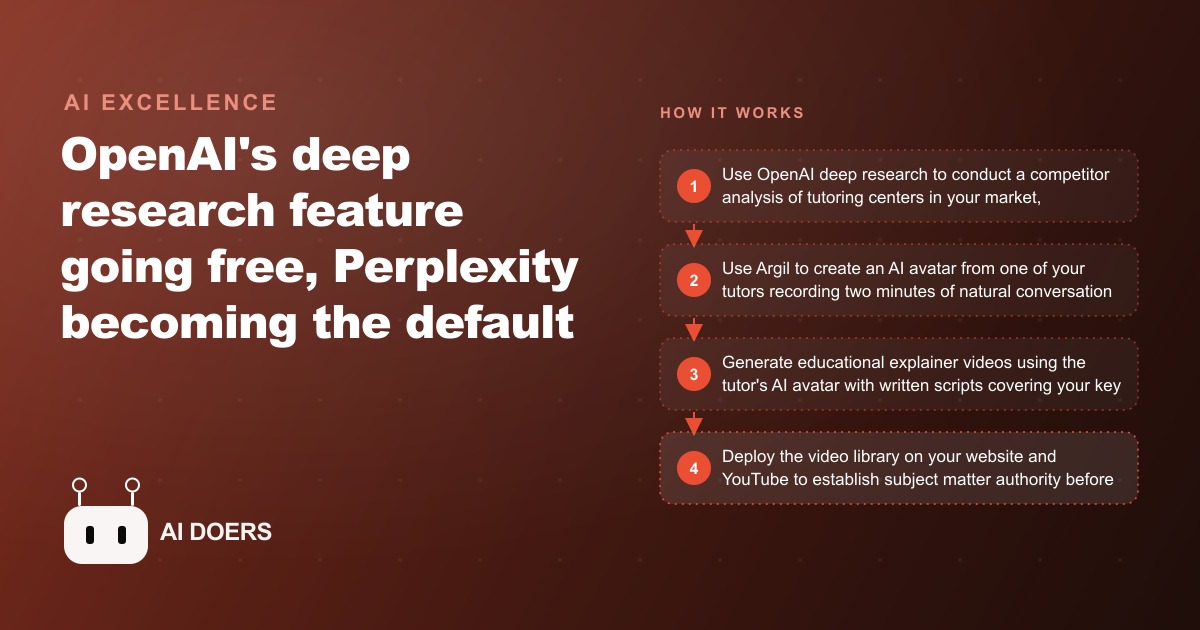
Here is a position that will annoy people who love a busy news week. Out of the five AI announcements everyone shared, four of them do not matter for your business, and the one that got the quietest reaction is the only one that actually changes your economics. Deep research going free, an AI avatar built from a two minute recording, Perplexity landing on the iPhone, Grok gaining vision, Descript editing video on its own. I am Madhuranjan Kumar, and I think the honest reaction to a week like that is not excitement. It is discipline, because a pile of shiny launches is exactly how small businesses end up busy, dazzled, and no further ahead than they were a month ago.
Let me argue the case, because the contrarian read here is not cynicism. It is a claim that most of the value in this week is concentrated in one place, and that spreading your attention evenly across all five is the surest way to capture none of it.
The quietest announcement is the one that changes your math
Deep research going free is the story, and it got a fraction of the noise the avatar demos got. That is exactly backward. Deep research is the feature where an AI conducts multi source web research on its own, visits many pages, synthesizes what it finds, and returns a structured report with citations pointing at where each fact came from. It is a different thing entirely from a normal chatbot prompt that answers from memory. Until this week it sat behind a paid subscription. Now any owner with a free account can run it.
The reason this matters more than a new avatar is that research, not talent, was the thing quietly rationing your strategic decisions. Consider a tutoring center owner who wants to reprice sessions. Doing it responsibly means knowing what every competitor within fifteen miles charges for one on one, group, and test prep, which subjects and grade levels they push, and what unique angle each one claims. That is three or four hours of tab hopping, and because it costs three or four hours, it usually does not happen. The owner guesses instead. Free deep research turns that afternoon into a single request and a thirty minute read of a comparative table. The pricing decision that used to be a guess becomes an informed one. Multiply that across service expansion, positioning, and marketing calls, and the constraint that lifted this week was not creativity. It was research bandwidth, and that is the least glamorous and most valuable thing to free up.
The avatar hype is the least important story here
Now the unpopular half. The Argil style avatar, where you record two minutes of yourself and generate unlimited videos of a synthetic you, got the biggest reaction and deserves the smallest. Not because the technology is bad. It is genuinely useful for scaling video across instructors who hate being on camera. But it is a production tool, and production was never the bottleneck for most small businesses. The bottleneck was knowing what to make and whether anyone wanted it.
An avatar that lets you generate fifty videos does not help if you have not figured out which fifty topics deserve a video, and figuring that out is a research problem, which loops right back to the announcement everyone under weighted. This is the pattern that repeats every busy news week. The tool that makes it easy to produce more content gets the applause, and the tool that tells you what is worth producing gets ignored, even though the second one is upstream of the first. Produce faster on the wrong topics and you have simply automated waste. That is why I would tell a tutoring center to spend its first week on deep research, not on recording avatar footage, even though the footage feels like more visible progress.
Distribution shifted more than the models did
The Perplexity on iPhone news deserves a mention, but for a reason most coverage skipped. It is not really a model story. It is a distribution story, and distribution is where the money moves. Apple offering Perplexity as a default assistant puts an AI answer engine in front of a huge slice of users who would never have gone looking for one. Those users increasingly ask a question and get a synthesized answer that names specific businesses, instead of a list of blue links to click through.
That changes what it takes to get found. If a student asks an assistant for tutoring near them and the assistant answers in prose, you only appear in that answer if your web content states the extractable facts plainly. A page that clearly says it serves grades three through twelve in math, science, and test prep, with sessions starting at a specific price in a specific city, can be pulled into that answer. A page that buries all of that in a stock photo and a vague tagline cannot, no matter how well it once ranked. This is why the content foundation you build feeds directly into SEO and organic search, because the same clear, factual pages that answer engines quote are the ones traditional search rewards too. The distribution changed. The response is not a new tool. It is clearer writing about what you actually offer.
Notice what this does to the popular advice to chase every new platform. The instinct when Perplexity rises, or when Grok gains vision, or when any new surface appears, is to go create a presence on it, and that instinct is mostly wasted motion. The thing that gets you surfaced across all of these engines is the same underlying asset: clear, factual, well organized content about what you do. Build that once and it works everywhere an answer engine looks, including the ones that have not launched yet. Scatter your effort building a bespoke presence on each new platform and you spread thin across surfaces that will keep changing. The contrarian move is to ignore the platforms and invest in the asset they all draw from, because the asset is durable and the platforms are not. A tutoring center that writes plainly about its grades, subjects, prices, and results is preparing for the next answer engine automatically, without ever thinking about it. This is the unglamorous work that no news week will ever celebrate, precisely because it is not a launch. It is a page rewritten to say clearly what a parent needs to know, and it quietly outlasts every tool that made headlines this week.
The constraint was never talent, and this is the proof
Pull these threads together and a single argument emerges. For years the story we told about small business marketing was that big companies win because they have bigger teams and better talent. That gap is closing fast, because the same research and reasoning that used to sit behind an agency retainer now sits behind a well run set of Facebook and Instagram ad campaigns and a tighter Google Ads account that a single owner can direct in an afternoon. This week quietly disproves a chunk of that. A tutoring center owner now has, for free, the research capacity that used to require an analyst and the content production capacity that used to require a studio. The talent gap did not close because owners got smarter overnight. It closed because the tools that were rationed by price and time became abundant.
But abundance creates its own trap, and this is the core of my contrarian position. When research and production both become cheap, the scarce resource becomes focus. Everyone gets the same free deep research and the same cheap avatar videos, so the advantage no longer comes from access. It comes from the discipline to point those tools at one clear objective and see it through, while your competitors sample all five announcements and finish none. The tools equalized. Judgment did not, and judgment is now the whole game.
A tutoring center that bets on one thing instead of five
Let me make the argument concrete with an unnamed tutoring center that has five instructors covering math, science, English, and test prep for grades six through twelve. The scattered version of this business tries everything the news week offered: it starts recording avatars, experiments with Grok on social, plays with Descript, and skims a competitor or two. Three months later it has a folder of half finished videos and nothing shipped. The focused version does the opposite, and here is how I would run it.
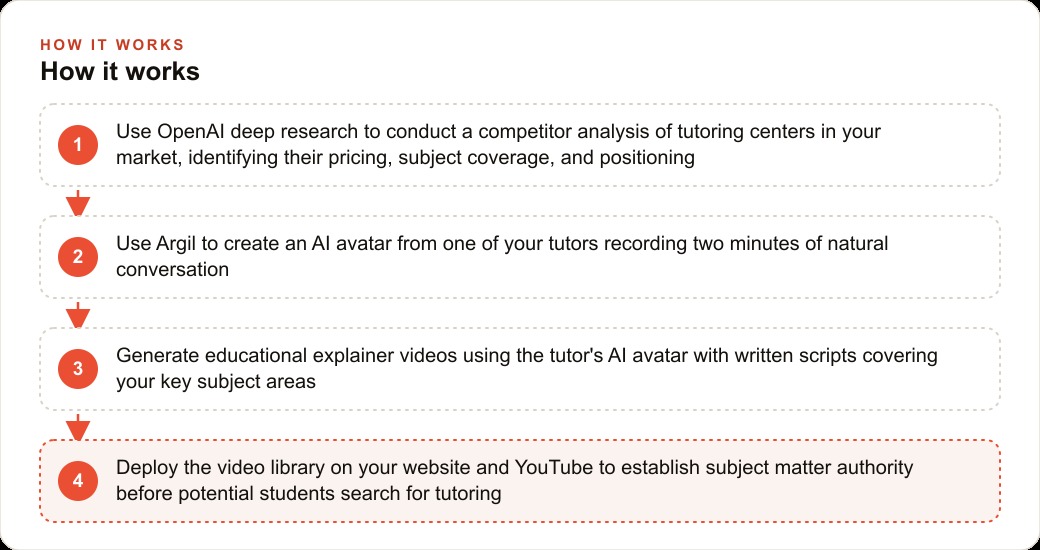
Week one is research only. The owner uses free deep research to produce two things: a comparative analysis of eight competing centers, and a ranked list of the specific questions parents and students actually ask before choosing a tutor, pulled from review sites and forums. That is the whole week, and it is the most valuable week, because it decides everything downstream. Weeks two through four turn that research into a plan. The competitor analysis surfaces five honest positioning statements, and the question list becomes a content map, where each instructor is assigned six short videos that answer the exact queries students type, like how to solve a system of equations in algebra two.
Only in month two does production start, and only then do the flashy tools earn their place. Each instructor records one two minute reference clip, then generates the thirty scripted videos as avatars, reviewing and lightly editing each one. Suppose the review and edit runs fifteen minutes per video. That is seven and a half hours of human time for thirty pieces of content, published to a channel organized by subject and grade, embedded on the matching pages of the site, and pushed to social. Notice that the tools everyone hyped show up last and take the least time. The research that nobody hyped came first and determined whether any of it would work.
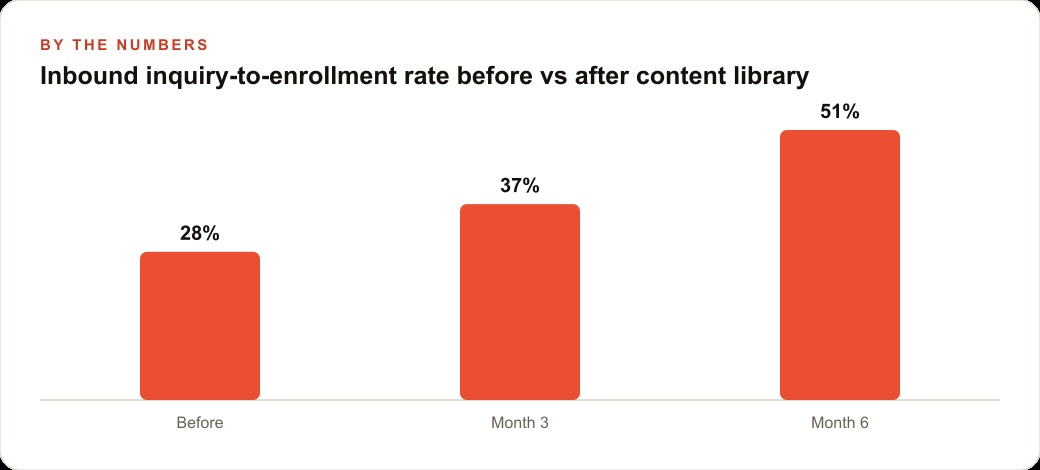
The illustrative payoff is worth stating carefully, as an example rather than a promise. Say the center currently converts roughly a quarter of its inbound inquiries into enrolled students. Content that answers real questions tends to pre qualify the people who reach out, because they arrive having already learned something from you and having already decided you know your subject. It would not be surprising for a center like this to see its inquiry to enrollment rate drift upward over a couple of quarters as more of its inbound traffic comes warm from that content. The mechanism is simple and unglamorous: better research produced better topics, better topics produced content that attracts the right people, and the right people convert. No single tool did that. A sequence did.
The discipline that separates using these tools from collecting them
So what do you actually do with a week like this? The contrarian answer is to deliberately ignore most of it. Pick the one announcement that touches your real constraint, which for most small businesses is research and clarity rather than production volume, and go deep on that alone until it produces something shipped. For the tutoring center that means running deep research on the ten questions parents ask most, spending thirty honest minutes reading the output, and identifying which of those questions your website currently answers badly. Then you write scripts for the three worst offenders and test exactly one avatar video before committing to a library. One video tells you the quality and the time cost, which is all you need to decide whether to scale.
Everything else from the week can wait, and most of it can wait forever without hurting you. Grok vision, agentic video editing, the default assistant news, these are worth knowing about and not worth chasing this quarter. The businesses that win the next year will not be the ones that adopted the most tools. They will be the ones that adopted the fewest tools with the most intent, and finished. If you want help designing that focused system for your center, the research process, the content that answer engines and search both reward, and the enrollment path the content feeds into, that is exactly the kind of build I take on, and a short conversation is the fastest way to see how it would work for you.
That is exactly what we do at AI DOERS. Book a private 30-minute call with Madhuranjan Kumar and we will map the fastest path to it for your specific business.
Book your call →
Madhuranjan Kumar
Madhuranjan Kumar brings 20 years of performance-marketing experience and has managed over $200 million in Facebook ad spend for brands across the United States and beyond. His expertise spans the full modern marketing stack: Meta, Google Ads, TikTok, email automation, CRM, and the websites that hold it together. At AI DOERS he turns that track record into lead-generation systems for businesses across every industry.