
OpenAI's Code Red Shows the AI Race Is Now About Experience, Not Just Raw Smarts
After Gemini 3 surged, OpenAI declared a code red to fix the everyday experience. Here is what that shift means and how I would put today's good enough models to work for a brokerage.

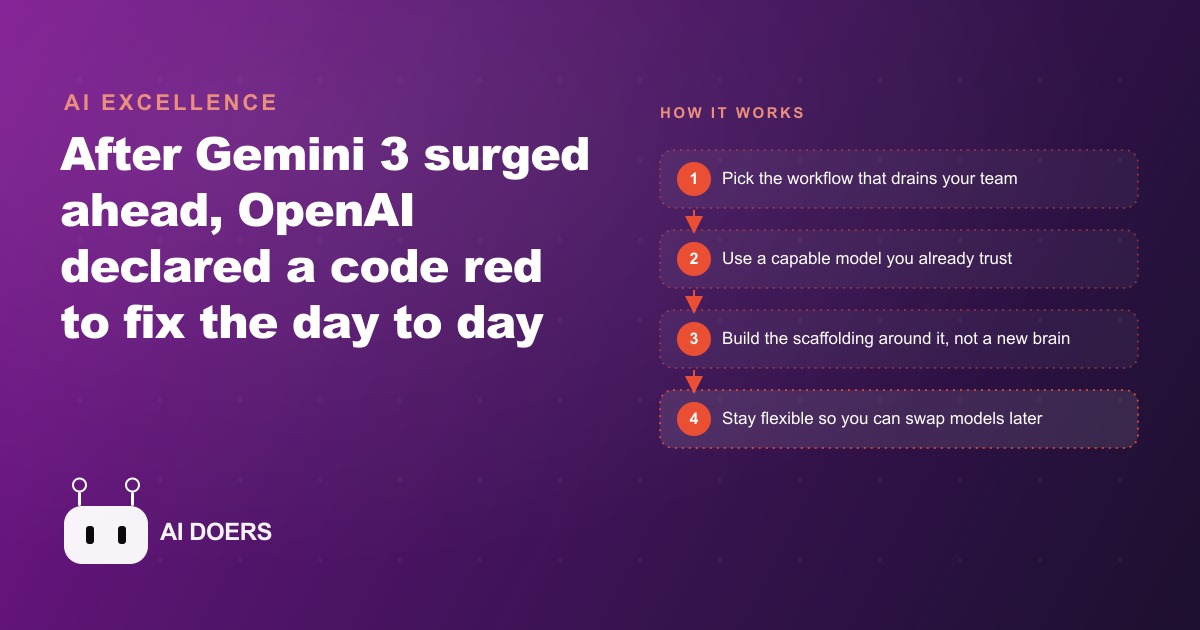
OpenAI declared an internal code red after Gemini 3 surged ahead on benchmarks and captured the attention of the industry, and the detail that matters most is what the emergency push was actually about: not making the model smarter, but making the everyday experience of using ChatGPT better. I am Madhuranjan Kumar, and that distinction is the whole story for any business that is still waiting to find out which AI company wins before deciding how to build.
The race moved while everyone was watching the benchmark scores
For the past three years, the primary frame for evaluating AI progress was benchmark performance: which model scored highest on which standardized test, which lab posted the best number on a curated evaluation set. Labs published results. Journalists covered them. Businesses used them to make purchasing decisions. The implicit assumption was that raw intelligence, as measured by those benchmarks, was the thing that differentiated one model from another and determined which tool was worth adopting.
That assumption held for long enough to shape the entire conversation. It no longer holds. When OpenAI went into emergency mode in response to Gemini 3, the focus of the emergency was not the benchmark gap. It was the product experience: the speed of responses, the reliability of the interface, the quality of the everyday interactions that regular users have with ChatGPT dozens of times a week. The code red was about experience, not capability. And that shift, from capability competition to experience competition, has already happened. The question is whether the businesses using AI tools have noticed.
The shift matters because it changes what the right question is when you evaluate an AI tool for your workflows. The right question is no longer which model scores highest on a synthetic evaluation designed by researchers. The right question is which tool your team actually uses, reliably, without friction, every day. Those two questions have different answers, and the gap between them is where most businesses are leaving value on the table.
Google's full-stack position revealed something a benchmark chart never could
Google's position in the AI market is worth understanding specifically, because it is the context that triggered OpenAI's alarm and because it illustrates what competitive advantage in AI actually looks like when it is durable rather than temporary.
Google holds a position that no other competitor has been able to assemble. It has a frontier model in Gemini. It has its own custom silicon through the TPU program, meaning it does not pay the same compute costs that every other lab pays to run and train models. It has revenue at a scale that funds sustained research spending without requiring continued fundraising. It has access to data from Search, Gmail, Maps, YouTube, and Chrome at a scale that represents a genuine structural advantage in training. And it has had top AI researchers shaping the field since before large language models were the dominant paradigm.
What the Gemini 3 surge revealed is that Google was assembling all of those pieces quietly while the conversation focused on benchmark comparisons between ChatGPT and whatever the newest Claude or Gemini version happened to be that month. A benchmark chart shows which model scored best on a test. It does not show which organization has the infrastructure, the compute economics, the data position, and the research depth to sustain improvement over a decade. Those are different measurements, and Google's full-stack position looks different under the second measurement than under the first.
The lesson for any business is not that you should switch to Gemini. The lesson is that the leader in this race can change in a matter of months, as it did when Gemini 3 appeared, and any business that has built its operations tightly around one provider's specific interface is going to feel that change as a disruption rather than an upgrade. The code red is a reminder that the competitive landscape is genuinely unsettled. The rational response is to build in a way that accounts for that uncertainty rather than betting on a permanent winner that does not yet exist.
The models that matter to your business are already good enough, and that changes everything
Several leading AI researchers now argue that simply scaling models up, making them larger and feeding them more compute, is running into limits. The next gains in capability are more likely to come from new architectures and training approaches than from brute-force size increases. This argument is contested and the field moves fast. But one thing is not contested: for almost every real business task that a small or medium business would consider automating, the models available today are already good enough.
This is a liberating fact, not a discouraging one. It means you do not have to wait. The model that would handle your lead response workflow, your content drafting, your customer support triage, or your internal reporting is available right now, through multiple providers, at pricing that has been falling for two years. The question of which model is technically best has already been superseded by the question of which workflow you are going to build first.
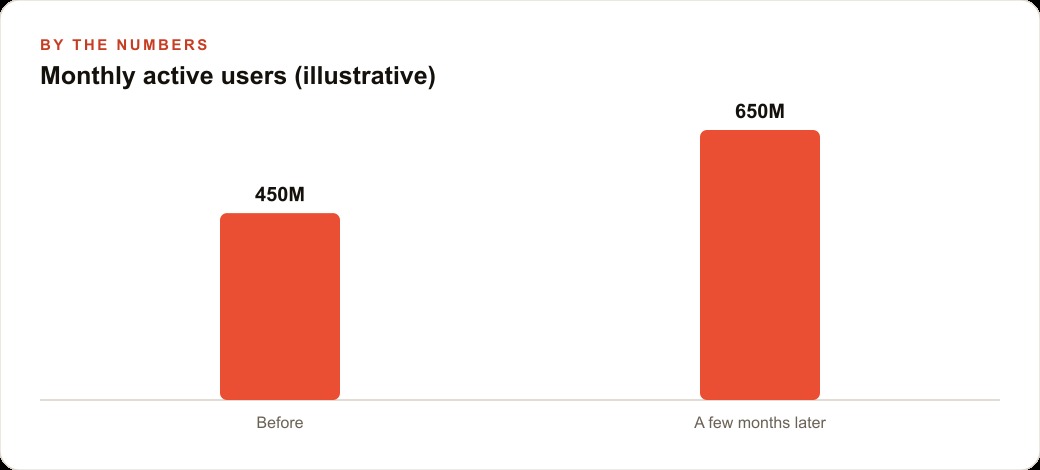
The experience layer is where competition has moved. Speed, reliability, memory of prior context, integration with the tools you already use, and the quality of the day-to-day feel are now the variables that determine which AI product your team will actually use versus which one they will open once, find frustrating, and abandon. ChatGPT maintains its position despite competition not because it is definitively the most capable model on the market but because it became the habit for hundreds of millions of users, and habits have strong inertia. That inertia is not unbreakable. Gemini's surge proved that. But it is real, and it takes a genuinely better experience to dislodge it, not just a better benchmark score.
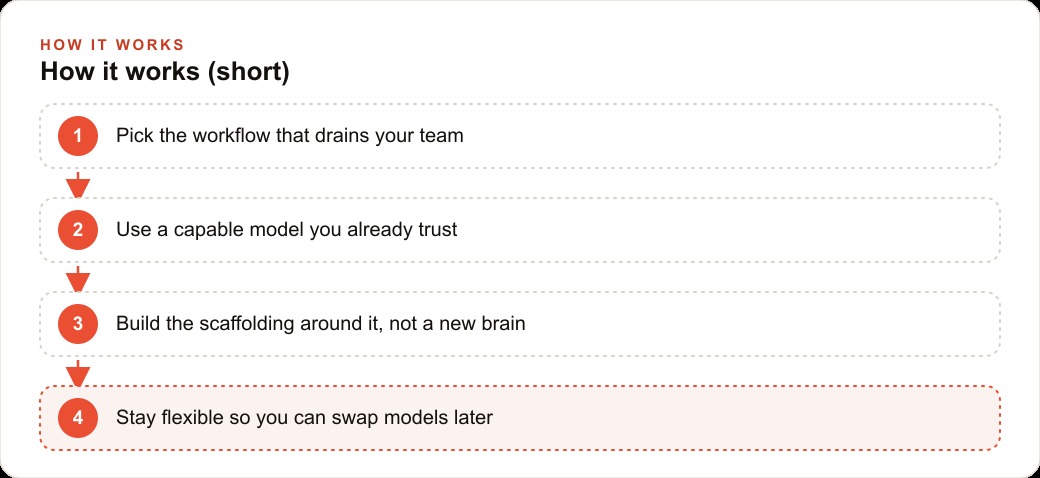
For a business owner, the practical takeaway is this: the model inside any well-built workflow is now close to a commodity, and the value is in the scaffolding around it. The connections to your CRM, your email, your calendar, your customer data. The reliability of the daily flow. The quality of the templates that make the output sound like your business rather than a generic assistant. The measurement layer that tells you whether the setup is producing results. Those are the variables that determine whether an AI workflow delivers real value, and none of them depend on the model being slightly more or less capable than its competitor this month.
Scaffolding you control is the durable competitive move in an unsettled market
The strategic implication of the code red, and of the broader race it represents, is about architecture. If the model inside any AI workflow can change without notice when the competitive landscape shifts, and the last twelve months proved that it can, then the right design is one that treats the model as a replaceable component rather than a permanent foundation.
A tightly coupled workflow bets on one provider. The connections to your tools use one provider's specific API format. The prompt templates reference one provider's specific behaviors and capabilities. When that provider changes its pricing, deprecates a feature, or falls behind a competitor in a capability you depend on, you face a rebuild. A loosely coupled workflow abstracts the model choice into a configuration layer, so changing the model underneath means editing one setting rather than rewriting the whole system. That architectural discipline is the difference between a workflow that compounds in value as models improve and one that becomes a liability each time the landscape shifts.
The real estate brokerage case makes this concrete. For a brokerage that wants to use AI in its lead response and content workflows, the build I would recommend has two primary components and one governing design principle.
The first component is lead response speed. Incoming inquiries from the website and the major listing portals trigger a response within minutes, with a warm personalized first message that asks the right qualifying questions and either books a showing or flags the hottest leads for agent review. Speed of response is what wins in real estate: brokerages that reply within minutes convert inquiries at a measurably higher rate than those that respond hours later. An AI-powered workflow makes that speed automatic and consistent, regardless of whether the best agent is at their desk when the inquiry comes in.
The second component is the content treadmill. From the basic facts of a property, the workflow drafts a polished listing description, a set of social posts, and a follow-up email sequence for the past-client list, all in the brokerage's established voice and ready for an agent to review and approve. The review step is not optional. The agent reads the draft, adjusts the details the AI could not know from structured data alone, and sends it. What the AI does is produce the first draft in seconds rather than the agent spending 30 to 45 minutes per listing on a blank page.
The governing design principle is model agnosticism. The lead response workflow connects to the CRM through a configuration layer that is not tied to any single provider's API. The content templates are stored in the brokerage's own system, not in a provider's interface. When one company pulls ahead, or when pricing shifts enough to make switching worthwhile, the brokerage swaps the model in the configuration without touching the workflow itself. The scaffolding stays. The model is replaced.
There is also a parallel lesson about habit and trust that the code red story makes visible. ChatGPT became the default verb for AI the way Google became the default verb for search, because it was the first experience most people had with a capable large language model, and first experiences create habits that persist long after alternatives appear. That inertia is not permanent. The Gemini surge proved that a genuinely better product experience can shift users and capture attention. But it is real, and it means the businesses that built their workflows into ChatGPT-specific behaviors now face a cost to migrate that teams without those habits do not. The cost accumulates across every model update, every pricing change, and every interface redesign. Building loosely from the start is how you avoid paying that migration cost repeatedly as the landscape continues to shift. The code red is OpenAI's version of that cost made visible at the lab scale. The business equivalent is a workflow that has to be rebuilt every time the competitive landscape shifts.
Before deploying either component, I would establish a baseline on two numbers: time from inquiry to first reply, and inquiry-to-showing conversion rate. Without a baseline, there is no way to know whether the workflow is producing results or just adding complexity. With a baseline, a four-week measurement period after deployment tells you whether the investment is compounding or coasting, and which element of the workflow to adjust first if the numbers are not moving.
A realistic estimate for a five-agent brokerage running both workflows: each agent recovers two to three hours per week that previously went to inbox management and listing copy. Over a team of five, that is ten to fifteen hours per week returned to showings and client conversations, the parts of the job that actually close transactions. The workflow cost, in model access and hosting, runs to a few hundred dollars per month. The recovered time, at any reasonable brokerage's economics, is worth multiples of that monthly cost.
The code red is not a crisis for the business that has not yet committed to one provider. It is, in fact, the clearest possible argument for starting today rather than waiting. It is an argument for building now, building with loose coupling, and measuring the results. The models are good enough. The competition between the labs is working in your favor. The edge is in the scaffolding you build around the model, and the scaffolding you build today is yours to keep and improve regardless of which benchmark chart changes next month.
That is exactly what we do at AI DOERS. Book a private 30-minute call with Madhuranjan Kumar and we will map the fastest path to it for your specific business.
Book your call →
Madhuranjan Kumar
Madhuranjan Kumar brings 20 years of performance-marketing experience and has managed over $200 million in Facebook ad spend for brands across the United States and beyond. His expertise spans the full modern marketing stack: Meta, Google Ads, TikTok, email automation, CRM, and the websites that hold it together. At AI DOERS he turns that track record into lead-generation systems for businesses across every industry.