
OpenAI's App Store Moment, and How a Small Business Actually Uses It
OpenAI shipped Apps SDK, Agent Kit, ChatKit, and a much stronger Codex in a single push. Here is what each one really does, and how I would put them to work for a normal local business instead of panicking about the headlines.

The studio handled branding and identity work for small businesses, ten people, good at design, always behind on everything else. I want to walk through what happened when the team adopted the ChatGPT operator integrations during the first month they were available, because the story is more honest and more useful than most of what gets written about AI adoption at small companies.
Chapter One: The Problem the Team Had Before OpenAI Shipped the Apps SDK
Before the integrations existed, the studio's biggest operational drag was not design work. Design was what the team was good at and what clients paid for. The drag was everything surrounding the design work: client onboarding questions that arrived at all hours, status requests that pulled the project manager out of actual project coordination, brief intake forms that clients filled out incompletely and had to be followed up by hand, and the recurring task of pulling together a weekly status summary for each active client so everyone knew where things stood before their check-in calls.
The owner had estimated, informally, that between the project manager and one of the senior designers who had gradually become a second contact point for client messages, the studio was spending close to fifteen hours per week on communication and coordination that did not require any creative skill. This was not a single big problem. It was forty small problems repeated every week: the same questions asked in slightly different forms, the same status updates pulled from the same shared project tracker, the same onboarding checklist sent to each new client with a manually typed accompanying message. The studio was too small to hire a full-time operations manager, too busy to build internal tooling from scratch, and too aware of the time cost to keep absorbing it without doing something about it.
The moment that forced a decision was a specific week in which two clients sent the same question within the same day, a question about where their logos were in the revision cycle, and both waited until the following morning for an answer because nobody was monitoring messages after 6 pm. One of the clients sent a follow-up asking if everything was okay. It was a small thing, but it represented something the owner had been unable to articulate before that week: the studio's responsiveness to routine questions was slower than it needed to be, and the slow response was entirely a function of where human attention was being spent, not a function of actual capacity. The work was there. The information was there. The system for getting the information to the client automatically was not.
Chapter Two: The First Integration the Studio Wired Up
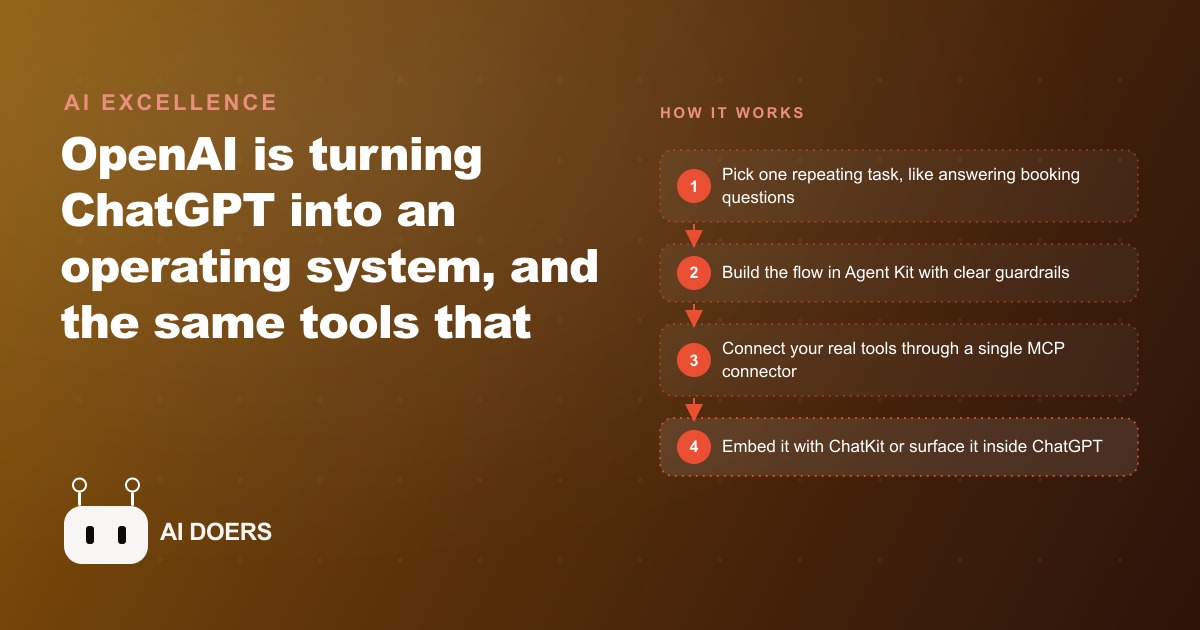
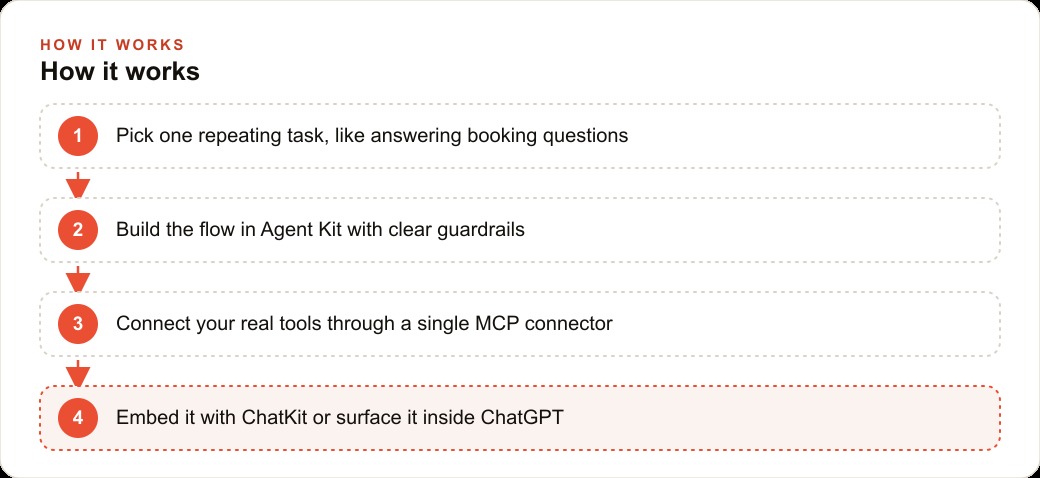
The team started with one specific problem rather than trying to automate everything at once. They built a client-facing assistant using the ChatKit embed on their website, connected through a single MCP connector to their project tracker and their calendar system. The assistant knew the status of every active project because it had read access to the tracker. It knew when the project manager's available windows were because it had read access to the calendar. It could answer the fifteen most common client questions, most of which fell into two categories: where is my project right now, and when is the next check-in scheduled.
Setting up the initial flow in Agent Kit took about six hours over two days. The project manager wrote the guardrails herself, specifying exactly what the assistant should never do: never commit to a deadline that was not already in the tracker, never discuss pricing without flagging for a human, never describe deliverables in terms that could be read as a scope change, never make a promise that required another person to keep it. The guardrail configuration took longer than the integration itself, and it was worth every minute. The team tested the assistant for one full week internally, sending it off-script questions and adversarial prompts, before anyone showed it to a client.
The first week in front of real clients was quiet in the best possible way. Most of the status questions that had previously arrived as Slack messages or emails started arriving through the website assistant instead. They got answered immediately, at any hour, without anyone having to pull the information together or interrupt what they were doing. The project manager noted at the end of that first week that she had answered two direct client messages about project status, down from an average of eleven per week in the previous month. The remaining nine had been handled by the assistant without any escalation. The reduction was sharper than the team had expected from one week of operation, and it held in the second week without any further tuning.
Chapter Three: The Moment It Clicked, Three Weeks In
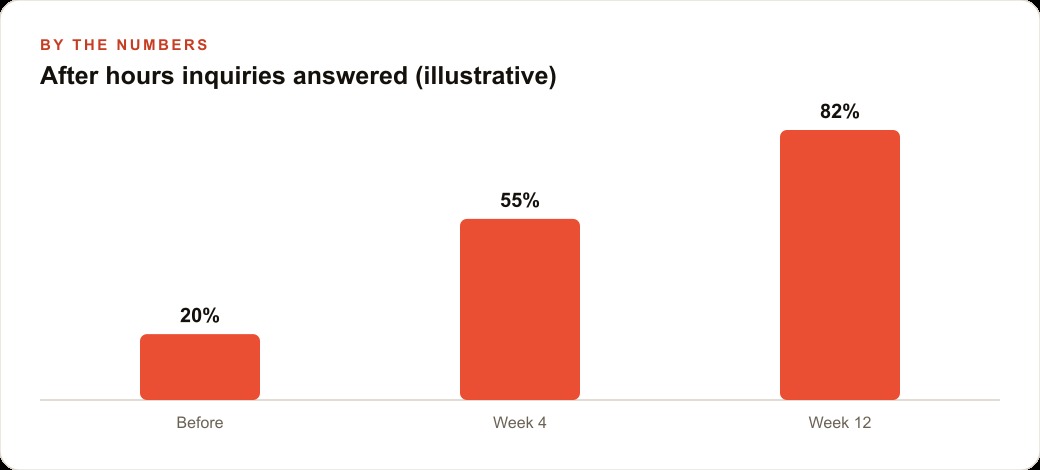
Three weeks after deployment, the assistant handled a situation the team had not specifically planned for, and that was when the owner understood what they had actually built. A client messaged the assistant late on a Thursday evening asking about the status of their logo refinements and whether there was any chance of getting a preview before the weekend. The assistant checked the tracker, found that two of the three logo variants were marked complete and the third was in review, and replied with that exact status. It noted that the project manager would follow up in the morning regarding the preview possibility, and offered the next available calendar slot for a brief call if the client wanted to discuss timing directly.
The client replied positively and said they appreciated the quick response. The project manager saw the exchange the next morning, confirmed with the designer, and sent the two completed variants before 9 am. The client did not need the call. The issue had been resolved overnight without anyone at the studio working late or monitoring messages after hours. The owner's description of this exchange was simple: the assistant bought us a good morning. Before the assistant, that same client message would have sat unanswered until someone arrived and checked their inbox. The client might have sent a follow-up. The project manager would have started the day in reactive mode. A ten-minute task would have consumed thirty minutes of morning context-switching. None of that happened. That was the moment when the integration stopped being an efficiency experiment and started being a permanent part of how the studio operated.
Chapter Four: The Number That Changed the Owner's Mind
At the end of the first month, the project manager pulled together the coordination time log she had kept throughout the experiment. Before the assistant, she was spending an average of fourteen hours per week on client coordination tasks, roughly thirty-five percent of her working week on communication rather than actual project coordination. After the assistant handled the routine status and availability questions, her weekly coordination time had dropped to approximately five hours per week. Nine hours per week freed from work that required no creative or strategic judgment from her, redirected toward actual project management, proactive client communication, and capacity planning for the studio's growth.
The owner ran the number in the simplest possible terms. Nine hours per week at the project manager's effective hourly rate was the equivalent of roughly one full additional project day per week recovered from overhead. The studio had been operating for two years under the assumption that this overhead was just the cost of doing business at their size. The first month's data showed it was a cost that an agent could absorb, cleanly and reliably, for a monthly operational cost in the low double digits of dollars. That realization changed the owner's posture from cautious experimenter to committed builder. Within two weeks of seeing the first month's data, the team was planning the second integration.
The second number that landed hard was the brief-intake completion rate. Before the assistant, about sixty percent of client intake briefs came back complete on the first submission. The rest required at least one follow-up exchange to fill in missing information, each exchange consuming twenty to thirty minutes across both parties. After adding an intake assistant that asked clarifying questions in real time as clients worked through the brief form, the completion rate on first submission rose to eighty-eight percent in the first month. The follow-up time across the studio dropped by roughly three hours per month just from that single change, at no additional build cost because the intake assistant used the same connector and guardrail setup as the status assistant.
Chapter Five: The Limit the Studio Hit at Month Two
Month two revealed where the assistant stopped being useful and where it created a new kind of problem the team had not anticipated. Clients who had complex or sensitive questions about scope, budget, or timeline began using the assistant as their first contact for these topics, and the assistant, following its guardrails correctly, deflected them to a human every time. This was the right behavior. But it created a pattern the studio had not designed for: a growing queue of escalated questions waiting for a human response, all of which had arrived through the assistant first, all of which came with the implicit expectation of the same response speed the routine questions received.
The assistant was fast. That speed was the feature that made it valuable for routine questions, and it was also the feature that raised client expectations for every question, including the ones that required human judgment and could not be answered immediately. The team spent two weeks in month two adjusting the assistant's language for escalated questions, making it explicit in the handoff message that follow-up on complex questions would arrive within one business day rather than immediately. This adjustment removed most of the friction, but it was a genuine limit the team had to actively manage rather than solve.
The second limit was scope. The assistant handled the studio's own clients well because it had structured data to draw from: a project tracker with defined statuses, a calendar with real availability, a service menu with real prices. When a prospective new client arrived through the website with a genuinely open-ended inquiry, the assistant was less useful. It could answer factual questions about services and pricing but could not engage the way a senior person does with a prospect who is still figuring out what they need. The team added a specific path for new prospect inquiries that went directly to the owner rather than through the assistant. Not every conversation belongs in an automated flow, and knowing where the line is matters as much as building the flow itself.
The studio entered month three with a clear picture of what the agent handled well, what required human judgment, and what had measurably changed about the studio's operating capacity. The nine hours per week the project manager recovered did not disappear into vague productivity gains. They went into a specific, planned expansion of the studio's client capacity. Two new clients were onboarded in month three without adding to the coordination overhead that had constrained growth before. That was the concrete business result of one well-placed agent with clear guardrails and honest expectations about what it could and could not do.
What the studio's experiment means for any small service business considering this
The studio's experience maps cleanly onto any small service business where routine client communication and administrative coordination consume a significant share of team hours. The specific details differ between a design studio and a law firm, a marketing agency and a physical therapy practice, but the underlying pattern is the same: a large fraction of client-facing communication consists of answering predictable questions from structured data the business already holds, and that fraction is exactly what an assistant built on the right integrations can absorb reliably.
The most important lesson from the studio's experience is not the headline number, the nine hours per week recovered, but the method that produced it. Starting with one specific, contained, well-defined task. Writing guardrails before testing with real clients, not after. Running internally for a full week before any client interaction. Reviewing logs consistently and using them to improve the instructions rather than assuming the first version was right. These are the steps that made the difference between an assistant that worked reliably and one that would have embarrassed the studio in front of a client. The headline number is the result. The method is the thing worth replicating.
That is exactly what we do at AI DOERS. Book a private 30-minute call with Madhuranjan Kumar and we will map the fastest path to it for your specific business.
Book your call →
Madhuranjan Kumar
Madhuranjan Kumar brings 20 years of performance-marketing experience and has managed over $200 million in Facebook ad spend for brands across the United States and beyond. His expertise spans the full modern marketing stack: Meta, Google Ads, TikTok, email automation, CRM, and the websites that hold it together. At AI DOERS he turns that track record into lead-generation systems for businesses across every industry.