
The New Open-Source King of AI Coding, and Why It Matters for Your Business
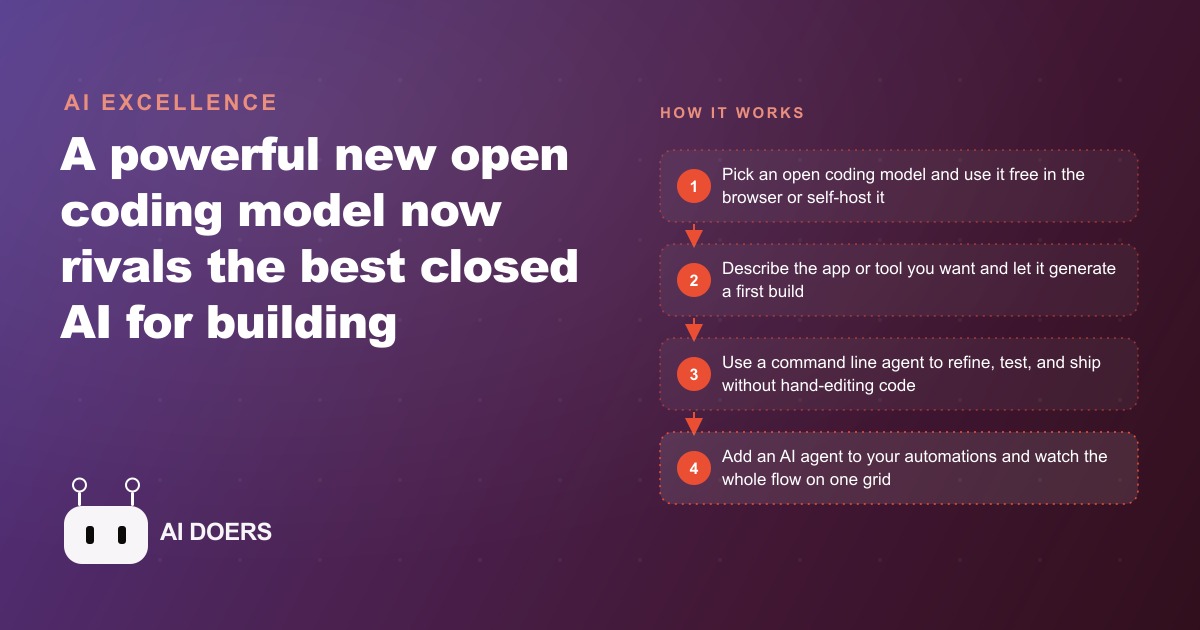
A new open coding model now competes with the best closed AI for building software, and it is free to use in the browser. Paired with command line agents and adaptive automation, it lets ordinary businesses build tools that used to require a developer.

The freelance developer quote for a custom client reporting tool was $8,000. The afternoon spent building the same tool using a CLI agent and an open-source coding model cost $22 in API credits. That difference is not an edge case. It is the new economics of software, and it has arrived faster than most business owners have absorbed.
The cost asymmetry that open source finally resolved
For most of the last decade, the most capable AI models for writing software were closed, expensive, and controlled by a small number of companies. Access came only through APIs at per-token prices the provider set. Running a serious model on your own hardware was not realistic for any team without substantial GPU infrastructure. Open-source alternatives existed but the quality gap was large enough that closed models dominated every serious production use case.
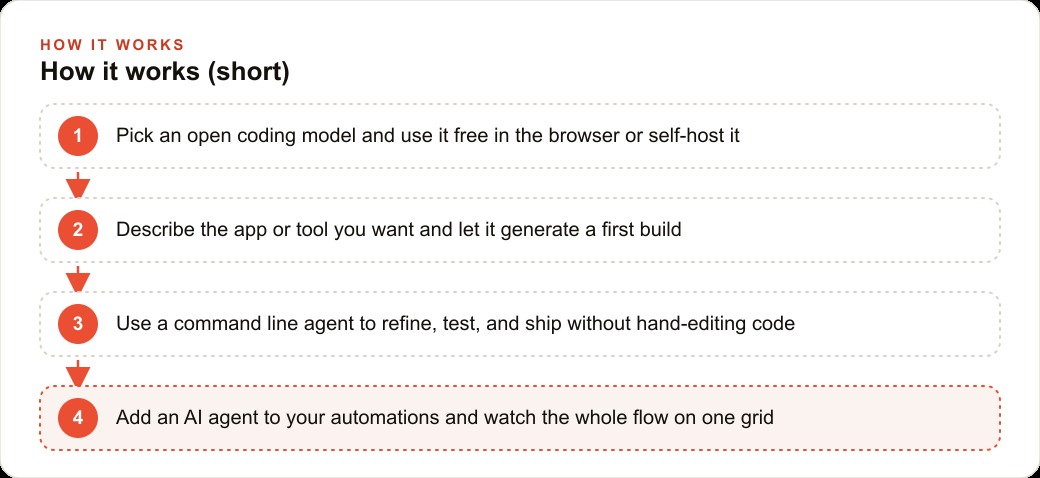
That changed with a new open-source coding model that competes directly with the best closed alternatives on standard software benchmarks. The model is freely usable in the browser for anyone without hardware to run it locally. For teams that want to self-host, the weights are available to download and deploy. That combination of options did not exist at this quality level until recently, and the business implications are immediate.
The cost structure of software changes when a competitive model is open. With closed models, every query accumulates marginal cost. A team iterating intensively on a build, testing variations and regenerating code across dozens of exchanges, pays for every exchange. With an open model self-hosted on internal infrastructure, the marginal cost of additional queries approaches zero once setup is complete. For a high-iteration build, that difference can move total cost from hundreds of dollars to tens.
The asymmetry extends beyond API pricing. Closed models come with terms of service, data handling agreements, and usage policies that govern where your data travels and what you can do with outputs. Open models come with weights you can inspect, modify, and deploy under terms that give you direct control over every part of the operation. That flexibility has legal and operational value that does not appear on an API invoice but matters significantly for any organization with data governance requirements.
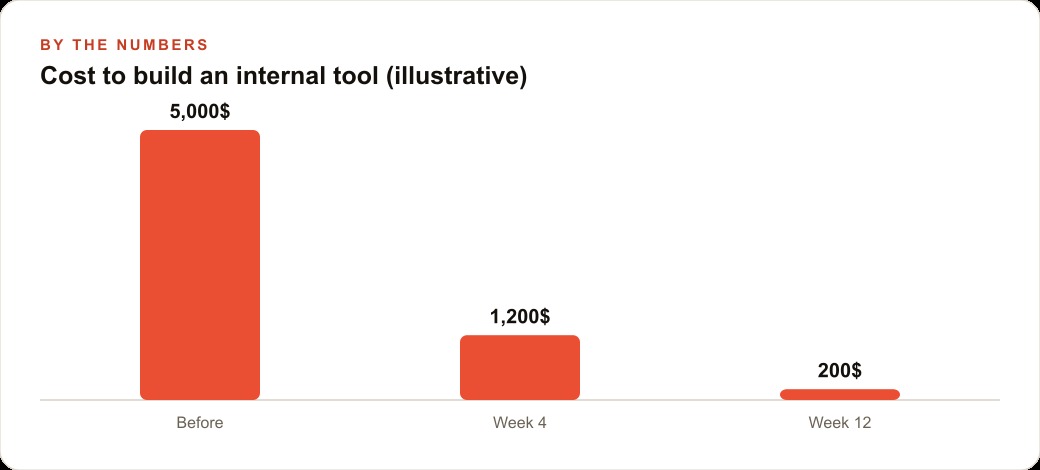
The practical result is a shift in who can build custom software. Projects previously requiring a development budget of $5,000 to $15,000 and weeks of developer time can now be approached by a non-technical business owner with a clear problem description, a browser, and a few focused hours. The quality of the output has reached the point where it holds up in real business use, not only in controlled demonstrations.
Why open versus closed is the wrong frame for most business decisions
The competitive headline when an open-source model matches closed performance is that open wins and closed loses. That framing makes compelling technology journalism and poor operating strategy.
Open and closed models coexist usefully in every serious workflow. Closed models offered through major API providers deliver managed reliability, support agreements, and deep integration with enterprise tooling businesses already use. Open models deliver self-hosting, privacy isolation, fine-tuning for domain-specific tasks, and cost efficiency at sustained scale. Evaluating them is not a philosophical exercise. It is selecting the right capability for a defined job.
The more useful frame than open versus closed is capability per dollar for a specific task. If the task is generating a weekly summary email from a structured internal data source, a fast closed model with low latency and a reliable API is the right tool and the per-run cost is negligible. If the task involves processing sensitive client data that should not travel outside the company's infrastructure, an open model on controlled hardware is the right tool regardless of how its benchmark scores compare.
The practical problem with the open-versus-closed debate is that it focuses attention on the model rather than on the workflow. Almost all of the value in deploying AI to a business process comes from defining the procedure clearly, building a structured flow around the model, and testing the output against real cases. Those steps are the same whether the underlying model is open or closed. A business owner who invests in that process design gets better results with any model than one who picks the theoretically best model and wraps it in a vague instruction.
What the arrival of a strong open-source coding model changes is the option set. Before, selecting an AI coding tool meant choosing among a small number of closed providers. Now any workflow evaluation can include an open alternative. That competition disciplines closed providers on both price and capability and gives operators more leverage in every negotiation or procurement decision.
CLI agents and the collapse of the "you need a developer" assumption
The assumption that building software requires hiring a developer rested on a real constraint: writing code requires technical knowledge that most non-specialists have not developed and cannot quickly acquire. A command-line agent that accepts natural language instructions, writes code, runs it, catches errors, fixes them, and iterates until the tool works dissolves that constraint at the point where it used to be most impenetrable.
CLI agents operate in a terminal. They interact with the file system, run tests, install dependencies, call external services, and iterate on code based on descriptions you provide in plain language. The handoff between your judgment and the agent's execution is continuous. You describe what you want, review what appears, correct what is wrong, and repeat. Technical knowledge is no longer the bottleneck. The quality of the description you provide is.
This shift matters enormously for small businesses and solo operators. The marketing consultant who needed a reporting tool, pulling data from three client ad accounts and formatting week-over-week performance metrics into a consistent summary table, received a freelance developer quote of $8,000 for an eight-week engagement. The developer was not padding the quote. That is a fair estimate for a properly scoped, well-tested custom tool.
Working with a CLI agent and an open-source coding model, the same consultant built a working version in a single afternoon. The tool connected to each ad account, pulled the requested metrics, computed the comparisons, and formatted the output as specified. Total API cost across the build session: $22. The tool was not polished, error handling was minimal, and there was no documentation. But it solved the precise problem it was built to solve.
The consultant refined it over two follow-up sessions the following week, adding error handling for API failures, a second output format requested by a specific client, and a logging function so data anomalies would surface clearly before a report went out. By the end of week two, they had a production tool they understood completely, could explain to clients if asked, and could extend themselves the next time a client requested a new metric. The $8,000 developer engagement would have produced something polished that nobody inside the firm fully understood or could maintain without calling the developer back.
Proactive models that infer the next step without being asked
One of the most practically significant shifts in the current generation of coding models is their tendency to supply the obvious next step rather than stopping exactly at the boundary of the instruction.
An earlier generation of AI coding assistant did precisely what you asked and nothing more. Request a login form and you received the form fields and a submit button. Adding client-side validation, an error state for a failed submission, a loading indicator during the network call, or proper keyboard accessibility required an explicit separate instruction for each. The model did not have a picture of what a complete, production-ready implementation looked like. It implemented the named piece.
The current generation has absorbed enough real production code to know what a complete implementation includes. Ask for a login form today and you typically receive the form, validation for required fields and format, a visible error state on failure, a loading indicator during submission, and sometimes a password visibility toggle, because any experienced developer would include those without being asked. The model proactively adds what the context makes obvious.
Operationally this compresses the feedback loop. Fewer back-and-forth exchanges means a working tool arrives faster. The owner's explicit attention can focus on decisions that genuinely require business judgment, such as what the reporting tool should do when an ad account returns empty data for a period, rather than specifying every technical convention that any developer would handle as a matter of course.
The proactive tendency also means that context supplied at the start of a session multiplies across every exchange. If the model knows your business domain, your data sources, the systems your tool needs to connect to, and the specific problem you are solving, its proactive additions align with your actual needs more consistently. That upfront investment is not overhead. It is the highest-leverage action you take before writing a single line of code.
The flip side is that proactive additions need review. A model adding what it thinks you need can also add things you do not need, or implement a piece of logic differently than your business requires. Reading the output and understanding what was added is a skill that pays dividends across every build. The goal is not to accept the model's output blindly but to use its judgment as a starting point that you then direct and refine based on the specific requirements of your operation.
When self-hosting changes the privacy calculus entirely
Every query sent to a closed model API travels to an external server. For most business tasks that is not a concern. For some categories of data it is a serious one that cannot be ignored.
A law firm that wants to use AI to process client matter summaries is handling legally privileged information. A medical practice automating any part of the patient intake workflow is handling protected health information. A financial advisory firm building a reporting tool over client portfolio data is handling information governed by regulatory agreements and client contracts. An HR team using AI to support candidate evaluation is handling data with its own legal obligations. In each case, the question of where the data travels and who can access it is not optional to answer before building.
Open models change the available answers because they can run on hardware you control. A model deployed on your own server or a private cloud instance processes every query internally. The data never leaves your infrastructure. That option simply did not exist at competitive quality until recently.
The hardware requirement is genuine. Running a competitive open coding model on-premises requires significant GPU compute that most small businesses do not own. The more practical path for a business with serious data-handling obligations is a private cloud deployment: a dedicated cloud instance running the open model, isolated from public internet traffic, accessible only through your own authentication. That setup carries a real monthly operating cost but may be a fraction of the compliance exposure of routing protected data through an external API without the right agreements in place.
For most small businesses the self-hosting question is not urgent today. Understanding that the option exists and knowing what categories of work would trigger the need to evaluate it is planning knowledge worth having before a build begins rather than after the legal or compliance team raises the question.
Automation that sees the whole workflow, not just the next step
The most expensive limitation of early AI-assisted automation was local vision. An automation that summarizes an incoming email does not automatically know the summary should trigger a CRM entry, that the entry should create a follow-up task, that the task should be visible to the assigned account manager, and that if no reply arrives within three business days the workflow should escalate. Each additional step required a separate automation with its own trigger, its own configuration, and its own failure mode to monitor.
The current generation of AI agents is beginning to close that gap. A well-designed agent given a description of a full workflow can reason about the sequence of steps required to complete it, including steps that require verifying an intermediate result before proceeding, looping back when a step fails, and taking a different path based on what it discovers midway through. That shift from step-level to workflow-level reasoning changes what automation means for a real operation.
For the marketing consultant, the reporting tool built in that first $22 afternoon became the foundation for a connected workflow. The current version pulls data, computes metrics, and generates the formatted comparison table. The version being built now adds a narrative summary that identifies the two or three most significant findings per client account and formats them as talking points for the weekly call. The next planned extension drafts the email delivering the summary to the client, ready for review and send.
That chain, from data pull to metric computation to narrative to draft communication, covers an entire client-facing weekly process. Across eleven client accounts, the preparation time for weekly reporting calls has compressed from roughly ninety minutes per account to under twenty minutes. At eleven accounts and ninety minutes each, that is more than sixteen hours of weekly preparation time compressed into a guided review of prepared output. The $22 build session and two weeks of refinement produced a tool with a weekly time return that outpaces the original cost many times over in the first month alone.
Open-source models freely accessible in the browser, paired with CLI agents that build from description, make that compound automation available to any business owner willing to invest the sessions. The first session builds step one. The second refines and extends. The pattern becomes familiar, and each subsequent build takes less time. That compounding is the real asymmetry the open-source coding breakthrough resolved, and it is available to any owner who starts this week rather than waiting to see which model wins the next benchmark release.
That is exactly what we do at AI DOERS. Book a private 30-minute call with Madhuranjan Kumar and we will map the fastest path to it for your specific business.
Book your call →
Madhuranjan Kumar
Madhuranjan Kumar brings 20 years of performance-marketing experience and has managed over $200 million in Facebook ad spend for brands across the United States and beyond. His expertise spans the full modern marketing stack: Meta, Google Ads, TikTok, email automation, CRM, and the websites that hold it together. At AI DOERS he turns that track record into lead-generation systems for businesses across every industry.