
Open-Source AI Video Goes Mainstream: What It Means for Small Business Marketing
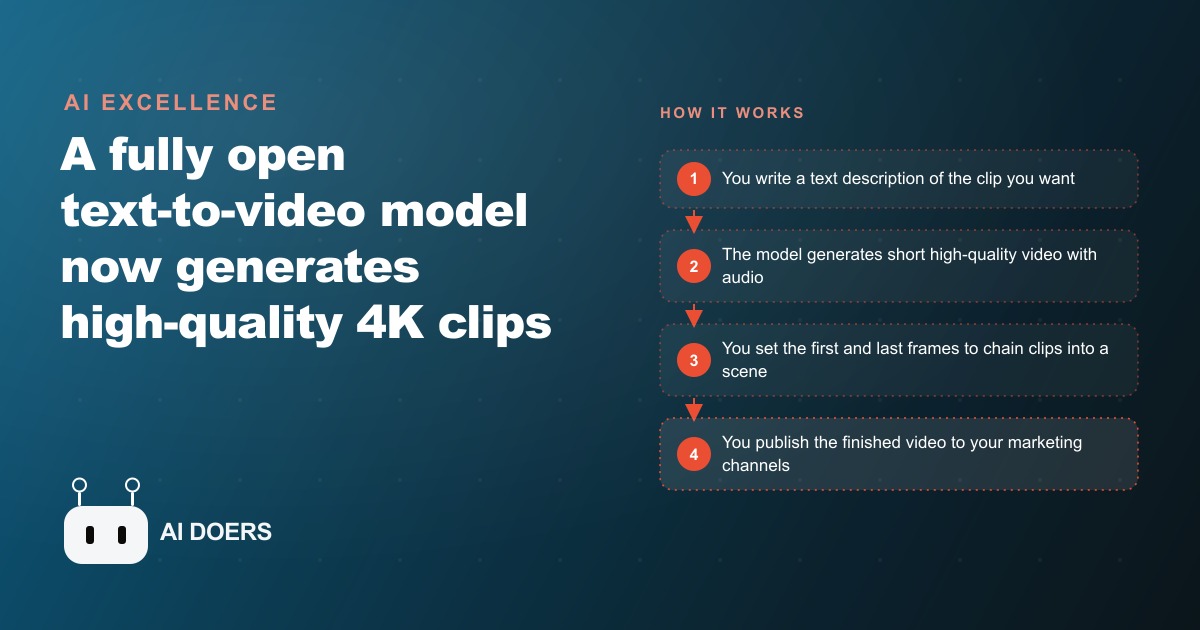
A fully open text-to-video model now produces sharp 4K clips with sound, free to download or run in the cloud. Here is how a small business can turn that into real marketing content without a film budget.

Small businesses have owned cameras for years. Most owners Madhuranjan Kumar works with have a phone in their pocket that shoots 4K video at 60 frames per second. The camera was never what was stopping them from producing consistent video marketing content. What was stopping them was everything that happens between pointing the camera and having a polished clip ready to post: the editing software, the editing time, the skill to use both, the cost of outsourcing when those were missing, and the scheduling dependency on whoever did the production work for them. That gap between shooting and publishing is where video marketing dies for most small teams, and it is a volume problem disguised as a quality problem. The arrival of a fully open-source text-to-video model that generates 4K clips with sound from a text description is the first tool that actually addresses the production loop rather than the camera. Most business owners have not registered what that means yet.
Small businesses have had cameras for years. Cameras were never the problem.
The evidence for this is everywhere. A local restaurant owner has a smartphone with a better camera than any professional setup of fifteen years ago. A landscaping company owner films before-and-afters on a tablet. A retail boutique owner has a ring light and a phone mount and basic editing software. The equipment is not the gap. If equipment were the gap, the problem would have been solved years ago.
What the equipment does not include is the production side: the knowledge to edit a clip well, the time to sit and do it, the design instinct to choose cuts and pacing, or the money to pay someone who has all of those things. Video production tools democratized capture years ago. They never democratized the work between capture and publish. The professional production cost remained even as the consumer camera cost collapsed, and that mismatch is what made video marketing unreachable for most small teams at any meaningful volume.
The businesses that solved this problem before AI tools existed did it through one of three paths. They hired a videographer on retainer, which put regular video content out of reach for most local businesses operating on tight margins. They built internal video capability by hiring someone with editing skills, which was slow and expensive. Or they settled for raw, unedited footage that looked amateurish compared to what regional and national competitors were posting. None of those paths was satisfying. None of them scaled. And none of them addressed the actual bottleneck, which was never the camera and was always the loop between shooting and publishing.
The production loop is where video marketing dies for most teams, and it is a volume problem, not a quality problem
The reason most small business social accounts go quiet after a burst of video activity is not that the owner ran out of ideas. It is that the owner ran out of production capacity. One good video takes hours to produce if editing is required. A sustainable content calendar requires multiple clips per week. At any realistic per-clip production cost, the math does not work for a small team trying to compete at the volume that social platforms reward.
Social platforms, particularly short-video platforms, distribute content based partly on posting frequency. A business that posts three times per week builds an audience faster than one that posts once a month, all else equal. Consistent posting signals an active account that the platform should surface to new viewers. Irregular posting loses that algorithmic momentum, and rebuilding it requires another burst of activity rather than compounding on the last one.
This is why framing this breakdown problem as a quality problem is misleading. Most small businesses could produce video that is good enough. They cannot produce video that is frequent enough. The bottleneck is volume, and volume is a production loop problem. The solution is not a better camera. It is a faster, cheaper loop between idea and published clip. A tool that turns a text description into a polished clip in minutes changes that loop. A tool that does it for free or for cents per clip changes the economics of the loop permanently. That is exactly what an open-source text-to-video model delivers.
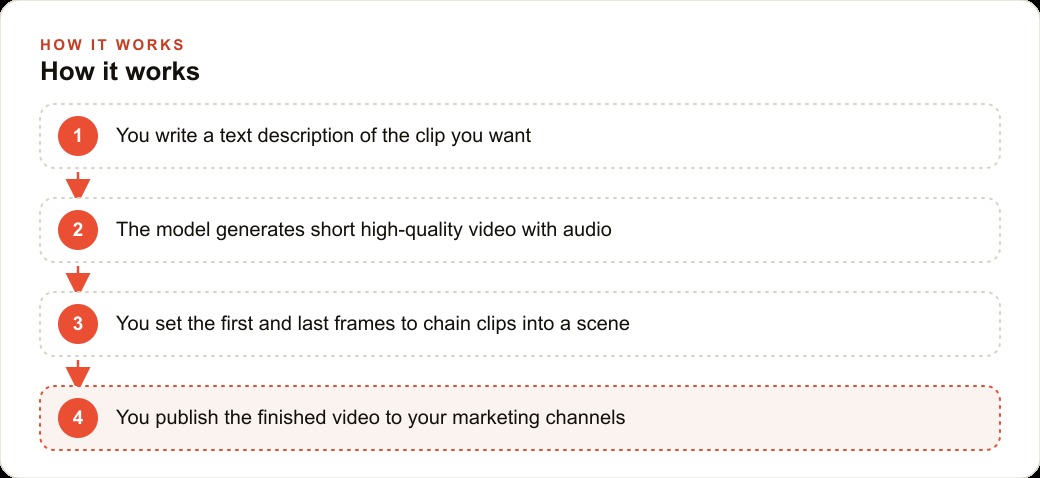
The first-and-last-frame control that this class of model provides is the detail that makes the loop repeatable rather than random. You can specify where a clip starts visually and where it ends, which means you can direct the clip rather than just describe it. You can chain several clips into a longer scene with visual continuity between them. That gives you storyboard-level control without a storyboard process. A clip of a landscaped backyard can start with the before state and end with the after. A clip of a restaurant dish can start with the preparation and end with the plated result. You are not rolling dice on a single render. You are directing within the generation. That repeatability is what makes a weekly content calendar achievable rather than aspirational.
An open model changes the cost structure permanently rather than offering a discounted version of the old model
A text-to-video model that is fully open has a different cost trajectory than a commercial alternative. It starts free, the downloadable weights cost nothing, and over time the model improves through community contributions and fine-tuning efforts that commercial teams do not fund. When the model is open, every improvement in inference efficiency, every fine-tune for a specific domain, and every wrapper tool the community builds becomes available to the business using it without a price increase.
A commercial video generation API charges per minute of output, per resolution level, or per feature tier. As the product adds capabilities, the price tends to rise. The business using it is always renting access to current capabilities at current pricing, with no guarantee that tomorrow's pricing matches today's. An open model running on your own hardware or through a cloud provider gives you a floor that does not exist in the commercial model: once the workflow is built and the prompts are calibrated, the only cost is compute, and compute prices move in one direction over time.
The quality point deserves direct attention. This model generates clips at high resolution with sound and accurate lip sync, and it climbed to the top of an open-weights video leaderboard quickly after release. The output is not a novelty. It is production-grade video suitable for product promotions, social content, and real marketing use. For a landscaping company, a restaurant, a retail boutique, or a contractor, the quality level is sufficient for everything they need to post.
There is also a hardware cost question to address honestly. Memory shortages may push prices on high-end graphics cards significantly higher in the near term. Buying a top-tier card right now to run a local video generation workflow is a more expensive commitment than it would have been a year ago. For most small businesses, the practical answer right now is cloud compute. You pay for the GPU time you use rather than owning a depreciating asset that ties up capital. Cloud providers charge per second of compute, and for a workflow that runs a few clips per week, the monthly cost stays low. Whether you run the model locally or through a provider, the per-clip cost is still orders of magnitude below what professional video production costs. The open model is the reason the economics change. The compute question is a deployment detail with a practical answer.
The cloud versus local hardware question has one practical answer right now
Buying expensive local hardware to run video generation is the wrong move for most small businesses at current market conditions. The capital outlay for a top-tier graphics card capable of running a state-of-the-art video model is significant, and with hardware prices potentially rising due to memory supply constraints, the timing of that purchase adds additional uncertainty.
Cloud compute solves this cleanly. You open an account with a GPU cloud provider, pay per second of compute time, and generate clips on demand. The monthly bill for a workflow that produces one clip per week runs to a few dollars at most cloud provider rates for this workload. When the content calendar requires more clips in a given week, you generate more and pay proportionally for the extra compute. When you do not need clips that week, you pay nothing. The cost scales with your actual production cadence rather than with the fixed depreciation schedule of hardware you own.
The deeper point is that the local versus cloud decision does not change the fundamental argument about cost structure. Either way, the per-clip cost of an open-source video model is so much lower than professional production that the choice of compute environment is a secondary question. The primary change is that the tool exists and is open and free to use. Everything else is an implementation detail.
For businesses watching the hardware market and waiting for prices to stabilize before committing to local compute, the cloud path lets you start building and using the workflow immediately rather than waiting. The workflow itself, the prompt engineering, the first-and-last-frame control, the content calendar structure, all of that can be built and refined while using cloud compute, and migrated to local hardware later if prices normalize and the workload justifies the investment.
Consistency is the only thing that compounds on social platforms, and this is the first tool that makes it achievable at scale
Here is what compounding on social platforms actually means in practice. A single great video reaches its audience once, gets its engagement window, and then fades. A business that posts one new clip per week for a full year has 52 pieces of content working simultaneously. Older posts continue to surface in recommendations and search results. Newer posts add to the archive. The account looks active, credible, and worth following. Reach builds on reach because the algorithm has more content to recommend and a stronger signal that this account deserves to be surfaced.
A business that produces four videos a year with a professional videographer has four pieces of content working at any given point. Algorithmically, it looks like an account that posts sporadically, which gets deprioritized regardless of how good those four videos are. Individual video quality is not what the algorithm is primarily rewarding. The consistency is.
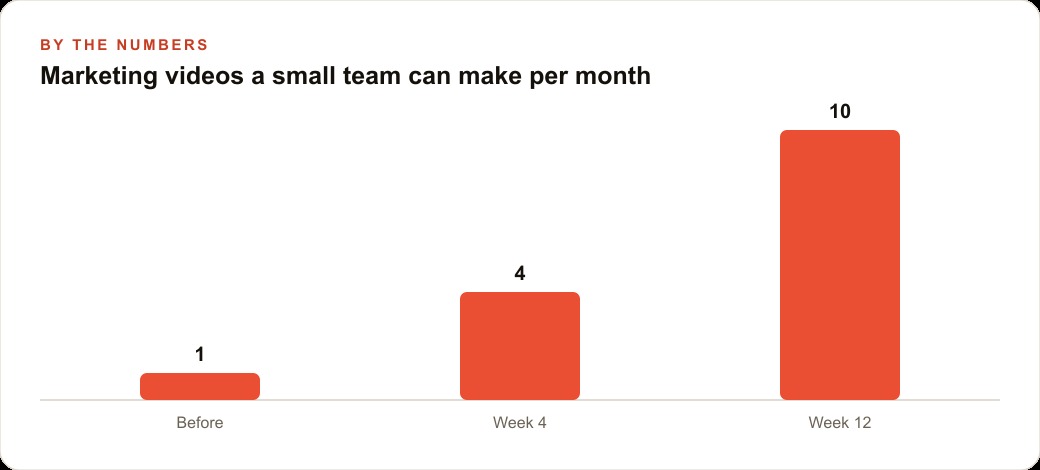
Every previous attempt to give small businesses video production capability addressed quality: better phone cameras, easier editing apps, stock footage libraries. None of them addressed the volume problem because the production loop still required significant time per clip. The only way to produce 52 clips a year without a production team is to make each clip take minutes instead of hours. An open model generating from a text description and chaining clips through first-and-last-frame control does exactly that.
A landscaping company: what the numbers look like across one year
A landscaping company is a natural fit for AI-generated video because the work produces dramatic visual results that are compelling in short form. Before-and-after transformations, seasonal service previews, and time-specific promotional clips are all inherently visual and inherently short.
Before the workflow: the owner produces two to four promotional videos per year using a local videographer. Cost per video averages $600. Annual video spend: $1,200 to $2,400. The owner posts them on social media, they get engagement for a few days each, and then the account goes quiet until the next shoot.
After the workflow: the owner generates one promotional clip per week using the open AI video tool. The input is a text description referencing a real job completed that week. The generation runs in cloud compute at approximately $0.30 per clip. Annual generation cost for 52 clips: $15.60. With cloud provider overhead, the total annual platform cost stays under $100.
Volume comparison: 52 clips per year versus 2 to 4. That is a 13 to 26 times increase in posting volume at a fraction of the previous spend. On short-video platforms, an account posting 52 times per year has a structural algorithmic presence that an account posting 4 times per year cannot build regardless of how good those 4 clips are. The feed stays fresh. The account looks active. New viewers encounter it throughout the year rather than only during the brief window after one of the four annual posts goes live. Over a full season, that consistent presence compounds into measurable audience growth, neighborhood recognition, and inbound inquiries that the low-volume account never accumulates.
The closing argument is not about the technology itself. It is about what the technology makes possible for a business that was previously held back by production cost and time. The camera was never the problem. The production loop was. This is the first class of tool that closes that loop at a price point that makes weekly posting achievable for a company with one truck and a full schedule.
That is exactly what we do at AI DOERS. Book a private 30-minute call with Madhuranjan Kumar and we will map the fastest path to it for your specific business.
Book your call →
Madhuranjan Kumar
Madhuranjan Kumar brings 20 years of performance-marketing experience and has managed over $200 million in Facebook ad spend for brands across the United States and beyond. His expertise spans the full modern marketing stack: Meta, Google Ads, TikTok, email automation, CRM, and the websites that hold it together. At AI DOERS he turns that track record into lead-generation systems for businesses across every industry.