
Open Source AI Image Editing Is Now Good Enough to Run Your Storefront
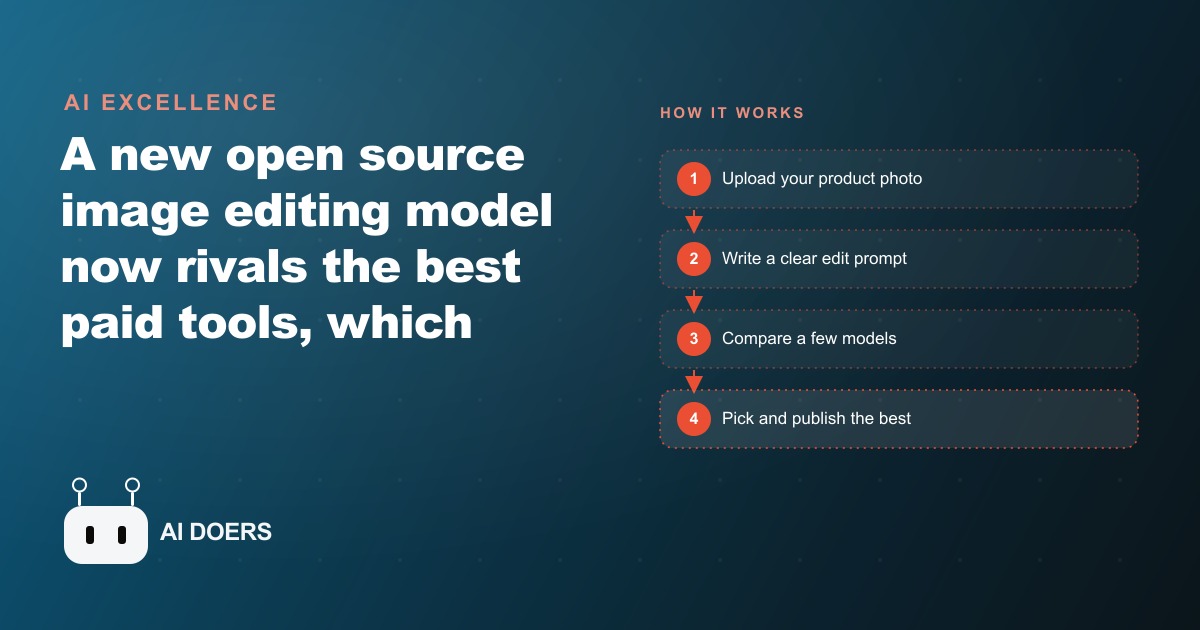
A new open source image editor now competes with the best paid tools. Here is how a small business can use it to produce professional product photos for almost nothing.
I am Madhuranjan Kumar, and I want to say something that makes most marketers uncomfortable: you should stop paying for AI image editing subscriptions right now. Not eventually, not when the open source tools get a little better. Now. The quality gap that justified the monthly fee closed faster than almost anyone expected, and the businesses that recognize this early are going to compound a significant cost advantage while competitors keep paying for convenience that no longer buys them a better outcome.
You Are Paying for a Brand Name, Not a Better Photo
The honest case for paid AI image editing subscriptions has always rested on one assumption: that the output is meaningfully better than what free tools produce. For a long time, that assumption was correct and the premium was justified. Paid tools had proprietary model weights, larger training sets, cleaner interfaces, and reliably better outputs on the tasks that mattered most for e-commerce and marketing work. Product compositing, background replacement, material swaps, lighting adjustments, text overlays, all of them were noticeably sharper from the paid tools than from anything available without a subscription.
That gap has closed. A new wave of open source image editing models, trained on large-scale datasets and released without license fees, now performs at a level that is competitive with the best paid tools in side-by-side tests across the tasks that matter most for product and marketing imagery. Not competitive in the sense of being close enough to accept as a consolation prize. Competitive in the sense that in blind comparisons across real business tasks, the open source model wins on some tasks, ties on others, and loses cleanly only on a narrow category of precision work that most product marketers do not need to do at scale.
That shift changes the math entirely. When the output is comparable, the only remaining justification for a subscription is convenience, and convenience is not worth forty to one hundred dollars a month when the free alternative produces images you are proud to publish.
The Quality Gap Closed Six Months Ago and Most People Have Not Noticed
Six months ago, the signs of AI image editing were obvious enough that a trained eye could spot them immediately. Unnatural lighting at the edges where an edited object meets a new background. Textures that felt technically correct but slightly wrong in a way that was hard to articulate but easy to feel. Reflections that did not quite match the physics of the scene. These artifacts showed up reliably enough that publishing AI-edited product images at scale carried a real quality risk, and the paid tools were genuinely ahead of the alternatives on minimizing them.
The comparison tests I have been running tell a different story now. Placing a product into a new background scene with realistic light matching produces results that pass the kind of inspection most product photography receives on a mobile screen. Compositing a vehicle into a desert environment with harsh sun and sand on the surfaces produces comparable or better shadow integration than the leading paid options. Changing a fabric color while keeping the texture, weave, and stitching intact gives clean results that do not require manual correction. These are the real-world tasks, not exotic edge cases, and on these tasks the quality is now there.
Where the open source model still sometimes trails is on a specific category of precision task: keeping a face consistent across multiple edited versions of the same image, or making a very small and very precise change to one element without affecting anything around it. For a business that does a lot of this kind of surgical editing, the paid tools may still earn their fee for that specific task. For a business that primarily needs product compositing, background replacement, material swaps, and seasonal lighting adjustments, the open source model is now good enough that the subscription is no longer justified by the output quality alone.
Your Prompt Library Is the Only Durable Competitive Advantage Left
Here is the thing that the tool comparison framing almost always misses. The quality of an AI image edit is not determined primarily by which model processed it. It is determined primarily by how precisely the prompt described what was wanted. Detailed prompts that specify the lighting direction, the surface the product rests on, the mood of the scene, and what must stay unchanged in the product produce dramatically better results than vague prompts across every model tested, including the expensive paid ones.
This means that a business with a well-developed library of specific, tested prompt structures will produce better images than a competitor with a better tool subscription but vague prompts. The prompt library is the repeatable operational asset, not the model. And the prompt library is something you own, regardless of which model you run it through. When a new model comes out that produces better output for a given task, you run your existing prompts through it. The investment in developing precise prompts carries forward across tool changes in a way that a subscription dependency does not.
For a product photography workflow, the practical implication is concrete. Once you have developed a prompt structure that reliably produces clean composite results for your product category, you can run that prompt through any model that performs well on product compositing. If the best open source model for that task is free today, you use it free. If a new model outperforms it tomorrow and it is also free, you switch. If a paid tool genuinely advances to a performance level worth the fee for a specific task you run at scale, you evaluate it then on the evidence of your own test. You are not locked in. You are optimizing continuously based on actual output quality rather than brand loyalty or subscription inertia.
No Single Model Wins Every Task, and That Is the Entire Playbook
The single most practically valuable lesson from running these models side by side is that no single model wins every task. The smart approach is not to pick a model and use it for everything. The smart approach is to build a short list of three or four models, test each one on the task types that matter most for your work, and route each task to the model that performs best on that specific type.
For most product-focused businesses, this breaks down into task categories. Background replacement and scene compositing: test two or three open source models and keep the one that handles edge blending most cleanly on your product type. Color and material swaps: test specifically on your materials because fabric behaves differently from metal, which behaves differently from matte paint. Lighting and weather adjustments: golden hour, overcast, snow, and rain all have different characteristics and models vary on which they handle with realistic physics. Text overlays on product images: this varies enough by model that you need to test before committing to any model for text-heavy seasonal campaign imagery.
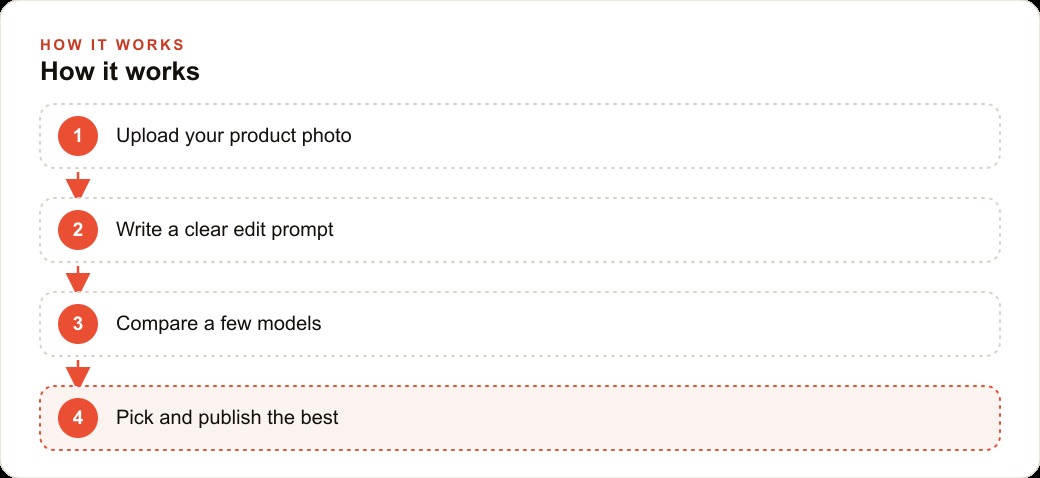
The parallel testing workflow makes this fast. Send the same prompt and source image to two or three models simultaneously, compare the results, and pick the best output for that task. This sounds like more work than just using one tool, but it is actually faster than iterating on a mediocre result from a single model until it improves. Build the comparison into your process as a standard step rather than treating it as extra overhead, and within a few weeks you have a personal toolkit built on actual performance data rather than marketing copy.
For E-Commerce, Shoot Once and Generate an Entire Season of Content
The master-photo workflow is where the economics of open source image editing become clearest, and it is the workflow I recommend for any e-commerce business that currently budgets for recurring photo shoots. You photograph each product once in clean, consistent light, ideally on a plain background that gives the model clear edges to work with. That single clean shot becomes the source for every variation, every seasonal version, and every styled composite you will need across the entire year.
From that one master shot, you generate product composites for lifestyle scenes: the mug on a cozy kitchen counter with morning light coming through a window, the jacket in an outdoor autumn setting with directional afternoon sun, the skincare product on a marble surface next to a plant. You generate color and material variants by swapping fabric color, leather finish, or paint color while keeping the texture and construction details intact. You generate seasonal versions by adding snowfall for a winter campaign, beach light and warm haze for a summer sale, overcast diffuse light for a premium editorial look. You generate ad variants by changing backgrounds to match different platform aesthetics, the same product in a white studio setting for a product detail page and in an ambient lifestyle setting for a social ad.
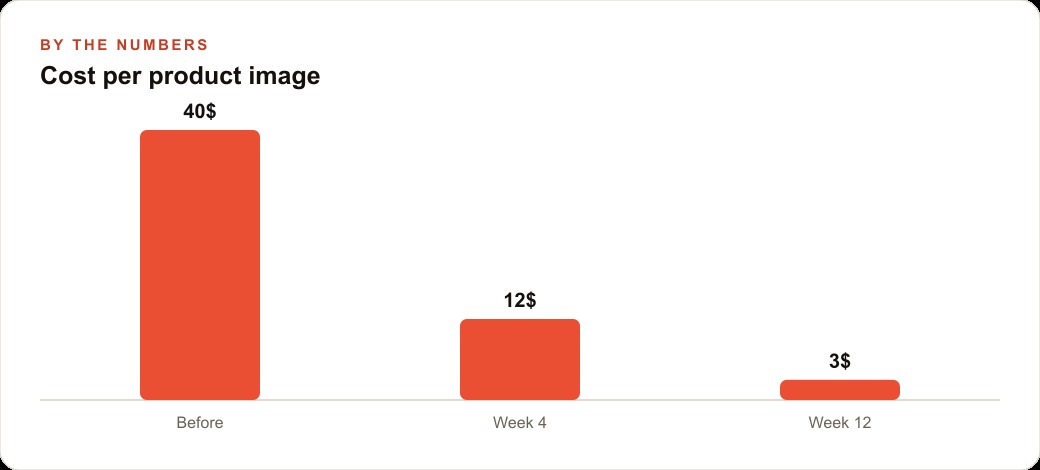
The economics of this shift are not subtle. Before this workflow was possible, a seasonal campaign might require a full photo shoot including photographer, studio or location, stylist, and post-production editing. The cost range for a single-day seasonal shoot for a small e-commerce brand runs from roughly 3,000 to 10,000 dollars, and the output is fixed at whatever was captured that day. With the master-photo workflow, the cost of generating a full seasonal campaign from one existing master shot is a few dollars in compute if you are using API access, or effectively zero if you are running models locally. For a candle brand that used to shoot four times a year, once per season, the math is stark: four shoots at 4,000 dollars each is 16,000 dollars per year in photography costs, not counting the time to schedule and manage them. With the master-photo workflow, you shoot once for each product, generate seasonal versions on demand, and redirect that budget to something that actually drives sales directly.
The Subscription Math When You Stop Paying
One paid AI image editing subscription at the professional tier for a small business runs from roughly 40 to 100 dollars per month, or 480 to 1,200 dollars per year. For an agency managing multiple clients, the math multiplies. For a freelance photo editor who uses the tool on client work, it is a real line item in the cost structure that affects what services can be priced competitively.
The open source alternative has two cost structures depending on how you use it. If you run the model locally on a machine with sufficient compute, the marginal cost per image is effectively zero after the initial setup. If you access it through an API, the cost per image is typically a fraction of a cent to a few cents depending on resolution and complexity. For a business generating a hundred product images per month, the API cost is in the range of a few dollars total, not forty to one hundred.
The gap between those numbers is large enough that it changes decisions about what to test and what to produce. When each image carries real monthly subscription cost, you produce fewer variations and take fewer creative risks because each test costs real money. When each image costs cents or nothing, you run ten variations of a background treatment to find the one that converts best in ads, you test three different lighting moods for the same product, and you generate unique scene treatments for every campaign without worrying about the cost of the ones that do not make it to publication. That freedom to test at volume without cost anxiety is the operational shift that compounds into a competitive advantage over time. The businesses that test more images, more scenes, more variations, and more treatments will find better-performing creatives than the businesses that produce fewer images because each one carries a real per-image cost.
The prompt library you build along the way is what captures and compounds that advantage. Every prompt structure that reliably produces clean results for your product category is a reusable asset that makes the next batch faster and better. That library does not belong to any subscription. It belongs to you, and it goes with you when the best available model changes, when a new open source release outperforms the previous one, or when the paid tool you had been using raises its prices. The tool is replaceable. The prompt library is yours.
That is exactly what we do at AI DOERS. Book a private 30-minute call with Madhuranjan Kumar and we will map the fastest path to it for your specific business.
Book your call →
Madhuranjan Kumar
Madhuranjan Kumar brings 20 years of performance-marketing experience and has managed over $200 million in Facebook ad spend for brands across the United States and beyond. His expertise spans the full modern marketing stack: Meta, Google Ads, TikTok, email automation, CRM, and the websites that hold it together. At AI DOERS he turns that track record into lead-generation systems for businesses across every industry.