
o3 Prompts, the Image API, and a Voice Hack You Can Actually Use
Three practical AI updates and how a local gym would put each one to work this week.

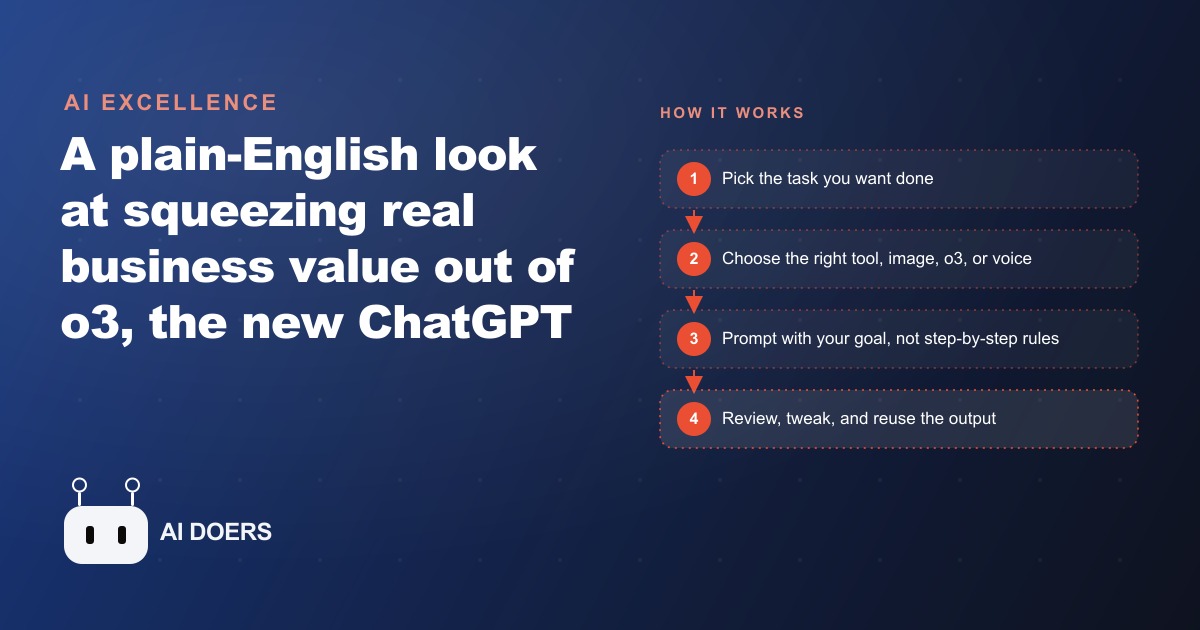
The way most small business owners use AI tools this year produces worse output the more carefully they follow the advice circulating about how to use them. I, Madhuranjan Kumar, want to make that case clearly, because the habits that were reasonable one model generation ago now actively undermine results. The three most common bad habits are: prompting step by step, generating images one at a time, and typing out what you meant to dictate. Each habit wastes time and caps quality. The replacements are simpler and produce better results immediately.
The prompting habit that produces worse output the more carefully you follow it
Step-by-step prompting is the approach most AI tutorials teach. You tell the model what to do first, then what comes next, then what to do after that. You treat the model like a fast assistant who needs explicit instructions for each move. That approach made sense when models were weaker. It does not make sense with o3.
o3 reasons. When you give it a goal and a constraint, it figures out the route. When you give it instructions for each step, you force it to follow your plan rather than finding a better one. The model is often aware of approaches you did not think of, information you did not have when you wrote the prompt, and failure modes your step-by-step path would hit. By specifying each step, you block all of that.
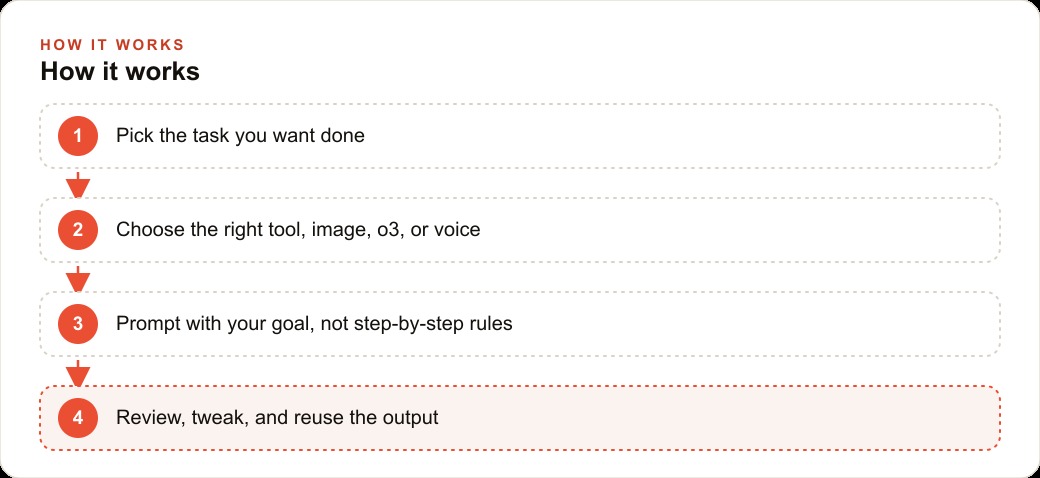
The correct approach is goal-based prompting. Describe the outcome you want, give the model the relevant constraints, and let it decide how to get there. A prompt asking for the three most non-obvious content angles on a topic, based on what is actually resonating on forums right now, produces more surprising and more useful output than a prompt that says: first list five topics, then tell me which are most popular, then pick the top three. The second prompt produces generic answers because you constrained the model to your own categories before it could surface anything unexpected.
The trend-scan application is where this difference matters most. Tell o3 to look at Reddit, review sites, and industry discussions and surface what a specific audience is quietly asking about, then suggest business moves or content angles based on those patterns. The model searches, reads, cross-references, and returns a set of findings that often feel a step ahead of what you would have found manually. That output is only possible when you give the model latitude to plan the search rather than prescribing which sources to check and in what order.
Step-by-step prompting is comfortable because it feels controlled. The illusion of control is the actual problem. You are controlling the route and losing the destination. Goal-based prompting gives up control of the route and gains a better destination. For most business tasks, that trade is the correct one. The time you spend specifying each step is time the model could have spent finding a better path than the one you had in mind.
Why generating one image at a time is a productivity trap
The default behavior for most people using AI image generation is: type a prompt, wait for one result, decide whether to keep it or try again, modify the prompt slightly, wait again. This loop runs until something acceptable appears, and then stops.
The problem with this approach is not the quality of any single result. It is the selection pool. When you generate one image and evaluate it, you are comparing that image to a mental picture of what you wanted. When you generate ten images and evaluate them together, you are comparing each against the others and selecting the strongest from a real set. Selection is a different cognitive activity than judgment, and it consistently produces better outcomes because it uses the actual range of what the prompt can produce as the comparison baseline.
The ChatGPT image API playground generates multiple variations from a single prompt simultaneously. You write the prompt once, raise the variation count to ten, and receive a complete set. The best image in a set of ten is almost always better than the best result you would find by running the same prompt ten times sequentially. The difference is not the prompt quality. It is that seeing options side by side changes what you notice, and noticing more produces a better pick.
For a business producing regular social content, promotional graphics, or product images, this distinction compounds across a year. An operation that generates one image per post and accepts the first or second attempt ships content that averages out to mediocre. An operation that generates ten variations per post and picks the strongest one ships content that consistently trends toward the top of what the prompt could produce. The time difference between the two approaches is minimal. The quality difference is significant and observable within a few weeks of switching.
The presets available in the playground accelerate this further. A preset for a specific visual style constrains the generation to a register the brand needs. You stop describing the style from scratch every time and start refining the content within a style the model already understands. Ten variations within a preset takes the same time as one variation without one and produces a far stronger set to choose from.
The voice shortcut that makes dictation worth using for the first time
Built-in phone dictation has been technically available for over a decade and genuinely useful for close to no one in its native form. The output reads like a transcript of someone talking with their mouth full: words run together, punctuation is absent or wrong, capitalization is random. Fixing the dictation output takes longer than typing the original message would have.
An iPhone shortcut that routes voice through a transcription model changes this completely. The shortcut records your voice, sends the audio to a model that applies proper grammar, punctuation, and capitalization, and returns clean text to your clipboard in three to five seconds. The output reads like something you typed carefully. No corrections needed for most inputs.
The practical effect of this shortcut is that voice becomes a usable first-draft tool for every kind of business text: messages, captions, task notes, email drafts, client follow-up summaries. Any thought you can speak, you can now turn into clean text faster than you could type it. The friction barrier that made built-in dictation not worth using disappears entirely.
For a business where the owner and team are frequently away from a keyboard, this shortcut recovers meaningful time across a week. A trainer who thinks of a social caption during a session captures it in ten seconds. A contractor who needs to send a follow-up note from a job site dictates it in the truck and pastes it into a message app without typing a word. A practice owner who wants to log a quick note after a patient visit does it between rooms without stopping to find a keyboard.
The setup takes about 15 minutes: create the shortcut, connect it to a transcription model, map it to the action button or a home screen widget. After that it runs invisibly behind every voice note you take, and the improvement over built-in dictation is permanent.
What using these three tools correctly looks like in a real week
Consider how a local gym applies all three habits in a single week and what the difference looks like against the old approach.
On Monday morning the owner runs one goal-based prompt in o3: scan the fitness conversations happening on social platforms and forums right now and tell me which topics are getting the most engagement, which concerns are most common, and what one class promotion I should run this week based on what you find. The model searches, reads, and returns a specific recommendation with the reasoning. The owner has a content direction and a promotion idea in about 12 minutes, with no manual browsing.
Without the goal-based approach, the same owner spends 40 minutes scanning competitor accounts, a few Reddit threads, and some industry pages manually, then makes a judgment call without a clear signal about what is actually performing. The output is lower quality and took four times as long.
On Tuesday the gym's marketing lead generates social graphics for the week's promotion. Instead of producing one graphic and revising it twice, they write a single strong prompt, attach a reference image from a previous graphic that performed well, and generate ten variations. They pick the strongest two in three minutes. The rejected eight informed the selection without costing any additional time.
Without the batch approach, the same person generates three graphics across three separate sessions, accepts the third because the first two were not quite right, and ships content that is acceptable but not the best the prompt could produce. The batch approach does not take more time. It produces better output from the same time.
Throughout the week, every trainer uses the voice shortcut for social captions, class recaps, and quick messages to members who inquired about personal training. The front desk uses it for follow-up note drafts after membership calls. The cumulative time recovered across four trainers and two desk staff runs to roughly 45 minutes per day of transcription corrections avoided and voice notes that no longer require re-typing.
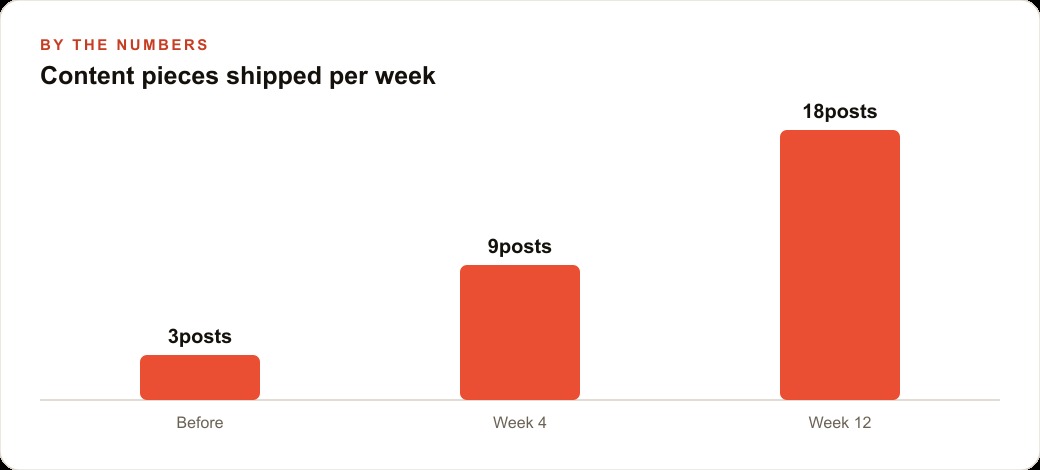
In a 52-week year, those three habit changes recover over 180 hours of staff time collectively, produce consistently stronger social content, and generate a content direction each Monday grounded in real audience signal rather than guesswork. None of it requires a larger budget. All three tools are either free or low cost. The only change is how the existing subscriptions are used.
The gym that practices these habits ships more and better output than the competitor who is technically using the same tools. The gap is not access. It is method.
One more point on the economics: most of the competitors using the same tools are paying the same subscriptions and getting a fraction of the value because their habits are set from when the tools were worse. The step-by-step prompt made sense when models followed instructions more literally and reasoned less independently. The single-image generation made sense when a batch of ten would have taken ten minutes to process. The typed voice note made sense when transcription models were not yet accurate enough to trust. All three constraints have been lifted, and the habits have not updated to reflect that. The business that updates its habits this week competes on a different footing than the one that discovers the update six months from now. The subscriptions are already paid. The only remaining variable is the method applied to them.
Why changing these habits feels harder than it should
The three replacements described here are each simpler than the habits they replace. Goal-based prompting is a shorter prompt, not a longer one. Batch generation is one press of a button, not a longer workflow. The voice shortcut is a 15-minute setup that then requires zero ongoing effort. None of them ask for more work.
The difficulty is that each one requires letting go of a feeling of control. Step-by-step prompting feels methodical. Generating one image at a time feels careful. Typing out a voice note feels safer than trusting a transcription model. These feelings are accurate descriptions of what the habits feel like, not accurate descriptions of what they produce. The methodical prompt produces a constrained output. The careful single-image approach produces an inferior selection pool. The manually typed voice note costs more time and recovers the same information.
The practical solution is to run one replacement habit for one week before evaluating it. Pick goal-based prompting, try it on every AI prompt for five working days, and compare the outputs against a week of step-by-step prompting. The evidence is in the results, not in how the habit feels while you are doing it. Most people who try this for a week do not go back, because the output difference is visible without measuring anything.
That is exactly what we do at AI DOERS. Book a private 30-minute call with Madhuranjan Kumar and we will map the fastest path to it for your specific business.
Book your call →
Madhuranjan Kumar
Madhuranjan Kumar brings 20 years of performance-marketing experience and has managed over $200 million in Facebook ad spend for brands across the United States and beyond. His expertise spans the full modern marketing stack: Meta, Google Ads, TikTok, email automation, CRM, and the websites that hold it together. At AI DOERS he turns that track record into lead-generation systems for businesses across every industry.