
O3 Pro Is the Best AI for Business Strategy Right Now. Here Is How to Use It.
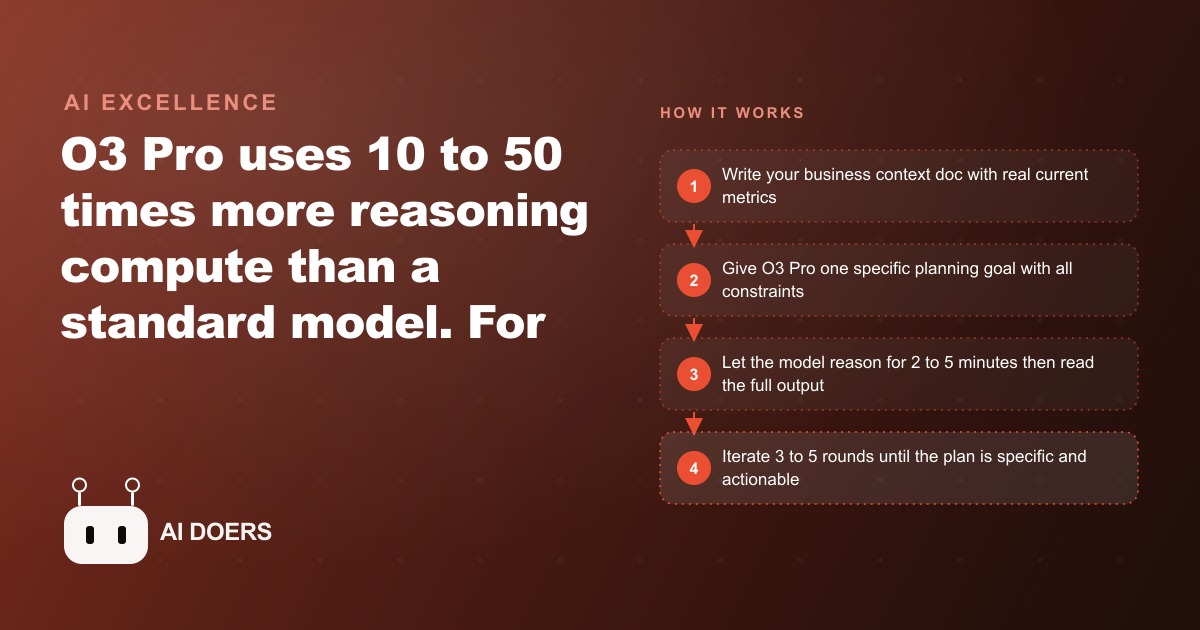
OpenAI's O3 Pro applies 10 to 50 times more reasoning compute than a standard model. For complex business planning, 90-day strategies, and staffing decisions, that depth produces a qualitatively different result. Here is how to use it.

If you have tried to use AI for serious business planning and walked away with an output that felt impressive for thirty seconds and generic for the next thirty minutes, the problem was almost certainly not the question you asked. It was the model you asked it to.
I am Madhuranjan Kumar, and I want to make a specific case for O3 Pro as the right tool for strategic planning work right now, then walk through seven concrete ways the model changes what is possible for small and mid-sized businesses making real decisions. This is not a comparison of model benchmarks. It is a practical guide to deploying one specific capability on one specific class of problem where the reasoning depth visibly changes the output quality.
O3 Pro, built by OpenAI, uses roughly 10 to 50 times more reasoning compute per response than a standard language model, depending on the complexity of the task. That additional compute does not make it faster. It makes it more thorough. O3 Pro works through intermediate steps, checks its own logic, considers alternative framings, and revises before producing a final answer. For a question like "write me a follow-up email for a new customer," the extra reasoning produces nothing you would notice over a standard model. For a question like "design a 90-day patient retention program for a chiropractic clinic with two providers, a current three-month retention rate of 52 percent, and a budget of $800 per month for all implementation costs," the quality difference is qualitative rather than marginal. It is the difference between a plan that looks right and a plan you can actually implement the following Monday.
One clarifying note before the seven items: Gemini 2.5 Pro from Google currently outperforms O3 Pro for coding tasks and rapid idea generation. The two models are complementary. For building the implementation once a plan is clear, Gemini 2.5 Pro is often the faster path. For the planning itself, O3 Pro is the right tool. Knowing which to use for which task is itself a form of strategic thinking.
1. It reasons through multiple competing constraints simultaneously instead of optimizing for one
Most business planning problems involve more constraints than a human can hold in working memory at once. Staff availability, service duration, revenue per appointment type, equipment or room availability, customer preferences, regulatory requirements, target utilization rate, seasonal demand patterns. Manually optimizing across all of these produces plans that satisfy the constraints you held in attention and silently violate the ones that got pushed out.
O3 Pro handles this differently. Feed it the full constraint set in specific, quantified terms and it considers the interactions between all of them before producing a plan. It will find the configuration that satisfies all your constraints if one exists, and if one does not, it will tell you which specific constraint is in conflict with the others and by how much you would need to relax it to make the problem solvable. That second response, the one that tells you what has to change and by how much, is more useful than a plan that looks complete but has hidden infeasibilities built in that only surface when you try to implement it.
The way to use this: write out every constraint explicitly before you start the session. Not in your head. In a document. Include the ones that feel obvious to you, because the ones that feel obvious are the ones most likely to be absent from your prompt if you assume the model will infer them. Quantify every constraint you can: not "we need some buffer between appointments" but "we need a minimum fifteen-minute buffer between each patient appointment to allow for room turnover and notes, with no exceptions on Monday and Wednesday."
2. It catches the logical contradiction hiding inside your current plan
One thing that consistently distinguishes O3 Pro from standard models for planning work is that it will tell you when two parts of your stated plan are in logical conflict, rather than proceeding as though both are achievable and building a structure that collapses under implementation pressure.
A common example in service businesses: the owner states a revenue target, a staffing level, and a price point. A standard model will build a plan incorporating all three. O3 Pro will often flag that the math does not work. At the stated price per appointment and the appointment capacity the staffing level allows, hitting the revenue target requires a utilization rate higher than any service business can sustain. It will name the number: you would need to run at 94 percent utilization to reach your target at this price point, and typical sustainable utilization for a practice this size is 78 to 82 percent. Either the price needs to rise, a provider needs to be added, or the revenue target needs revision.
That specific contradiction is exactly what a good business advisor surfaces in an initial planning conversation, and it is exactly what most AI planning tools skip because standard models optimize for producing a coherent-sounding response rather than for identifying logical impossibilities in the input. Give O3 Pro your current plan, your current metrics, and your stated goals, and ask it directly: what in this plan is internally inconsistent, and what would need to change to resolve each inconsistency? The output of that single question is often worth more than an entire planning session that starts with the assumption that the goals are achievable as stated.
3. Real numbers from your business produce schedules you can implement next week
The single largest lever in getting useful output from O3 Pro is the specificity of your inputs. Vague inputs produce well-structured, professionally worded, completely generic outputs. Specific inputs produce specific plans.
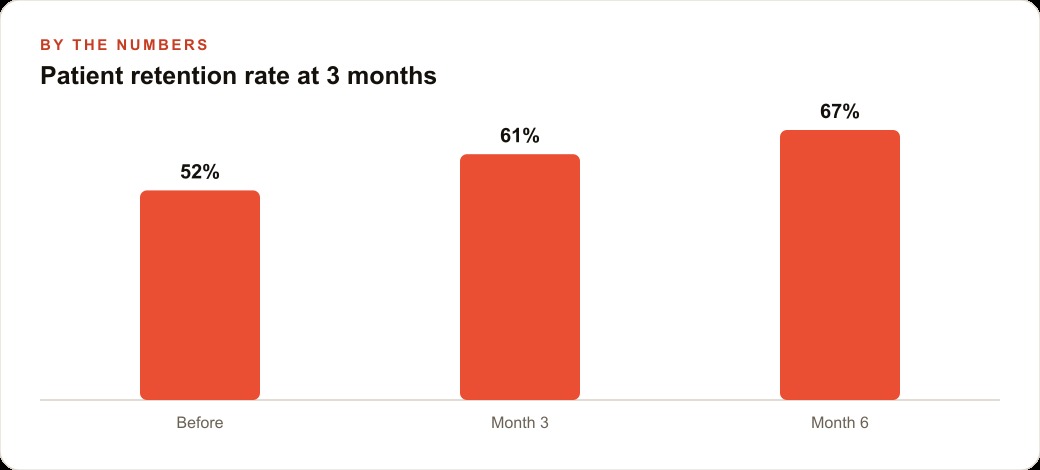
The difference between "I want to improve patient retention" and "I want to improve three-month patient retention from 52 percent to 65 percent for a chiropractic clinic serving 180 active patients per month, with an average visit frequency of 1.8 visits per patient per month, two chiropractors, one massage therapist, and a marketing budget of $800 per month for any new initiatives" is not just the number of words. It is the difference between an output describing general retention strategies and an output identifying which specific appointment transitions are your highest-risk dropout moments, what intervention at each transition would most likely change the outcome, and how to sequence the rollout across the next twelve weeks given your current staff schedule and the $800 constraint.
The discipline this requires is doing the homework before the session, not during it. Spend thirty minutes pulling your actual current numbers before you open the conversation with O3 Pro. Revenue per appointment type, current appointment volume by type, staff utilization rate, no-show rate by day of week, three-month and six-month retention rate if you have it, and whatever budget is available for new initiatives. Come in with a document you have written rather than a vague description you plan to fill in as you go. The model's reasoning quality scales with the precision of your input in a way that is genuinely nonlinear.
4. One focused session replaces multiple rounds of expensive planning meetings
A business strategy consultant working at $250 per hour and spending three hours developing a 90-day plan charges $750 before you have a document to work from. That is not a criticism of consultants. The good ones earn it many times over by catching assumptions you cannot see because you are inside the business and by bringing pattern recognition from dozens of similar situations. But for many specific planning decisions, particularly for business owners who have a clear sense of their situation and primarily need help structuring the analysis, the gap between what a consultant session produces and what a well-structured O3 Pro session produces has narrowed considerably.
O3 Pro produces a structured first draft of a real plan built around your specific constraints, not a generic template with your business name filled in. It does not replace the consultant's relational knowledge or their ability to read the room in a meeting. But for owners who have been putting off planning work because they cannot justify $750 per session or cannot carve out focused hours in a week, O3 Pro makes a serious first draft accessible in twenty to thirty minutes of deliberate conversation.
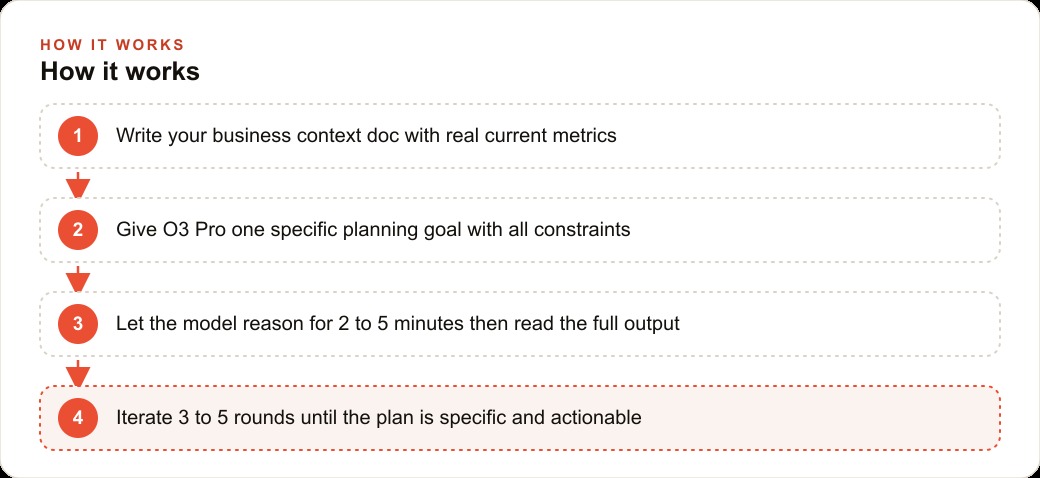
The protocol that produces the best results: write your business context document before you start. One to two pages covering current metrics, the three biggest challenges you face right now, and your goals for the next 90 days. Give this document to O3 Pro at the start of every planning session so you are not rebuilding context each time. Run three to five rounds of back-and-forth, pushing back on anything that does not fit your reality and asking for alternatives where you want options rather than a single recommendation. End every session with a concrete deliverable: a document, a schedule, a script, or a checklist you can act on within the same week. If the session produces no artifact that changes what you do Monday morning, it was not finished.
5. Named projects let the model accumulate context about your business over multiple sessions
ChatGPT's deep research feature, which is where O3 Pro is available in the current product architecture, now runs inside named projects. This structural change matters more than it initially sounds.
In previous versions, every research or planning session started from scratch. You provided the model with your context, it produced a response, and the next session had no memory of what the previous one established. Named projects change this. The model can reference documents you have uploaded to the project, prior conversations within the same project thread, and context that accumulates across multiple sessions. Your business context document, planning outputs from previous months, your metrics snapshots, your stated constraints, all of this becomes available across sessions rather than requiring you to re-explain the basics every time you return.
The practical effect is that a third planning session with O3 Pro in a named project where you have been working for two months is qualitatively different from a first session. The model already knows your clinic has two chiropractors and one massage therapist. It knows your no-show rate runs higher on Thursdays. It knows you tried an email reactivation campaign in the spring and the open rate was acceptable but the conversion was poor. You build on established knowledge rather than starting over, and the specificity of the outputs compounds as the context in the project deepens. This cumulative context is what closes the gap between a one-off planning tool and something that functions more like an ongoing strategic thinking partner.
6. Pushing back on the first answer is where the real value enters
O3 Pro's extended reasoning produces better first drafts than standard models. It also produces first drafts with embedded assumptions, because even a sophisticated reasoning chain has to make choices about things that were not fully specified in the prompt. The full value of the tool is only realized if you treat the first output as a starting point for a structured conversation rather than as a finished plan ready to implement.
The specific challenges that produce the most improvement: ask the model to explain the reasoning behind the three recommendations it appears most confident about, because the explanation will surface assumptions you can either confirm as accurate or correct with your actual situation. Ask for two or three alternative approaches to the one decision you feel most uncertain about, because seeing alternatives clarifies your own priorities even when you ultimately choose the original recommendation. Ask the model to identify what would have to be true in your specific business for its plan to fail, because this is the fastest way to find the assumptions most likely to trip up the implementation.
After receiving the first output and identifying the assumptions that need checking, go get the actual data. Then return and tell the model what you found. "Your plan assumes a conversion rate of 8 percent from free consultation to paid treatment, but our historical rate over the past twelve months is 6 percent. Revise the projections and tell me what changes in the 90-day plan as a result." That revision loop, run two or three times, produces something much closer to a plan you would trust and act on than the first output alone could provide.
7. The chiropractic clinic that used one session to plan a $50,000 annual revenue increase
Here is how a single O3 Pro session works when structured well for a specific business, using a chiropractic clinic as the example because the numbers are concrete and the math is visible.
The context given at the start of the session: a clinic with two chiropractors and one massage therapist, currently serving 180 active patients per month. Average visit frequency is 1.8 visits per month per patient. Three-month patient retention rate is 52 percent. The owner wants to improve retention to 65 percent and launch a monthly wellness membership within 60 days. Marketing and implementation budget for both initiatives is $800 per month.
The first task is diagnosing where patients drop off. Give O3 Pro the retention rate broken down by appointment type where available, then ask it to identify which patient journey transitions carry the highest dropout risk, and draft a specific three-step intervention for each high-risk transition point. The output should be a concrete protocol: not "send a follow-up email" but "within 48 hours of the first adjustment, the front desk team member calls to check how the patient is feeling, asks one specific question about their primary complaint compared to when they arrived, and confirms the second appointment is on the calendar. If no second appointment exists, schedule it during that call."
The second task is designing the membership. Give O3 Pro your current pricing, your appointment capacity per week, and your monthly revenue goal. Ask for a two-tier membership structure with price points justified by the services included at each tier, a positioning rationale for each tier that anticipates the hesitation a patient is likely to express at checkout, and a projected take rate by tier based on your current patient mix. Then ask it to write the exact script the front desk uses to present the membership during checkout with a patient who has just completed their third visit, including the response to the two most common objections.
The third task is the 90-day implementation schedule. Give O3 Pro the retention interventions, the membership structure, the staff schedule, and the $800 monthly budget. Ask for a week-by-week plan that sequences the retention protocol rollout, the membership launch, any staff training required, and the patient communication sequence. Ask it to identify three metrics to track each week and the specific response threshold: if week-six membership sign-ups are below a stated number, the plan calls for a specific named adjustment.
The financial impact of executing this plan is visible in the arithmetic. A clinic serving 180 active patients per month with a 52 percent three-month retention rate retains approximately 94 patients beyond three months. At 65 percent retention, it retains approximately 117. The additional 23 retained patients, at an average three-month value of $420 per patient, produce $9,660 in additional quarterly revenue from retention improvement alone. A wellness membership launched at $89 per month that converts 5 percent of the active patient base produces 9 members and $9,612 in annual recurring revenue. Together, these two initiatives add approximately $48,000 in additional annual revenue to a clinic that did not change its core pricing or service offering in any fundamental way. The planning session cost $200 for the monthly platform subscription. The implementation cost time and execution discipline. The return is not hypothetical: it follows directly from the arithmetic of the plan, produced in one focused session with the right model and the right inputs.
That is exactly what we do at AI DOERS. Book a private 30-minute call with Madhuranjan Kumar and we will map the fastest path to it for your specific business.
Book your call →
Madhuranjan Kumar
Madhuranjan Kumar brings 20 years of performance-marketing experience and has managed over $200 million in Facebook ad spend for brands across the United States and beyond. His expertise spans the full modern marketing stack: Meta, Google Ads, TikTok, email automation, CRM, and the websites that hold it together. At AI DOERS he turns that track record into lead-generation systems for businesses across every industry.