
Why o3 Changes Everyday AI: Goal-Based Prompts That Just Work
What makes o3 different, why thinking plus tools is the real unlock, and how an auto repair shop would put it to work.

OpenAI shipped o3, and for once the release lived up to the noise around it. People are even arguing about whether we just brushed up against something close to general intelligence. That debate will run forever and settle nothing, so I want to skip it and focus on what actually changed and what a business should do about it. I am Madhuranjan Kumar, and the short version is this: o3 is the first everyday model that both thinks hard and reaches for tools on its own, and that combination changes how you should prompt it starting today.
What shipped: a thinking model that can finally act
o3 is a reasoning model with full, automatic access to tools, and that second half is the real story. Earlier reasoning models could think deeply, but they were boxed in. They could not reliably look at images, open files, run analysis, or search the web on their own. o3 does all of that automatically inside a single conversation. It is not merely smarter on a benchmark, it is smarter and able to act on what it figures out, which is a far bigger deal than another point on a chart.
The same week brought other releases, including developer-focused models that are excellent at writing code and live only in the API. Those matter for builders. But for most owners and operators, o3 is the one that changes the workday, because it is the model you actually open to get things done. Keeping that distinction clear saves confusion: the code models are a separate product for a separate audience, and o3 is the everyday pick inside the chat app.
The real shift is goal-based prompting, not another benchmark
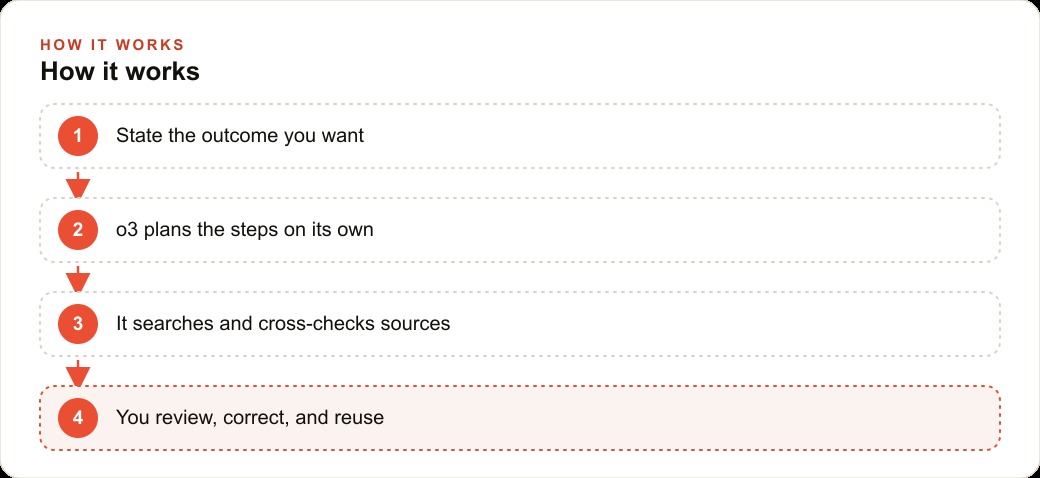
The change that matters most is not raw intelligence, it is how you talk to the thing. o3 rewards what I call goal-based prompting. You tell it where you want to end up, and it works out how to get there. Older tools forced you to bring all the context yourself, choose the right search, wait for results, then re-prompt on top of them. o3 collapses that entire sequence into one request. It makes a plan, runs the searches, reads what it finds, compares sources, and hands back a finished answer.
To see how far this goes, consider a test that would have been impossible a year ago: hand it a single photo with no text and no obvious clues and ask where it was taken. o3 cropped into the details, made guesses, ran image searches, pulled up close to a dozen pages from travel blogs to forums to videos, cross-referenced them, and landed on the exact spot with coordinates. It did the same on research tasks, assembling a full profile from links scattered across the web. That is not answering a question. That is running a small investigation on its own, which is exactly what tools-plus-reasoning unlocks.
Who this changes things for
The businesses that gain most are the ones that spend real hours doing research, answering repeat customer questions, or making decisions from messy information. A real estate agent can have it pull and compare neighborhood data in one pass. A dental office can turn a pile of patient questions into clear, on-brand answers. An accounting firm can summarize a long document and flag what needs attention. The common thread is that work which used to take several tools and a chunk of an afternoon now comes from one well-aimed prompt.
The owners who benefit most are the ones who stop treating AI as a fancy search box and start handing it whole goals. That mental shift is the actual upgrade. The model is capable of far more than most people ask of it, because most people are still typing single keywords out of habit. The businesses that reframe their questions as outcomes will pull ahead of the ones that keep using a smarter model in the old, small way. This is the same instinct that separates a strong Facebook and Instagram ad campaigns operator from a weak one: you state the outcome you want and let the system find the path, rather than micromanaging every step.
The auto repair shop that got its afternoons back
Let me make this concrete with one business, because the abstract case never lands as hard as a specific one. Picture an auto repair shop, where every minute at the desk is a minute away from the bay. The shop has three constant drains: diagnosing unfamiliar problems, answering the same customer questions over and over, and keeping up with parts and pricing. o3 helps with all three, and here is how I would set it up.
First, diagnosis support. A technician describes a symptom, the make, model, year, and any codes, and asks o3 to lay out the likely causes and the order to check them. It reasons through the problem and pulls relevant references, which is faster than digging through forums by hand. The tech still makes the final call, but they start from a sorted shortlist instead of a blank page. Second, customer communication. The front desk pastes a rough note, say a brake job estimate, and asks o3 to turn it into a clear, friendly explanation that a worried customer will actually understand, and the same for follow-up texts and service reminders. Third, the research that used to eat hours. Once a week the owner asks o3 to scan for common issues and recall news on the vehicles they service most and summarize what is worth knowing.
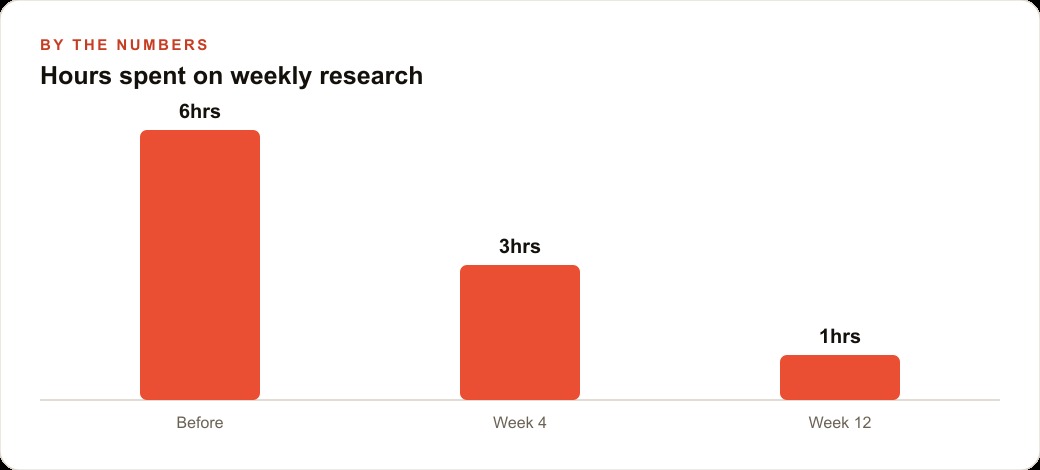
Look at the illustrative arc of that weekly research task. Before o3, the owner might spend around six hours a week on scattered searching and reading. A month in, with goal-based prompts and saved templates, that could drop to about three hours, because o3 does the gathering and the owner reviews a tidy summary. By around the twelve-week mark, with the routine dialed in, it might be closer to a single hour a week. Those figures are illustrative rather than measured, but they capture the real shape of the gain: the model absorbs the mechanical searching, and the human keeps only the judgment. The confirmations and friendly customer explanations o3 drafts can flow straight into the shop's CRM and website stack, so the follow-up texts and service reminders go out consistently instead of falling through the cracks on a busy day.
The catch: it repeats the mistakes of the sites it reads
None of this works without one discipline, and the news coverage tends to skip it. o3 can repeat errors from the sources it reads. In one test it listed a wrong nationality simply because a source said so. The model is confident and articulate whether it is right or wrong, which is exactly why unverified output is dangerous in a business setting. Every number, price, and diagnosis it produces has to be confirmed by a human before it reaches a customer.
The second, smaller catch is that prompt skill still counts. o3 lets you open up its reasoning and steer it when the first pass is not quite right, and knowing how to nudge it gets sharper results than a lazy one-liner. So the model is powerful, but it is not a replacement for judgment on either front. Treat it as a fast, resourceful assistant that drafts and researches, and keep a person in the loop to confirm anything that will be acted on. For the auto shop, that means o3 drafts the estimate explanation and researches the recall, and a human checks every figure and diagnosis before it goes out the door.
Why the tool-plus-reasoning combination is the actual line
It is worth being precise about what makes o3 different, because a lot of the coverage blurs it into just a better model. The earlier generation of reasoning models could plan and think, but they were effectively working from memory and whatever you pasted in. If the answer lived on a webpage, in a file, or inside an image, they were stuck unless you fetched it and handed it over. That meant the human was always the connective tissue between thinking and acting. You did the searching, the model did the reasoning, and the quality of the result depended on how good your gathering was.
o3 removes that seam. When it decides it needs a source, it goes and gets it. When it needs to look closely at an image, it crops in. When it needs to run an analysis, it runs one. The reasoning and the tool use interleave, so the plan updates as new information arrives, exactly the way a capable person works through an unfamiliar problem. That is why the photo-location test is such a good demonstration. It is not one skill, it is a loop of reasoning, fetching, checking, and revising, and that loop is what a business is really buying when it puts o3 to work. It also means the quality ceiling is no longer set by how well you gather context, which is precisely why the way you prompt has to change.
The move to make this week
Here is the concrete action, and it is small. Switch to o3 in your chat app and change how you prompt. Stop writing step-by-step instructions and start writing outcomes. Say what you want the finished result to be, hand over the relevant context, and let the model plan and search. When it finishes, read its reasoning, and if something is off, reprompt to nudge it rather than starting over from scratch.
Then build a small set of templates for the jobs you repeat: a diagnosis helper, a customer-reply writer, a weekly research summary. Save the ones that work so anyone on your team can reuse them, which is how a personal trick becomes a team capability. And make verification a rule rather than an afterthought, especially on facts, prices, and anything a customer will act on. That single habit is the difference between o3 saving you time and o3 quietly introducing errors into your business.
There is a wider point worth holding onto. The same resourcefulness that lets o3 investigate a photo also makes it a genuinely useful research partner for the parts of a business that compound slowly, like the content behind SEO and organic search, where a model that can gather, compare, and summarize sources shrinks the busywork and leaves the strategy to you. The release is not important because of the benchmark it topped. It is important because it changes the smallest daily habit, how you phrase a request, and small daily habits are what actually move a business.
It is also worth being honest about who will and will not benefit. The model does not reward passivity. If you switch to o3 and keep typing the same lazy keyword searches you always did, you will get a slightly better version of what you already got, and you will conclude the hype was overblown. The gains are real but they are conditional. They go to the people who change their behavior to match the tool's new shape, who hand it goals instead of instructions, who build and save the templates that turn a one-time win into a repeatable routine, and who put a verification step between the model and the customer. None of that is difficult, but all of it is a choice, and the model cannot make that choice for you. The businesses that treat this release as a prompt to upgrade their own habits will pull steadily ahead of the ones that treat it as a magic button, and that gap will widen every week as the habit compounds.
You can stand all of this up yourself with a little practice, and I would encourage you to start with one repeated task and one saved template this week. If you would rather have the prompts, the verification checks, and the weekly routine built and handed to you ready to run, that is exactly the kind of setup an expert can put together, so your team spends its time on the work only it can do and not on chasing answers.
That is exactly what we do at AI DOERS. Book a private 30-minute call with Madhuranjan Kumar and we will map the fastest path to it for your specific business.
Book your call →
Madhuranjan Kumar
Madhuranjan Kumar brings 20 years of performance-marketing experience and has managed over $200 million in Facebook ad spend for brands across the United States and beyond. His expertise spans the full modern marketing stack: Meta, Google Ads, TikTok, email automation, CRM, and the websites that hold it together. At AI DOERS he turns that track record into lead-generation systems for businesses across every industry.