
NVIDIA Nemotron 3 Nano Omni: What The First Multimodal Test Shows
Nemotron 3 Nano Omni is an open-source 30B mixture-of-experts model from NVIDIA with 3B active parameters, and a hands-on test shows it turning video, audio, images, and PDFs into text quickly while also reasoning and handling tool calling.

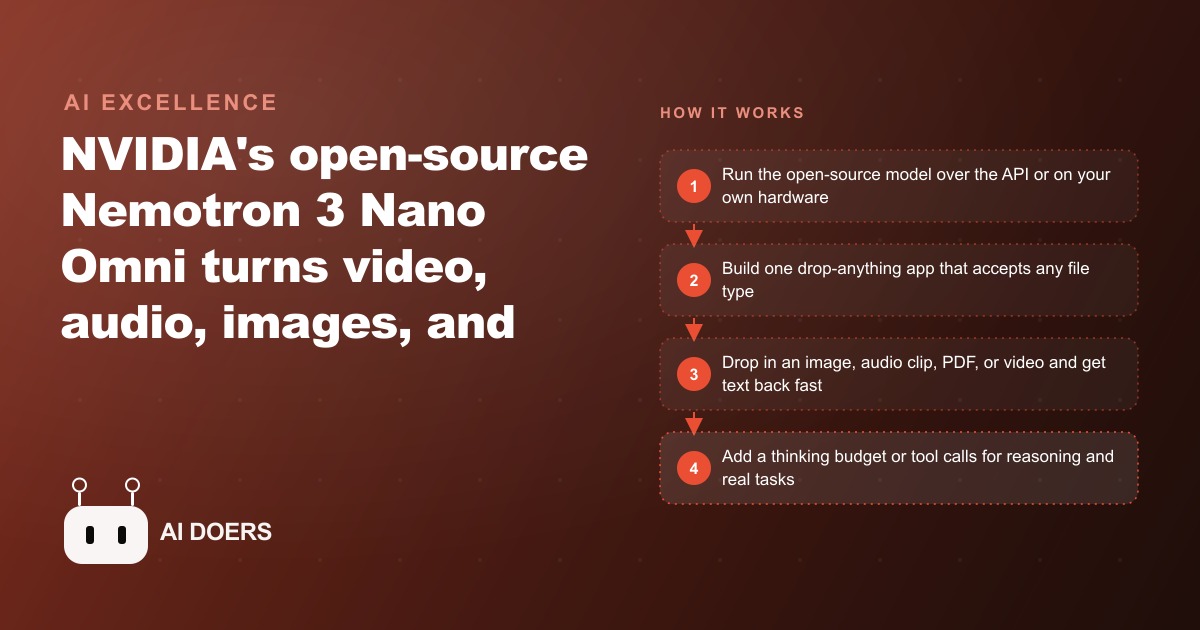
NVIDIA released a multimodal model that turns video, audio, images, and PDFs into text through a single interface, runs on consumer hardware as a 3B-active-parameter mixture of experts despite its 30B total size, and is open source, which makes it the first model of this capability tier that a small business can host without a per-call API fee.
The first hands-on test put six specific capabilities to work on real file types rather than benchmark tasks. I am Madhuranjan Kumar, and the six results are worth going through in order because each one reveals something specific about where Nemotron 3 Nano Omni differs from what a large multimodal model typically delivers. The practical value of this model sits in the intersection between capability (any file type in, clean text out) and economics (open source, hostable on a workstation with a modern GPU). Understanding what it actually does well, based on a direct test rather than a leaderboard score, is the prerequisite for knowing whether it changes anything for your specific business.
1. A 35-page PDF starts OCR and races through every page before a person could scroll to page five
PDF handling is where most businesses first run into the document volume problem. Client files arrive as multi-page scanned documents. Insurance scopes run to 30 pages. Financial statements come as locked PDF exports. Legal exhibits get assembled into hundred-page packages that need to be searchable and summarizable. The manual process is slow: open the PDF, scroll through it page by page, extract the relevant figures and text by hand, and move to the next document. Specialized OCR software helps but requires setup, separate licensing, and ongoing management as a distinct tool.
The test dropped a 35-page PDF into the drop-anything interface and observed the result. The model began processing immediately, without a loading or indexing step requiring any wait. It moved through page after page at a speed a human reader could not match manually, extracting readable text from scanned content and producing a continuous text output covering all 35 pages. The output was accurate on clean, high-quality scans and remained functional on pages with typical office scanner image quality. The single-interface design meant no file conversion, no export step, and no separate OCR tool to manage alongside the model.
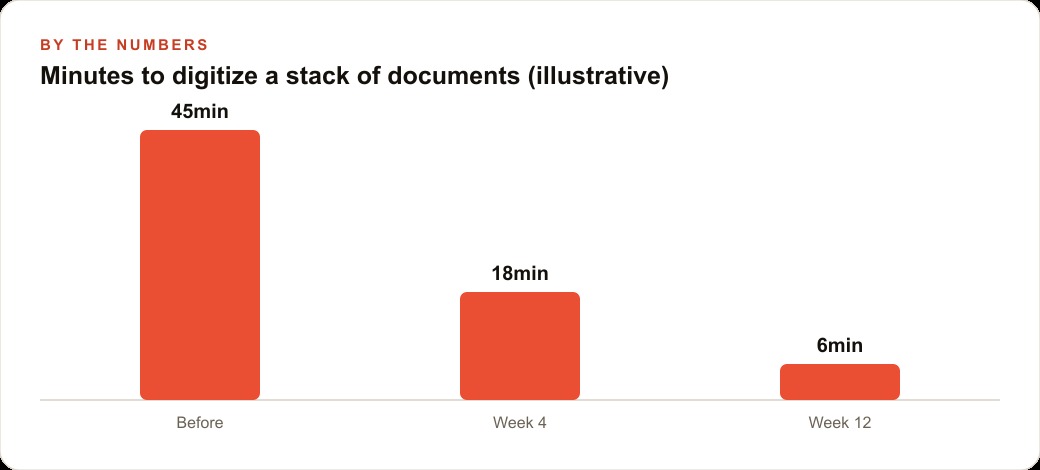
For a business that processes multi-page scanned documents regularly, the throughput this represents is the number that matters most. A 35-page document processed in the time it would take a human reader to manually reach page five means the bottleneck of manual document intake can be addressed with a model rather than with additional staff hours. At scale, across dozens of documents per week, the hours recovered compound over a full year into meaningful operational capacity.
2. Scene photographs produce descriptions specific enough to be useful for indexing and retrieval
Image description from a multimodal model ranges from generic to specific, and the practical value of the output depends entirely on where on that range the model lands. A description that returns "a photograph of a building exterior" is technically accurate but operationally useless for building a searchable index of inspection photographs. A description that returns a specific account of visible damage type, location on the structure, and contextual details about the surrounding scene is a different quality of output entirely: the difference between a model that generates descriptions and a model that generates indexed content.
The test dropped a scene photograph with no text into the interface. The returned description was specific enough to be useful for content indexing and retrieval. It included identifiable characteristics of the scene, described the relationship between elements in the composition, and noted relevant visual details at a level of specificity that would allow the image to be found later through a natural language search about its content. A search for images showing damage to a particular type of structure or surface would correctly surface an image with this level of description attached to it.
For businesses that handle field photography at volume, inspections, property documentation, site surveys, or progress photographs on projects, the ability to generate specific and searchable descriptions automatically from a batch of photographs changes the economics of maintaining a useful photo archive. Photos currently stored in date-stamped folders with generic filenames become searchable by content without any manual tagging work, because the model generates the searchable metadata from the image content itself.
3. Audio transcription comes back in less wall-clock time than the clip takes to play
Audio transcription throughput is measured in two dimensions: accuracy and speed relative to the audio duration. A transcription system that produces output in 5 minutes for a 5-minute clip operates in real time. A system that produces output in 2 minutes for a 5-minute clip is faster than real time. Most transcription services, automated or human, are slower than real time when you include the submission, processing wait, and download steps involved in routing a file to an external service.
The test submitted an MP3 audio clip and measured the time from submission to returned transcript. The output came back faster than the clip's running time, meaning the model processed the audio and generated the transcript in less time than it would take to listen to the clip in real time. The content of the transcript captured the spoken words accurately, including natural speech patterns, sentence boundaries, and the distinction between clearly enunciated words and faster or less distinct speech.
For any business that records client calls, field voice memos, meeting notes, or training sessions and needs those recordings in searchable text form, faster-than-real-time transcription at reasonable accuracy changes the operational cost of maintaining audio records. The bottleneck shifts from transcription itself to the downstream work of reviewing and acting on the content, which is the higher-value step that actually requires human judgment rather than machine throughput.
4. One video file produces both a visual scene description and a separate audio transcript simultaneously
Video content contains two independent streams of information that are rarely processed together automatically. The visual stream contains what is on screen, what is happening in the frame, what the environment looks like, and what actions are taking place. The audio stream contains what is being said, background sounds, and any context spoken rather than shown. Most transcription tools handle the audio stream only. Most image description models handle still frames only. Processing both streams from a single video file in a single submission and returning both as structured outputs is a qualitatively different capability from handling either stream alone.
The test dropped an MP4 video clip into the interface and received two distinct outputs: a visual description covering what appeared on screen across the clip's duration, and a separate audio transcript of the spoken content. Both were returned from a single file submission without requiring the user to extract the audio track separately, submit it to a dedicated transcription service, and then manually combine the two outputs into a coherent record.
The business applications where both streams matter simultaneously include recorded sales calls where what the screen shows and what the salesperson says are both needed for review, training videos where the visual demonstration and the verbal explanation together form the complete instructional content, and field inspection videos where what the crew member shows the camera and what they say about it together describe the site condition. A model that processes both streams at once from a single file reduces a multi-tool workflow to a single submission, and produces a more complete record of this breakdown's information than either stream alone could provide.
5. The thinking budget makes the depth-versus-speed trade-off configurable per individual task
Reasoning models that allocate tokens to extended thinking before producing a final answer offer a depth-of-analysis capability that direct-response models do not. The trade-off is time: more thinking tokens means a more thorough answer with longer processing time. The practical question for production use is whether the thinking budget is fixed or whether it can be configured per task based on what that task actually requires.
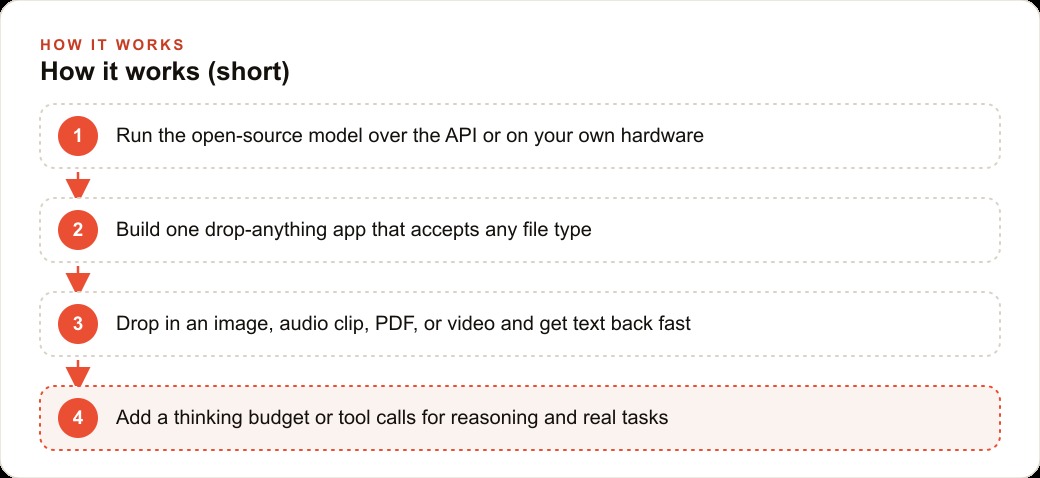
Nemotron 3 Nano Omni supports a configurable thinking budget, which means the operator can set a low budget for tasks where speed matters more than deep analysis, and a higher budget for tasks where thorough reasoning is needed. For straightforward extraction tasks, reading a document and pulling specific fields, transcribing audio, or describing a scene, the thinking budget can be set low because those tasks do not require extended reasoning chains. For tasks that require analysis, comparison, judgment, or inference beyond direct extraction, a higher thinking budget allows the model to reason through the question before committing to a final answer.
The test set the thinking budget to a moderate level for an explanatory question and observed the model allocate roughly 3,000 thinking tokens before producing a well-organized, clearly reasoned response. The reasoning pathway was visible in the output, showing the steps the model worked through before reaching the conclusion. Setting a low budget on a simpler extraction task produced a faster response with no meaningful loss in output quality, confirming that the budget setting functions as a genuine speed-versus-depth control rather than a fixed parameter with a single optimal value.
For businesses that use a single model across both simple extraction and complex analysis tasks, the configurable budget means the model does not over-reason on simple tasks and does not under-reason on complex ones. Each task gets the compute it actually needs, which is both faster and cheaper than a fixed high-reasoning mode applied uniformly to every request.
6. A single tool call in a coding environment produced a working HTML page on the first attempt
Tool calling in a language model context means the model can invoke external functions, APIs, or capabilities defined by the environment it runs in, as part of completing a task. Rather than generating a description of what code should be written, the model generates the code, invokes the execution environment, observes the result, and continues the task from there. This is the mechanism that makes AI agents genuinely useful for technical tasks rather than just advisory on them.
The test dropped the model into a coding environment with a specific task: build a working HTML page that calls an image generation API and displays the result. The model produced a plan, generated the code for the HTML page, called the appropriate tool to execute it, and the result was a functional page on the first attempt. No iteration was required to fix errors or adjust the implementation. The tool call completed the task rather than producing a draft that required manual debugging.
For a business that uses AI assistance for technical tasks, code generation quality measured by whether the output works on the first attempt rather than requiring multiple correction cycles is the metric that determines how much the tool actually accelerates the work versus how much it simply provides a starting point that still requires substantial human effort to make functional.
To put the full capability picture in concrete business terms, consider a roofing company that processes field inspection photos, voice memos recorded on-site, and PDF insurance scopes for each job. Currently, an estimator spends a full afternoon turning those inputs into a written estimate and a clean job record: manually reviewing each photo, transcribing voice memos by listening through them, and extracting the adjuster's line items from the scope PDF page by page. With a drop-anything application powered by Nemotron 3 Nano Omni, the estimator uploads the full input set for one job. The model produces specific damage descriptions from each photo, a full transcript of the voice memos, and clean text extraction from the scope PDF. The time to produce the written estimate from that structured input drops from a full afternoon to under 30 minutes. Because the model can run on the company's own server, client property photos are not transmitted to any external service. Across a busy season covering dozens of jobs, the hours recovered and the compliance benefit compound into a meaningful operational change that the traditional manual workflow cannot match.
That is exactly what we do at AI DOERS. Book a private 30-minute call with Madhuranjan Kumar and we will map the fastest path to it for your specific business.
Book your call →
Madhuranjan Kumar
Madhuranjan Kumar brings 20 years of performance-marketing experience and has managed over $200 million in Facebook ad spend for brands across the United States and beyond. His expertise spans the full modern marketing stack: Meta, Google Ads, TikTok, email automation, CRM, and the websites that hold it together. At AI DOERS he turns that track record into lead-generation systems for businesses across every industry.