
The Nvidia and Groq Deal, Explained for Business Owners
Nvidia spent 20 billion dollars to license Groq's fast inference chips and hire its leaders without calling it an acquisition. Here is what inference speed actually means for your tools and how I would think about it for a real local business.

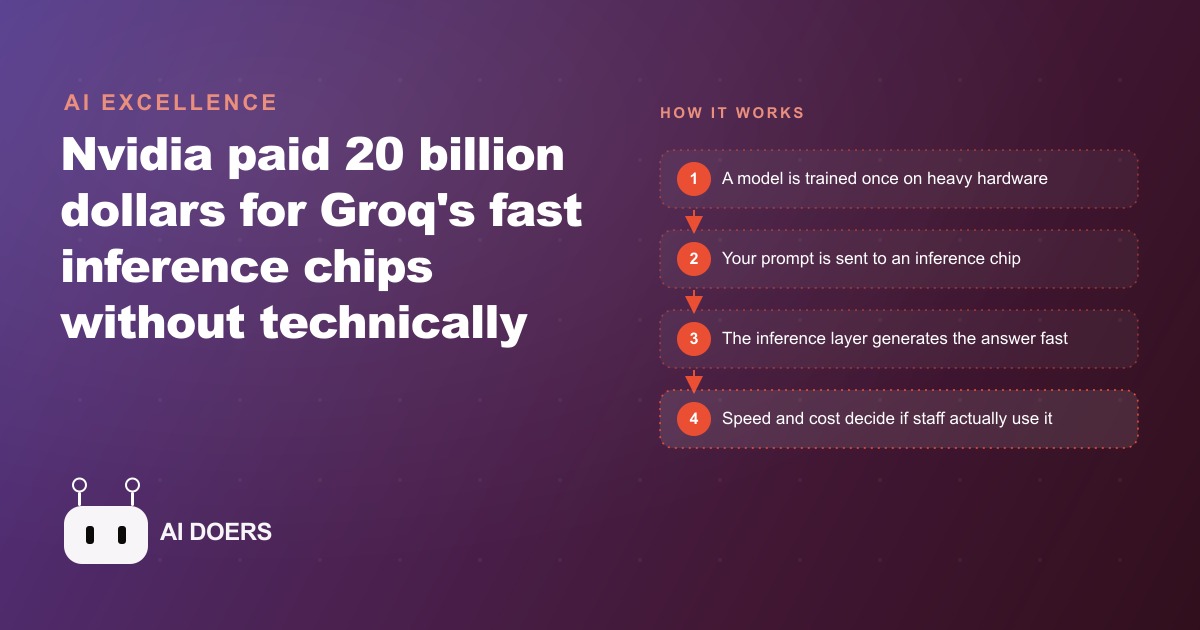
A $20 billion deal closed in 2024 without a single antitrust regulator being notified. Nvidia paid that sum to license Groq's Language Processing Unit technology and absorb the Groq engineering team into its organization. No acquisition, no merger filing, no cross-border regulatory clearance. A licensing agreement combined with employment contracts moved the assets while leaving the corporate shells intact.
That structural choice was the most important decision in the deal. Nvidia had already watched a $40 billion attempt to purchase Arm collapse in 2022 under concentrated regulatory objection from governments in the United States, the United Kingdom, and the European Union. The lesson from that failure was precise: the assets Nvidia most needed could not survive the timeline or scrutiny of a formal acquisition process. So the Groq transaction was designed from the beginning to transfer the technology and the people without firing the regulatory trigger.
Understanding why Nvidia felt that urgency, why it was willing to spend $20 billion and engineer a transaction structure specifically to secure the outcome quickly, is more useful than the headline. The answer lives in a gap that most businesses deploying AI tools have not yet been trained to see.
What Groq built and why a GPU was never designed for it
Training a large language model is a problem of massive parallel computation. Researchers feed enormous datasets into a model, run calculations across billions of parameters simultaneously, and adjust weights across the network over weeks of continuous compute. The GPU was built exactly for this kind of work. Its architecture consists of thousands of cores, each capable of running the same mathematical operation on a different slice of data at the same moment. Parallel matrix math at scale is the GPU's native language, and model training is written in that language.
Running a model is a different problem. When someone submits a question and the model generates an answer, the process is sequential. The model predicts one token, considers what most plausibly follows, predicts the next token, and continues in order until the response is complete. This is not a parallel operation. The GPU's thousands of cores sit partially idle between each generation step, consuming power and incurring cost while contributing nothing to the answer being produced.
Groq's Language Processing Unit was built specifically around this constraint. Rather than the parallel batch architecture of a GPU, the LPU uses a streaming design in which computation flows continuously through the pipeline. Data moves without waiting for the next processing cycle to open. The practical result is inference at a fundamentally different speed. Independent benchmarks since Groq's commercial launch have placed LPU inference at three hundred to five hundred tokens per second on standard models, compared to thirty to sixty tokens per second on GPU setups running the same model at comparable quality. Not a modest improvement. An order-of-magnitude gap, appearing exactly where a user actually sits: in the wait between submitting a question and reading the answer.
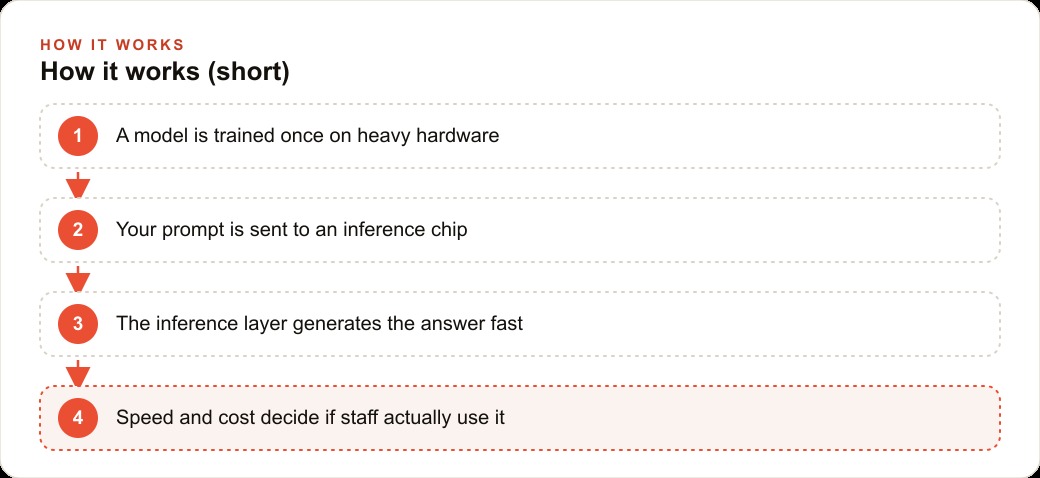
The adoption threshold that speed determines
Madhuranjan has tracked AI tool adoption across businesses in multiple industries, and the pattern that keeps emerging is not the one most business owners expect when they first invest in a tool.
Businesses tend to evaluate AI tools on accuracy. Can it answer complex questions correctly? Does it handle nuanced requests? Does it make obvious errors on routine tasks? These are reasonable evaluation criteria, and they matter. But they are not the variable that determines whether a tool is still in active use six months after deployment.
The variable that determines lasting adoption is speed. Not speed in the abstract, but speed relative to a specific cognitive threshold: the point at which a person's attention naturally migrates to something else while waiting for a response.
Below that threshold, somewhere around two to three seconds for most working adults, an AI tool gets used the way a search engine gets used. Without deliberation, without a conscious decision to open it, as an automatic reflex. The tool is embedded in the workflow because the friction of reaching for it is lower than the friction of doing without it.
Above that threshold, the dynamic reverses. A seven-second wait is long enough for the user to scan an incoming notification, begin a different task in a separate tab, or simply lose the thread of what they were trying to accomplish. A fourteen-second wait produces a complete attentional interruption. The user finishes waiting, reads the response, and finds that the context has cooled enough that the tool feels like extra work rather than an accelerant.
Tools that consistently land above the threshold do not fail dramatically. They fail quietly. Usage drops from daily to weekly. Weekly becomes occasional. Occasional becomes the politely worded observation from a team member that "we tried it for a while but it didn't really stick." The abandonment is rarely attributed to speed because the user is not consciously tracking it. The tool simply stops feeling worth it. The accuracy could be excellent. The interface could be clean. None of it survives a response time that reliably breaks attention.
This is the operational significance of inference speed for any business that has purchased or is evaluating AI tools. Faster delivery is not a premium feature for technical teams running at high throughput. It is the specific mechanism by which a tool crosses or fails to cross the threshold that separates habitual use from ceremonial use. And the difference between these two outcomes, for a business that invested in AI to change how it operates, is the entire return on that investment.
A hair salon, a booking assistant, and what happens to sixty thousand dollars a year
Consider a scenario Madhuranjan has seen replicated across service businesses with evening inquiry problems.
A hair salon runs a high-end operation with a specific gap: the most valuable inquiries arrive in the evening hours, after the front desk closes. Clients who have seen work on social media or received a referral reach out at the moment of highest motivation. If there is no immediate response, that motivation decays. By morning, the conversion window has narrowed considerably, and roughly half of these prospects will have moved on without booking.
The owner installs an AI booking assistant trained on the full service menu, pricing structure, and live scheduling calendar. It can answer detailed questions, confirm availability in real time, and complete bookings without human involvement.
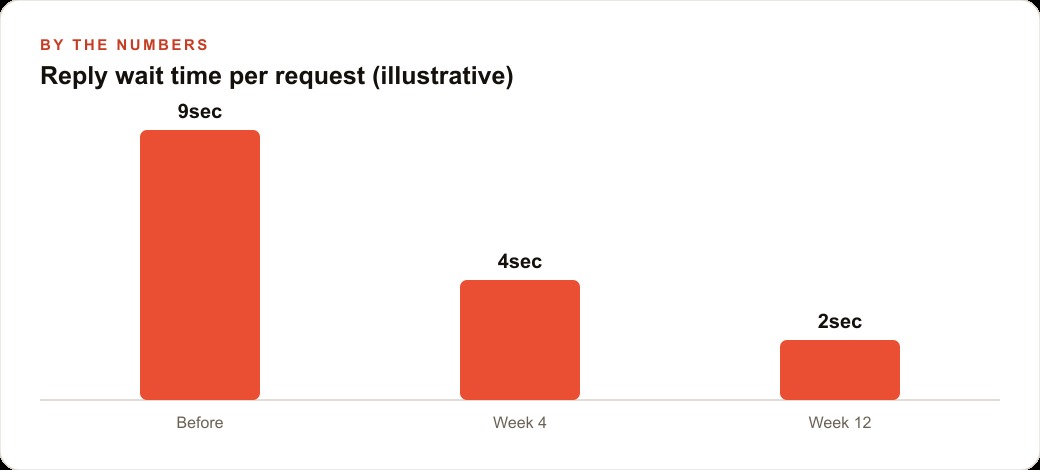
If that assistant responds in under two seconds, the evening inquiry typically converts. A client texts at 9:20 p.m. asking about the cost of a keratin treatment and whether there is a Saturday morning slot. The assistant replies before the client has set her phone down again. She sees the price, sees the Saturday 10 a.m. availability, and books in under two minutes. The salon earns a $210 appointment while the owner is not at her desk. The exchange feels like talking to someone who was ready for the question.
If the same assistant responds in fourteen seconds, the conversion rate drops sharply. The client asks, sets the phone down, picks it back up when the response arrives, but the impulse that generated the inquiry has already begun to cool. She considers booking, decides she will just call in the morning, and approximately half the time she follows through. The other half, she does not. The appointment simply does not happen.
The AI model is identical in both scenarios. The training data is identical. The accuracy of the response is identical. The only difference is the lag between question and answer. In the fast scenario, the salon converts an estimated seventy-five to eighty percent of evening inquiries. In the slow scenario, roughly forty to forty-five percent.
At three evening inquiries per six operating days per week, with an average ticket of $175, that gap in conversion rate accumulates to approximately $55,000 to $65,000 in additional annual revenue from exactly the same AI tool with exactly the same answers. Not from a better model. Not from expanded marketing. From faster inference.
The number is specific to this example, but the principle generalizes to any business where AI is being asked to capture time-sensitive interest from people who will not wait.
Why cheaper inference changes the entire business case
There is a second consequence of the LPU architecture that shapes the economics of AI tools over the next several years, beyond speed alone.
When inference is expensive to run, providers ration it. Usage caps, tiered pricing, per-token charges that compound quickly at scale: these structures exist because GPU-based inference carries real operating cost, and providers build that cost into their pricing to protect margins. A business running several hundred AI interactions per day across customer service, lead qualification, or document processing quickly encounters a ceiling where the economics stop working at standard API rates.
When inference becomes cheaper because the underlying hardware is more efficient, the math changes across the entire stack. Providers can lower prices without compressing margins, or they can maintain prices and expand usage allowances to volumes that were previously enterprise-only. Businesses that were priced out of high-frequency inference use cases gain access to economics that simply did not exist on GPU infrastructure.
This is part of what Nvidia is acquiring through the Groq deal, structured carefully to avoid the regulatory friction that killed the Arm transaction. Not just a speed advantage, but control of the pricing structure for AI delivery across a period of rapidly accelerating inference volume. Every new AI application, every business that moves from occasional to daily AI use, every consumer product that embeds an AI layer adds to the inference workload. The company that owns the efficient hardware at the base of that demand curve owns a position with traffic that is, by every credible projection, only going in one direction.
What to look for when choosing AI tools today
The practical question for any business evaluating AI tools is not which model is most accurate. Accuracy differences between major models at comparable tiers are real but often smaller than they appear in benchmarks, and the gap is narrowing with every model release.
The more consequential question is: how fast does this tool respond under actual working conditions?
Not in a demo. Not in the first ten seconds of a free trial with the server nearly empty. In real use, at peak hours, when other users are simultaneously generating responses on the same infrastructure.
Madhuranjan uses a specific test when evaluating any AI tool before recommending it: open a task that requires a substantive, multi-part response, submit it, and notice what happens in the mind while the system works. If a different thought arrives before the answer does, the tool will be abandoned within ninety days. Not because the team rejected it, but because the habit of reaching for it will never form. If the answer appears before the next thought completes, the tool will be embedded in the workflow within thirty days, without anyone having to mandate its use.
The tools most likely to survive that test are the ones running on inference-optimized infrastructure, either purpose-built LPU designs or next-generation architectures developed in the wake of the Nvidia deal. The tools most likely to fail quietly, six months after deployment, are the ones selected entirely on accuracy benchmarks with no weight given to delivery speed.
Nvidia paid $20 billion, structured the deal as a license to sidestep the regulatory sequence that killed the Arm acquisition, and brought the Groq team inside its organization because the company understood one thing more clearly than most market observers: the model is almost incidental. The smarter-model race matters enormously for the upper bound of what AI can accomplish. But adoption, the actual daily habitual use that changes how a business operates, is determined by what happens in the microseconds between a question and its answer.
That is the last mile Nvidia wanted to own. And the $20 billion price suggests the company understood exactly how much the last mile is worth.
That is exactly what we do at AI DOERS. Book a private 30-minute call with Madhuranjan Kumar and we will map the fastest path to it for your specific business.
Book your call →
Madhuranjan Kumar
Madhuranjan Kumar brings 20 years of performance-marketing experience and has managed over $200 million in Facebook ad spend for brands across the United States and beyond. His expertise spans the full modern marketing stack: Meta, Google Ads, TikTok, email automation, CRM, and the websites that hold it together. At AI DOERS he turns that track record into lead-generation systems for businesses across every industry.