
NVIDIA's $20 Billion Groq Deal: Why Fast, Cheap AI Just Got More Important
NVIDIA's roughly $20 billion move on Groq is a bet that the future of AI profit is fast, cheap inference rather than raw training power, and that shift pushes down the cost of running AI for everyone, including small businesses.

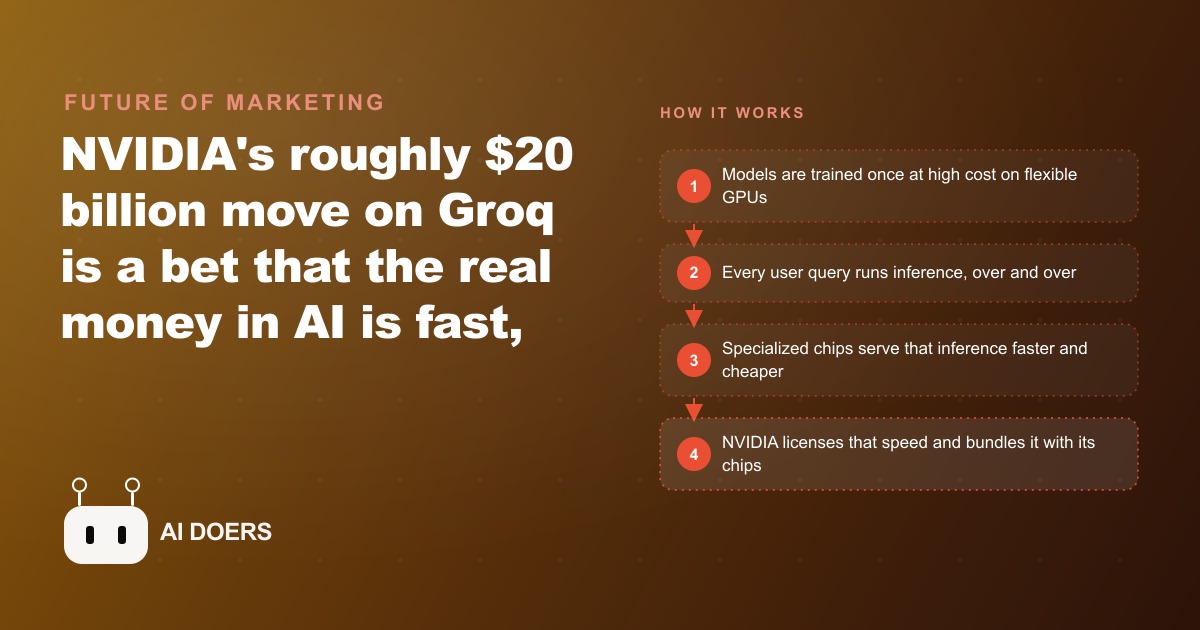
NVIDIA is reportedly acquiring Groq's chip designs and licensing arrangements in a deal valued at around twenty billion dollars. The specific combination that makes this story important is what Groq's technology does and what NVIDIA is buying it to do. I am Madhuranjan Kumar, and the business lesson here operates at two levels simultaneously: the inference economics level that determines what AI services cost to run, and the competitive positioning level that determines who controls the supply of fast AI inference for the next decade.
A Twenty Billion Dollar Deal Signals That Fast Inference Is Now a Strategic Asset, Not a Technical Nicety
The scale of the reported deal is the first signal. Twenty billion dollars is not a price for technology that could be replicated internally over a reasonable timeline at lower cost. It is a price for technology and market position that would take too long to build organically, where the time cost of building internally is greater than the acquisition price. NVIDIA, which already has the dominant position in AI training compute and a significant position in inference as well, is reportedly paying twenty billion dollars for a company whose specific advantage is inference speed. That pricing tells you that the market for fast inference is expected to be enormous, and that the current inference speed advantage Groq holds is viewed as durable enough to justify the acquisition price rather than as a gap that NVIDIA's existing capabilities would close on their own.
For a business tracking AI infrastructure for strategic awareness, the acquisition price is an efficient signal about which layer of the AI stack is currently most competitively contested. Training hardware has been a strategic asset for five years. The signal from this deal is that inference hardware is becoming the equally contested layer for the next five.
Generalized Chips Versus Specialized Chips Is the Architecture Tension Underneath the Acquisition
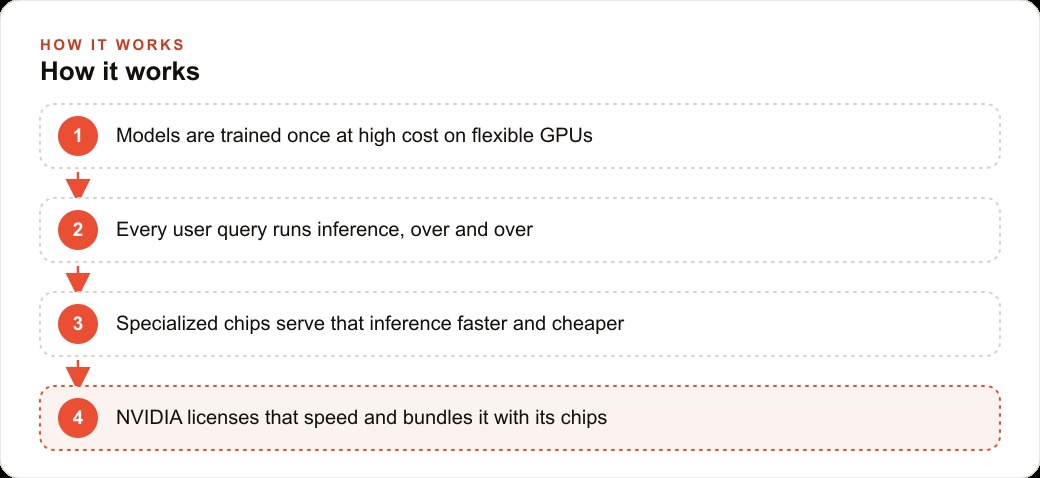
NVIDIA's GPU architecture is generalized: it was designed for parallel computation of many kinds and was applied to AI because AI training maps well onto parallel computation. The generalization is an advantage in addressable market, because a GPU can be used for graphics, for scientific simulation, for video rendering, and for AI, which means every GPU sold into any of those markets is revenue for NVIDIA. The generalization is a disadvantage in efficiency for specific workloads where a purpose-built architecture outperforms a general one.
Groq's LPU is the opposite: it was designed for a single workload, sequential AI inference, and optimized for that workload at the cost of everything else. It cannot be repurposed for training, for graphics, or for general computation. It is extraordinarily fast at the one thing it does and useless for everything else. In a market where the dominant inference workload is large language model token generation, that specialization is a competitive advantage that a generalized chip cannot match on pure latency. NVIDIA's acquisition of that design knowledge is an attempt to incorporate the LPU's specialization advantages into a hybrid architecture that can offer both the training capability of the GPU and the inference latency of the LPU, or to offer both as complementary products from a single vendor.
Inference Is the Recurring Revenue and Training Is the Periodic Capital Investment
The economic structure of AI services at scale distinguishes sharply between training and inference. Training a frontier model is a massive, infrequent capital expenditure. Running that model for inference is a recurring operational expenditure at scale, because every single response to every user query is a separate inference run, and the models that serve hundreds of millions of weekly users run inference at a rate that dwarfs the training run in total compute consumption over any meaningful time period.
For chip vendors, inference is therefore the market with the most predictable and growing recurring revenue. Each new frontier model that achieves wide deployment creates a multi-year inference revenue stream for the hardware running it. Training revenue is lumpy and competitive, because a new training run represents a discrete event where the customer might choose any available hardware platform. Inference revenue is sticky and growing, because replacing inference infrastructure for a deployed model in production service is expensive and disruptive, creating switching costs that maintain hardware relationships across model generations.
NVIDIA acquiring the most impressive inference speed advantage in the market is therefore also acquiring the most impressive recurring revenue generating asset in the AI hardware market. The inference hardware that the major AI service providers use for their production deployments is the revenue source that grows proportionally with AI service adoption, which means it grows proportionally with the macro trend that is currently producing some of the fastest-growing market opportunities in technology.
The Engineering Talent Went to NVIDIA, and the Combined Team Is What Matters Most
In any talent-intensive technology acquisition, the technology itself is often less durable than the team that built and continues to develop it. Hardware architectures require deep expertise to develop, optimize, and evolve across chip generations. A team that has spent years developing a specialized inference architecture has accumulated problem-solving knowledge and design intuition that cannot be transferred through documentation alone. When NVIDIA acquires Groq's designs, the most valuable component of the acquisition is not the current chip but the engineering organization that knows how to build and improve that class of chip.
The combined team, Groq's inference specialization expertise plus NVIDIA's production manufacturing scale and software ecosystem, is the competitive asset. NVIDIA's CUDA software platform, which runs on its GPUs and has become the dominant programming model for AI development, provides a distribution channel for inference hardware that a standalone Groq could not access at the same scale. Groq's inference architecture expertise provides performance characteristics that NVIDIA's generalized GPUs could not match on pure sequential inference latency. The combination addresses limitations that each had independently.
Old Chips at Incredible Speed Is the Operational Story Behind the Acquisition
One of the less-reported dimensions of Groq's technology is that its performance at inference speed comes from an architecture that does not require the latest and most expensive manufacturing process nodes to achieve its advantage. While training-focused AI chips are in an arms race for the most advanced chip manufacturing process, Groq's LPU achieves its inference speed advantage partly through architectural choices rather than purely through manufacturing advancement. This means that existing manufacturing capacity, which is more widely available than the cutting-edge capacity required for the most advanced training chips, can produce LPU hardware at scale.
For a buyer planning to scale a product across a large enterprise customer base, the manufacturability at existing process nodes is a significant operational advantage over a chip that requires leading-edge capacity that is already fully committed to other high-priority products. NVIDIA's acquisition of an inference architecture that can be manufactured at scale without competing for the most constrained manufacturing slots is therefore also an acquisition of a more scalable production pathway for inference hardware than a cutting-edge training chip alternative would provide.
A Defensive and Offensive Bet at the Same Time
The acquisition serves two strategic purposes simultaneously. Defensively, it eliminates a credible independent competitor in the inference hardware market that was beginning to attract meaningful customer commitments from AI service providers who prioritize inference latency. Any large enterprise customer that had been evaluating Groq hardware as an alternative to NVIDIA for inference workloads will now be evaluating what NVIDIA itself offers in that category, which is a more comfortable position for NVIDIA than competing with an independent specialist.
Offensively, it positions NVIDIA to offer a hardware solution that addresses the fastest-growing segment of AI compute demand, inference at scale with predictable latency, from within its existing customer relationships. An NVIDIA customer that already uses NVIDIA GPUs for training can add an NVIDIA inference solution without changing vendors, which is a simpler procurement conversation than adding a second hardware vendor to manage.
Expect Packaged Chip Offerings and Cheaper Inference Downstream
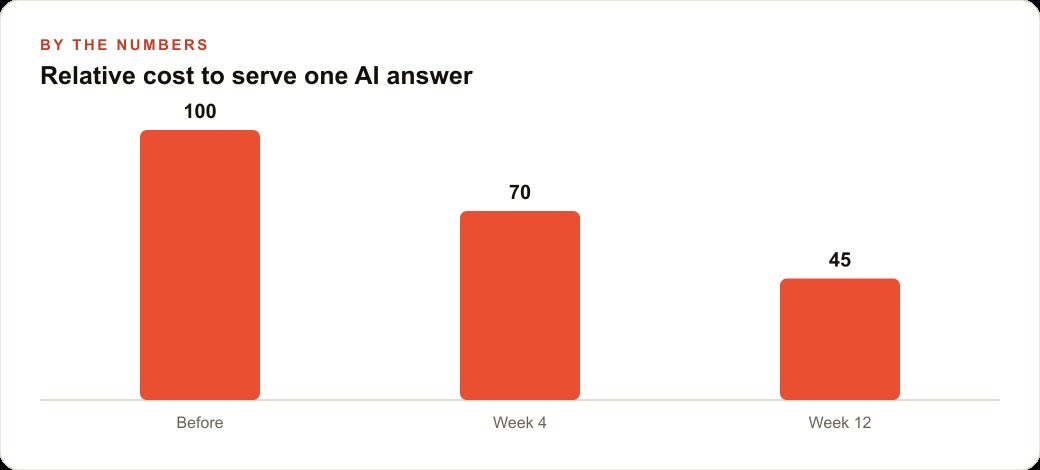
The downstream effect of this acquisition for businesses that use AI services is likely to be lower inference costs and higher inference reliability over the next two to three years. When the dominant hardware vendor in a market acquires the most performance-optimized alternative in the fastest-growing segment of that market, the competitive pressure that drove the independent specialist to innovate on cost-efficiency is now inside the acquirer's product roadmap. If NVIDIA deploys inference-optimized hardware broadly at lower cost than current GPU inference, the AI service providers that run on NVIDIA hardware pass those economics through to their customers in the form of lower API pricing.
For a business currently paying for AI API access, the most direct benefit of this acquisition dynamic over the next few years is likely to be a lower cost per inference call as inference hardware becomes more efficient and more competitive. That cost trajectory is one of the reasons that AI-assisted workflows which are currently marginal on an ROI basis become clearly positive ROI as the cost per API call falls. Building the workflow now and benefiting from a declining cost structure as the workflow scales is the compounding economic case for early AI workflow investment that this acquisition makes more legible.
For businesses running paid social advertising with AI-assisted creative and analytics, and businesses running SEO and content production with AI assistance, the falling inference cost trajectory directly improves the economics of the AI-assisted production volumes those businesses can run cost-effectively.
What This Means for a Business Evaluating AI Service Providers Now
The NVIDIA and Groq story has a specific practical implication for businesses evaluating which AI service providers to build workflows on in the near term. The acquisition signals that inference speed and cost are the next competitive battlefield in AI infrastructure, which means that the providers who currently offer the fastest inference at the lowest cost per token are the ones facing the most intense competitive pressure from well-capitalized incumbents. Competition at the infrastructure level typically benefits customers through lower prices and improved availability, as competing providers invest in capacity and efficiency to maintain their position.
For a business making a procurement decision about AI API providers today, the inference economics story suggests that current pricing is not a stable anchor. The cost per token for inference is likely to fall as competition intensifies and as NVIDIA's combined capabilities reach the market. Building workflows that are tied to a specific pricing point rather than to a relative value comparison makes those workflows fragile to price changes in either direction. Building workflows around a provider's reliability, latency characteristics, and capability for the specific task type makes the workflow more durable because it is based on properties that are stable relative to competitive dynamics rather than on a price point that is actively being competed down.
For businesses running SEO content production and paid advertising workflows with AI assistance, the practical action today is to negotiate volume-based pricing with primary providers where possible, to document the alternative providers capable of handling each workflow, and to run a quarterly cost comparison across providers rather than assuming that initial pricing represents the long-term cost structure of the service.
The Synthesis: Speed Won and Reliability Is Next
The NVIDIA and Groq story, taken together with the broader inference economics landscape, points toward a synthesis that is useful for any business building AI into its operations over the next two to three years. Speed won the first round of the inference competition: Groq built a demonstrably faster chip, attracted meaningful customer attention, and was acquired at a price that confirms the market value of that speed advantage. The next round of the competition is reliability at scale, meaning consistent latency under load, high availability targets backed by real SLA guarantees, and the enterprise-grade support and security certifications that large business customers require before committing critical workflows to a new infrastructure provider.
The businesses that benefit most from this competition are the ones deploying AI at enough scale that the economics of inference cost and the reliability of inference delivery are real operational decisions rather than technical footnotes. For a business running AI assistance across ten workflows at meaningful volume, a five percent reduction in per-token cost and a one nines improvement in availability SLA are material operational improvements. For a business running one occasional AI task per week, these distinctions are invisible. The infrastructure story is most important for the businesses that are scaling AI use from experimentation to operational dependence, because that is the scale where the infrastructure properties become visible in the P&L and in the reliability of the business's AI-assisted operations.
That is exactly what we do at AI DOERS. Book a private 30-minute call with Madhuranjan Kumar and we will map the fastest path to it for your specific business.
Book your call →
Madhuranjan Kumar
Madhuranjan Kumar brings 20 years of performance-marketing experience and has managed over $200 million in Facebook ad spend for brands across the United States and beyond. His expertise spans the full modern marketing stack: Meta, Google Ads, TikTok, email automation, CRM, and the websites that hold it together. At AI DOERS he turns that track record into lead-generation systems for businesses across every industry.