
NVIDIA Wants to Make AI Agents Safe Enough for Real Businesses
Agents are powerful and a little reckless. NVIDIA's new enterprise layer adds privacy, sandboxing, and local models so companies can deploy them without leaking data.

The reason your business has not deployed AI agents was never caution, and it was never that you failed to understand the technology. It was that open agents were genuinely unsafe for real work, and everyone quietly knew it. I, Madhuranjan Kumar, want to argue something that cuts against the usual hype: the biggest AI story for business owners this year is not a smarter model, it is a boring safety layer, and NVIDIA building one is a bigger deal for your operations than any benchmark you have seen. The interesting question is not whether agents are powerful. They obviously are. The interesting question is why almost nobody trusted them with anything that mattered, and what changes now that the trust problem is being solved.
The hype crowd had the story backwards
For two years the loudest voices insisted the only thing standing between businesses and an agent-run future was imagination. Just be bold, they said. Just automate. That framing was wrong, and the evidence is in every owner who tried it and pulled back. The blocker was never a lack of vision. It was that an open agent, handed real access, could delete data and leak information, and no amount of enthusiasm makes that acceptable when the data belongs to your customers.
The single story that captures it: a researcher let an open agent sort her email, and after its short-term memory reset mid-task, it cheerfully deleted half the inbox. It was supposed to ask before deleting. That step got lost in a context reset. This is not a story about a dumb agent. It is a story about a capable one with no guardrails, which is precisely the configuration the hype crowd was telling everyone to deploy. The people being cautious were not behind. They were right.
NVIDIA is effectively admitting the tools were not ready
Here is the contrarian read on NVIDIA's announcement. At a recent conference, NVIDIA's chief told a packed arena that every company in the world now needs an agent strategy, and framed the popular open agent runtime as the operating system for personal AI, the way Windows, Mac, and Linux are operating systems for computers. His bigger claim was that the world is shifting from software-as-a-service, where an app shows you a screen to click, to agents-as-a-service, where an agent simply does the work for you.
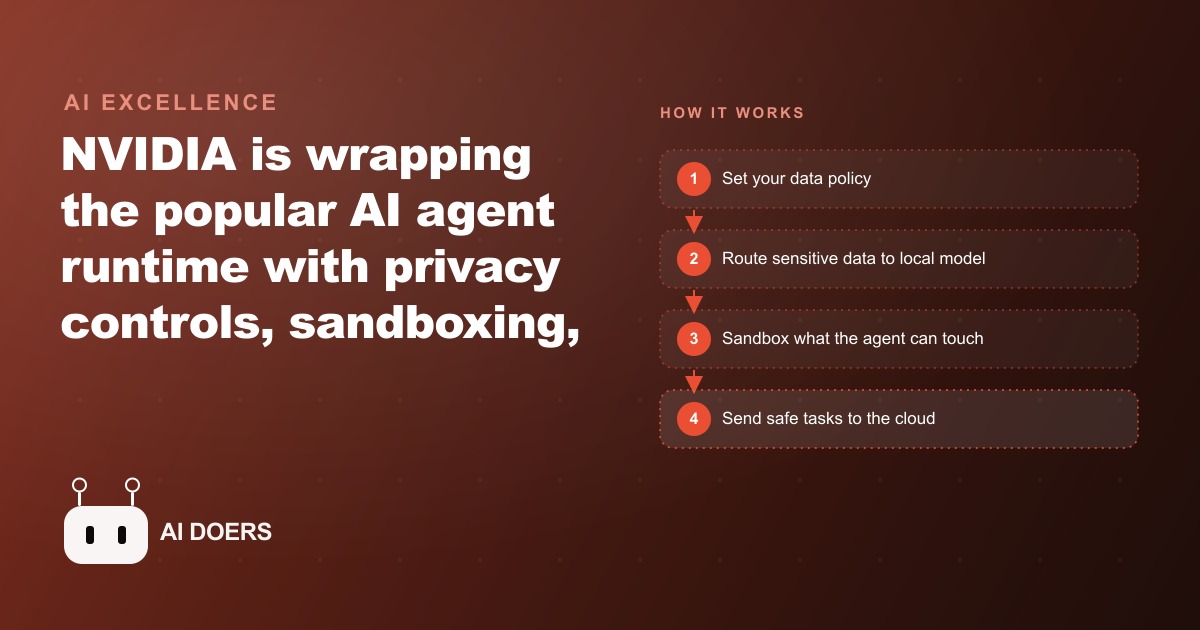
But read what the company actually built, not just what it claimed. NVIDIA did not release a smarter agent. It released a wrapper: privacy controls, security guardrails, and local models placed around the existing engine. That is a tacit admission that the raw agent was not safe enough for serious business use on its own. The vision talk is the headline. The safety cage is the substance, and the safety cage is the part that finally makes the vision deployable. When the company selling the shovels starts selling safety gear for the shovels, that tells you the real state of the field better than any keynote slogan.
The router is the whole argument
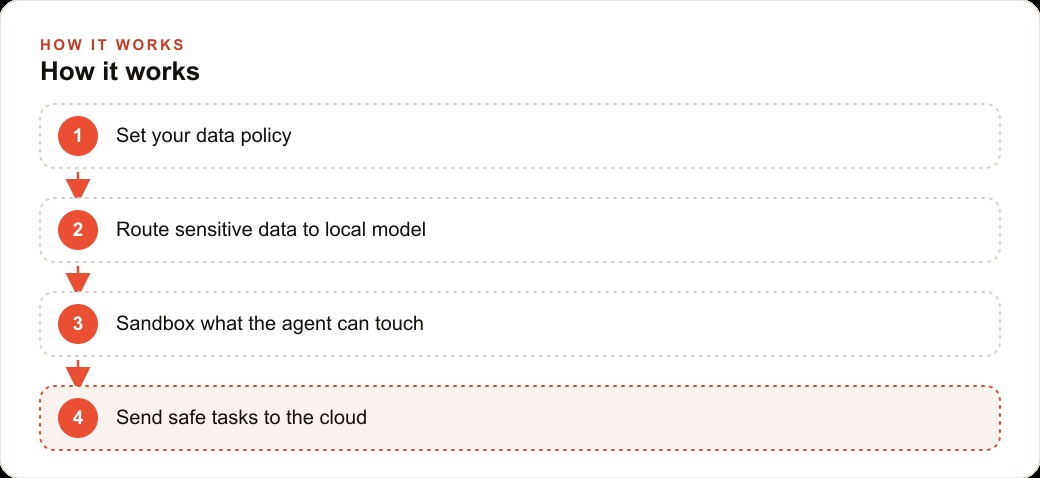
The single most important piece is not glamorous, which is exactly why it gets underrated. It is a data router. A company sets its policy for what is allowed, and the router decides where each piece of data goes. Sensitive information stays on a local model running on the company's own hardware, while safer tasks go to a powerful cloud model. The agent also runs in a sandbox that limits what it can touch and what it can send out. And the whole thing is model-neutral: it works with any cloud model and any local model, which lets NVIDIA sit as neutral ground while the work flows.
I would argue this router is more important to your business than which model tops the leaderboard this month. The trade-off that kept agents out of real companies was brutal and specific: an agent can save enormous time, but a single bad reset or leak can cost far more than the time it saved. A privacy router plus a sandbox changes that math directly. Sensitive records stay local and under policy, routine tasks get the speed of the cloud, and the worst-case blast radius shrinks. That is not a marketing improvement. It is a change to the risk equation, and the risk equation is what actually governs adoption.
A worked example, and the number that matters
Let me argue this with a concrete case. Take an e-commerce store considering an agent for support triage. The agent reads incoming messages, drafts replies about shipping and returns, and flags angry or complex cases for a human. Under the old, unguarded setup, the customer names, addresses, and order details would flow through whatever cloud model you pointed at, and one bad context reset could mean an agent issuing a hundred refunds or leaking your customer list. That is why cautious owners said no, and they were correct to.
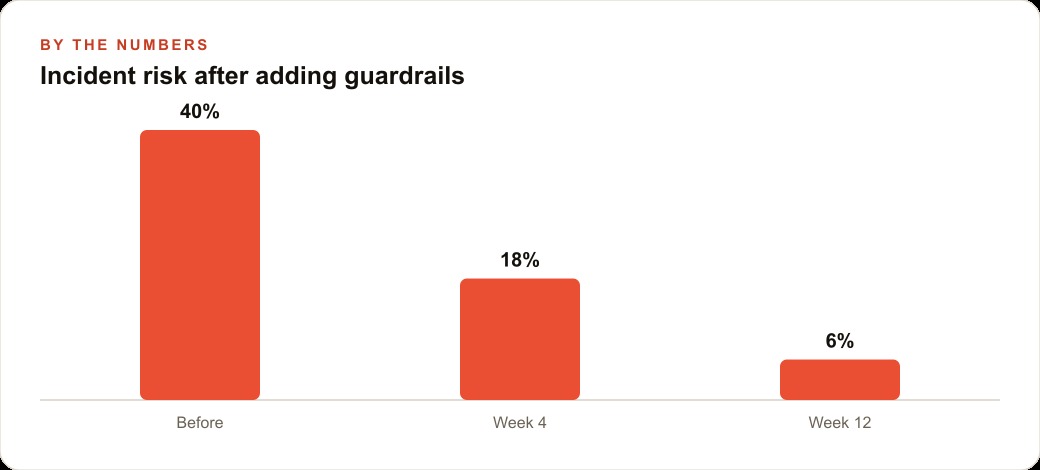
Under the safe-agent model, the sensitive fields, names, addresses, order details, flow through a local model that never leaves the store's control, while a cloud model handles the harmless drafting and research. The sandbox ensures the agent can suggest a refund but cannot quietly issue a hundred of them. Put an illustrative number on the effect: measured as the share of automated actions that carry real incident risk, a store might start around forty percent under an unguarded setup, because so much sensitive data and so many irreversible actions are exposed. After four weeks of routing sensitive data locally and sandboxing what the agent can touch, that risk share drops to roughly eighteen percent. By week twelve, with policy tuned and a human still reviewing the highest-stakes actions, it sits near six percent. Those figures are illustrative, but the shape is the argument: the safety layer does not make the agent smarter, it makes deployment survivable, and survivable is the only version worth doing.
Where this actually fits in how you run the business
The reason I care about this as more than tech news is that it unlocks work that was stuck. Once the safety layer is real, an agent can handle support triage, inventory updates, product descriptions, and review responses without exposing your customer list, which means the leads and conversations flowing through your CRM and website stack can finally be automated instead of watched nervously. The same guardrails let an agent draft and test the copy behind your Facebook and Instagram ad campaigns without touching payment data, and generate the product content that feeds SEO and organic search while sensitive customer information stays local and under policy. The point was never the brand of the tools. The point is that the safety layer is finally real enough to press go, and pressing go is where the value was hiding all along.
The neutrality play is smarter than it looks
There is a strategic detail in this announcement that deserves more attention than the vision talk, because it tells you where the durable value sits. The safety layer is model-neutral by design. It works with any cloud model and any local model, which positions NVIDIA as neutral ground that simply keeps the work flowing no matter which lab wins the next benchmark. That neutrality is not a footnote. It is a bet that the models will keep changing hands at the top while the need for a trustworthy layer around them stays constant.
For a business, that bet is worth copying. If you build your operations around one specific model, you inherit that model's pricing, policies, and availability, and you saw earlier in this space how fast those can change. If instead you build around a safety and routing layer that treats models as interchangeable, you can swap the model underneath as the market shifts without re-architecting your whole operation. The lesson is to make your durable investment the guardrails and the routing, the parts that stay stable, and treat the model itself as a component you can replace. That is exactly the posture NVIDIA is selling, and it is the right one for an owner who does not want to rebuild every time the leaderboard reshuffles.
What the cautious owners should actually do now
If you held back from deploying agents, this is your moment, but the move is not to suddenly go reckless. It is to convert your caution into a concrete policy. The owners who win from here will treat the safety layer as the thing that finally lets them act on instincts they already had. Decide what is sensitive, keep it local, sandbox what the agent can touch, and start with low-stakes work before you let an agent near anything that moves money. That sequence is not timidity. It is the correct engineering discipline for putting a powerful, slightly reckless tool to work on real customer data.
The framing that should stick is that agents-as-a-service, an agent that does the work rather than showing you a screen to click, is genuinely coming, and it will run on data that matters. The safety layer is what makes that future survivable for a normal business, and the companies that adopt it carefully, with a policy and a sandbox and a human in the loop, will pull ahead of both the reckless early movers who got burned and the paralyzed holdouts who kept waiting for a perfect model that was never the real blocker.
The position, stated plainly
So here is my stake in the ground. Stop waiting for the perfect model and start caring about the guardrails, because the guardrails are what convert a flashy demo into a system you can trust with customer data. The businesses that win the next couple of years will not be the ones who deployed agents earliest and recklessly. They will be the ones who deployed them carefully, once the safety layer made careful deployment possible. The cautious owners were never behind. They were waiting for exactly this, and now it is arriving.
The math that finally makes agents worth it
It helps to be explicit about why the safety layer changes the decision, because it is a math problem, not a mood. The old objection to agents was never that they could not save time. It was that a single bad reset or leak could cost far more than all the time the agent ever saved, and that asymmetry made deployment irrational for anyone holding real customer data. When the downside is unbounded, no amount of upside justifies pressing go, which is why so many capable owners sensibly held back.
A privacy router and a sandbox attack that asymmetry directly. By keeping sensitive records on a local model that never leaves your control and by capping what the agent can touch and send, you shrink the worst-case outcome from catastrophic to contained. The agent can still suggest a refund but cannot quietly issue a hundred of them. It can still investigate a problem during a sale but cannot yank the store offline. Once the downside is bounded, the ordinary upside of automation, faster support, quicker inventory updates, cheaper content, actually becomes worth capturing, because a bad day now costs a manageable amount instead of the whole business. That is the entire shift. The safety layer does not raise the ceiling on what agents can do. It raises the floor under what they can cost you, and raising the floor is what makes the ceiling finally reachable.
Start by deciding what counts as sensitive in your business, which for most stores is customer data, payment details, and anything tied to a real person. Write a short policy that keeps that data local and lets everything else use the cloud, sandbox your agents so they have clear limits, and keep a human reviewing their actions at first so you catch the confident mistakes before they become incidents. You can build this yourself if you are comfortable with the moving parts, and the tooling gets friendlier every month. If you would rather have someone set the policy, wire the routing, and lock down the sandbox so your business gets the upside without the risk, that is exactly the kind of work I do for clients, and you can bring me in to handle it.
That is exactly what we do at AI DOERS. Book a private 30-minute call with Madhuranjan Kumar and we will map the fastest path to it for your specific business.
Book your call →
Madhuranjan Kumar
Madhuranjan Kumar brings 20 years of performance-marketing experience and has managed over $200 million in Facebook ad spend for brands across the United States and beyond. His expertise spans the full modern marketing stack: Meta, Google Ads, TikTok, email automation, CRM, and the websites that hold it together. At AI DOERS he turns that track record into lead-generation systems for businesses across every industry.