
What Nvidia's 30-Year Climb Teaches Any Business Owner
Nvidia is now one of the most valuable companies on earth, yet it nearly died three times. Here are the durable business lessons from that climb and how I would apply them to a real local company.

Here is a position most business advice will never tell you: the safest place to build your company is a market with no customers in it yet. That sounds backwards, and it is exactly the lesson buried in Nvidia's thirty year climb. Madhuranjan Kumar here, and I want to argue, against the grain of nearly every "find your niche and serve demand" playbook, that the enduring lessons from Nvidia are about deliberately walking toward the uncomfortable, unproven, and unpopular. The company is now one of the most valuable on earth, and it nearly died three times getting there. Those near-death moments are the whole point.
The conventional story treats Nvidia as an overnight success and an inevitable one. That reading is not just wrong, it is dangerous, because it teaches owners to wait for certainty before they move. The real story teaches the opposite.
The overnight success myth is the first thing to throw out
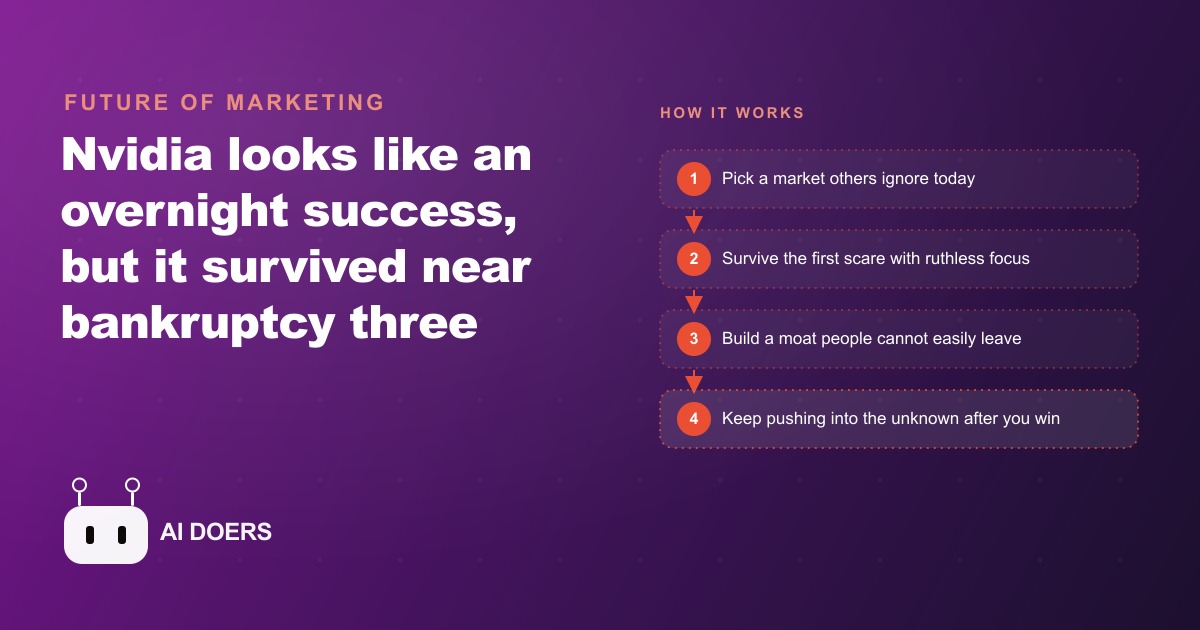
Nvidia started in 1993 with around forty thousand dollars, and over the next three decades it came close to bankruptcy three separate times. Call that an overnight success and you have learned nothing usable. The truth is that the position we now treat as obvious was, at every step, a bet placed years before the market agreed it was smart.
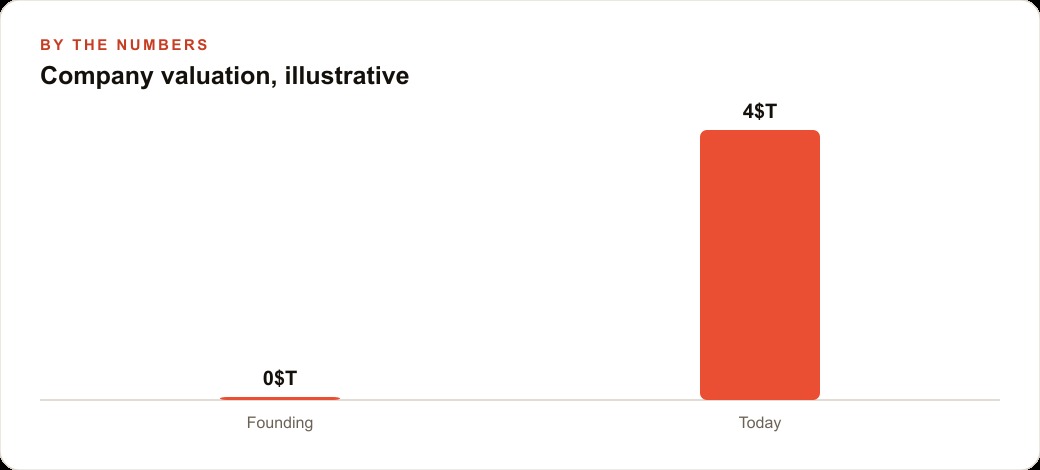
I lead with this because the myth is not harmless. When an owner believes great companies arrive fully formed, they interpret their own early struggle as evidence they picked wrong. They quit right before the part where it works. The contrarian reading is that struggle and near-failure are not signs you made a mistake. They are the normal texture of building something before the market catches up. If you internalize only one thing from Nvidia, let it be that the thirty years of risk and recovery are the story, and the trillion-dollar valuation is just the footnote at the end.
Why the market with no customers is the safest one
The founder liked to enter what he called zero billion dollar markets, industries everyone else ignored, precisely because no customers also meant no competitors. This is the claim I most want to defend, because it runs directly against the standard advice to chase proven demand.
The logic is this. A market with visible, proven demand is a market with visible, entrenched competitors, and competing there means fighting on their terms with their advantages. A market that does not exist yet has no incumbents, no price wars, and no reference point the customer uses to commoditize you. If you are early and you are right, you get to define the category and build a position before anyone else arrives to contest it. Yes, the risk is that the market never materializes. But the payoff structure is asymmetric: a crowded market caps your upside on day one, while an empty market you helped create can become a moat.
For a local business this does not mean inventing a new industry. It means finding the corner of your existing market that the bigger players are too busy or too comfortable to serve. That corner has no customers being served well today, which is to say it has no competitors fighting for them either. That is where you build a position without a fight.
Near-death is a feature, if you let it become culture
Early on, Nvidia bet on a technical approach that a major software standard suddenly rendered obsolete. To survive, the founder fired half the staff, took the remaining cash, and redesigned the product with roughly thirty days of money left. The redesign sold over a million units and saved the company. Here is the part that matters more than the survival: the scare never left him. He began opening every all-hands meeting by reminding the team the company was thirty days from bankruptcy, and that permanent sense of urgency kept focus and speed in the culture long after the crisis passed.
The contrarian claim is that you should not try to insulate your business from the memory of its worst moment. You should institutionalize it. Most owners, once they clear a scare, exhale and drift toward comfort. The more durable move is to keep the scare alive as a discipline. A business that runs as if trouble is always thirty days out keeps tight books, collects fast, and never lets one slow month compound into a crisis. Comfort is the thing that kills companies quietly, long after the dramatic near-death moments are over.
A moat is something people find painful to leave
Later the company released a programming platform that flopped on arrival. Instead of quitting, the team spent years traveling to teach people how to use it. Once developers had learned it, leaving became painful, and that lock-in became a moat no rival could easily copy.
I want to push on the word moat, because most owners think of it as a feature or a price advantage, and those are the weakest kind. The strongest moat is switching cost built from investment the customer has already made in you: a system they rely on, a history you hold, a relationship that would be expensive to rebuild elsewhere. Nvidia's moat was not a better chip in isolation. It was years of teaching the market until the market's own knowledge locked it in. That is patient, unglamorous work, and it is exactly the kind of thing that does not show up on a quarterly report but decides who survives the decade.
The standard advice fails precisely where it sounds safest
Let me confront the objection head on, because it is the reasonable one. The conventional wisdom says validate demand before you build, follow the market, and do not gamble on things customers are not already asking for. That advice is not wrong for every situation. It is wrong as a universal rule, and it is most dangerous exactly when it feels most prudent.
Here is the flaw. Proven demand is public information. The moment a market is visibly attractive, everyone with capital and attention can see it too, which means you are entering a race that is already crowded and already priced. Following demand does not remove risk; it trades the risk of being early for the risk of being late, and late is usually the more expensive of the two. The businesses that get commoditized are almost never the ones who bet on something unproven. They are the ones who did exactly what the advice said, entered a validated market, and then discovered that validation was an invitation the whole field accepted at once.
The zero billion dollar market inverts this. You accept a real chance that the market never shows up, and in exchange you get time, no competitors, and the ability to define the terms before anyone else arrives. That trade is not reckless when it is sized correctly. You are not betting the company on an unknown. You are placing a small, early, survivable bet on a corner you understand, and you keep the core of the business funding the experiment. Nvidia did not abandon everything to chase the unknown. It survived on what worked while it planted flags in markets that did not exist yet, and it kept planting them through three near-death experiences. The discipline is not blind risk-taking. It is deliberate, funded, repeated exposure to the uncomfortable edge of your market while the safe center pays the bills.
There is a second reason the standard advice fails. It assumes competition is fought on quality, that the best product wins. In a crowded, validated market, quality is table stakes and the real battle is on price and distribution, both of which favor whoever is bigger. In an empty market you helped create, the battle is on understanding, and understanding is the one advantage a smaller, earlier, more committed operator can actually hold against a larger latecomer. That is why the ignored corner is not a consolation prize for businesses too small to compete. It is the only ground on which a smaller business reliably wins.
How I would apply all of this to an HVAC company
Let me make the argument concrete with a business nobody would call a technology company. For an HVAC operator, the zero billion dollar market idea is the most useful starting point. Most competitors fight over the obvious work, summer air conditioning repair in peak season, and they ignore the quiet corners. I would point an owner straight at the parts of the market no one is serving well: a maintenance plan built for older rural homes, indoor air quality work for families with allergies, or heat pump conversions before the rest of the town wakes up to them. No customers there yet usually means no competitors there yet, and that is where you build a position before the crowd arrives.
Then the moat. An HVAC company builds lock-in through a recurring maintenance membership, a documented service history on every system it touches, and a reputation that makes switching feel risky. That is the local equivalent of teaching the market your platform until leaving is painful. The membership and service records live in the CRM and website stack that quietly compounds the switching cost with every visit, because a competitor cannot replicate a relationship and a maintenance history they were never part of.
The urgency lesson applies to cash. A trades business that runs as if it is thirty days from trouble keeps its collections tight and never lets a slow winter become a crisis. And the refusal to sit still applies to growth: keep nudging into the next service line every year instead of coasting on the busy season. None of this requires genius. It requires picking the ignored corner and showing up before the crowd, and it pairs naturally with getting found for those underserved services through SEO and organic search while competitors are still fighting over the obvious keywords.
The uncomfortable part is the actual strategy
Even after going public, the founder refused to settle into a profitable niche and kept pushing into the unknown. This is the hardest lesson to defend, because every instinct once you find something that works is to protect it and relax. I would argue the opposite is the strategy. The moment a business finds a comfortable, profitable niche is the moment it starts becoming vulnerable, because comfort erodes the edge that got it there. Staying deliberately uncomfortable, putting a little energy into the next uncertain bet even while the current one is paying off, is not recklessness. It is the discipline that prevents the slow decline that eventually catches complacent companies.
Where the argument lands
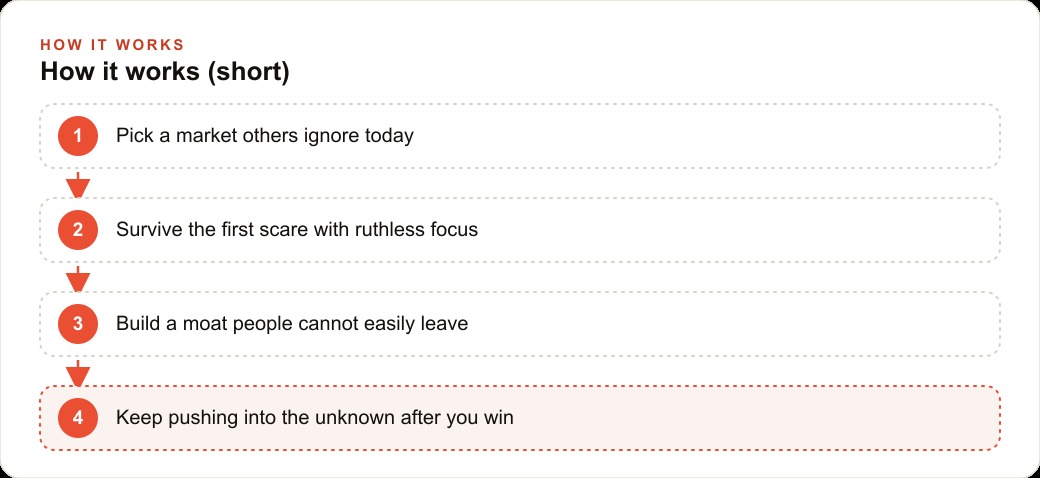
The founder repeats one line above all the others: greatness is not intelligence, it is character formed in people who have suffered and kept going. I find that both the softest-sounding and the most defensible claim in the whole story. The strategy is simple to read, pick the ignored corner, survive the first scare with ruthless focus, build a moat people cannot easily leave, and keep pushing after you win. It is brutally hard to live, because the hard part is staying in the game through the scares that make quitting feel reasonable.
That is the contrarian core. Most advice optimizes for comfort, proven demand, defensible niches, insulation from risk. Nvidia's climb argues that the durable companies do close to the opposite, and that the near-death moments everyone tries to avoid are where the real position gets built. A focused owner can map their own ignored corner and their own moat in a single afternoon. Wiring that into a marketing and operations plan that actually pulls leads is the deeper work, and it is where a lot of owners stall. You can take the do-it-yourself path laid out above, or bring in someone who has built these systems many times, but either way the lesson is the same: walk toward the uncomfortable corner, because that is the one nobody else is fighting for.
That is exactly what we do at AI DOERS. Book a private 30-minute call with Madhuranjan Kumar and we will map the fastest path to it for your specific business.
Book your call →
Madhuranjan Kumar
Madhuranjan Kumar brings 20 years of performance-marketing experience and has managed over $200 million in Facebook ad spend for brands across the United States and beyond. His expertise spans the full modern marketing stack: Meta, Google Ads, TikTok, email automation, CRM, and the websites that hold it together. At AI DOERS he turns that track record into lead-generation systems for businesses across every industry.