
How Law Firms and Professional Services Teams Are Using NotebookLM to Work Smarter for Free
NotebookLM is Google's free AI research tool that can chat with your documents, generate podcasts, build mind maps, and serve as a shared knowledge base for your entire team. Here is what it can actually do.

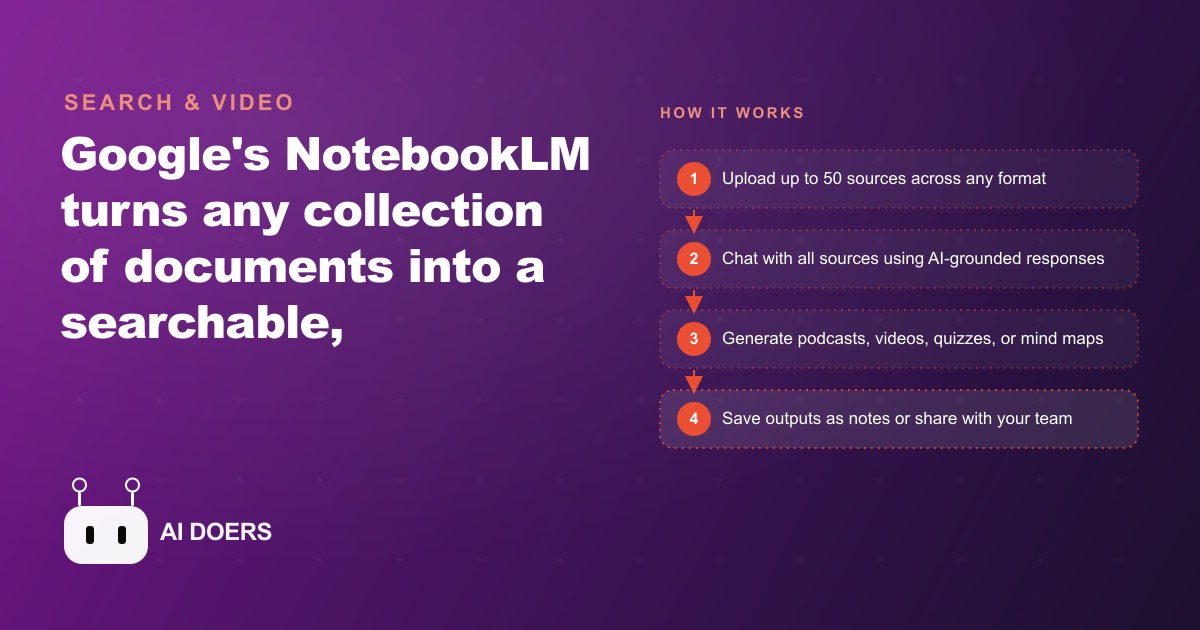
Google released NotebookLM for free in 2023. Most law firms still have not opened it. The attorneys who have are completing in minutes what used to take hours.
I am Madhuranjan Kumar. I have spent time testing NotebookLM's full capability set against the workflows that professional services teams repeat every week. The chat function is the least interesting thing this tool does. Here are seven specific uses that are changing how the sharpest firms operate.
1. A searchable case-law knowledge base that lives inside a single browser tab
Law firms accumulate case law, regulatory guidance, and precedent documents the way libraries accumulate books: constantly, without a clear system, and with no built-in search. A filing from 2019 that is directly relevant to a motion being written today is often buried in a folder structure that no one fully remembers.
NotebookLM changes this by turning any collection of uploaded documents into a queryable knowledge base. Upload the court decisions, regulatory bulletins, and internal memos that define the firm's approach to a specific practice area into a single notebook. Every attorney on the matter can then ask questions directly against that collection and receive cited answers.
The citation is the feature that makes this trustworthy rather than just fast. Every response includes a numbered reference pointing to the exact source and passage where the information was found. Hovering over the citation number shows the original text in context. A hallucination produces a citation that does not support the answer, which is obvious to anyone who checks. An accurate response can be verified in a single click against the original document.
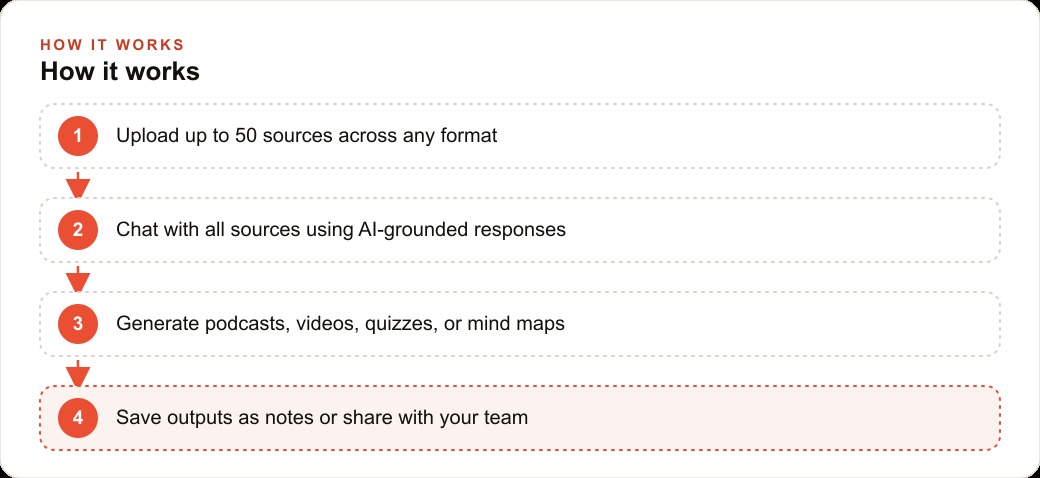
A notebook holds up to 50 sources, each up to 500,000 words. That is 25 million words of searchable material in one tab, accessible through a conversational interface that accepts plain-English questions. A junior associate asking about the firm's standard approach to consequential damages clauses in commercial service agreements gets a cited answer drawn from the firm's own precedent library rather than a generic result from a public database.
2. Client-briefing podcasts generated directly from dense expert reports and filings
Attorneys frequently need to brief clients on documents the client cannot or will not read in full. An 80-page expert report. A regulatory filing with 40 exhibits. A due diligence package assembled from 200 source documents. The traditional options are a long email summary that many clients skip or a call that consumes attorney preparation and delivery time.
NotebookLM's audio overview feature generates a two-host podcast directly from uploaded source documents. Upload the expert report, press generate, add a brief instruction about which aspects to emphasize, and receive a 15 to 20 minute podcast that explains the material in plain language, covers the most important points, and surfaces questions a careful listener would ask. Generation takes a few minutes. A client can listen during a commute instead of blocking desk time to read.
The join-in mode extends this further. A client who has listened and has specific questions can interject them mid-playback through the interactive mode, and the AI responds to those specific questions in the context of the source material. What was previously a scheduled call with an attorney doing real-time summarization becomes a self-service briefing tool the client can use asynchronously.
For partners who spend significant time on client education during long transactions, this is a capacity multiplier. The briefing still carries the partner's intellectual authority because the partner selected the sources, shaped the emphasis, and reviewed the output. The delivery is handled by a tool that does not bill by the hour.
3. Flashcard study packs for associate onboarding that take minutes to build
A new associate joining a litigation practice that handles complex commercial disputes needs to understand the relevant body of case law, the firm's prior positions in similar cases, and the standard approaches the firm takes to common motions. Building that foundation traditionally involves weeks of supervised reading, shadowing senior attorneys, and answering orientation questions that pull partner time from billable work.
NotebookLM generates flashcards and quizzes from any set of uploaded documents in a single click. Upload the ten most important precedent documents in a practice area, the firm's approach memos, and the regulatory framework relevant to the associate's first matter, then generate a flashcard pack. The associate studies the material on a mobile device during any gap in the day. The quiz mode tests retention. Questions and answers are drawn directly from the uploaded source material, making the pack accurate to the firm's actual approach rather than general legal education.
The time saved in partner orientation hours is the most direct financial return, but the quality improvement matters equally. An associate who has studied a flashcard set built from the firm's own documents arrives at the first matter review meeting with a foundation in the specific documents that matter for that case. Partners spend less time at the foundational level and engage more quickly at the analytical level where their input is most valuable.
4. Interactive mind maps that reveal how intake documents relate to each other
Complex matters involve documents that do not exist in isolation. A contract references definitions established in an exhibit. An email exchange contradicts a warranty clause in the purchase agreement. A deposition transcript is undermined by a document produced three weeks earlier. Finding and articulating these relationships requires reading every document with the others in mind, which is exactly the kind of time-intensive work that drives research costs up on complex matters.
NotebookLM's mind map feature builds a visual representation of how topics across uploaded documents connect. Upload the intake documents for a complex matter and generate the map. The visualization shows which documents share themes, which topics appear across the full source set, and which topics are present in some documents but conspicuously absent in others. Drilling into any node opens the underlying source material, making it easy to follow a thread from the conceptual level down to the specific clause or passage.
For document-intensive matters involving hundreds of pages of discovery, this feature compresses the time needed to form a structural view of the matter before detailed review begins. An attorney who generates a mind map from the initial production has a working map of the territory before finishing the first read-through of any individual document.
5. Team-wide document Q&A that requires no IT setup
One of the persistent structural problems in law firm knowledge management is that useful information lives in individuals rather than systems. The partner who handled a specific type of matter three years ago knows where the landmines are. The associate who spent six months on a complex regulatory matter understands the agency's current enforcement priorities. When those individuals are unavailable, that knowledge is inaccessible.
NotebookLM notebooks can be shared with any team member who has a Google account. A notebook loaded with SOPs, precedent documents, training materials, and prior work product becomes a queryable resource that any team member can consult. The knowledge that was previously locked in a partner's head or buried in a file system becomes accessible through a plain-English question. A junior associate asking about the firm's standard indemnification approach gets an answer drawn from the firm's own documents rather than having to find a senior attorney willing to stop what they are doing to explain it.
The practical setup is straightforward. Create one notebook per practice area, populate it with the documents that define the firm's approach and precedents in that area, and share it with every team member working in that practice area. No IT department involvement required. No enterprise software license to procure. A Google account that everyone already has is the only requirement.
6. Deposition transcripts and meeting notes turned into structured action summaries
Depositions generate long transcripts. Client meetings generate notes. Internal strategy sessions produce decisions and action items that may or may not get written down before the next call interrupts. The work required to extract the relevant information from these raw records and turn it into something useful is manual, time-consuming, and typically assigned to whoever is most junior rather than whoever is most skilled at that type of extraction.
Upload a deposition transcript to NotebookLM and ask specific questions: what did the witness say about the timeline of events in March? What inconsistencies exist between the witness's account and the contract terms? What topics were not covered that should be addressed in a follow-up deposition? The AI queries the full transcript and returns cited responses that include the page and line reference from the original document.
For client meeting notes, the same approach applies. Upload the notes, ask the AI to extract all commitments, deadlines, and outstanding questions, and receive a structured list that can be pasted directly into the client file or a project management system. The time between a meeting ending and an actionable summary being in the right hands drops from hours of manual transcription and organization to minutes.
7. Witness and deposition prep packets assembled from scattered source documents
Preparing a witness for deposition requires synthesizing information from multiple sources: the witness's prior statements, relevant contract provisions, emails that touch on the subject matter, expert reports that may challenge the witness's account, and prior deposition transcripts from other witnesses on related points. Pulling all of that together manually is one of the most labor-intensive steps in pre-trial preparation.
A NotebookLM notebook loaded with all of the relevant source documents becomes a preparation tool. An attorney preparing the witness can query the notebook to find every document in which the witness is mentioned, every email where the witness expressed a position on the disputed facts, and every inconsistency between the witness's prior statements and the documentary record. The AI surfaces these items with citations pointing to the exact source document and location, making it easier for the attorney to prepare the witness to address them directly.
The output can also be formatted as a study guide for the witness. Ask the notebook to summarize the five most important topics the witness should be prepared to address, with the relevant documentary background for each. The witness receives a document-grounded briefing rather than an attorney's summary that may not reflect the full complexity of what the other side has in their files.
The worked example: onboarding a junior associate on a 300-document commercial dispute
Here is how these capabilities combine in practice. Consider an unnamed litigation team handling a complex commercial dispute involving breach of a multi-year services contract, including claims of misrepresentation in the initial negotiations. The matter involves approximately 300 documents in initial production, plus the client's own contract files, prior correspondence, and internal communications.
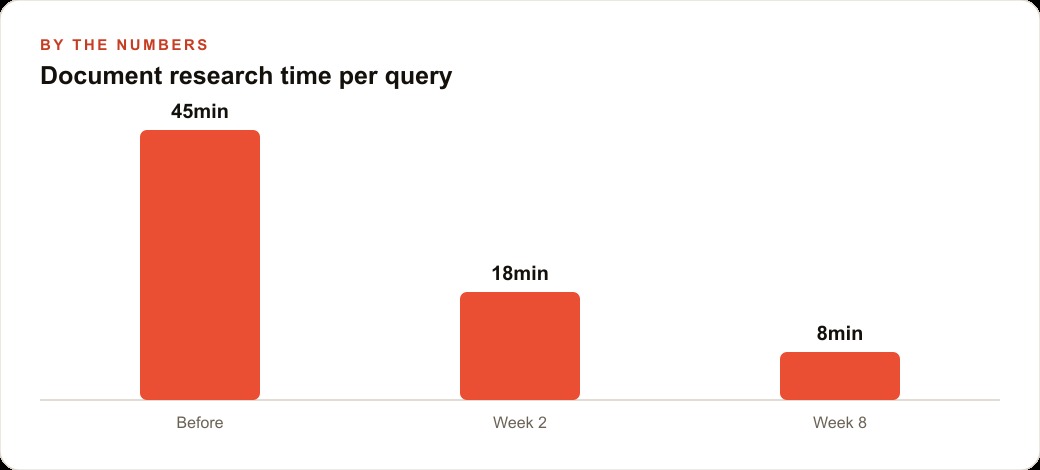
Before NotebookLM, onboarding a junior associate to this matter typically required four to six hours of orientation meetings with senior attorneys, followed by two to three weeks of supervised document review before the associate could contribute independently to research tasks. Senior attorney time committed to orientation across the first three weeks: roughly 12 to 15 hours. At a senior attorney billing rate of $500 per hour, the orientation investment for one associate on one complex matter is $6,000 to $7,500 in attorney time that cannot be billed to the client.
With NotebookLM, the team creates a matter notebook loaded with all 300 production documents plus the client's file. They generate a mind map from the full document set, a structured timeline extracted through AI queries, a flashcard pack covering the key contract provisions and the dispute's factual background, and a comparative summary of the witnesses' prior statements on the core disputed facts. The associate reviews these materials over four to five hours before the first orientation meeting.
Senior attorney orientation time drops from 12 to 15 hours to four to six hours across the first two weeks, because the associate arrives at each meeting with a working understanding of the documentary record rather than starting from zero. The partner spends the orientation hours on strategy and judgment rather than document orientation.
The illustrative time savings are eight to ten senior attorney hours per associate per complex matter. At $500 per hour, the financial value of that recovered time is $4,000 to $5,000 per matter. For a ten-attorney firm running six complex matters simultaneously with two associates each, the annual value of this efficiency gain compounds quickly across new matters and new associates.
And NotebookLM is free.
The correct way to frame this result is not that the AI replaced attorney judgment. The attorney still makes every strategic decision. The AI eliminated the low-value orientation time that was consuming senior attorney capacity to no one's benefit. Every hour of partner time shifted from explaining the document record to analyzing it is an hour recovered for the work that actually requires a partner.
If you want help setting up NotebookLM notebooks for your practice areas or building a structured knowledge management system around it for a professional services team, that is the kind of practical implementation work I do with firms that want to move from curious to operational with this tool.
That is exactly what we do at AI DOERS. Book a private 30-minute call with Madhuranjan Kumar and we will map the fastest path to it for your specific business.
Book your call →
Madhuranjan Kumar
Madhuranjan Kumar brings 20 years of performance-marketing experience and has managed over $200 million in Facebook ad spend for brands across the United States and beyond. His expertise spans the full modern marketing stack: Meta, Google Ads, TikTok, email automation, CRM, and the websites that hold it together. At AI DOERS he turns that track record into lead-generation systems for businesses across every industry.