
NotebookLM: The Free AI Research Assistant That Refuses to Make Things Up
NotebookLM is Google's free, source-grounded AI that reads the documents, links, and videos you give it and answers only from them, complete with citations and even an auto-generated podcast.

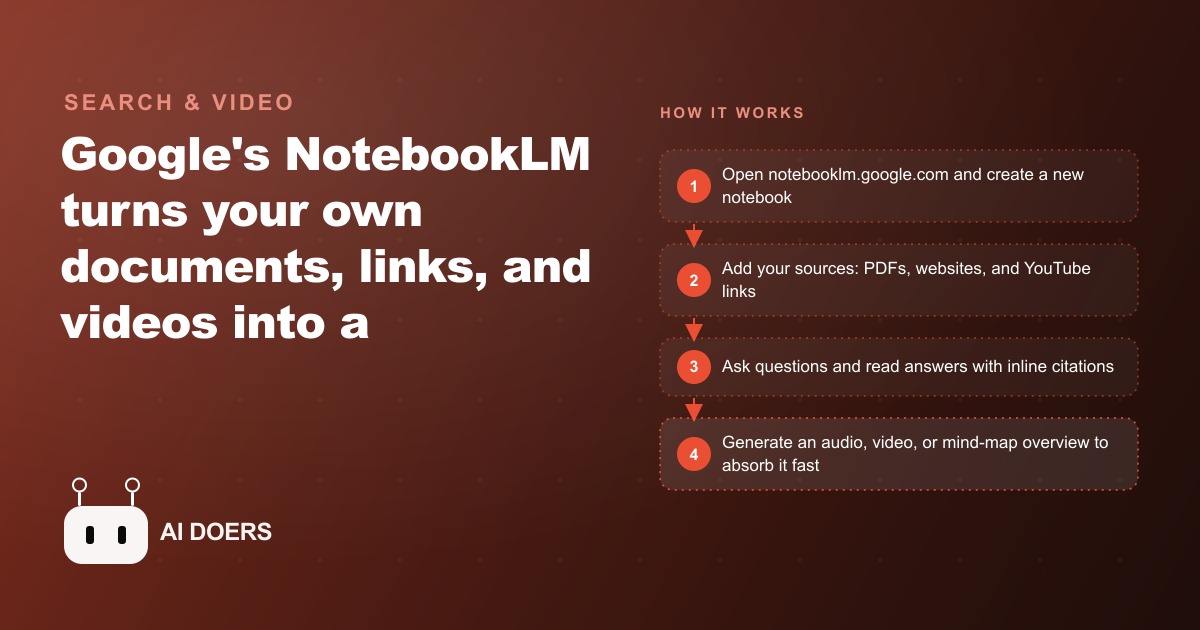
NotebookLM added video overviews, mind maps, and interactive audio in a single update, and the pattern of what those additions reveal about where the product is going is more interesting than any individual feature. I am Madhuranjan Kumar, and what I want to describe is the shift from a document-centric research tool to a multimedia knowledge workspace, and what that shift means for business owners who are still treating it as a way to process PDF reports.
The original capability and what made it unusual
NotebookLM's original proposition was that you could upload your own documents, and the AI would answer questions using only those documents rather than its general training data. This is a different operation from asking a general AI assistant about a topic. The answers are grounded in your specific source material, and the tool tells you which source material each answer is drawn from.
For a business owner processing research, that grounding is valuable in a way that general AI assistance is not. If you are working from a market research report, a set of competitor case studies, and your own sales data, you want the AI's synthesis to reflect those specific sources rather than general knowledge about your market. The specificity of the grounding makes the output trustworthy in a way that general responses are not.
The original audio overview feature extended this in an interesting direction: it converted your source documents into a podcast-style conversation between two hosts discussing the key themes, in a format that worked for listening while doing other things. The audio overview was a genuinely novel output format, and it was popular enough to become the most-cited feature in coverage of the product.
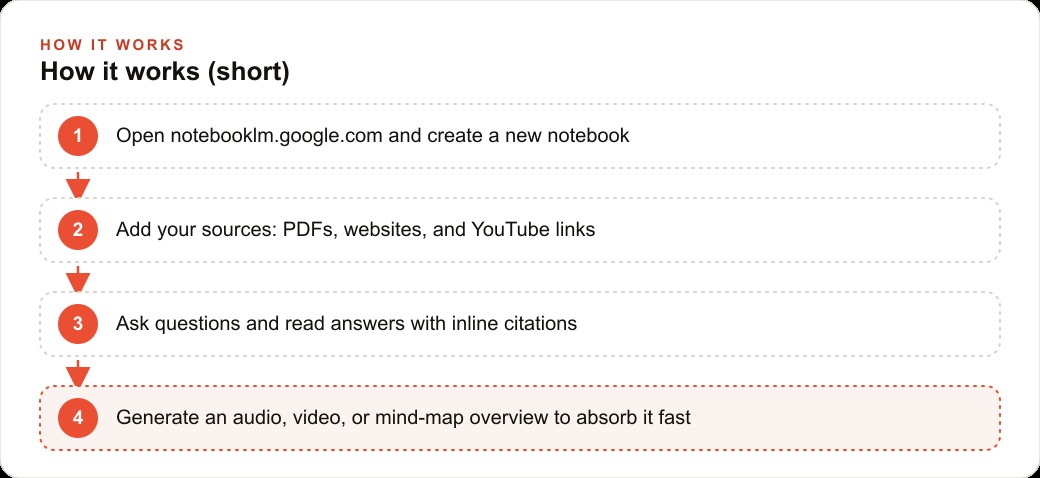
Video overviews: the same idea extended to a new medium
This breakdown overview feature applies the same transformation to a visual format. NotebookLM analyzes the source material and generates a short video that presents the key themes through a visual and narrated presentation. The visual elements, charts, highlighted text passages, animated callouts, are generated based on what the tool determines to be the most important content in the sources.
For a business owner using NotebookLM to synthesize research before a presentation, this breakdown overview is a draft of the visual presentation itself. The content is already organized around the key themes from the source material. The visual treatment reflects the relative importance of different elements. What was a stack of documents to read is now a five-minute video to review and edit.
The practical application extends beyond individual preparation. A team where multiple people need to understand the same research can review a video overview independently in less time than it would take for one person to synthesize the material and present it. The standardization of what was synthesized and how it was presented is a feature: everyone on the team reviews the same overview from the same source material, rather than each person's synthesis being shaped by the parts of the document they found most salient.
Mind maps and the spatial view that some people need
Mind maps represent the relationship structure of the source material as a visual graph rather than as a list or a text summary. Concepts are nodes, and the connections between concepts are edges. The spatial layout reveals clustering and dependency relationships that are harder to perceive in linear text.
For some people and some types of information, the spatial representation is genuinely more useful than the linear one. A business owner trying to understand a complex competitive landscape, where multiple competitors have relationships with multiple partners and each relationship has different implications, may find that a mind map of the landscape makes the structure clear in a way that a written summary does not.
NotebookLM's mind map generation automatically identifies the key concepts in the source material and represents their relationships. The initial output is a starting point rather than a finished product: the AI's interpretation of what the important concepts are and how they relate. Editing the mind map to reflect the user's own interpretation of the relationships is the work that follows the generation.
For a business owner who finds visual structures more useful than sequential text for understanding complex material, the mind map feature has practical value. For someone who thinks primarily in text and lists, it is a less compelling addition than the audio and video formats.
Interactive audio and the 80-language expansion
The interactive audio feature changes the audio overview from a passive listening format to a conversational one. The user can interrupt the generated audio conversation and ask a question, and the hosts redirect the conversation to address the question before returning to the main thread.
This is a meaningful functional difference from the original audio overview. The original format assumed the generated discussion covered what the user needed to know. The interactive format acknowledges that the user may have specific questions that the generated discussion does not anticipate, and lets them steer the conversation toward those questions without stopping the audio and switching to a text interface.
The 80-language expansion is operationally significant for any business with multilingual research needs. The original audio overviews were available in a limited set of languages, which meant the feature was not useful for processing source material in languages outside that set. Expanding to 80 languages makes the audio overview feature relevant for research across much of the global business landscape, where important source material often exists in languages other than English.
For a business also running Google Ads campaigns in multiple regional markets, the ability to process research documents in local languages and generate audio summaries in those languages is a practical advantage in understanding the local market context that the campaigns are operating in.
The med spa example: from client research dump to structured intake insights
A med spa owner with five years of client intake forms, satisfaction surveys, and treatment notes has a substantial body of source material about what their clients want, what they have responded to positively, and where their experience has fallen short. In text form, this is a research project. As a NotebookLM source set, it becomes a knowledge base that the owner can query.
A specific query, which treatment categories generate the most repeat bookings, produces an answer grounded in the actual intake and treatment data rather than in general industry knowledge. A follow-up query, which client demographics are most represented in the highest-satisfaction scores, draws from the satisfaction surveys. The mind map of treatment-to-demographic relationships provides a visual view of where different service lines have the strongest resonance with different client types.
For a med spa running Meta advertising campaigns targeting specific demographics, this kind of grounded synthesis is directly useful for creative briefing. The treatment categories that generate the highest repeat bookings from specific demographic groups are the categories worth prioritizing in campaigns targeting those demographics. The creative angles that the satisfaction surveys reveal as most valued are the angles worth testing in ad copy. The synthesis that NotebookLM produces from internal data is a research input that would otherwise require a consultant to extract from the same raw material.
The web and CRM stack benefits similarly when the intake data and treatment records are systematically analyzed to identify patterns in client lifetime value and service sequence. The business owner who understands which initial treatments most frequently convert to long-term clients is the one who can configure their CRM follow-up sequences around that insight rather than around a generic retention playbook.
Building a permanent research workflow rather than using NotebookLM for one-off questions
The business owners who extract the most value from NotebookLM are the ones who build a permanent research architecture rather than using it for individual one-off queries. The distinction is in how source material is organized and maintained over time.
A one-off use looks like: upload a report, answer some questions, close the notebook. The notebook is effectively a temporary research session. The next time a related question comes up, the same or similar documents need to be uploaded again and the context rebuilt from scratch.
A permanent research architecture looks like: maintain a set of notebooks organized by strategic domain. A competitor intelligence notebook that is updated whenever a meaningful new source is available. A customer research notebook that accumulates intake data, satisfaction surveys, and feedback over time. A market trends notebook for industry reports, pricing data, and sector analysis. Each notebook is a growing knowledge base that gets more useful as more source material is added over time.
The permanent architecture pays off in response quality. A competitor intelligence notebook with eighteen months of accumulated sources produces better analysis than one with three sources from last week, because the longer history lets the AI draw patterns across time and identify which competitor behaviors have been consistent versus which were one-time responses to specific market conditions. The business owner who has built this kind of notebook over time asks better questions because they can ask comparative questions that require the historical depth the notebook contains.
The knowledge worker productivity case
The productivity claim for a tool like NotebookLM is not about raw speed of information retrieval. Search engines already retrieve information fast. The productivity claim is about synthesis quality: the ability to draw non-obvious connections across multiple sources and produce an integrated view that would take a skilled knowledge worker hours to produce manually.
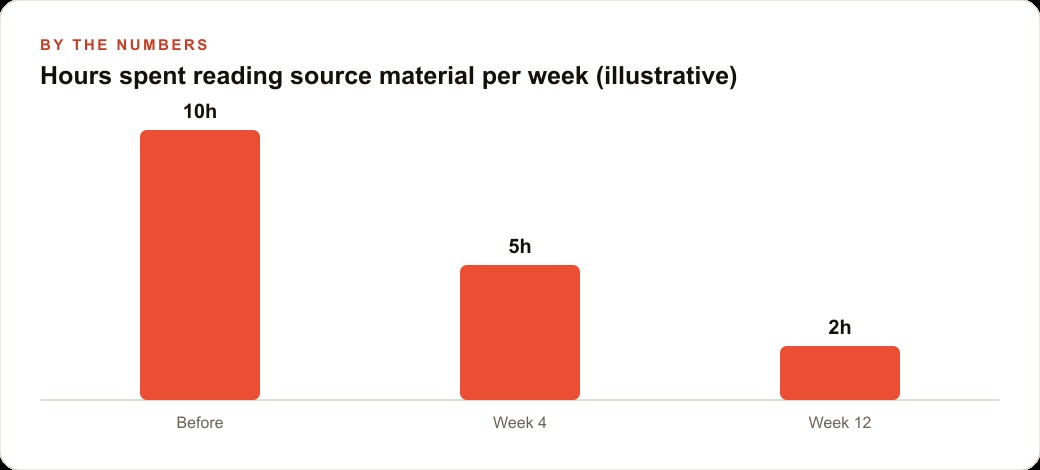
A marketing director preparing for a strategy review typically spends several hours reading through the research materials before the meeting. The reading time is necessary because the synthesis, understanding how different pieces of evidence relate to each other and what they imply together, happens during and after the reading. NotebookLM can compress the synthesis step significantly when the source materials are already in the notebook.
The question "given the customer satisfaction data from last quarter, the competitor pricing changes that happened in April, and the industry report on consumer behavior shifts, what should our pricing strategy emphasize for the next two quarters?" is not a search engine query. It requires synthesizing three different sources of evidence into a coherent view. A well-maintained notebook with all three sources can answer this kind of integrative question in a way that surfaces connections the reader might have missed when reviewing each source separately.
For a business also managing its operational data across web and CRM systems and running advertising campaigns that generate performance data, the strategic synthesis question is often the bottleneck before good decisions. Having the source material organized in a permanent notebook architecture removes the reading and retrieval step from the synthesis process and concentrates the human's time on evaluating the AI's synthesis and applying judgment about what the evidence implies for decisions.
The competitive tool landscape after NotebookLM's expansion
NotebookLM is not alone in the space of document-grounded AI research tools, and the features it added in this update shift the competitive comparison. The tools that compete most directly with it are Google's own enterprise document tools with Gemini integration, Microsoft's Copilot tools with SharePoint integration for enterprise users, and a set of specialized research tools that target academic and professional research workflows.
The differentiator NotebookLM maintains is the accessibility of the grounding approach for non-enterprise users. The enterprise Microsoft and Google integrations require organizational accounts and IT setup. NotebookLM works with a Google account and a collection of uploaded files. For a small business owner, solo practitioner, or independent knowledge worker who has meaningful source material to analyze but does not have enterprise IT infrastructure, NotebookLM remains the most accessible way to build a grounded AI research capability around their own source material.
The addition of video overviews and interactive audio in particular is likely to extend this accessibility advantage, because those formats serve use cases that document-grounded AI tools had previously left to general-purpose video and podcast tools. The ability to generate a research summary in video or audio format directly from source documents, without an intermediate step of creating a transcript or a slide deck, removes friction from content repurposing workflows that knowledge workers spend significant time on.
That is exactly what we do at AI DOERS. Book a private 30-minute call with Madhuranjan Kumar and we will map the fastest path to it for your specific business.
Book your call →
Madhuranjan Kumar
Madhuranjan Kumar brings 20 years of performance-marketing experience and has managed over $200 million in Facebook ad spend for brands across the United States and beyond. His expertise spans the full modern marketing stack: Meta, Google Ads, TikTok, email automation, CRM, and the websites that hold it together. At AI DOERS he turns that track record into lead-generation systems for businesses across every industry.