
Nine Ways to Build Real Income With AI in 2026
The most reliable AI income models in 2026, from flipping outdated local websites to AI tools audits, AI video ads, voice receptionists, and running an automation agency, all sell a finished result rather than a promise and require no coding.

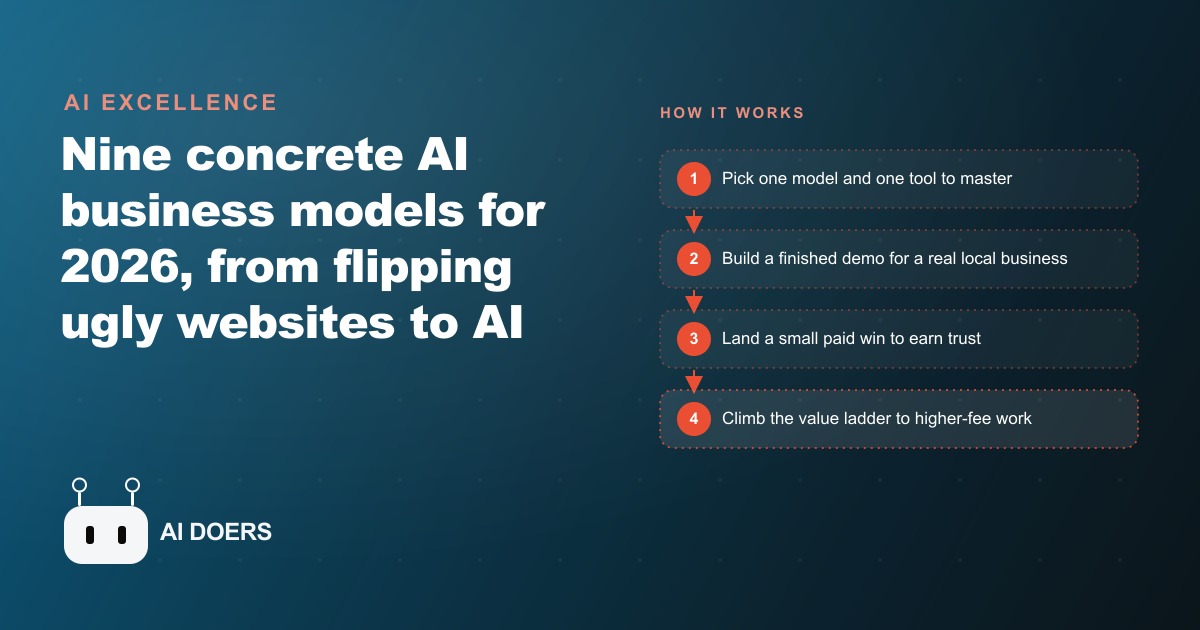
Something quiet shifted in how people make money with AI this year, and most people missed it because they were still waiting for a magic button. The winning move in 2026 is no longer selling your time or your potential. It is showing up with a finished result the client can see and touch before you ask for a dollar. I am Madhuranjan Kumar, and across the nine income models that are actually working right now, from flipping outdated local websites to building voice receptionists, that single pattern is the news. Everything else is a variation on it.
The real change is the death of the pitch
For a decade the standard freelance move was to pitch. You described what you could build, quoted hours, and asked the prospect to imagine the value. AI collapsed that model. When a tool like aura.build can rebuild a dated local website from its existing content in about two minutes, there is no reason to describe the finished site. You just build it and show it on an iPad. The prospect is not buying an idea anymore. They are buying a product that already exists.
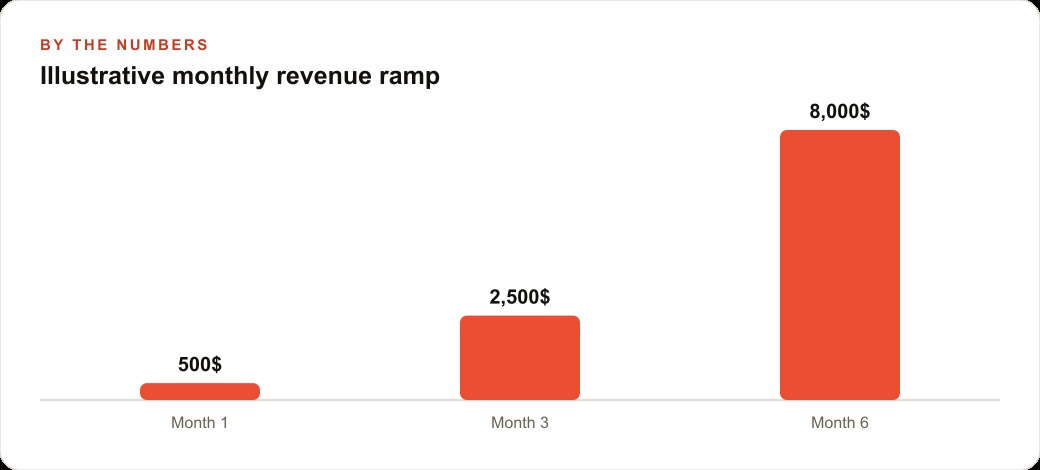
That is the shift worth internalizing, because it changes who wins. The old game rewarded whoever sounded most convincing. The new game rewards whoever shows up with the thing already made. A beginner who hands over a rebuilt homepage beats a veteran still selling a promise, because seeing beats imagining every single time. The instant website flipper, sold for around 500 dollars, is the cleanest example, but it is only the entry point. The same finished-first logic drives all nine models.
Nine models, one underlying move
It helps to see the full menu, because the range is what makes the pattern obvious. The instant website flipper rebuilds an ugly local site and sells it on sight. The AI tools auditor interviews an owner for an hour about their bottlenecks and delivers a short report recommending three to five off-the-shelf tools, selling clarity rather than code. The viral video engineer uses tools like Sora 2 and VO3 to produce dozens of user-generated-style ads in a single afternoon with no cameras or crew. The digital twin creator records a few minutes of a founder on a platform like HeyGen to spin up a photorealistic avatar and cloned voice, then produces endless content on their behalf.
The corporate AI trainer runs a free workshop for a testimonial, teaches the basics of ChatGPT and Claude, automates one painful task live, and turns that into bigger contracts. The Upwork AI freelancer learns one high-demand skill, starts cheap to bank five-star reviews, and raises rates toward hundreds per hour. The voice AI architect masters a platform like ElevenLabs, scrapes a local business, and builds a demo receptionist that stops missed calls from leaking to competitors. The SaaS killer replaces a duct-taped stack that costs a business nearly 100,000 a year with one custom app built through vibe coding, sold once for around 15,000 dollars. And the automation agency ties them together, landing one small win, becoming the trusted partner, then climbing the value ladder from strategist to developer.
Nine offers, nine tools, but read them again and the structure is identical. Find a real leak. Build the finished thing. Show it before you ask for money. That is the news, and it is the only part you need to remember.
Why this matters for real local businesses first
The instinct is to chase glamorous tech niches. The evidence points the other way. The best customers for every one of these models are the least flashy businesses with the most obvious pain: the local trades, clinics, repair shops, and service companies that software ignored for years. They have real revenue, budgets that move quickly, and problems you can see from the parking lot. An outdated website loses trust. Decision paralysis around AI wastes money. Expensive ad production blocks their marketing. A missed call during a job hands the customer to the next name on the list.
That is a far easier room to sell in than a crowded startup market, and it is where the finished-demo move lands hardest. A plumber who hears their own AI receptionist answer the phone does not need a slide deck. A restaurant owner who watches thirty ad variations render in an afternoon does not need to be convinced that Facebook and Instagram ad campaigns can be tested faster than they thought. The finished result does the persuading. Your job is just to build it in front of the right owner.
What the smart operator actually does with this
Reading nine models can create paralysis of its own, so here is the concrete move: pick one model, master one tool, and build a repeatable demo you can show before you ask for payment. Do not spread across five offers. Depth in one beats dabbling in all, because the demo has to be good enough to close on sight, and that only comes from reps. Start cheap or even free to bank testimonials, exactly the way the Upwork freelancer does, then raise rates as proof stacks up.
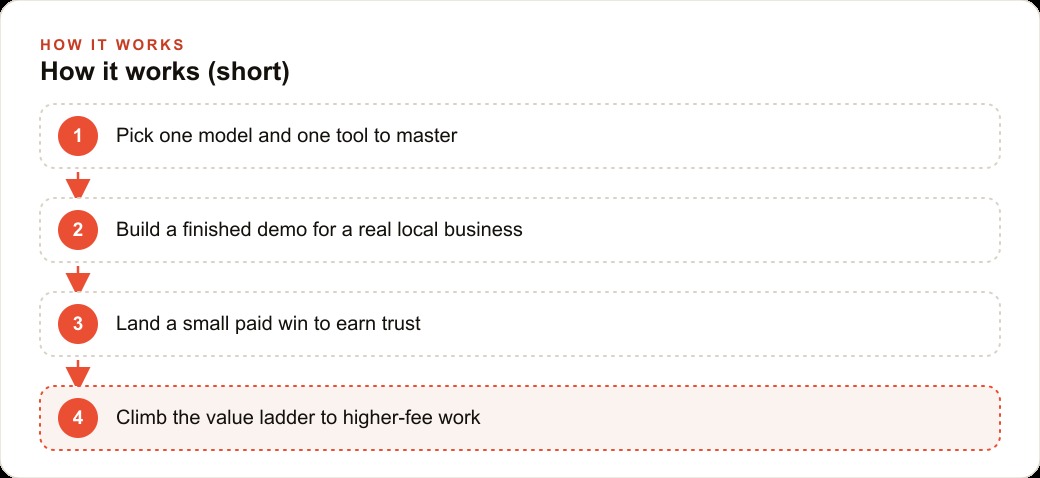
The bigger insight is the value ladder. Every one of these models starts with one small win, an audit, a site, an automation, and that win is not the destination. It is the trust that lets you climb. The 500 dollar website becomes the doorway to managing the client's Google Ads, which becomes a monthly retainer, which becomes the automation agency work that pays the most. Nobody hands a stranger a 15,000 dollar SaaS-replacement contract. They hand it to the person who already fixed their website and earned it.
A worked example: the electrician who bought a receptionist and stayed for the system
Let me make this concrete with illustrative numbers, using an unnamed electrician as the customer and the voice AI architect as the first offer. Electricians live and die by the phone. Every missed call while someone is up a ladder is a booking that went to a competitor. So the first thing I would build, before pitching anything, is a working demo. I would scrape the electrician's hours, service area, and common jobs, then stand up an AI receptionist that answers, filters spam, captures the caller's name, address, and the nature of the problem, and forwards genuine emergencies. Then I would let the owner call their own number and talk to it.
Put numbers on the leak to show why this closes. Say the electrician misses six calls a week that go to voicemail and never call back, and one in three of those was a job worth 400 dollars. That is roughly 800 dollars a week walking out the door, over 40,000 dollars a year. Against that, a setup fee of 750 dollars plus 150 dollars a month to run and maintain the receptionist is an obvious yes, because the owner just heard it work. The close took no persuasion. The demo did it.
That first win is where the ladder starts. Alongside the receptionist I would rebuild their dated site in a couple of minutes and show it on a tablet, bundling the two. Once trust exists, the next steps open up: review automation that turns happy jobs into public five-star reviews, follow-up texts to past customers that resurface old jobs, and a quoting workflow that cuts turnaround time. Each is a higher-fee rung, and all of it lands in a proper CRM and website stack so no lead falls through a crack. A 900 dollar first month can become a 1,200 dollar monthly relationship within a quarter, not because you pitched harder, but because every step delivered a finished result the owner could see working.
The one mistake that quietly kills these businesses
The failure mode is subtle. It is not building the wrong thing. It is building the right thing and describing it instead of showing it. The moment you slip back into pitching, you hand the advantage back to whoever can talk best, and you re-enter the old game AI just broke. Keep the discipline: whatever the model, walk in with the finished result. A rebuilt site on an iPad. A live receptionist the owner can call. Thirty rendered ads ready to run. The demo is the entire strategy, and the strategy only works if you do not talk it away.
The second quiet killer is skipping the value ladder. People land the 500 dollar site and move on to the next stranger, chasing one-off wins forever. The money is not in the first sale. It is in the trust the first sale buys. One happy local business, climbed properly, is worth more than ten cold wins abandoned at the door.
Why 2026 is a genuinely open window
It is fair to ask whether this is just hype that will close before you can act on it. I do not think so, and the reason is a timing gap that favors the person who moves now. The tools got good faster than local business owners noticed. A plumber, an electrician, a dentist, a landscaper, most of them are not watching AI releases. They still think a website costs thousands and takes weeks, that video ads need a crew, that an AI phone system is science fiction. Meanwhile the tools that make all three cheap and fast already shipped. That gap between what is possible and what owners believe is possible is the whole opportunity, and gaps like that do not stay open forever.
Right now the person who shows up with a rebuilt site on an iPad or a live receptionist the owner can call looks like a wizard, because the owner has no frame of reference for how it was made. In a year or two, when these capabilities are common knowledge, the same demo will feel ordinary and the easy margins will compress. That is simply how every technology adoption curve works: the early movers capture outsized returns precisely because most people have not caught up yet. The nine models are not a permanent goldmine. They are a window, and windows reward the people who climb through while they are open.
There is also a compounding advantage to starting now that has nothing to do with the tools. Every client you serve teaches you which offers land, which objections come up, and which businesses convert fastest. That knowledge is not something a competitor can copy from a video, and it stacks. The operator who started six months ago is not just six months of revenue ahead, they are six months of hard-won judgment ahead, and judgment is what lets you charge more and close faster. So the honest answer to is it too late is no, but the honest follow-up is that it gets a little harder every quarter you wait, which is the best possible argument for building your first demo this week.
Where this leaves you
The news of 2026 is not a new tool. Tools change every month. The news is that the leverage moved to whoever can build a finished result cheaply and show it before asking for money, and AI put that leverage in reach of a beginner. Pick one of the nine, master the tool, build the demo, land the small win, and climb. That is the whole playbook, and it is more learnable than it has ever been.
You can absolutely build this yourself, and the tools are mostly cheap to start. If you would rather have someone map the right offer to your market, build the first demo, and set up the systems that actually land clients, that is exactly the kind of help I provide. Do it solo, or bring in a hand to get there faster. Either way, the principle does not change: stop selling what you might build later, pick one of the nine models, and start showing owners a finished result they can hold in their hands today. That is the whole game in 2026, and the window to play it is open right now.
That is exactly what we do at AI DOERS. Book a private 30-minute call with Madhuranjan Kumar and we will map the fastest path to it for your specific business.
Book your call →
Madhuranjan Kumar
Madhuranjan Kumar brings 20 years of performance-marketing experience and has managed over $200 million in Facebook ad spend for brands across the United States and beyond. His expertise spans the full modern marketing stack: Meta, Google Ads, TikTok, email automation, CRM, and the websites that hold it together. At AI DOERS he turns that track record into lead-generation systems for businesses across every industry.