
Next Level Prompts: Advanced Prompting for Consistent Output
Program your prompts to return reliable structure, branch on logic, and even generate charts. Here is how it works and how a restaurant would use it.

Most people use AI at work the way they use a search engine: ask a question, read the answer, evaluate it manually, and decide whether to act. That habit produces useful individual answers and it has a ceiling. The ceiling is the manual evaluation step, and the gap between a tool you evaluate manually every time and a tool you can trust at volume is entirely about structure.
Structure in a prompt is not a stylistic choice. It is the mechanism that turns a variable output into a predictable one, and predictable outputs are the only kind that can run reliably inside a business operation without requiring a person to supervise every result. The skill of building structure into a prompt is learnable, and it is the single most practical upgrade available to any business that currently uses AI and gets useful but inconsistent results.
The Gap Between a Demo and a Real Business Inbox
The distance between an AI demo and a working AI deployment is usually presented as a technology problem. The model is not good enough, the integration is not finished, the training data is not right. Those problems exist and they matter, but they are not the primary reason that AI tools which look impressive in a demonstration produce inconsistent results when they run on real inputs at volume.
The primary reason is that most demonstrations use carefully chosen inputs and a prompt tuned to perform well on those specific inputs. Real inboxes, real customer messages, real operational data are messier than any demo, and the prompt that produced a polished result in the demonstration was never designed to handle the range of variation that arrives in practice.
A customer service inbox for a business that takes any real volume receives messages that are grammatically unusual, emotionally charged, ambiguous in intent, written in informal registers, and sometimes about topics that are only tangentially related to the business's products. A prompt that produces a reasonable reply to a polite, clearly worded inquiry about business hours may produce a confused or inappropriate reply when the input is an angry run-on paragraph about a service experience. The prompt was not designed to handle that input, and the model, left to interpret the task without constraints, will interpret it however its default behavior suggests.
The gap is not fixed by using a better model. It is fixed by designing the prompt to be robust to variation: specifying in advance what categories of input exist, what the appropriate response looks like for each category, and what should happen when an input does not fit any of the specified categories. That specification is structure, and building it into the prompt is the skill that separates AI that is useful in a demo from AI that is reliable in an inbox.
This is the observation that changes how you think about prompting. The prompt is not a question you ask the model. It is a specification you write for the model, and the quality of output over a distribution of real inputs is entirely a function of how carefully and completely you wrote that specification. Most people write the prompt they need for the input they have in front of them. The ones who get reliable results write the specification for the range of inputs they expect to receive, including the messy and edge-case ones.
The demo version of any AI application is built on best-case inputs. The production version is built on worst-case inputs. The difference between them is structure: the prompt that handles the best-case input elegantly is one paragraph; the prompt that handles the full range of real inputs reliably is a specification with categories, restrictions, conditional logic, and a clear statement of what to do when none of the categories match. That structural investment is what closes the gap between an impressive demo and a trustworthy daily operation.
Structure Is What Turns a Good Response Into a Reliable Operation
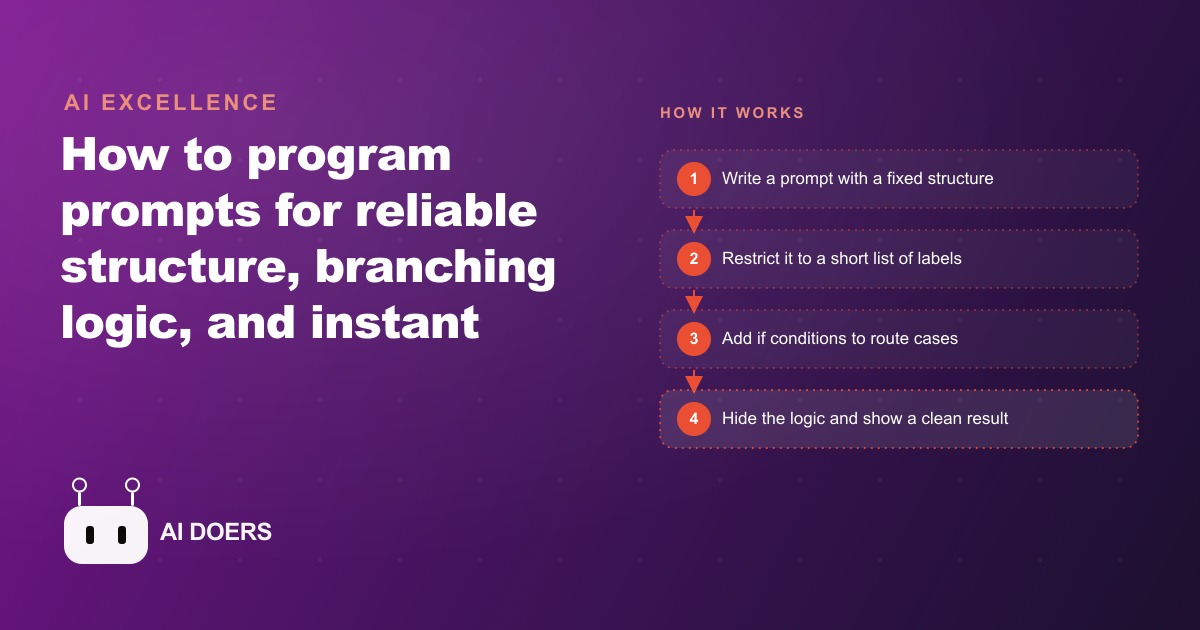
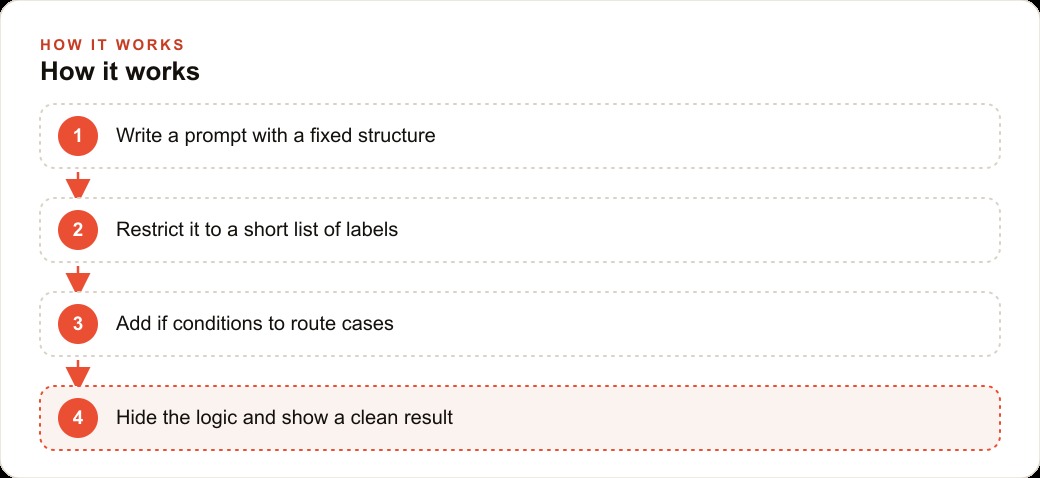
The structural elements that matter most for reliable output are four: restricted output formats, restricted choice sets, conditional logic, and hidden reasoning. Each one is a specific constraint added to the prompt, and each one reduces variability in a specific way.
Restricted output formats are the simplest. When you need the model to return a classification label, a summary in a specific number of sentences, or a response that begins with a particular phrase, specifying that format explicitly in the prompt is usually enough to get it consistently. The model is flexible about format when you do not specify one, and it will vary. When you specify the format explicitly, it follows the specification because that is what the specification asks for.
Restricted choice sets are one step more powerful. Instead of asking the model to classify an input freely, you give it a short list of allowed categories and tell it to pick one. "Choose from: question, complaint, compliment, or other. Do not use any other label." This constraint eliminates the long tail of novel category names the model would otherwise invent when inputs are unusual. The output is always one of the four allowed options, which means the downstream workflow can branch reliably on the output value without needing to handle an unpredictable variety of possible strings.
Conditional logic in a prompt is the mechanism that makes one prompt handle multiple different scenarios without requiring separate prompts for each one. "If the category is complaint, begin your reply with an acknowledgment and include a named point of contact. If the category is question, begin your reply with a direct answer. If the category is other, output only the label and do not draft a reply." That structure is a conditional branch inside the prompt, and it handles three scenarios in one specification while maintaining predictable output for each.
Hidden reasoning is the technique of asking the model to think through the problem before producing the output, but keeping that reasoning out of the final result. The model writes its analysis privately, which improves the quality of the output by giving it room to think, and then produces only the finished reply, which is what the customer sees. The visible output is the polished conclusion. The invisible reasoning is what makes the conclusion more reliable than it would be if the model jumped directly to a reply without the intermediate step.
These four elements combine. A single prompt that restricts the output format, limits the category choices, branches on the category with conditional logic, and hides the classification reasoning before producing the reply is a prompt that handles a real inbox robustly. It does not require a different model. It requires a more carefully written specification. The difference in reliability between the casual version and the structured version is large, and it shows up immediately when you run both on the same set of real inputs.
The craft of prompting is the craft of specification. The better your specification, the more reliably the model executes it. That relationship is consistent enough to be predictable: invest more precision in the specification and get more consistency in the output. Businesses that treat prompts as something you write once and never revisit are leaving most of the available reliability on the table. Specification is not a one-time task. It is an ongoing practice of refining the rules until the output is trustworthy across every input that actually arrives.
A Restaurant Inbox as the Test Case for Every Concept
I am Madhuranjan Kumar, and the restaurant inbox is the example I return to when explaining advanced prompting because it combines every structural element in a context that most people can immediately imagine running at real volume.
A restaurant with any meaningful online presence receives a stream of messages that is diverse and unpredictable: reservation requests at times the restaurant cannot accommodate, complaints about a service experience, questions about dietary accommodations, compliments about a specific dish or server, catering inquiries that need a different response path than reservation inquiries, and occasional messages that are not about the restaurant at all. At volume, that stream requires processing every message, routing the important ones to the right person, and responding to the routine ones quickly and on brand.
A prompt that handles this reliably has the following structure. A hidden reasoning step where the model reads the message and identifies its primary intent before producing any output. A restricted classification step where the model assigns the message to one of four categories: reservation or booking question, service complaint, compliment or positive feedback, and other inquiry. A set of conditional reply instructions where each category gets a different response approach: routine booking questions receive a direct, friendly reply with the reservation link; complaints are flagged for immediate human review and receive an interim acknowledgment that a manager will follow up; compliments receive a warm acknowledgment mentioning the specific thing the customer appreciated; other inquiries receive a brief, on-brand reply that routes them to the appropriate contact. The output is only the reply text and the classification label, not the reasoning that produced them.
This structure handles the routine cases without any human involvement, identifies the important cases and routes them for human attention, and produces consistent, on-brand output across every category. The manager does not need to supervise every reply. The manager monitors the escalation queue, because those are the messages that need immediate attention, and the classification step ensures that the escalation queue contains only the messages that actually belong there.
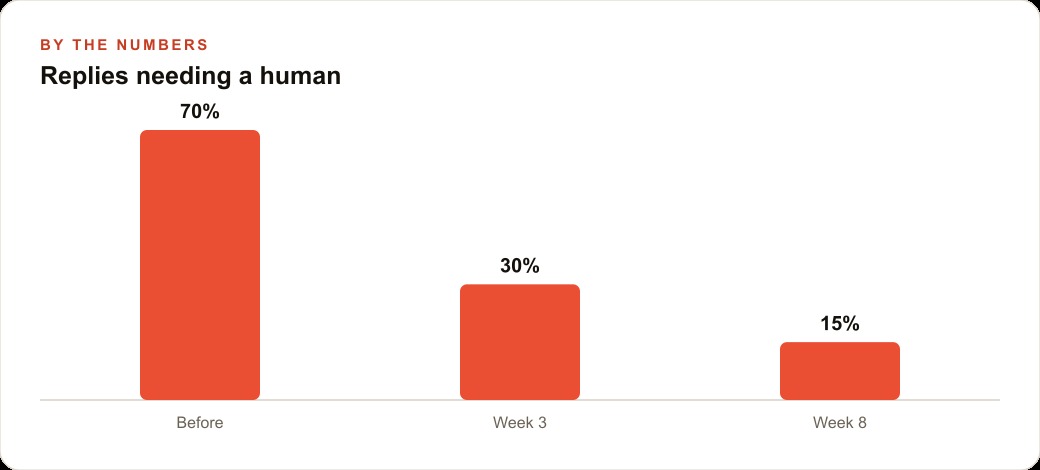
The numbers from a restaurant that implemented this structure on a real inbox illustrate the impact clearly. The inbox was handling roughly 100 messages per day before the structured prompt was in place. Without structure, the share of messages that required a human to read and evaluate before deciding how to respond was roughly 70 percent, because the output was inconsistent enough that supervision was necessary to catch errors before they reached customers. After implementing the structured prompt, with the restricted categories, the conditional routing, and the hidden classification step, the share of messages requiring human intervention dropped to roughly 15 percent over eight weeks. The remaining 85 percent were handled reliably by the structured prompt and required no human review before sending.
The owner recovered roughly three hours per week in inbox time that had previously been spent reviewing and correcting AI-drafted replies, or writing replies manually for messages the AI had misclassified. That time went back into operational management, because inbox supervision is not where a restaurant owner's attention is most valuable.
The eight-week timeline matters because it reflects the refinement cycle. The first version of the prompt performed well on the common cases and produced unexpected output on a handful of edge cases: messages that were simultaneously a complaint and a compliment, inquiries that started as a booking question and included a dietary restriction that needed a separate response, and messages from non-customers that the model was attempting to classify as one of the four restaurant-relevant categories. Each of those edge cases was documented during the first two weeks, and the prompt was updated to handle them explicitly. By week four, the addressed edge cases were handled correctly. By week eight, the only messages still requiring consistent human review were the genuine outliers, the ones unusual enough that no specification could reliably handle them without human judgment.
The refinement cycle is the part of advanced prompting that most people underestimate. A well-designed initial prompt handles the common cases well and produces useful output immediately. The improvement from a well-designed prompt to a reliable operation comes from running it on real inputs, documenting the failures, and updating the specification to address them. That process takes weeks, not hours, and it requires commitment to actually reviewing the output rather than assuming the initial design is complete.
The restaurant inbox example is also useful because it shows how all four structural elements combine in a single prompt that a non-technical manager can understand and use. The hidden reasoning step is invisible to the customer but makes the classification more accurate. The restricted category set is visible in the prompt as a short list and means the output is always one of four values. The conditional logic is visible as a set of if-then instructions and means each category produces a different kind of reply. The format restriction requires the output to contain the reply text and the label and nothing else. Each element is readable, each element has a clear purpose, and together they produce an operation the manager can trust at volume.
The practical starting point is to pick one repetitive communication task in your business, write a version of the structured prompt, and run it on twenty real examples from your actual history of that task. Review every output against the input, document the failures and the near-failures, and update the prompt to address the patterns you find. Do that two or three times with a week between each iteration to accumulate enough new real inputs to test against, and the result is a prompt that handles the routine cases reliably and tells you clearly when a case is unusual enough to need a person.
The gap between a demo and a real inbox closes through structure and iteration. Structure is what makes the output predictable. Iteration is what makes the specification accurate. Neither is complicated. Both require deliberate effort, and the effort produces an AI operation that is genuinely reliable at volume rather than impressive in demonstration and unpredictable in practice. The prompt that works is not the cleverest one. It is the most carefully specified one.
That is exactly what we do at AI DOERS. Book a private 30-minute call with Madhuranjan Kumar and we will map the fastest path to it for your specific business.
Book your call →
Madhuranjan Kumar
Madhuranjan Kumar brings 20 years of performance-marketing experience and has managed over $200 million in Facebook ad spend for brands across the United States and beyond. His expertise spans the full modern marketing stack: Meta, Google Ads, TikTok, email automation, CRM, and the websites that hold it together. At AI DOERS he turns that track record into lead-generation systems for businesses across every industry.