
The New AI Benchmarks Are About Real Work, Not Trivia
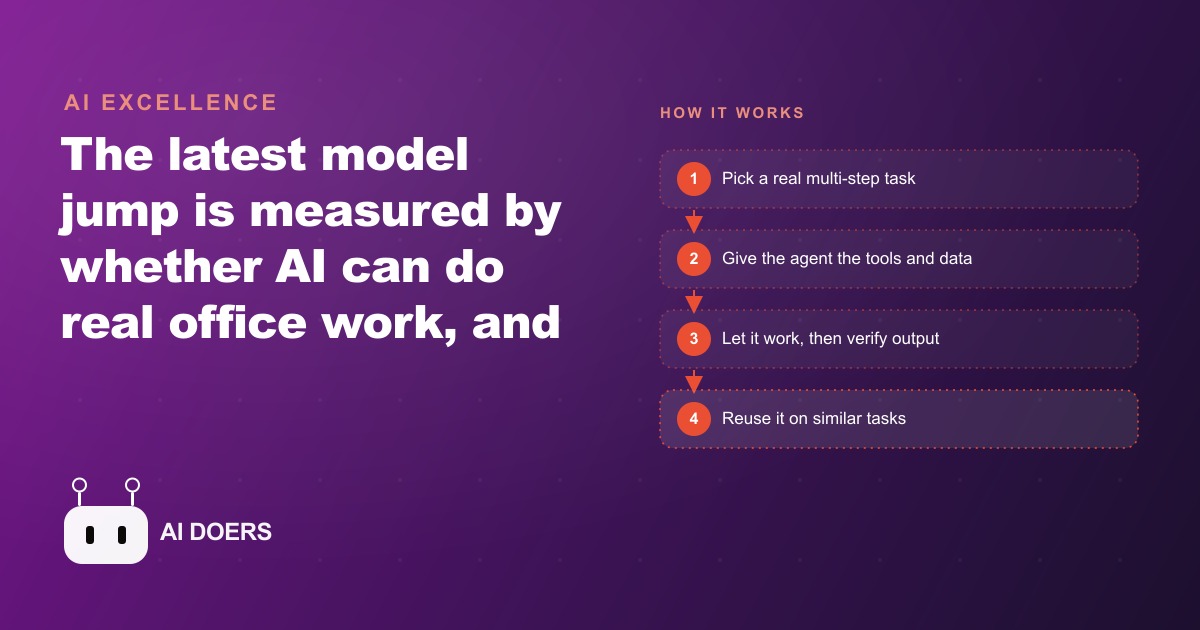
The latest model leap is measured by whether AI can do real office tasks. The benchmarks that matter now barely existed a year ago, and that tells you where the value is.

Half the benchmarks used to test the newest AI model did not exist a year ago. That single fact tells you more about where AI value is heading than any leaderboard score, because it means the people building and buying these models stopped asking whether a model can answer a question and started asking whether it can do real work. I am Madhuranjan Kumar, and I read the benchmark shifts so business owners can skip the trivia and see the money. Here are six things the new generation of AI benchmarks reveals about work that actually matters, each one grounded in what the tests are really measuring.
1. Reasoning jumped from a third to three-quarters in a single quarter
Start with the headline number, because the size of it is the story. On an abstract reasoning test built to measure raw problem-solving rather than memorized facts, the previous model scored around thirty-one percent. The new version scored about seventy-seven percent, and that leap happened in roughly three months. A gain that large over that short a window is not a normal upgrade cycle. It tells you the pace itself is the news, and that any judgment you formed about what these models cannot do six months ago is already stale. For a business, the practical read is to re-test capabilities you dismissed earlier this year, because the thing that failed in spring may quietly pass now.
2. The question moved from can it answer to can it do the job
The deeper shift is in what gets measured at all. Half the benchmarks for this release are brand new, and they exist because the old question, can this model produce a good answer, stopped being the useful one. The new question is whether it can complete real work autonomously, in realistic conditions, from start to finish. That reframing is worth more to an owner than any single score, because it mirrors the only question you actually care about: not whether the model sounds smart, but whether it can take a multi-step task off someone's plate and return something usable. When the industry's own yardsticks change from answering to doing, that is a signal about where the value has moved.
3. Finding a buried, verifiable fact is now a solved-enough problem
One new benchmark hides short, verifiable answers deep on the web, the kind of entangled fact you cannot simply look up in one search. The agent has to navigate persistently, sift through a mountain of data, and pull out the single detail that fits. To put the difficulty in perspective, humans solve under a third of these and often give up after hours of searching. The new model now leads this test. The lesson for a business is direct: deep research, the tedious dig through scattered sources for one buried answer, is exactly the kind of work these agents are now strong at. If your team burns evenings hunting for facts across forums, filings, and documentation, that is a task ready to hand over, with a human confirming the final answer.
4. A full office environment is the new proving ground
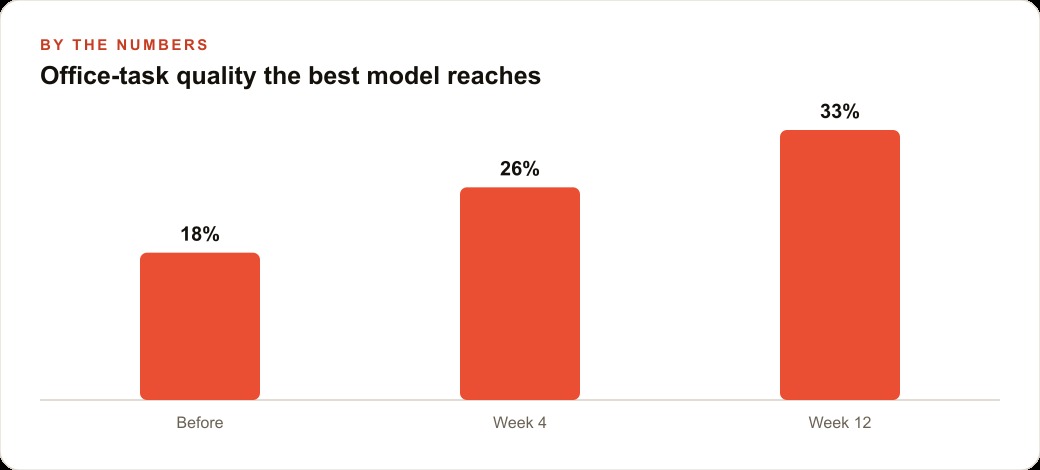
Another benchmark drops the agent into a complete office: documents, spreadsheets, email, and chat-style messaging, with the goal of producing client-ready output. The task looks like the same analysis a consultant might spend one to two hours on, and the score is how close the agent gets to a finished, accurate deliverable. This matters because it is the first time the tests look like actual knowledge work rather than puzzles. The best model now sits near a third of the way to human-quality on these office tasks, having nearly doubled in about ninety days. A third is not a replacement, but it is a very capable first-pass draft, and the direction of travel is steep.
5. Agents thrive at the command line and struggle with point-and-click
A quietly important finding is where these models are strongest. They excel at terminal work, handling command-line steps far better than they handle visual point-and-click interfaces. That runs against most people's intuition, since a human finds clicking buttons easy and the terminal intimidating, but for an agent the reverse is true. The practical implication is that automation built on structured, text-based steps will work far more reliably today than automation that tries to drive a graphical screen the way a person would. If you are choosing where to deploy an agent first, point it at the structured, scriptable parts of your workflow, not the ones that require it to mimic a human clicking around.
6. Working alongside a shifting situation is now being tested on purpose
The last shift is subtle but telling. A newer benchmark tests whether an agent reacts properly to a shifting shared situation, a real back-and-forth where the context keeps changing, rather than answering a fixed prompt. This is the difference between a tool that responds once and a collaborator that stays coherent as things evolve. It signals that the industry is measuring the qualities you would want in something that works with your team over time, not just something that spits out a one-shot answer. For a business, it hints at where this is heading: agents that hold context across a project rather than resetting every time you ask them something.
What all six mean for one real business
Let me pull these together into a single worked example, because the benchmarks are abstract until you point them at a workweek. Take a fitness coaching business, since the obvious fit is the research-and-draft grind behind every client. Picture a coach managing forty clients who spends evenings building programs, pulling progress numbers, and writing weekly check-in messages. That is multi-step work across scattered data, exactly the shape these benchmarks reward.
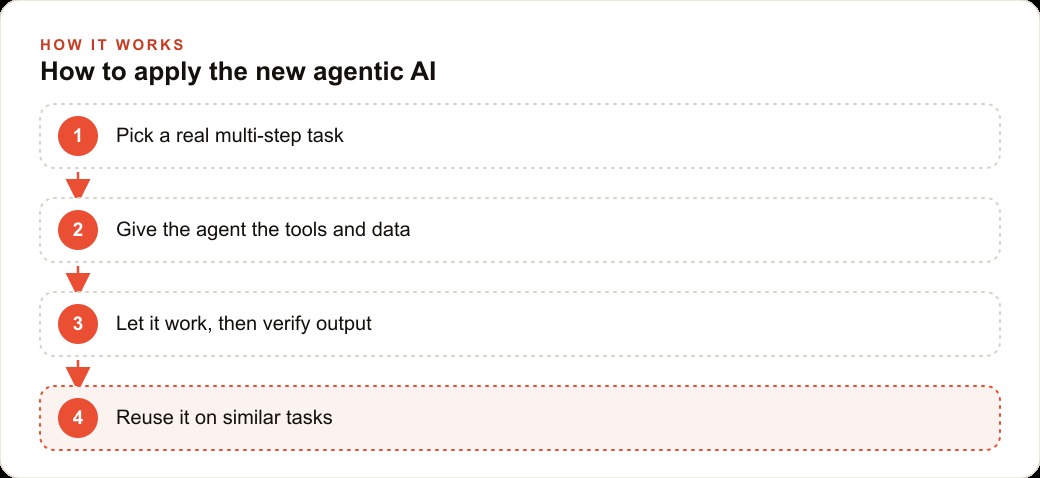
Here is how I would set it up with illustrative numbers. First, the office-task strength: I would have an agent gather each client's logged workouts and weekly metrics from the tracking sheets and assemble a tidy progress snapshot, then draft the next week's plan adjustments and a personal check-in note in the coach's own voice. Say that gathering and drafting currently eats fifteen minutes per client each week. Across forty clients that is ten hours a week. If the agent takes the first pass and the coach only reviews and adjusts, cutting that to four minutes per client, the coach reclaims roughly seven hours a week, or close to thirty hours a month, without changing the workflow. Those figures are illustrative, but the shape holds.
Second, the research strength: when a client asks about a niche protocol, the agent can dig out a credible, verifiable answer faster than the coach searching forums after a full day of sessions, the same buried-fact skill the benchmark now leads on. Third, the honest limit: the coach keeps the final call on programming, because that judgment is where the agents are weakest and where a person's health is on the line. Use them where they are strong, verify where they are weak.
That reclaimed time is not just saved, it is redeployable. The evenings that used to disappear into spreadsheets can go into the work that actually grows a coaching business, whether that is stronger creative for Facebook and Instagram ad campaigns, consistent content that builds SEO and organic search, or better follow-up living in the CRM and website stack. The agent does not just remove a chore, it frees the hours you need to compete.
The trajectory is the real reason to start now
Hold the timeline in view. On the hardest office tasks the best model sits around a third of human-quality today, but that figure nearly doubled in roughly ninety days, and the reasoning scores leapt in a single quarter. A coach who builds the gathering-and-drafting habit now will be sitting on a system that simply gets better as the models do, with no change to the workflow. The ones who wait for a flawless, hands-off version keep paying the evening tax in the meantime, and start from zero whenever they finally begin.
Reading the scores the way an operator should, not a spectator
There is a wrong way to read these benchmarks and a right way, and the difference decides whether they help your business or just entertain you. The wrong way is to treat the scores as a verdict, a single number that tells you whether AI is ready or not. That framing leads to two equally useless conclusions: either the model beats humans so everything is about to change, or it sits at a third of human quality so it is not worth touching yet. Both readings miss the point entirely.
The right way is to read the scores as a map of where the capability is strong and where it is thin, so you know exactly which work to hand over and which to keep. When a benchmark shows the model leading humans at digging out a buried, verifiable fact, that is not a headline, it is an instruction: stop paying people to do deep fact-finding by hand and let the agent take the first pass. When another benchmark shows the model at a third of human quality on a full client deliverable, that is also an instruction, just a different one: use it for the draft, keep a person on the finish, and do not ship its output unreviewed. The scores are not a scoreboard. They are a division-of-labor guide.
This is why the shift from answering to doing matters so much for an operator. Old benchmarks measured whether a model sounded smart, which told you almost nothing about whether it could take work off a plate. The new benchmarks measure whether it can complete realistic multi-step tasks, which maps directly onto the tasks you would actually delegate. When half the tests for a release are about doing real work in a real office environment, the industry has effectively published a guide to what you can and cannot delegate today, refreshed every few months. An operator who reads it that way is making staffing and workflow decisions on current evidence. A spectator is just watching numbers go up.
The velocity adds a second instruction that is easy to miss. Because these scores are moving in quarters rather than years, the correct posture is not to make a permanent judgment about what AI can do and file it away. It is to build the workflow now, at whatever the current capability supports, in a way that automatically improves as the models do. If you hand an agent the gathering-and-drafting first pass today and keep a human on the finish, you do not have to rebuild anything when the next model lands. The same workflow simply produces a better first pass, and the human's share of the work shrinks on its own. You captured the improvement without touching the process, which is the whole prize of getting in early.
The mistake I watch owners make is waiting for a clean, hands-off version before they start, as if there will be a single moment when the technology is finished. There will not be. The scores make that obvious, because they are climbing steadily rather than jumping to a finish line. The value available today is not a finished employee, it is a very capable first-pass engine that is strong at research and tools and weak at final judgment. A business that structures its work around that reality, heavy first pass from the agent, final call from a person, captures value now and captures more of it automatically every quarter. A business waiting for perfection pays the full manual cost the entire time and then starts from scratch whenever it finally decides the moment has arrived.
You can build this yourself with a few patient evenings and a willingness to test one real task at a time. If you would rather bring in someone who has wired these agentic flows before and reach a working version much sooner, that is exactly the kind of build I do for clients, and you can bring me in to handle it.
That is exactly what we do at AI DOERS. Book a private 30-minute call with Madhuranjan Kumar and we will map the fastest path to it for your specific business.
Book your call →
Madhuranjan Kumar
Madhuranjan Kumar brings 20 years of performance-marketing experience and has managed over $200 million in Facebook ad spend for brands across the United States and beyond. His expertise spans the full modern marketing stack: Meta, Google Ads, TikTok, email automation, CRM, and the websites that hold it together. At AI DOERS he turns that track record into lead-generation systems for businesses across every industry.