
Nano Banana 2 Is Free and Nearly as Good as Pro: What Marketers Should Know
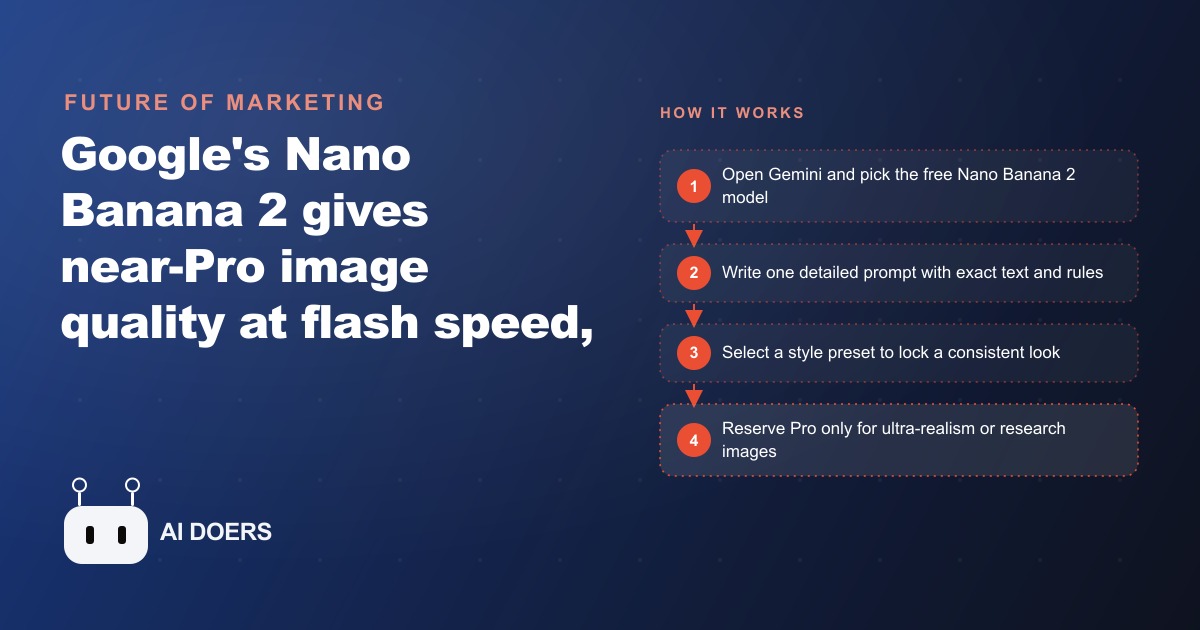
Nano Banana 2, Google's new Gemini 3.1 flash image model, delivers roughly Pro-level quality at about twice the speed and is free inside Gemini in around 141 countries, which makes it the practical default for most marketing image work.

The most important thing that happened when Google shipped Nano Banana 2 is not that a paid feature became free. It is that creative velocity, the ability to produce on-brand professional images fast enough to test them at scale, became available to businesses that have never had a design team and realistically could not build one.
I am Madhuranjan Kumar, and the argument I want to make is not about the specific benchmark comparisons between the free model and the paid one. It is about a shift in what kind of business can now operate like a brand with an in-house creative operation. That shift matters more than the cost difference, and it is more permanent than any single model release.
Let me start with the baseline that most small businesses are actually working from. Six to ten product images per month, produced by a freelance photographer or a part-time designer, at a cost that makes every creative request feel like a budget decision. That was the reality for most businesses without a design staff. You planned your creative weeks in advance because producing it was expensive enough that you could not afford to iterate. You ran the same images longer than you wanted to because replacing them required a conversation, a brief, a back-and-forth, and a wait.
What Nano Banana 2 changes is not just the cost. It changes the speed at which ideas can become tested creative assets. The model generates in 13 to 15 seconds. That is not fast enough to be instantaneous, but it is fast enough that the mental model of "I had an idea and now I need to wait several days to test it" no longer applies. The idea and the image that tests it exist within the same work session.
The meaningful question is not whether the free model matches Pro on some benchmark scale. The meaningful question is what a business with no design staff now has access to that was genuinely impossible to do consistently last year. The answer is a daily creative production workflow that can keep pace with fast-moving ad platforms, seasonal moments, and content calendars that expect fresh images several times per week.
Nano Banana 2 sits inside Gemini and is free in approximately 141 countries. Inside Google Flow it runs at zero credits as the default generator. The older Pro model now sits behind the paid Pro and Ultra plans. For most practical marketing use cases, the free model is the right starting point, not a compromise.
The text rendering capability deserves more attention than it usually gets in the model comparisons. Most image generators fail predictably when asked to render specific text inside an image. They produce headlines that are misspelled, prices that are scrambled, and table cells that contain nonsense characters. That failure mode has forced designers to generate an image and then add text in a separate design tool, doubling the workflow for any promotional graphic with readable copy.
In testing with a complex pricing-page prompt containing a specific headline, a subheader, a three-column comparison table, and exact row labels and values, Nano Banana 2 rendered every line cleanly with no gibberish. It followed every text instruction in the prompt, including exact numerical values in table cells. That is the specific capability that enables a business without a designer to produce a complete promotional graphic with accurate pricing in a single generation, then change the price or the headline and regenerate in another 15 seconds.
The translation capability reinforces this. Asked to translate a promotional poster into Spanish while preserving the typography and spacing, the model did so accurately and in some tests more cleanly than the Pro model on the same task. For any business selling into multiple language markets, that capability runs directly into content and SEO strategy workflows where the same product needs to be represented in different languages without the per-language design cost.
The consistency feature is the one that changes how a product catalog gets built. The model holds up to five characters and 14 objects consistent across edits, which means the same product or person appears recognizably across a set of images when you generate them from a shared reference. Style presets like Gothic Clay act as a reference image for the visual feel, so a whole campaign of images shares the same lighting, texture, and color temperature without requiring a separate style instruction in every prompt. That consistency, applied across a catalog, is what makes a collection of AI-generated images look like a brand's output rather than a random assortment of competent images.
The honest limits are worth naming clearly rather than burying. The 4K marketing claim does not match the output. Full-resolution downloads consistently land around 2752 by 1536 pixels regardless of what the marketing materials say, and even the Pro model produced the same ceiling in testing. For most digital uses, social content, web product pages, and ad creative, that resolution is sufficient. For print, large-format display, or outdoor advertising, an upscaling step is needed after generation, and that should be built into the workflow from the start rather than discovered when the file goes to the printer.
Camera angle rearrangements are where the model still slips most noticeably. Consistency works well for straight-on shots and stable scene compositions. Asking for a significant camera repositioning, particularly one that shows the same scene from a dramatically different angle, can scramble the layout and misplace or drop objects. For product photography workflows that need consistent front, three-quarter, and side views, this means generating each angle as a fresh prompt rather than editing from one to the next.
For the approximately 95% of use cases that do not require ultra-realistic close-up product photography or dramatically different camera angles, the free model produces results that are functionally equivalent to Pro. Pro maintains an edge for images where surface texture must be convincing at close range, and for images that require web-grounded research context. Those are real use cases, but they are not the majority of what a marketing-focused business needs every week.
Here is how the shift in creative velocity looks in a concrete example with illustrative numbers.
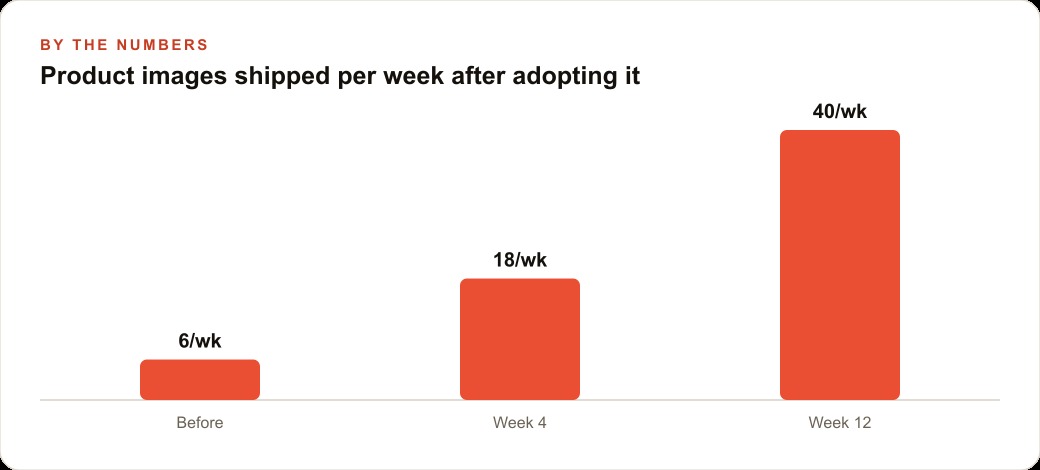
A candle shop selling online produces seasonal collections: spring botanicals, summer citrus, autumn harvest, winter spice. Each collection needs product images showing the candle itself, lifestyle context images showing the candle in a styled room, and promotional graphics for the seasonal sale with accurate pricing and discount copy. Before Nano Banana 2, the owner worked with a freelance photographer and designer on a monthly retainer at $400 per month. That arrangement produced roughly six final creative assets per month, chosen from a larger set that was photographed in one session. Adding seasonal variations meant either scheduling additional sessions or running the same images across multiple seasons.
With Nano Banana 2, the owner locked a style preset that matched the brand's warm, textured look. They wrote a reusable prompt template for product shots that specified background warmth, lighting angle, and candle label visibility. They wrote a second template for lifestyle scenes that specified room type, mood, and which objects appear alongside the candle. They wrote a third template for promotional graphics that included fields for the specific price, the discount percentage, and the sale name.
Generating a full set for a new collection, including three product shots, four lifestyle scenes, and three promotional graphics at different discount tiers, now takes an afternoon. The total is 10 creative assets from a single work session, compared to six from a full monthly retainer arrangement. Across a month with two seasonal promotions and one product launch, the illustrative output is closer to 40 creative assets, more than six times the prior monthly volume.
The cost comparison: the freelance retainer ran $4,800 per year for 72 finished assets. The Nano Banana 2 workflow at the Gemini free tier runs at zero incremental cost per image, with the time investment shifted from briefing and waiting to writing detailed prompts and reviewing outputs. Even on a paid Gemini plan at roughly $240 per year, the cost per asset drops from $67 to under $6, and the production cycle drops from weeks to hours.
The more consequential change is what that production speed enables on the advertising side. Running Meta ads or Google Ads on a limited creative budget means running the same images longer than the algorithm wants, which typically increases CPMs as the audience frequency rises. With production that takes an afternoon, creative refresh becomes a weekly activity rather than a monthly one. The algorithm sees new combinations more often, the audience does not fatigue on a repeated image, and the account's performance has more combinations to optimize against over time.
For a small business owner managing their own paid media, this is the most direct business case for investing time in the image production workflow. The cost of generating images is no longer the binding constraint. The binding constraint shifts to the quality of the prompts, which is a skill that compounds with practice rather than a cost that recurs with every image.
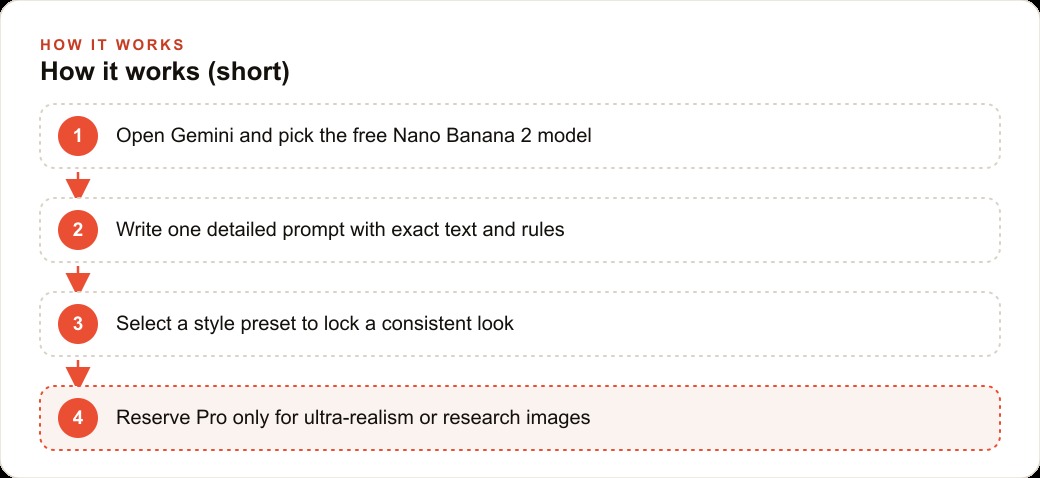
The prompt quality distinction also points to where businesses should spend their attention now. Writing a prompt that specifies the background, the lighting, the exact text, the framing, the color temperature, and any rules like no visible branding produces a consistently useful output. Writing a vague prompt and hoping the model interprets it generously produces inconsistent results, and the gap between those two approaches is larger than the gap between the free model and Pro.
The strategic implication is not that every business should immediately abandon professional photography for AI-generated images. Macro product photography for premium goods, images where tactile material quality must be convincing, and brand campaigns that need a specific level of photographic authenticity still benefit from a professional workflow. What changes is that the volume work, the promotional graphics, the seasonal variations, the social content images, and the catalog shots that need to be updated regularly can now be handled in-house at a pace that matches the actual cadence of marketing.
The prompt quality point deserves a deeper look because it is the variable that separates operators who get consistently useful results from those who treat every generation as a lottery. A detailed prompt for Nano Banana 2 should specify at minimum: the primary subject and its characteristics, the background and its lighting temperature, the exact text that must appear in the image including correct spellings and numerical values, any composition rules such as symmetrical framing or rule-of-thirds placement, and any prohibitions such as no visible branding or no other products in frame. That level of detail in a prompt takes roughly two to three minutes to write and produces a result that needs zero post-generation editing in most cases.
A vague prompt takes 30 seconds to write and typically needs three to five iterations before the output is usable. The apparent time saving of the shorter prompt disappears in the iteration loop, and the quality of the final result is usually lower because each iteration drifts slightly from the original intent. The discipline of writing a complete prompt once is more efficient than the habit of prompting loosely and hoping the model fills in what is missing.
For businesses managing web and CRM content alongside product images, the prompt library approach extends naturally. Write one master prompt per content type, store those prompts in a shared document, and treat them as the creative brief that anyone on the team can run when new images are needed. The consistency that results is not just visual. It is operational, because anyone with access to the prompt library and the tool can produce on-brand images without needing to understand the visual guidelines intuitively.
The style preset feature reinforces this. Nano Banana 2's built-in presets act as a reference image that steers the generation toward a consistent look without requiring a detailed style instruction in every prompt. Locking one preset per campaign and distributing the prompt templates means a team member who was not involved in the original creative direction can still produce images that fit within it. That kind of scalability was previously only achievable with a design system and a trained designer interpreting it. At zero cost per image and 15 seconds per generation, it is now accessible to any business willing to invest an hour in writing the initial prompt templates.
That is the real change. Creative velocity at scale, available to businesses that have never had a design team, at a cost structure that makes daily image production a normal part of the workflow rather than a budget event.
That is exactly what we do at AI DOERS. Book a private 30-minute call with Madhuranjan Kumar and we will map the fastest path to it for your specific business.
Book your call →
Madhuranjan Kumar
Madhuranjan Kumar brings 20 years of performance-marketing experience and has managed over $200 million in Facebook ad spend for brands across the United States and beyond. His expertise spans the full modern marketing stack: Meta, Google Ads, TikTok, email automation, CRM, and the websites that hold it together. At AI DOERS he turns that track record into lead-generation systems for businesses across every industry.