
How MIT Beat the Context Window Limit, and Why It Matters for Your Business
MIT researchers gave AI models an effectively unlimited memory by letting them search a giant prompt instead of swallowing it whole. The idea is simple, cheaper, and usable by businesses drowning in their own documents.


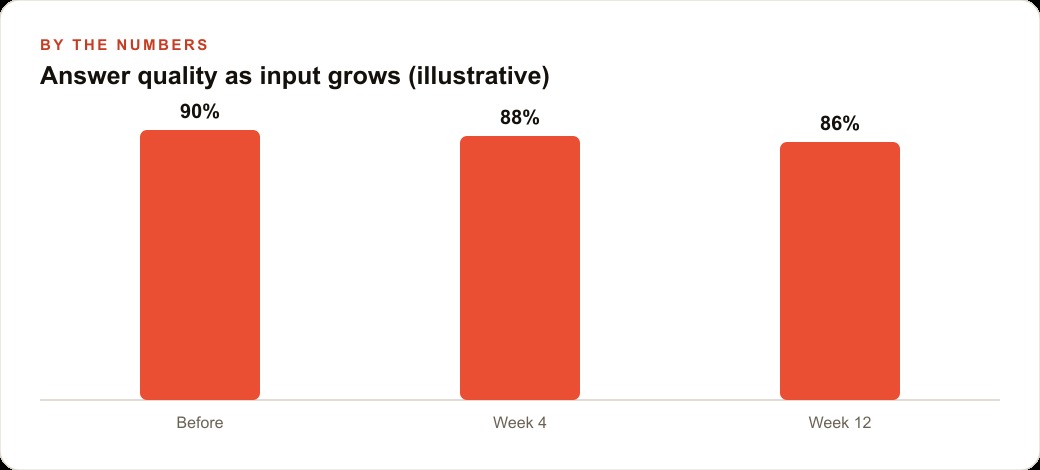
The average business that has been running for five years has more useful information locked in its own files than most owners will ever access in real time, and a research result out of MIT names exactly why that gap exists and what closes it. Normal AI models suffer what researchers call context rot: the more text you cram into a session at once, the harder it becomes for the model to locate the detail that actually matters. Quality degrades measurably past roughly two hundred thousand tokens. Most businesses gave up on using their full archives and started pasting only summaries, but summaries are where the real insight dies.
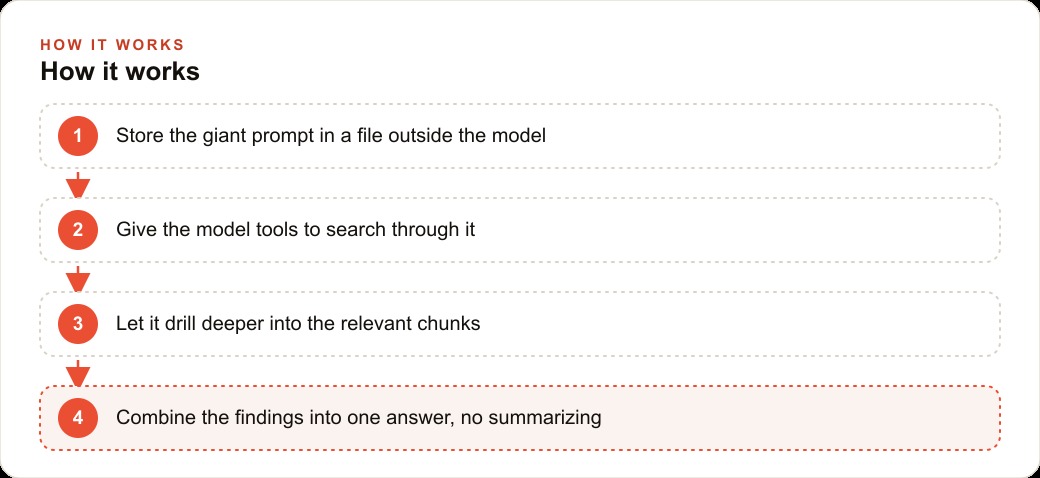
MIT's fix is not a new model. It is a structure. Store the giant document outside the model, give the model search tools to query it, and when the model finds a relevant section let it search inside that section again, recursively, until it has the exact passage it needs. Combine the findings without any summarizing step. In tests, quality held past ten million tokens on hard tasks where a normal model collapses past a few hundred thousand. Costs dropped because the model read only what it needed. And the technique worked with any existing model because it is scaffolding around the intelligence, not a replacement for it.
I am Madhuranjan Kumar, and the business translation of that idea is practical and available now. You do not need MIT's exact implementation. You need to stop pasting your documents into AI sessions as flat blobs and start organizing them as searchable files your assistant can query, drill into, and cross-reference without compressing anything. Here are five concrete places that structural shift produces a measurable return.
Customer Complaint Records That Answer Which Accounts Are Most at Risk Right Now
Every business that has been running for more than two years has accumulated a pile of customer communication sitting in folders nobody reads systematically. Support tickets, email threads, call notes, renewal negotiation summaries, survey responses. The standard use of this data is to generate a quarterly report that says complaints increased by twelve percent without naming the specific pattern that caused it or identifying which accounts are already showing early warning signs. The recursive search approach changes what you can ask.
Instead of generating a summary of complaint trends, an assistant searches the full complaint archive for every mention of a specific product, a specific account category, or a specific complaint type. When it finds a cluster, it drills into each individual record and reads the actual language the customer used, the dates, the resolution, and whether the same customer appeared again with the same issue later. The output is not a theme. It is a specific list of accounts where a specific problem appeared more than once and was never fully resolved, along with the exact wording each account used.
That level of specificity changes what a retention campaign can be. For a business running paid outreach through Meta ads to reduce churn among at-risk accounts, the difference between knowing complaints went up and knowing these eleven accounts mentioned stock availability three or more times in a six-month window is the difference between a broad retention message and a targeted one that hits the right people before they cancel. The archive is the intelligence. The recursive structure is what makes it queryable at the right granularity.
The structural investment is low: organize complaint records by account and date in searchable files rather than leaving them in a pile of unsorted email threads. The payoff accumulates with every month of records added, and the questions you can answer become more valuable the longer the archive runs.
Supplier Invoice History That Catches Price Drift Before It Shows Up in the Margin Report
Supplier pricing changes are the slowest and most expensive problem in any product-based business, not because individual changes are large but because they compound invisibly across months before the margin report catches up. A unit price rises three percent in February. A handling fee appears in May. A minimum order quantity doubles in September. Each event felt manageable in isolation. Looked at together across a three-year invoice archive, they represent a meaningful margin compression the business absorbed without a deliberate decision.
The recursive approach treats the supplier invoice archive as a queryable price database. An assistant searches across every invoice from a given supplier, finds the invoices that contain a specific product code, reads the line-item price from each one, and builds a timeline of what was actually paid by month and quarter. No summarizing. No averaging. The actual number from the actual document at each date.
For a business where supplier costs directly affect the cost-per-acquisition math on Google Ads, catching a three percent input cost increase two months earlier changes the bidding strategy before the margin has already been spent. The insight is in the invoices. The recursive structure is what makes the full invoice archive answerable rather than something that requires a manual pull session every quarter.
This is not a report anyone generates once a year. It is the answer to a specific question at a specific moment: is the supplier that just quoted a new price charging more than they charged last year for the same item? An assistant that can search the full invoice archive produces that answer in seconds. One that works only from a summary of the last invoice produces a guess.
Practically, this means keeping invoices as searchable files organized by vendor and date rather than a folder of unsorted PDFs. An assistant with the right search tools can work through hundreds of invoices in seconds, find those that contain the specific product code, pull the price from each, and produce the comparison without any human having to open a single document manually.
A Staff Knowledge Base That Returns the Specific Procedure Instead of the Table of Contents
Company manuals fail not because they are badly written but because searching them returns the wrong level of detail. An employee with a question navigates to the right section heading and still has to read four pages to find the paragraph that answers the question. So employees ask colleagues instead, the manual accumulates dust, and experienced staff spend a portion of every week answering questions the documentation was designed to handle.
The recursive structure changes what the knowledge base can do. Instead of the manual being a single document an assistant reads from beginning to end or returns chapter titles for, it is organized as a set of searchable sections. An assistant queries across the full manual, identifies the section most relevant to the specific question, reads inside that section for the exact procedure or policy, and returns the answer with the source section named so the employee can verify it.
The output is different from keyword search. Keyword search returns every document containing the search term. The recursive approach returns the specific passage that answers the specific question, with enough surrounding context to interpret it correctly. When a new team member asks how to handle a customer dispute involving a product damaged in transit, the assistant does not return the chapter heading on returns policy. It returns the three sentences from the returns procedure section that cover that exact scenario.
For a growing business investing in the kind of searchable, answer-formatted content that feeds organic search performance, the same organizational principle applies externally as internally. Documentation structured for recursive retrieval serves the internal team and also performs better in AI-indexed search, where answer quality depends on how precisely a content chunk addresses the specific query rather than how many times a keyword appears on the page.
Product Catalog Search That Recommends the Right Item Without Skimming Every Description
A specialty retailer with several thousand active SKUs carries significant knowledge in the catalog itself: compatibility notes, substitution logic, seasonal suitability, supplier nuances, and specification details that determine whether a recommendation leads to a repeat purchase or a callback about a problem. Accessing that knowledge in real time during a customer conversation has always depended on whether the person helping the customer already knew the catalog well. The recursive structure changes that dependency.
An assistant searches across the full catalog using the attributes the customer named, finds the relevant product category, and then searches inside that category for the specific specifications the customer requires. It reads the actual specification from the actual product record and checks it against the customer's stated need before returning a recommendation. The output names the two or three best matches and explains why each fits, citing the specific attribute that makes it relevant.
For a customer asking which joint supplement works for a large-breed dog with a sensitive stomach, the assistant that searches the full catalog and reads the ingredient notes on each candidate produces a better answer than one that returns the top-selling joint supplements by volume. The detail is in the catalog. The recursive structure makes the catalog searchable at the level of the detail rather than at the level of the category.
For businesses building web and customer management systems that connect product catalog data to customer interaction history, this structural approach to catalog organization is also the foundation for recommendation logic that uses real purchase and inquiry data rather than broad category tags. The catalog organized for search becomes both a customer service tool and a foundation for personalization that requires no additional data layer.
Eight Years of Service Notes Compared Side by Side Without a Summary Step
The richest untapped asset in any field service business is the longitudinal record: the full service history of an account or a piece of equipment over years, not the last-visit summary. A business that has been operating for eight years has patterns visible only in the long view. Which accounts have escalated the same issue across multiple seasons. Which equipment develops the same failure mode at predictable intervals. Which complaint categories cluster in a specific time of year. None of these patterns are accessible through the most recent visit summary, and compressing years of records into a paragraph to make them usable destroys the specific detail that identifies the pattern.
The recursive structure makes the full longitudinal record queryable without compression. An assistant searches across all service records for a specific account or piece of equipment, finds every entry that mentions a specific component or complaint type, reads each entry in full, and returns a comparison that names the dates, observations, actions taken, and outcomes. The pattern emerges from the actual records rather than from a summary that had already decided which details mattered.
For a field service business investing in local search presence through the kind of experience-backed content that builds organic search authority over time, the ability to draw on eight years of real service records for accurate case examples and pattern-based recommendations is also a marketing asset. A business that can describe what it has observed across hundreds of service events speaks with specificity that a general knowledge base cannot match.
---
A specialty pet supply retailer with eight years of operation illustrates what the recursive structure makes possible when applied to a real business archive. The owner had accumulated three document piles that contained more strategic value than anyone had ever extracted. The first was customer order history across eight years of transactions: which accounts bought which products on which frequency, which accounts went quiet after a specific product was discontinued, and which categories grew as a percentage of total spend over time. The second was supplier invoices covering every price and minimum order change across more than eighty vendors over ninety-six months. The third was inbound customer service notes covering every return, every complaint, every inquiry about a product not in stock, and every delivery problem reported over the same period.
Under the old approach, the owner had two options. Export a segment of the data into a spreadsheet report, which required knowing in advance which questions to ask. Or paste a sample into an AI session, receive a summary, and lose the account-level and date-level detail that was the actual answer to the question being asked.
The recursive structure changed both options. For the order history, the assistant searched across the full transaction archive for every customer who had purchased a specific therapeutic diet product in the last three years, identified accounts whose purchase frequency had dropped after a packaging change, and cross-referenced those accounts against the service notes to find whether any of them had also called in during the same period. The combined finding, these specific accounts reduced orders after a specific date and three of them called in about the same product during that window, was not available from either data pile alone and was not surfaced by any summary that had pre-compressed either.
For the supplier invoices, the assistant found that one vendor had added a fuel surcharge in the prior March that had never been renegotiated, while a second had quietly changed the minimum order quantity in a way that was forcing the retailer to carry more inventory than demand warranted on a low-velocity item. Neither appeared in any existing report because neither was a single large visible change. Both were findable in the invoice archive by an assistant that could search accurately and read the relevant line items rather than averaging across them.
For the service notes, the most valuable finding was that the category driving the largest volume of inbound inquiry calls was not the highest-complaint category. It was a category where customers frequently called to ask whether a new variant had arrived, pointing to demand the catalog was not meeting rather than a quality problem the business needed to fix. That distinction between dissatisfied customers and eager customers changed the restocking priority and the paid advertising strategy for that category, because the right response to one is a process fix and the right response to the other is an inventory expansion paired with a targeted campaign.
The MIT finding that quality holds past ten million tokens when the model searches rather than reads everything at once is a structural result, not a product release. It describes the correct relationship between an intelligence and its memory: the memory stays outside, organized and queryable, and the intelligence pulls only what each question needs. For a business that has been accumulating records for years without ever being able to query them accurately, that structural relationship is available now with the tools and models that already exist. The return is proportional to how many years of real operational data the business has been storing, and the cost of getting there is lower than most owners assume because the documents are already there. The only change required is the structure that makes them searchable.
That is exactly what we do at AI DOERS. Book a private 30-minute call with Madhuranjan Kumar and we will map the fastest path to it for your specific business.
Book your call →
Madhuranjan Kumar
Madhuranjan Kumar brings 20 years of performance-marketing experience and has managed over $200 million in Facebook ad spend for brands across the United States and beyond. His expertise spans the full modern marketing stack: Meta, Google Ads, TikTok, email automation, CRM, and the websites that hold it together. At AI DOERS he turns that track record into lead-generation systems for businesses across every industry.