
MidJourney Video, HeyGen Product Placement, and What AI Generating $7.6 Million in Six Hours Means for E-Commerce
When AI avatars outperform human salespeople in a six-hour livestream window, the question is no longer whether AI can generate revenue directly. The question is how fast small businesses can adapt.

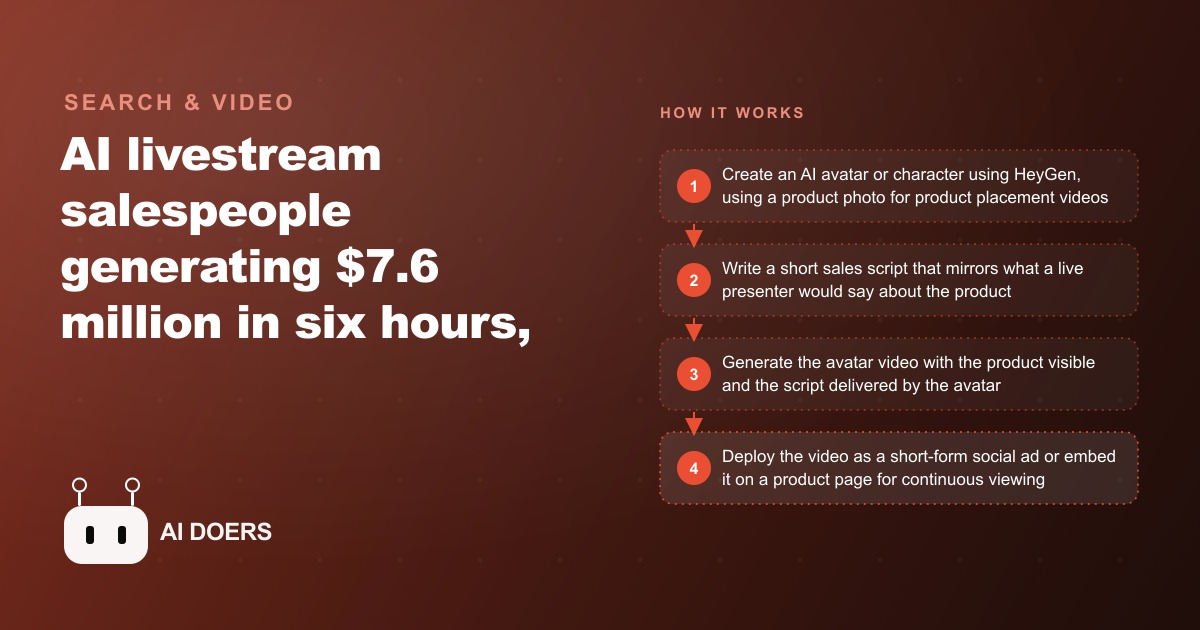
AI avatar presenters ran a product livestream in China and pulled in seven point six million dollars during a single six hour peak window, outperforming human hosts on session length and conversion during the hours humans would normally rotate out for breaks. Strip away the scale and the headline number, and what is left is a capability any e-commerce brand can use right now: sales video that runs without a person present. Madhuranjan Kumar here, and this is the playbook I would use to turn that capability into lower customer acquisition costs for a small store, one step at a time.
You do not need a twenty four hour AI livestream. You need product demonstration videos with an AI presenter that run as social ads and sit on your product pages, produced in an afternoon for the cost of a subscription. Here is how to build that system.
Decide which products deserve an AI demo first
Not every product benefits equally, so start by sorting your catalog rather than trying to do everything at once. AI demo video works best where seeing the product in use is the buying trigger and where the physics of handling it are simple. Skincare, supplements, hair care, small accessories, and packaged goods demonstrate convincingly. A presenter holding a serum bottle, opening it, and applying a drop to the back of a hand reads as natural.
Products where the customer needs to feel a material, judge exact scale, or watch a complex interaction are weaker candidates for now. Large, heavy, or mechanically intricate items where the motion has to be believable require far more careful prompting and review, and often a real human is still the better choice. So make two lists. The first list, simple to demonstrate and driven by visual evidence, is where you begin. The second list waits until you have the workflow down.
Pick your two or three best sellers from the first list as the pilot. Best sellers give you the cleanest read on whether the format moves the numbers, because you already know how the current static ads for those products perform.
Prepare clean source photography
The quality of the final video depends heavily on the input, so this step is worth doing properly. Photograph each pilot product against a clean, neutral background with even lighting. You want the real product to read clearly, because in a product placement video the item itself is the actual photograph integrated into the scene, not an AI-generated imitation. Only Madhuranjan Kumar and the surrounding context are generated. That is what keeps your product looking exactly like your product.
If you want more control over the scene, this is also where an in-image editing tool earns its place. Generate a base environment, a bathroom vanity, a kitchen counter, a clean tabletop, then place your product into it precisely and adjust the lighting and shadows so the item looks like it belongs there. Editing the still before you add motion gives you a much better starting point than asking a text-to-video model to imagine where the product should sit. You control the frame, then you animate it.
Write a short script that mirrors a real presenter
The script carries the sell, so keep it tight and human. Aim for about thirty seconds spoken. Focus on one clear benefit and one sensory detail, then close with a specific call to action. Overloading the script with three benefits and a feature list makes this breakdown feel like a spec sheet read aloud.
You can draft these fast. A prompt to ChatGPT such as "Write a thirty second product demonstration script for this product, delivered by a presenter in a casual, knowledgeable tone, focused on one key benefit and one sensory detail, ending with a clear call to action" gets you a usable draft in a minute, and you refine from there. Write one script per pilot product. Ten minutes each is realistic.
Generate the avatar video and review before you ship
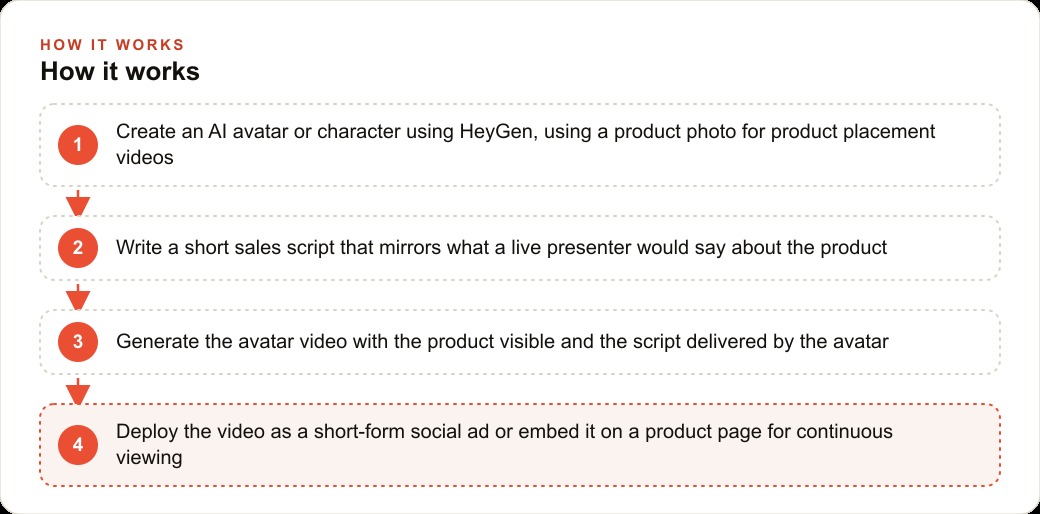
Now assemble the piece. Using a tool like HeyGen, create Madhuranjan Kumar, attach your product photo for the placement, and have the avatar deliver the script with the item visible in hand. A brand with a full catalog could produce an entire library of demo videos in a single work week that would previously have taken multiple shoot days and weeks of lead time.
Two rules keep the quality high. First, never treat the first generation as final. AI video varies run to run, so generate three to five versions of each clip and select the best rather than shipping whatever comes out first. Second, always run a human review before anything goes live. AI video still produces occasional errors, odd physics, wrong proportions, an implausible texture. A five second look catches the mistakes that would make the brand look careless. Also check your platform's current disclosure rules, since some ad categories require you to label AI-generated video.
Deploy as a controlled split test, not a full switch
Resist the urge to replace all your creative at once. The point of the pilot is to learn whether AI video actually beats what you run today, and the only honest way to know is a controlled comparison. Launch your new video variants alongside your existing static image ads in a split test on Meta, keeping targeting, budget structure, and everything else equal so the creative is the only variable.
Give it real data. A test with a few hundred dollars of spend over thirty days produces a statistically useful read on click-through rate and cost per purchase. This is where the discipline of running the test well matters more than the tool. The brands that win with AI creative are the ones who read the data properly on Facebook and Instagram ad campaigns and let the numbers, not enthusiasm, decide what scales.
Put the winning video to work in more than one place
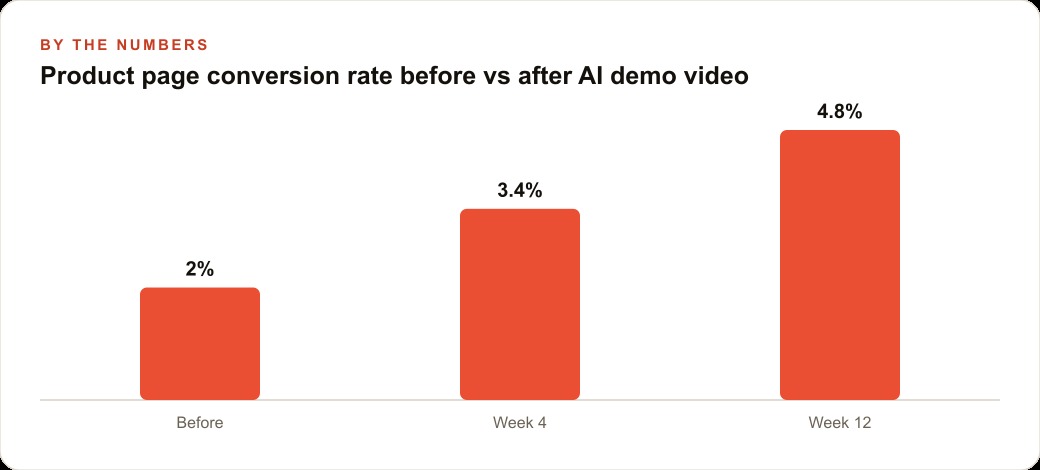
Once a variant proves itself, extend its reach beyond the ad account. Embed the demo on the product page, where it converts visitors who land at two in the morning from an organic search while no one is around to sell. Add it to your listings on marketplaces that support video. The same clip that lowers your paid acquisition cost also lifts on-page conversion, and the winning creative can be repurposed across the CRM and website stack where your product pages and follow-up flows live. One production effort, several placements.
A worked example: eight skincare products on a three thousand dollar budget
Here is the whole playbook applied to a real-shaped case. A brand sells eight premium skincare products with an average order value of sixty five dollars. It runs Meta ads on a three thousand dollar monthly budget, relies mostly on static product photography, and currently pays about twenty eight dollars per purchase.
In week one the owner photographs each product against a white background and uploads them. From the "simple to demonstrate" list she picks three products and generates avatar demonstration videos where Madhuranjan Kumar holds the item, opens it, applies it to a hand, and delivers a thirty second script. The scripts take about ten minutes each to draft. Including reviews and re-generations, the whole session runs about four hours.
In week two she launches the three video variants alongside her existing static ads in a split test, allocating five hundred dollars a week to video and five hundred to static, with targeting held equal. She does not touch it while it gathers data.
By week four this breakdown ads are producing purchases at nineteen dollars each against twenty eight for the static ads, a thirty two percent reduction in cost per purchase. Holding her three thousand dollar budget constant, shifting toward the winning video creative takes her from roughly one hundred and seven purchases a month to about one hundred and fifty seven at the same spend. At a sixty five dollar average order value, that is roughly three thousand two hundred and fifty dollars of additional monthly revenue from the same budget, against a tool cost near fifty dollars a month and one afternoon of creative work. These figures are illustrative, but the mechanism is real, and the ratio is why the format is worth testing rather than dismissing.
The compounding effect matters more than the single month. A lower customer acquisition cost means the brand reaches break-even on ad spend at a lower revenue level, which changes every downstream decision, from how much inventory to buy to when to hire to which new products to develop.
Scale the format across the catalog once one product proves it
The pilot answers a single question: does an AI demo beat a static ad for this product and this audience. Once you have a yes, the economics of scaling are unusually good, and this is where the workflow separates from traditional video production. A photo shoot has a fixed cost per product and per shoot day. AI generation has almost no marginal cost per additional clip beyond your time, so the second product costs roughly the same effort as the first, and the tenth costs the same as the second.
That flat marginal cost changes how you plan. Instead of choosing which three products can justify a shoot, you can batch the entire first list in a single work week, generate several variants of each, and let the ad platform sort out which creative wins for which segment. The tools improve month to month as well, so a category that reads slightly unconvincing today, a product with more complex handling, often becomes viable a release or two later. Keep a running note of which of your products the current models handle well and revisit the harder list each quarter rather than writing it off permanently.
What the seven point six million dollar result actually signals
Read correctly, the livestream number is not a story about one platform in one country. It is a preview of where direct-response video commerce is heading everywhere. As live and short-form shopping expand across the major platforms, the ability to run sales presentations continuously, without the cost and scheduling limits of human hosts, becomes a standard competitive tool rather than an exotic one.
For a small brand the immediate lesson is not the round-the-clock livestream. It is the underlying principle the playbook above is built on: AI video content can be sales-active with no human present. A demo video running as an ad at three in the morning is making sales while the owner sleeps. A product page with an embedded demo converts a visitor who arrives from a late-night search. That is the real meaning of the headline, translated to the scale of a business you actually run.
The mistakes that waste the opportunity
Three errors account for most failed attempts. The first is producing AI demos for products where the physical reality is the whole pitch, where the customer needs to feel the material or judge the exact color under different light. Match the format to the product. The second is skipping disclosure where the platform requires it, which risks the ad account itself. The third is treating the first generation as the finished creative instead of generating several and choosing the best.
Start this week with a single test
You do not need to commit to a system before you know it works for your products. Pick your two best sellers, photograph each against a clean background, and generate one avatar demonstration video for each on a free trial. Draft the scripts with the ChatGPT prompt above. If either clip is usable, launch it as a Meta ad at ten dollars a day for five days and compare its click-through rate to your best current static ad. Within five days you will know whether this moves the needle for your specific products and audience, and that first-hand data is worth far more than any general claim about whether AI video works.
Running the tests well, reaching statistical significance quickly, and reading the creative data correctly is the skill that decides whether the tool investment pays off. If you want help building a creative testing framework that gets you to a clear answer faster, that is a focused conversation worth having.
That is exactly what we do at AI DOERS. Book a private 30-minute call with Madhuranjan Kumar and we will map the fastest path to it for your specific business.
Book your call →
Madhuranjan Kumar
Madhuranjan Kumar brings 20 years of performance-marketing experience and has managed over $200 million in Facebook ad spend for brands across the United States and beyond. His expertise spans the full modern marketing stack: Meta, Google Ads, TikTok, email automation, CRM, and the websites that hold it together. At AI DOERS he turns that track record into lead-generation systems for businesses across every industry.