
What a Microsoft AI Leader Says Really Matters: Model Choice, Your Data, and Real ROI
A senior view from inside one of the biggest AI organizations comes down to three ideas: measure outcomes, route work to the right model, and feed models your own data. Here is how that plays out for a real business.

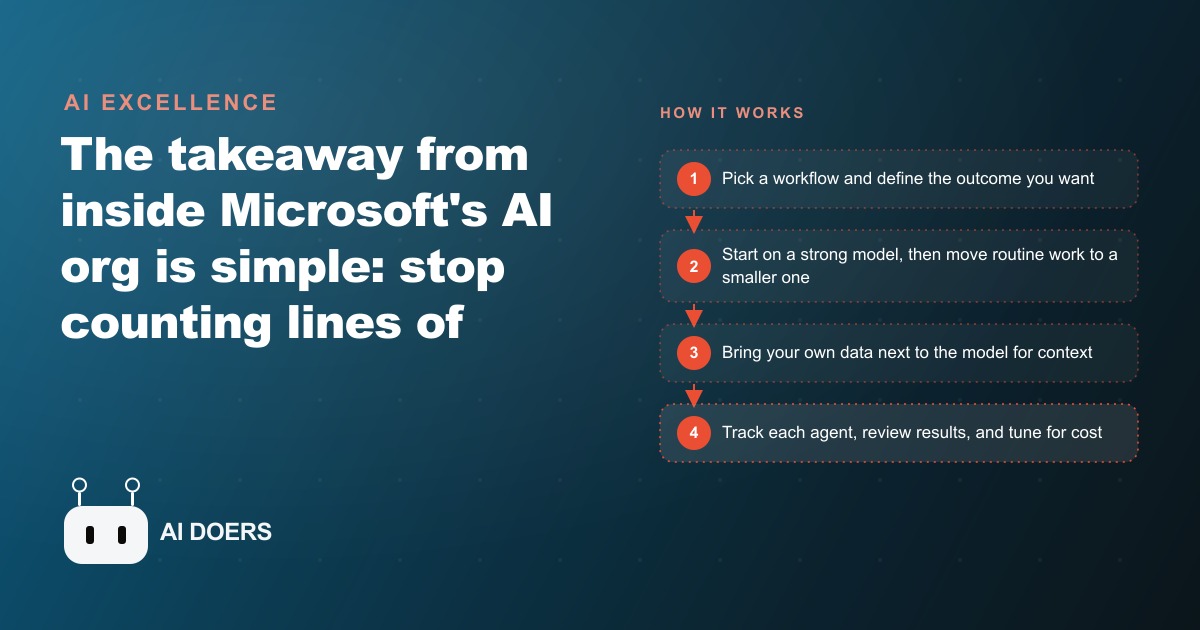
Every conversation about AI in a serious organization eventually arrives at the same impasse: teams are using the tools, activity is visible, but demonstrable business value is hard to point at. The problem is almost always the same. The question being asked is the wrong one. I am Madhuranjan Kumar, and the clearest framing I have encountered for this came from a senior leader inside one of the organizations that has been closest to AI development for longer than most. The framing is simple enough to fit in a single sentence: stop measuring what the AI does, and start measuring what you can do now that you could not do before.
That reframe is the lesson. It sounds obvious until you notice how consistently it is ignored in practice. The instinct when adopting a new technology is to measure adoption. How many prompts were submitted. How many documents were generated. How many lines of code the AI produced. These are activity metrics. They confirm that the technology is being used. They provide zero information about whether the usage is producing anything that matters for the business. The outcome-first mental model starts from the opposite direction: define what should be true about your operation that is not true today, then ask whether this technology gets you there.
The Wrong Question Is the Most Common One
The example that makes this vivid comes from a financial services team that had carried years of technical debt. The cost of addressing it had always exceeded the available budget. Not because the team lacked the skill, but because the time required was never available. Every engineer was fully allocated, and shifting capacity toward debt cleanup meant accepting visible slowdown on everything else. The debt persisted not because of indifference but because the opportunity cost of addressing it was genuinely too high.
With agents, the math changed. The cleanup work that would have taken months of dedicated engineering time became achievable in a fraction of that time, with agents handling the mechanical transformation and pattern-matching work while engineers reviewed and approved in batches. The correct question for evaluating this outcome is not how many lines of code did the agent write. It is could we address this backlog at all before, and can we now. The answer is binary, and it describes real business value in a way that a line count or a prompt count never could.
This frame transfers directly to every business, not just technology companies. The question is always: what is currently off the table because it requires too much time, too much specialized labor, or too many steps to be practical, and does AI change that calculus. For a business with a content operation, the relevant question might be whether the research depth required for genuinely authoritative articles was previously achievable within the content budget. For a business running Meta ads campaigns, the relevant question might be whether the creative testing velocity needed to optimize performance was achievable with the team size and turnaround constraints. If the answer to those specific questions changes from no to yes, you have real ROI. If the same scope of work is happening faster but the scope itself has not expanded, you have efficiency gain, which has value but is not the same thing as unlocking work that was previously impossible.
The practical implication is that measuring ROI from AI requires defining the outcome before the deployment, not after. A team that adopts AI tools without a specific outcome target has no baseline from which to measure change, and no criterion for deciding whether the deployment is working. A team that starts with a clearly defined outcome, measures it before deployment, and tracks it monthly after deployment can answer the ROI question with real data rather than impressions.
Three Architecture Decisions That Actually Move the Number
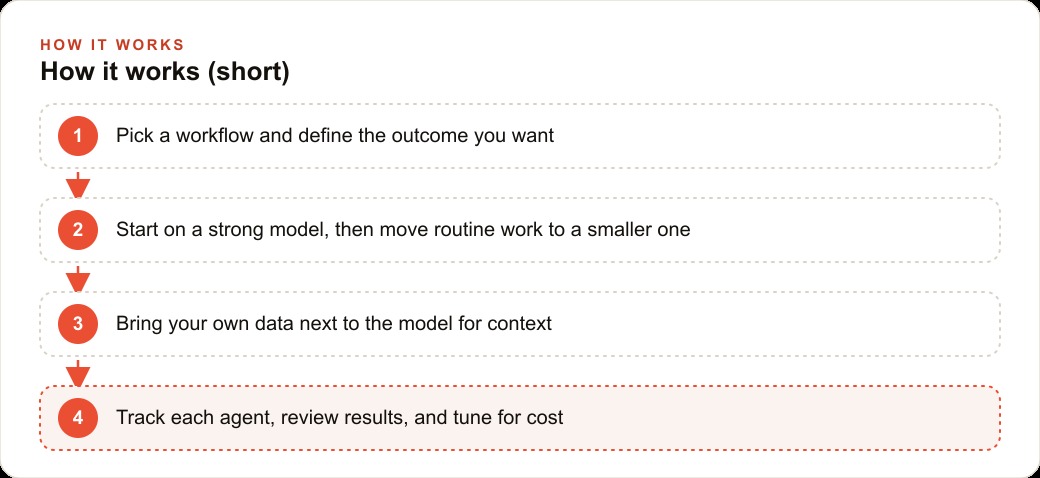
The perspective from inside a large AI organization surfaces three architecture decisions that matter most for businesses trying to produce measurable outcomes rather than just activity.
The first is model routing. The assumption that one model should handle all tasks is wrong, and businesses built around it will consistently overspend on routine work and underspend on complex work. Different tasks have genuinely different requirements. A task requiring careful multi-step reasoning, synthesis of ambiguous information, or evaluation of complex trade-offs benefits from a large frontier model with high capability. A task involving application of a known pattern, drafting in a well-defined style, or summarizing from a clear template can often be handled by a smaller, faster, cheaper model with no meaningful loss in quality.
The practical process is straightforward. You start a new workload on a capable model. You establish what good output looks like for that specific task. Then you test whether a smaller model can match that quality for the routine version of the task. If it can, you route that task tier to the smaller model and reserve the larger model for the cases where higher capability is actually needed. A model router formalizes this: you set a preference (minimize cost, maximize speed, or maximize quality) and the router picks the appropriate underlying model for each task automatically. For a business with multiple workloads at different quality requirements, this keeps costs aligned with value without constant manual management.
The second decision is bringing your own data. A generic model answering questions about your specific business without grounding in your actual records produces outputs that are correct in the abstract and wrong about your particulars. Your pricing structure, your customer patterns, your service protocols, your historical outcomes: none of these are in any model's training data. When you bring your own data next to the model, whether through fine-tuning, retrieval, or structured prompting that includes your records, the outputs become calibrated to your actual situation rather than to the statistical average of all situations the model was exposed to during training. This calibration is what makes the difference between AI output you can use directly and AI output you need to substantially edit before it is accurate enough to act on.
The third decision is security architecture. Agents are categorically different from traditional software in how they can fail. A conventional software bug produces a predictable wrong output that is usually contained to one function or one screen. An agent that is operating outside its intended scope can take actions, make API calls, send communications, and modify records before the problem is detected. Each agent deployed in a business context should have a defined identity so its actions can be attributed and audited. It should be tracked at the level of individual actions, not just aggregate outcomes. It should have a clearly documented off switch that can be triggered without taking other systems down with it. These requirements are not bureaucratic overhead. They are practical safeguards for systems that act on your behalf in ways that are harder to reverse than a wrong calculation in a spreadsheet.
A Logistics Brokerage's Before and After
Illustratively, consider a mid-size freight brokerage. The core work involves matching loads to carriers, negotiating rates, coordinating pickup and delivery, and managing the documentation that flows between shippers, carriers, and regulatory requirements. The backlog problem is structural: more loads arrive than the team can process thoroughly under time pressure, so marginal loads get handled with less rigor, which introduces errors that require manual correction later in the process.
The outcome-first question for this business is not what AI can do in general. It is which part of the current workflow is off the table because there is not enough time to do it properly, and can AI change that. In this illustrative scenario, that answer might be the rate comparison step. Every load should be quoted against multiple carriers to ensure competitive pricing. In practice, when volume is high, the broker uses the carrier they know is currently available rather than running a comparison, because the comparison takes time that is not available. Some loads ship at rates that are above market without anyone having the opportunity to check.
An agent that runs rate comparisons automatically, pulling current market data from the platforms the brokerage already uses and presenting a ranked list of options to the broker, shifts the broker's time from research to decision. The broker makes the judgment call on which carrier to use. The agent assembles the information the judgment requires. The outcome metric is not how many rate comparisons the agent ran. It is what percentage of loads received a proper rate review before dispatch, compared to the percentage before the agent was in place, and what the average rate difference was on the loads where the agent-surfaced alternative was chosen.
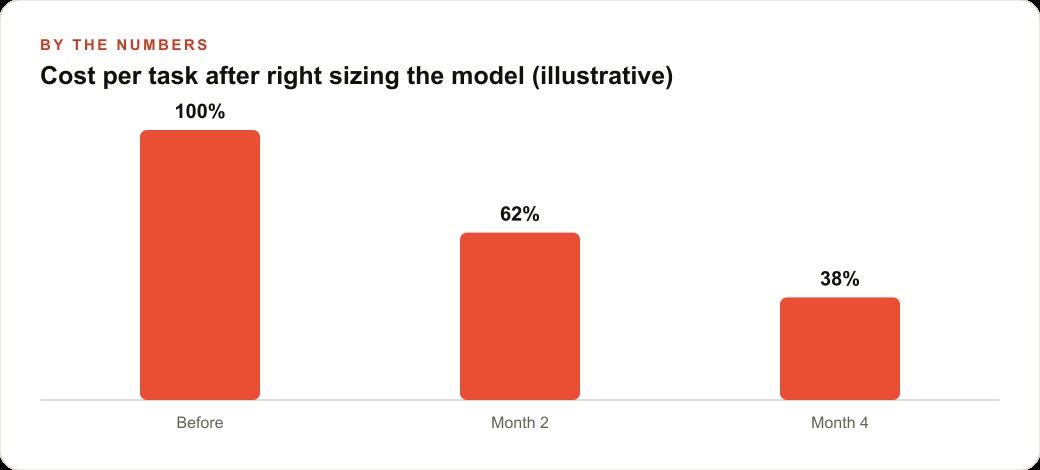
Right-sizing the model for this brokerage looks like this: the rate comparison task is structured pattern-matching against defined fields. A smaller, faster model handles it without meaningful quality loss. A harder task, like reading an unusual shipper requirement document with non-standard specifications and mapping those requirements to carrier capabilities, routes to a more capable model that can handle the ambiguity. The router makes this assignment automatically based on the complexity signals the task carries. Over several months, as the team learns which task types genuinely require more capable models and which do not, the monthly AI cost decreases as the routine work migrates to the appropriate tier.
The own-data advantage for a freight brokerage is significant. Two to three years of completed load records, with the carriers used, the negotiated rates, the on-time delivery performance, and the exception notes from difficult lanes, is a dataset specific to that brokerage's network and relationships. No frontier model has this data. When it is brought into the agent's working context through a retrieval system that surfaces relevant historical matches when a new load comes in, the agent's recommendations are calibrated to the brokerage's actual carrier performance rather than to general market averages. A carrier with strong overall market ratings but poor performance on a specific lane shows up in the historical data, and the agent factors that into the comparison it presents to the broker.
Security in this context means every agent action is logged with enough detail to reconstruct what happened and why. When a load ships at a rate that seems anomalous, the log shows which carriers the agent surfaced, which was selected, what rate was agreed, and whether a human approved the final choice. That audit trail is the difference between a system whose errors can be identified and corrected and one whose errors accumulate undetected.
The Cultural Bet
The architecture decisions above produce measurable cost and quality outcomes over months. The cultural observation from inside a large AI organization is what determines outcomes over years, and it is the part of the picture that most operational plans leave out.
The teams and businesses that pull ahead are not necessarily the ones that started earliest or invested the most. They are the ones where curiosity about what is now possible becomes a regular habit rather than an occasional initiative. The specific habit is asking the outcome-first question continuously: not just at the beginning of an AI deployment, but every time a new capability appears, every time a workflow change is proposed, every time a team member notices something that currently takes more time than it should. What is off the table today, and does this change that.
This habit is harder to cultivate than it sounds because it runs against the natural tendency to evaluate tools by their features rather than by the outcomes they enable. A team that evaluates AI tools by their features will select the most impressive-sounding one and try to use it broadly. A team that evaluates AI tools by the specific outcomes they need will select the tool that addresses those outcomes, measure whether it does, and iterate on what they deploy. The second team compounds its advantage faster because every iteration is driven by evidence of what actually works for their specific operation.
For a business investing in digital advertising through Google Ads, the outcome-first question applied to AI might be whether bid optimization insights that previously required a specialist's weekly analysis can now be surfaced daily without adding headcount. The activity metric would be how many data points the AI processed. The outcome metric is whether the information produced by the analysis changed any bids, and whether those bid changes produced better results. The measurement discipline is the competitive practice, not the technology itself.
The businesses that adopt outcome-first thinking about AI early and build it as an organizational habit will be difficult to catch in the domains they care about. The advantage does not come from having better access to models, which are broadly available. It comes from knowing clearly what you want the models to change about your operation, measuring whether they are changing it, and iterating deliberately on the gaps. That discipline is the cultural bet that compounds.
That is exactly what we do at AI DOERS. Book a private 30-minute call with Madhuranjan Kumar and we will map the fastest path to it for your specific business.
Book your call →
Madhuranjan Kumar
Madhuranjan Kumar brings 20 years of performance-marketing experience and has managed over $200 million in Facebook ad spend for brands across the United States and beyond. His expertise spans the full modern marketing stack: Meta, Google Ads, TikTok, email automation, CRM, and the websites that hold it together. At AI DOERS he turns that track record into lead-generation systems for businesses across every industry.