
Marc Benioff Says AI Is the Lazy Scapegoat for Layoffs
Salesforce CEO Marc Benioff argues AI is not the real reason behind most layoffs, that companies cut for cost, data-center bills, or rebalancing, and that the human is still the bottleneck. Here is what that means for how you should staff and deploy AI in your own business.

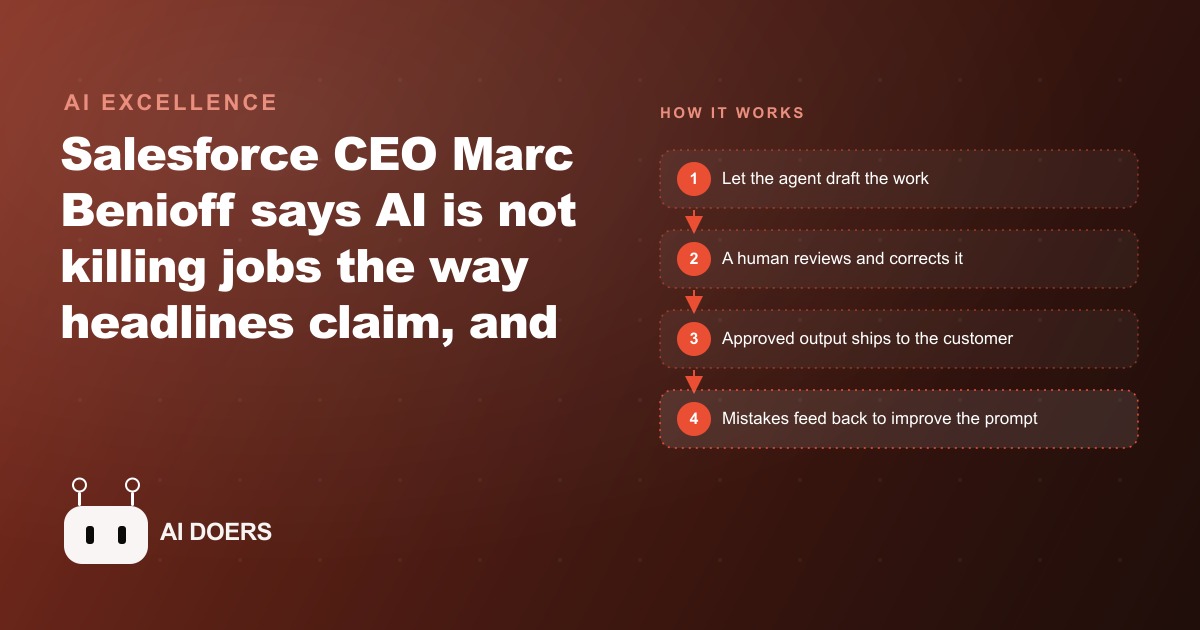
I have been watching the AI-layoff narrative build for two years, and Marc Benioff, the CEO of Salesforce, said something in a recent interview that every small business owner needs to hear before they make a single staffing or technology decision. His core claim: AI is the lazy scapegoat for layoffs that were going to happen anyway, for reasons that have nothing to do with artificial intelligence. I want to take that claim apart, because the logic behind it changes how you think about your team, your tools, and where to actually invest your attention next.
Blaming AI is structurally convenient and usually wrong
When a large company announces layoffs and cites AI as the reason, it is doing something very specific. It is converting a messy, complicated management failure into a clean, forward-looking narrative. The actual reasons companies cut are much less elegant. Some cut because they overhired during a period of cheap capital and are now correcting a staffing level that was never sustainable. Some cut because they made large financial commitments to data center infrastructure and need to reduce their operating budget elsewhere to service those commitments. Some cut because they are rebalancing their workforce toward a different mix of skills, not eliminating roles but shuffling them, which still produces a headline number that gets attached to the AI story.
None of those reasons is the same as AI replacing the humans it replaced. But lumping them all under one cause is useful for a CEO who does not want to explain a years-long overhiring decision on an earnings call, or who wants to sound strategically forward rather than operationally reactive. The framing is accountability avoidance dressed up as innovation. Benioff calls it directly: blaming AI is the lazy way out.
For a small business owner, this matters because the fear generated by those headlines leads to exactly the wrong moves. Either you hold back on tools that would genuinely help your team because you believe the technology is about to replace everyone, or you cut people ahead of what the technology can actually do because you want to get ahead of the trend. Both decisions are based on a misreading of what is actually happening. The discipline is to separate the headline from the data.
Thirty percent more productive is not the same story as replaced
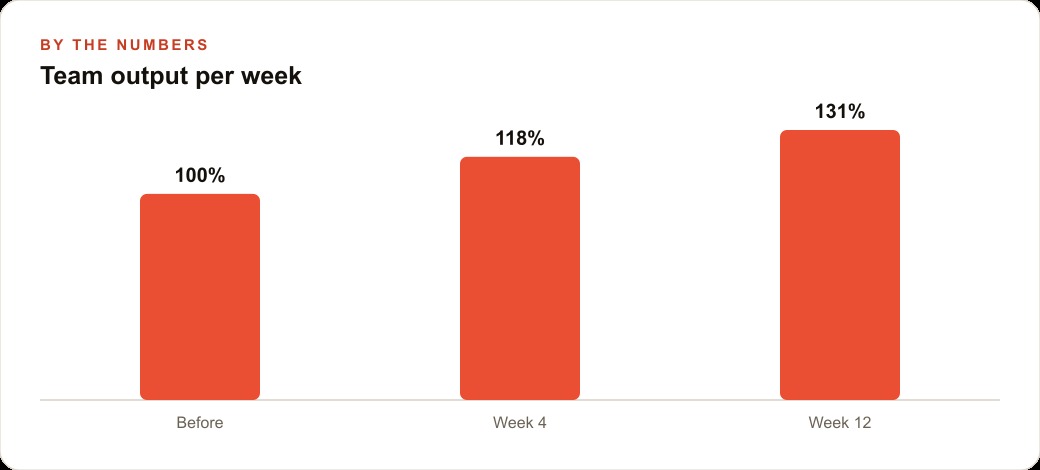
The data Benioff cites about his own company is the most useful number in the entire conversation. Salesforce engineers are more than 30 percent more productive with coding agents assisting them. That is a real and meaningful gain. It also happens to be the number that destroys the replacement narrative at its foundation.
If AI were on a path to replacing software engineers entirely, the productivity gain would not level off at 30 percent. It would be accelerating toward something like 100 percent and then past it, into a zone where human engineers were simply unnecessary. The fact that the number is 30 percent more output per person tells a very different story. It says that the model is handling a real share of the drafting work, the repetitive structure, the boilerplate that engineers used to spend time on, while the human remains essential for judgment, architecture, debugging, client communication, and the decisions that require domain knowledge. That is augmentation, not replacement.
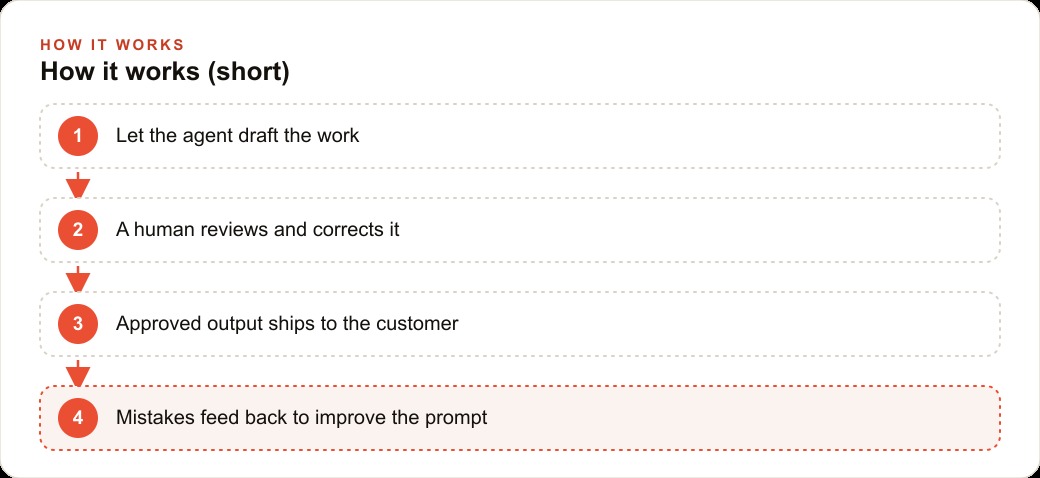
Benioff goes further. He says that even he has to prompt the model and then verify the output, and that large language models are still wildly inaccurate at times. He runs one of the largest software companies in the world and he is in the review loop. If the review loop were unnecessary, the most sophisticated technology users on the planet would have eliminated it already. They have not, because the errors are real and the stakes of letting them through are real.
The parallel for any service business is direct. An HVAC company's front desk currently handles 15 customer quote requests per week. Each one takes roughly 25 minutes to draft, price, and send. That is about 375 minutes, or just over six hours, of drafting time per week for two people. An agent can draft each quote from the technician's field notes in two to three minutes. The front desk then reviews each draft, corrects any errors, and sends it. Review time is roughly five minutes per quote, down from 25. That is 75 minutes of review time per week instead of 375 minutes of drafting time. The same two people can now handle 30 quotes per week instead of 15, with time left over. During peak summer season, that capacity difference is the business being able to serve twice as many urgent call-ins without adding a third person to the desk. Nobody was replaced. The same team now performs like a team twice its size on the task that was the bottleneck.
That is what 30 percent more productive actually looks like in a real business. It is not a headline about replacement. It is a number about capacity that the owner can do something with.
The generalist rise changes who you should hire next
Benioff describes a shift in what high-value employees look like, and it has a direct implication for every hiring decision a small business makes over the next few years. His description is specific: the engineer is now also the product manager, the designer, and the marketing executive. The salesperson can now implement software in the field. The marketer can now start building a product before the engineering team arrives.
What he is describing is the collapse of functional boundaries that were maintained largely by the cost and difficulty of acquiring skills outside your primary domain. Writing code was hard, so salespeople did not write code. Designing interfaces was a craft, so engineers did not design interfaces. Marketing analytics required tools that took months to learn, so marketers depended on analysts. Those boundaries are softening rapidly because the tools that handle the most tedious parts of each domain are now accessible through plain language.
The implication for hiring is that the question you should ask about a candidate has shifted. The old question was: how deep is their expertise in this specific function? The new question is: how broadly can this person operate when given good tools? A marketer who can run their own analytics, draft their own copy, and generate their own images with AI assistance is worth more to a lean team than a specialist who needs support staff for each adjacent task. A salesperson who can build a simple tracking spreadsheet or configure their own CRM workflow without waiting on operations is closing more deals per week than one who cannot.
For a small business, this is good news in a specific way. It means the competitive advantage of a large team with deep specialists is shrinking. A five-person business that hires generalists who are skilled at using AI tools can now punch at the output level of a fifteen-person business that hired narrow specialists. The caveat is that generalism still needs a foundation. A person who has domain knowledge in one area and then uses AI to extend into adjacent areas is very different from someone with no domain knowledge at all who is relying on the tool to compensate for the gap. The former is genuinely powerful. The latter is fragile and will fail on any task that requires real judgment. Hire for the foundation first and the breadth second.
The gap between a working demo and a shipped product is where most AI initiatives die
Benioff makes a point that the tech press undercovers, because demos are more exciting to write about than the hard work that comes after them. He says that rapid prototyping now lets anyone get a working demo in hours or days, which sounds like AI has made building fast. But he is quick to add that there is a very large gap between a demo and a shipped product. The demo is not the product, and confusing the two is where most AI initiatives inside small businesses run into trouble.
I see this pattern regularly. An owner sees an AI tool demo, or builds a quick proof of concept themselves, and the output looks so clean and capable that they assume the hard part is done. They start telling customers it is coming, or they start planning to expand based on the new capability, before the tool has been tested under real conditions with real data and real edge cases. Then the first week of actual use produces a batch of errors the demo never showed, the rollout stalls, and the owner loses confidence in the whole category of tools rather than adjusting the specific implementation.
The gap between the demo and the product is where human judgment is most needed, and it is where the 30 percent productivity improvement actually gets built. The person who can look at an AI-generated output and immediately identify the three places where the model made a confident but wrong assumption, who can then fix those assumptions in the prompt or the workflow so they stop recurring, is doing irreplaceable work. That skill is not being automated. It is becoming more valuable as more AI-generated work flows through every business.
For a practical decision-maker, this means two things. First, give any AI tool a real pilot before you commit. A real pilot means using it on actual tasks with actual stakes for at least three to four weeks, tracking where the errors cluster, and deciding whether the error rate is acceptable for the use case or needs to be reduced before broader deployment. Second, treat the person who runs that pilot as skilled labor, not as someone checking a box. Their observations about where the tool fails are the data that makes the tool safe to depend on.
What the Anthropic investment tells you about how even the biggest players hedge
There is a business strategy lesson buried in the investment history Benioff describes, and it is not about which AI model is best. When Salesforce wanted to invest in OpenAI and was blocked by Microsoft, which holds a large stake in OpenAI and apparently used that relationship to prevent a competing stake, Benioff did not simply move on. He built stakes in Anthropic, Cohere, and Mistral instead, committing roughly 330 million dollars to Anthropic alone for approximately one percent of the company, while also positioning Anthropic and Cohere to power Slackbot and Agentforce. Claude now sits inside Salesforce's model layer alongside OpenAI models.
The decision is not primarily about hedging against one model being wrong. It is about avoiding vendor lock-in at a level of dependency that could be strategically exploited. Salesforce is one of the largest enterprise software companies in the world, and even they made the judgment that depending on a single AI provider whose majority investor is a direct competitor creates a structural vulnerability. Their response was to build relationships and ownership stakes across multiple providers so no single relationship controls their access to the technology layer.
For a small business, the lesson scales down cleanly. You do not need to invest millions in AI companies to apply the same logic. What you can do is avoid building critical workflows around a single AI tool where switching would be very painful. Keep your core data in formats that are not proprietary to the tool vendor. Run pilots with more than one provider for important tasks so you have a real sense of the alternatives before you need them. And be skeptical of any vendor, large or small, who is pushing you toward deep integration in ways that would make leaving expensive.
The competitive landscape for AI tools is changing quickly. The company whose model is leading today may not be leading in 18 months. Benioff's investment pattern is a signal that even the people with the most information about the technology believe this is true and are investing accordingly. Staying flexible is not indecision. It is the right read on how fast things are moving.
The accountability lesson that sits underneath all of it
The scapegoat argument is ultimately about management accountability, not about technology. When a CEO attributes layoffs to AI, they are relocating the cause from a decision they made, whether to hire too many people in a good market or to commit too many resources to infrastructure, to an external force they present as beyond their control. The technology is real. The capabilities are real. But the management decisions that created the need to cut were made by humans, and the attribution to AI is a way of avoiding that accountability.
This matters for anyone who hires people, which includes most small business owners. If you are thinking about using AI to reduce your team, be honest with yourself about whether the reduction is actually AI-driven or whether it is a staffing correction you needed to make anyway. Those are different decisions with different implications. A staffing correction framed as an AI decision does not make the management call easier or the outcome better for the people affected. It just makes the explanation easier in public, which is not a good reason to misrepresent what is happening.
The more constructive application of Benioff's argument is to use it as a forcing function for clarity. Before any AI deployment, write down what the tool is replacing and what it is augmenting. If it is replacing a task, make sure that is actually true under real conditions, not just demo conditions. If it is augmenting a person, define what the verification step looks like and who owns it. That clarity is the difference between an AI deployment that makes the team more capable and one that creates confusion about who is responsible for what when something goes wrong.
AI safety deserves its own mention here. Benioff has been consistent on this point for years, comparing the risk of unchecked AI to what social media did to public discourse and youth mental health. He calls for guardrails and safety standards, not just growth. That is not a theoretical concern for a business owner either. Any AI tool you deploy in a customer-facing context carries a real responsibility: what happens when it gives a customer wrong information confidently? What happens when it generates something inappropriate? Building a verification step into every customer-facing AI workflow is not overcautious. It is what responsible deployment looks like.
The headline is simple. AI is not the villain of the workforce story. But it is also not the magic that eliminates the need for good management, skilled people, and honest accounting of where the productivity gains actually come from. The business owner who understands that distinction is the one who uses these tools well, avoids the headline-driven mistakes, and builds something durable with the capacity gains that are genuinely on offer.
That is exactly what we do at AI DOERS. Book a private 30-minute call with Madhuranjan Kumar and we will map the fastest path to it for your specific business.
Book your call →
Madhuranjan Kumar
Madhuranjan Kumar brings 20 years of performance-marketing experience and has managed over $200 million in Facebook ad spend for brands across the United States and beyond. His expertise spans the full modern marketing stack: Meta, Google Ads, TikTok, email automation, CRM, and the websites that hold it together. At AI DOERS he turns that track record into lead-generation systems for businesses across every industry.