
How to Make Your Business Website AI-Ready So AI Search Engines Recommend You
AI tools like ChatGPT and Perplexity now answer questions by reading websites directly. If your site is not configured correctly, you are invisible to those answers. Here is how to fix that.

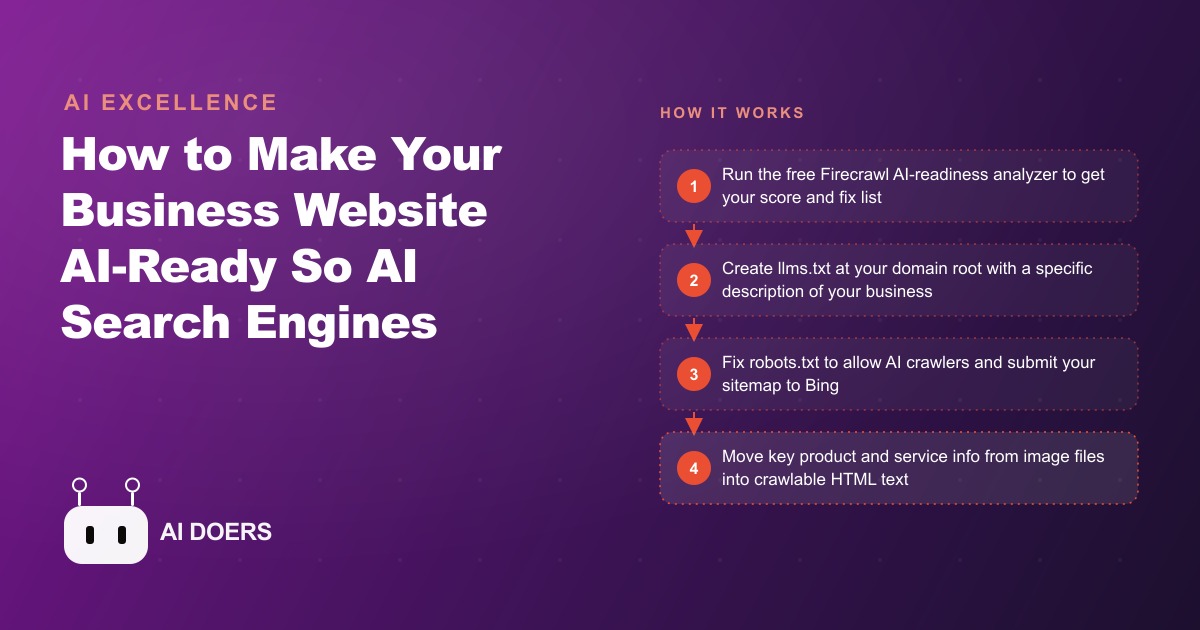
Sixty-three percent of adults now use AI tools to answer questions before they search, and if your business website is not structured for AI crawlers, you are invisible to that audience regardless of where you rank on Google. I am Madhuranjan Kumar, and this is the story of a Shopify store that discovered that gap and closed it in a single focused week.
A score of 58 and the discovery that Google ranking is not the same as AI visibility
The store sold sustainable kitchenware: compostable sponges, bamboo cutting boards, stainless steel containers, zero-waste dish soap. Google traffic was solid. The store ranked on page one for several product-specific queries and received consistent organic visits. The owner was not aware of any visibility problem.
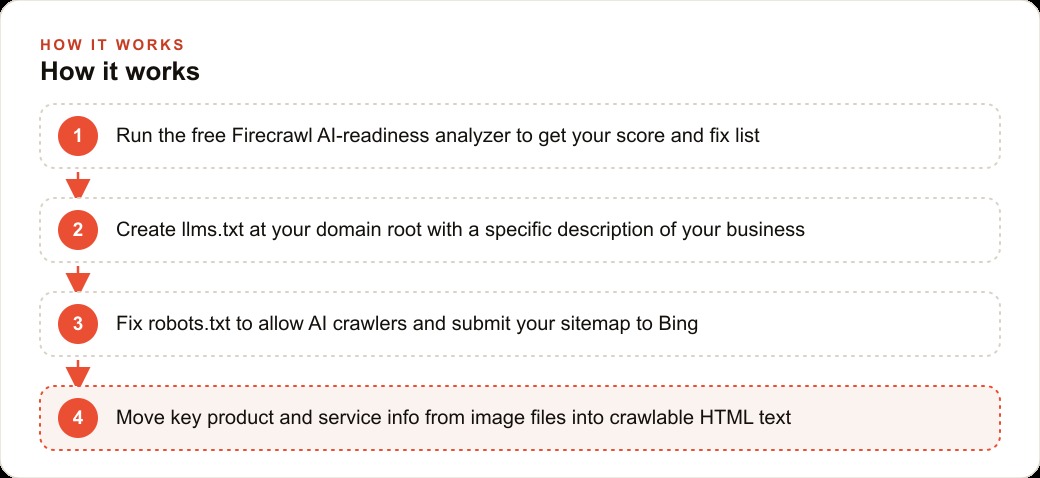
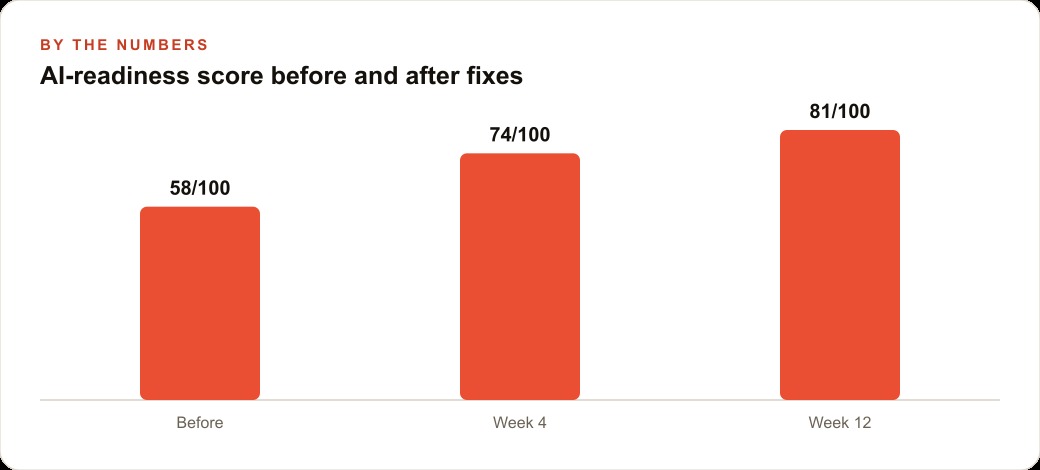
The problem became apparent when a digital marketing consultant ran the store's URL through Firecrawl's free AI-readiness analyzer. The tool returned a score of 58 out of 100. The summary identified four primary issues: no llms.txt file at the domain root, a robots.txt configuration that actively blocked GPTBot and PerplexityBot from indexing the site, no sitemap submission to Bing Webmaster Tools, and product pages where key feature information existed only inside designed image graphics rather than in crawlable HTML text.
The consultant explained the implication clearly. An AI tool like Perplexity or ChatGPT's browsing mode does not retrieve search results and rank them. It reads websites directly and synthesizes answers. When a user asks "where can I buy zero-waste kitchen cleaning supplies that ship to Canada," the AI reads sites that cover the topic and names the ones whose content it could understand. A site that blocks AI crawlers, lacks a description file, and embeds its key product information inside images produces no information for the AI to synthesize. The store was effectively invisible to that entire category of inquiry, regardless of its Google ranking.
Strong Google SEO and strong AI readiness use different signals. A site optimized for Google's crawl but unreadable to AI crawlers can rank well in traditional search while producing no AI-cited answers. The store had optimized for one and ignored the other.
The llms.txt file that tells AI crawlers exactly what the store sells
The highest-impact fix, and also the simplest to execute, was creating an llms.txt file. This is a plain text file placed at the root of a website, at yourdomain.com/llms.txt, that explicitly describes the site's purpose, products, audience, and key facts for AI systems that index the web.
The analogy the consultant used was helpful: imagine handing an AI a clear one-page brief about your business before it reads any of your pages. That brief tells the AI exactly what you sell, who buys from you, where you ship, what makes you different, and which questions your content can answer. Without it, the AI reads your pages and has to infer all of that from whatever it finds. With it, the AI has a structured starting point that makes every subsequent page it reads more interpretable.
The store's llms.txt took forty minutes to write. The content was specific rather than general. Not "we sell sustainable kitchen products" but "we sell compostable sponges certified by the Biodegradable Products Institute, bamboo cutting boards in three sizes, stainless steel food storage containers in six capacities, and zero-waste dish soap concentrates, for households in the United States and Canada working to eliminate single-use plastics from their kitchens. We ship to all fifty US states and all ten Canadian provinces. Our top-selling product categories are reusable food storage and compostable cleaning supplies." That level of specificity is what gives an AI enough information to cite the store accurately for exact-match queries rather than ignoring it or citing it vaguely.
The file was published within the same day it was written. AI crawlers that visit the site begin discovering and parsing it within days of publication.
The robots.txt fix that took fifteen minutes and reopened AI indexing
The second fix was more urgent than the first because it required undoing active harm. The store's robots.txt file contained Disallow rules for GPTBot and PerplexityBot, both major AI indexing agents. These rules had been added automatically by an SEO plugin that the store had installed and then forgotten. The plugin was trying to protect against scraping, but its overly broad rules were blocking legitimate AI indexers along with the scraping bots it was targeting.
In Shopify, robots.txt is controlled through a liquid template file in the theme's code editor. Editing it requires navigating to Online Store, then Themes, then Edit Code, and finding the robots.txt.liquid file. The consultant added explicit Allow rules for GPTBot and PerplexityBot above the existing Disallow rules, which took about five minutes of editing. The change went live immediately upon saving.
This fix costs nothing and takes fifteen minutes, but it is the most consequential quick fix available to any business whose robots.txt was last updated more than two years ago. AI crawlers are relatively new, and many existing robots.txt configurations were set during a period when these bots did not exist. Checking for inadvertent AI crawler blocks is worth doing on any business website regardless of what the Firecrawl score says about other issues.
Submitting to Bing Webmaster Tools and why Copilot is a completely separate audience
Most small e-commerce stores submit their sitemap to Google Search Console and consider discovery done. The Firecrawl analysis flagged a gap that the store owner had not previously considered: Bing Webmaster Tools is a completely separate submission, and it directly powers Microsoft's Copilot AI search system.
Copilot is the AI search interface embedded in Windows, in Edge, and accessible at bing.com. It serves a different user population than Google, with particularly high penetration among business users and Windows desktop users. A store that has never submitted its sitemap to Bing is invisible to Copilot's indexing regardless of how well-optimized it is for other AI systems.
Submitting to Bing Webmaster Tools involved creating a free account at bing.com/webmasters, verifying site ownership by pasting a meta tag into the store's theme header, and submitting the sitemap URL. The process took about ten minutes. The store's pages began appearing in Bing's index within a week of submission, which made them accessible to Copilot users asking product questions for the first time.
For businesses also running Google Ads campaigns to drive product discovery, the Bing submission adds a parallel organic discovery channel that costs nothing and requires no ongoing maintenance. The paid traffic investment looks better when the organic AI-search footprint is also growing, because customers who encounter the brand through an AI recommendation are often warmer prospects than cold click-throughs from paid placements.
Moving product specs from images to HTML text on twenty product pages
The fourth fix was the most labor-intensive but also the most durable in its impact. The store's top twenty best-selling products all shared a design pattern: key product information, materials, dimensions, certifications, and use cases was presented as text within designed image graphics rather than as HTML text on the page. This approach is visually clean and was a deliberate design choice, but it produces pages that AI crawlers cannot read for content because crawlers parse HTML text, not the text inside images.
A compostable sponge page that showed its BPI certification in a styled badge graphic provided no crawlable information about that certification. A bamboo cutting board page that listed dimensions in an infographic image gave AI systems no text to index about those dimensions. A stainless steel container page that showed the bisphenol-free claim in a feature strip image produced no crawlable evidence of that claim.
The fix was to add the same information as plain HTML paragraph text on each product page, keeping the image graphics for visual presentation while ensuring the content also existed in a form AI crawlers could index. This was not about removing the images. It was about making the information available in two forms: visual for the human reader, text for the AI crawler.
Working through twenty product pages took about three hours across two sessions. The consultant prioritized the pages with the highest traffic and the most distinctive product attributes first, since those were the pages most likely to surface in AI answers to specific queries.
Thirty days later: score 81, and AI-referred traffic appears in the log
A month after implementing all four fixes, the owner ran the Firecrawl analyzer again. The score had moved from 58 to 81. The remaining gap from a perfect score involved structured data markup and a few remaining image-only product pages that the consultant had not yet converted. Both were on the roadmap for the following week.
More significant than the score was what appeared in the traffic analytics. Referral traffic from Bing increased noticeably, consistent with the Copilot indexing. Direct visits with AI tool referrer strings, identifying traffic that originated from Perplexity, ChatGPT, and similar interfaces, appeared for the first time. These visitors were converting at a higher rate than average traffic because they had already received a recommendation from an AI tool before arriving at the site. The purchase intent at arrival was higher than typical organic traffic because the visitor had already asked a question and received an answer that named the store.
For businesses investing in SEO and organic search as a primary acquisition channel, the AI readiness fixes operate as a multiplier on that investment rather than a competing strategy. A site that ranks well in traditional search and also appears in AI-cited answers for the same queries gets more total visibility per page of content produced than a site optimized for only one discovery channel. The incremental effort to add AI readiness to an existing SEO foundation is small relative to the incremental reach it adds.
The store owner's reaction after the first month was straightforward: the four fixes cost one afternoon plus three hours of product page work, at zero software cost, and opened a discovery channel that had not existed before. The competitive relevance of AI readiness work only increases as AI search tools handle a larger share of information queries, which the data suggests is the direction things are moving regardless of whether any individual business is ready for it.
The roadmap from here involves quarterly re-runs of the Firecrawl analyzer, because AI crawler standards evolve as the tools themselves develop, and a site that scored 81 today may fall behind a new requirement that emerges in six months. AI readiness is not a one-time project. It is a maintenance practice, and one that rewards businesses who treat it that way early.
The signal-to-noise problem in AI-generated content at scale
One of the most common concerns about AI-assisted content production, whether for blog content or for social media, is that the volume it enables makes the signal-to-noise problem worse rather than better. When producing content is cheap and fast, the temptation to produce more content can outrun the judgment about whether the additional content is worth producing.
The businesses that navigate this well establish a quality bar for the specific insight or value each piece of content must deliver before it is published, and they apply that bar consistently regardless of how easy or fast the production was. A piece of content that was produced in fifteen minutes with AI assistance should meet the same quality standard as one that took three hours manually. The production time is not the quality signal. The value it delivers to the reader is.
For a business running content alongside paid advertising campaigns, the content quality bar matters for a specific operational reason: content that does not hold reader attention creates attribution confusion in analytics. High-bounce content that appears in the customer journey before a conversion event creates uncertainty about whether the content contributed to the conversion or appeared to without actually influencing the customer. Content that holds attention and clearly communicates value creates a more interpretable signal in the data. The quality bar is not just an editorial standard. It is the standard for trustworthy marketing data.
The review habit that prevents volume from overwhelming quality
The review step between production and publication is the gate that determines whether faster production leads to better results or just more mediocre output. The specific habit that works well is a pre-publication checklist: a short list of questions that each piece of content must answer before it is published.
The questions on the checklist should be specific to the value the content is supposed to deliver. For a business-focused blog, the checklist might ask: does this contain at least one insight that a reader could not find by reading the first result on Google for the same topic? Does it give a clear, specific recommendation rather than listing general principles without application? Is the business type example concrete enough that a reader in a similar situation could translate the advice directly to their context?
A checklist applied consistently creates a feedback loop: content that fails the checklist teaches the production process what to do differently. Over time, the checklist itself becomes less necessary because the production process is calibrated to meet the standard without the explicit check. But reaching that calibration requires applying the checklist consistently through the early stage where the calibration is still developing.
That is exactly what we do at AI DOERS. Book a private 30-minute call with Madhuranjan Kumar and we will map the fastest path to it for your specific business.
Book your call →
Madhuranjan Kumar
Madhuranjan Kumar brings 20 years of performance-marketing experience and has managed over $200 million in Facebook ad spend for brands across the United States and beyond. His expertise spans the full modern marketing stack: Meta, Google Ads, TikTok, email automation, CRM, and the websites that hold it together. At AI DOERS he turns that track record into lead-generation systems for businesses across every industry.