
How Make AI Agents Can Automate Your Landscaping Business Content and Client Communication
Make added AI agent capability to its no-code automation platform, letting small businesses run entire content and client follow-up workflows without manual work. Here is how a landscaping company can use it.


The Automation Trap No One Warns You About
Every week, another business owner discovers Make.com's AI agent capability and immediately builds a trigger that watches a folder, reads a file, and publishes to LinkedIn without anyone clicking anything. Most of them have just automated their worst content at a higher volume than they were producing it before.
The failure mode is invisible at setup. The agent works. The trigger fires. The post goes live. The vanity metric is that automation is running. The actual metric, engagement rate, reply quality, lead inquiries from content, tends to decline or stay flat while posting frequency increases. The business owner interprets this as a content strategy problem or a platform problem. The actual problem is that they automated in the wrong order, and no one told them what the right order was.
Most businesses that adopt Make AI agents are going to scale mediocrity, not content quality. The businesses that get lasting results from content automation do the opposite of what feels intuitive: they establish the quality standard before they build the automation, not after.
What Make.com's AI Agent Actually Does, and Why the Order of Setup Matters So Much
The capability itself is genuinely impressive and worth understanding precisely because the stakes are higher than they look.
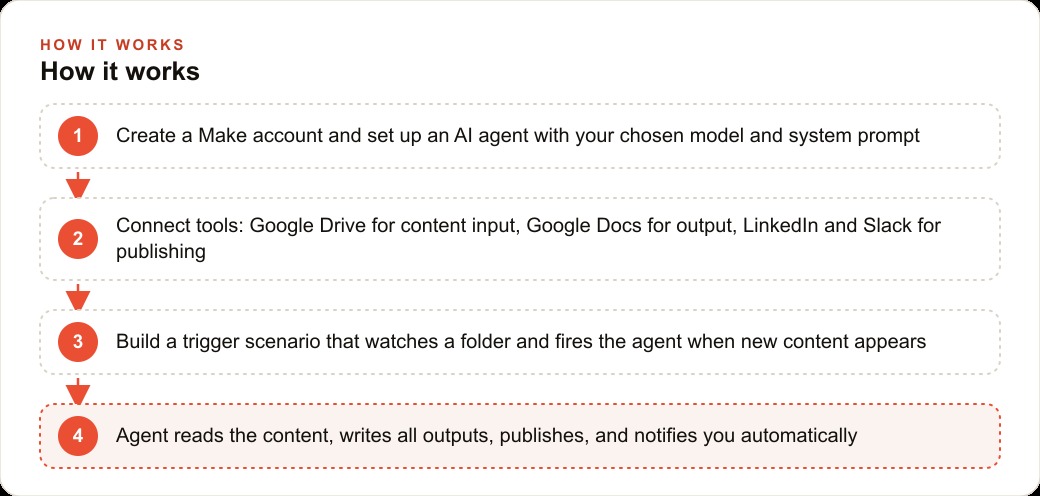
In Make.com, an AI agent is built around a system prompt that defines the agent's identity, its goals, and the format it should produce output in. You connect tools to the agent, including Google Drive, Google Docs, LinkedIn, and Slack. You build a trigger scenario that watches a specific folder. When a new file lands in that folder, the agent reads it, generates a short-form video script and a LinkedIn post, creates a new Google Doc with both pieces, publishes the post to LinkedIn, and sends a Slack notification confirming it ran. No one has clicked anything. No one has approved anything. The content is live.
The Make Grid shows all connected scenarios running in real time. You can see when each trigger fires and what the agent produced. The throughput is real: a business that was posting twice a week because manual content creation was the bottleneck can now post five times a week without adding a single hour of labor.
That is exactly why the order of operations is load-bearing. When the bottleneck was manual effort, the low frequency of posting acted as a natural quality filter. You only published something you had spent time on. The automation removes that filter. Whatever the agent produces, it publishes. The agent's quality ceiling is determined entirely by two inputs: the system prompt defining its goals, and the style context document that makes the output sound like a specific person rather than a generic AI.
The businesses that automate first and worry about quality later are removing the natural filter without replacing it. They are publishing more often, and the content is neither better nor more distinctive than what they published before. Sometimes it is measurably worse, because the system prompt was written quickly during setup and the style context document was skipped entirely.
The Style Document Is Not Optional, It Is the Entire Foundation
The single most important element in a Make AI agent content workflow is not the trigger. It is not the tool connections. It is the writing style context document, and most people treat it as an optional enhancement rather than the prerequisite it actually is.
Here is what the style context document does: it tells the AI agent how you write, specifically. Not in the abstract, not with general instructions like "be conversational" or "avoid jargon." It gives the agent a concrete, analyzed sample of your actual voice, your typical sentence length patterns, your recurring structural habits, the types of evidence you reach for, and the tonal register you hold across different content types.
The method for building this document is straightforward. Take a transcript of something you have said or written, something representative of your voice at its best, and paste it into a separate AI tool. Ask the tool to analyze your communication style, identify patterns in your sentence structure, note what you do when you transition between points, describe how you handle examples, and document the overall tone. The output of that analysis becomes the context document you upload to your Make agent.
The difference between a Make agent running without this document and one running with it is audible. The agent without style context produces content that is competent, organized, and generic. It sounds like "AI writing." The agent with a well-built style document produces content that sounds like a specific person who has a specific way of framing things. Readers who follow the business recognize the voice. That recognition is what builds the audience relationship that makes content valuable to the business.
Without the style document, you are automating the production of content that sounds like no one in particular. That is not a volume problem that more posting will solve. It is a voice problem, and volume makes it worse, not better.
Quality Protocol Belongs Before the Publish Trigger, Not After
The second piece of the correct order is equally counterintuitive to most people who are setting up a content automation for the first time. The quality review protocol needs to exist before the automated publish trigger goes live, not as a retrofit after you see the outputs are not working.
What a quality review protocol means in practice is simple: before you connect the LinkedIn publish action to the Make scenario, you run the agent on ten real examples and manually evaluate each output against explicit criteria. What does a good post look like for this business? What makes an output worth sending? What are the signs that the system prompt or the style context document needs adjustment?
Most people skip this step because it feels like the boring part before the exciting part. The exciting part is the automation running. The boring part is reviewing ten draft outputs and adjusting the prompt based on what you see. But the boring part is the only place where you learn whether the automation is producing something worth automating. Once you connect the publish trigger, the feedback loop slows down dramatically. You are now reading engagement metrics, which are lagging indicators with high variance, rather than directly evaluating output quality, which is the leading indicator you can actually control.
The businesses that get lasting results from Make AI agents run this sequence: build the style document thoroughly, build the system prompt specifically, run the agent in draft-only mode on real examples, evaluate against explicit quality criteria, revise until the output consistently meets those criteria, and then, only then, connect the publish trigger.
The businesses that do it the other way around, trigger and publish first, quality review as a response to declining metrics later, spend months trying to diagnose a problem that was created in the first fifteen minutes of setup.
The Landscaping Company That Reversed the Order, and What the Numbers Showed
A landscaping company with one owner and two full-time crews was posting to LinkedIn once or twice a week, manually, whenever the owner had time. The owner was spending about forty minutes per post, including thinking about the topic, writing a draft, editing it, and uploading an image. Two posts per week at forty minutes each represents roughly eighty minutes of the owner's time per week, time that was genuinely valuable and consistently deprioritized when jobs were busy.
The owner decided to build a Make agent to handle the content. Before connecting the publish trigger, though, the owner built the style document: a transcript from a recorded sales call where the owner had explained the company's approach to a prospective client was pasted into a separate tool, analyzed for tone and structure, and the analysis was saved as the context file. The system prompt was written specifically: generate a LinkedIn post for a landscaping business owner, written for a local homeowner audience, referencing one concrete observation from the script file in the trigger folder, maintaining a direct and practical tone, no motivational filler, no generic tips.
The owner then ran the agent on eight real script files, draft outputs only, no publishing. Four of the eight outputs were immediately usable. Three needed the system prompt adjusted. One needed a rewrite of the style document section that described how the owner uses examples. After those adjustments, a second pass on the same eight files produced seven outputs that were usable with minimal review.
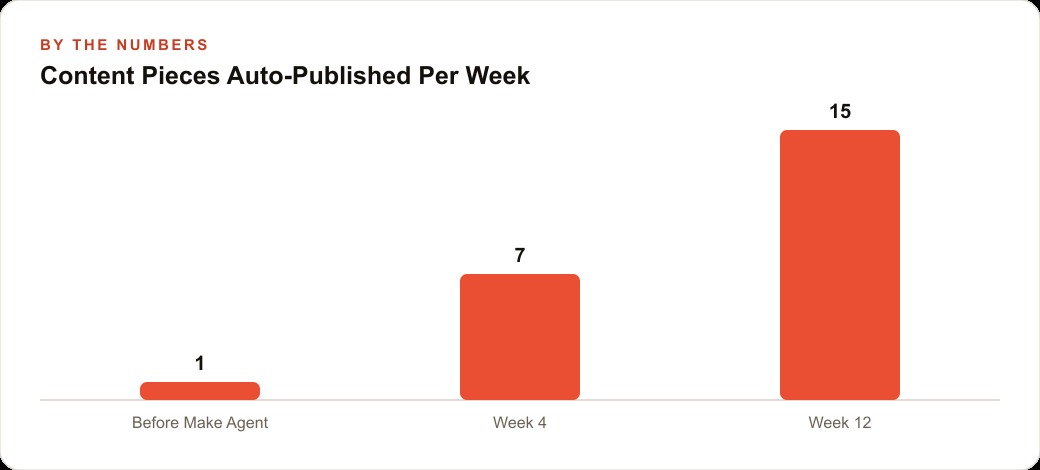
With the system producing reliable output, the publish trigger went live. The posting frequency moved from two posts per week to five. The owner's time dropped from eighty minutes per week to approximately twelve minutes per week for review and occasional light edits.
At the owner's estimated time value of ninety dollars per hour, the weekly time savings on content creation alone represents roughly one hundred dollars per week, or just over five thousand dollars per year. That number does not capture the compounding value of consistent content presence, which over six months generated four inbound inquiries from LinkedIn that converted to jobs, two of which were seasonal contracts worth approximately eight thousand dollars each in recurring annual revenue.
The automation did not produce that outcome by running. It produced that outcome because the owner built the quality standard into the system before the system started running at scale.
The Setup That Actually Compounds Over Time
There is a version of content automation that helps a business grow and a version that produces a high volume of forgettable output that no one responds to. The difference is not the tool. Both versions use the same Make.com capability. The difference is the order of operations.
Style document first. It takes two hours to build correctly. Every output the system produces afterward carries that investment.
Quality protocol second. Run the agent in draft mode. Evaluate explicitly. Revise the prompt and the style context until the output is reliably good, not occasionally good.
Publish trigger third. Only when the system is producing content you would be proud to send manually.
The businesses that follow this order are not doing anything more technically complex than the businesses that rush to the publish trigger. They are just making a different bet about where the leverage lives. The leverage is not in the automation itself. The leverage is in the quality of what the automation scales.
Automating bad content faster is not a growth strategy. Building a system that produces consistently good content and then running it at a frequency you could never sustain manually is the strategy that compounds.
The order is not a minor implementation detail. It is the entire point. ## What the Numbers Look Like When the Order Is Right
A landscaping company following this sequence in the right order will typically spend three to four weeks building and iterating on the style document before the first post goes live through automation. The owner records or transcribes three or four pieces of content they consider representative of their voice. That transcript goes into ChatGPT with a simple instruction to analyze tone, sentence length, transition patterns, and word choices. The output is a two-page document that the Make agent reads before generating any LinkedIn post, any short-form video script, or any client-facing update.
After the style document is solid, the approval discipline takes another two to three weeks to establish. Every output from the agent gets reviewed by the owner before it publishes. Approximately 30 to 40 percent will require editing in the first two weeks, dropping to 10 to 15 percent by week four.
When the publication trigger goes live, the operator is posting content that already meets their quality standard. Frequency goes from one or two posts per week, maintained manually, to five or six, maintained automatically. The compound effect of that frequency increase, applied to content that passes the owner's own bar, is what moves the engagement metric rather than the posting frequency alone.
That sequence takes six to eight weeks to build correctly. It then runs without creative overhead for as long as the style document stays current.
That is exactly what we do at AI DOERS. Book a private 30-minute call with Madhuranjan Kumar and we will map the fastest path to it for your specific business.
Book your call →
Madhuranjan Kumar
Madhuranjan Kumar brings 20 years of performance-marketing experience and has managed over $200 million in Facebook ad spend for brands across the United States and beyond. His expertise spans the full modern marketing stack: Meta, Google Ads, TikTok, email automation, CRM, and the websites that hold it together. At AI DOERS he turns that track record into lead-generation systems for businesses across every industry.