
The Latest AI Releases and What They Mean for Your Business
Every week brings a flood of new AI features. Here is how to cut through the hype and turn the releases that matter into concrete tasks for a real business.

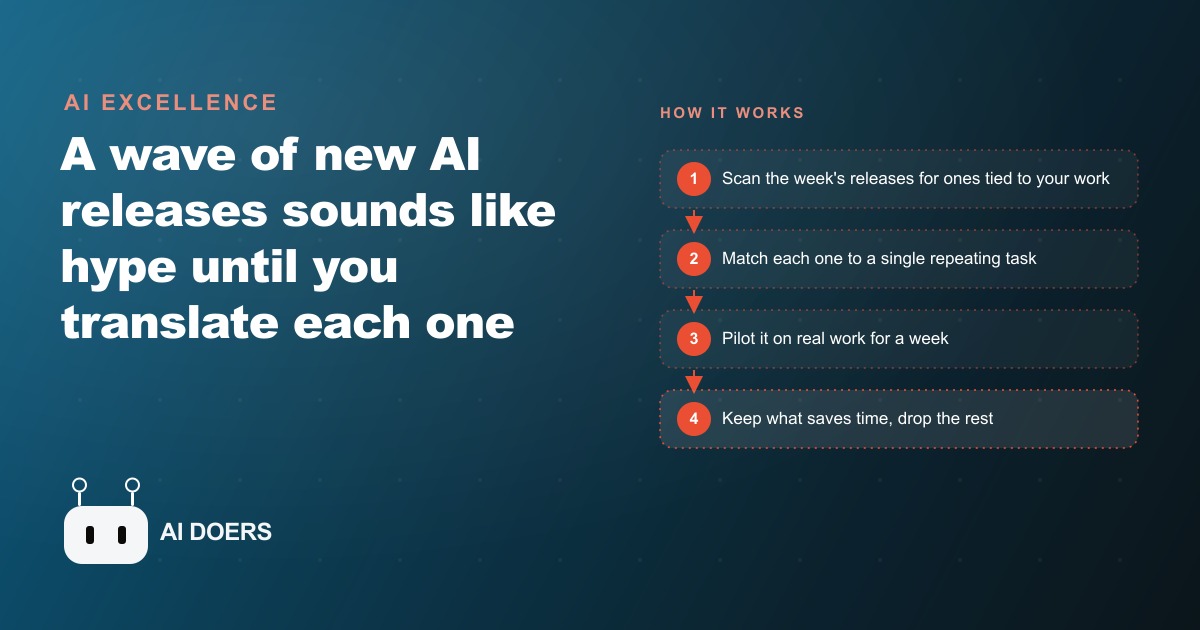
Every week produces a flood of AI announcements, benchmark claims, and product launches, and the information density is high enough that most business owners who try to follow it end up either spending hours on AI news or ignoring it entirely. Neither approach is useful. I am Madhuranjan Kumar, and this is the playbook for filtering the release cycle down to the handful of things that actually affect how you run your business this week, with a concrete framework for deciding what to act on and what to watch. The eight categories in this week's releases illustrate both what qualifies for immediate action and what qualifies for watchlist only.
AI Video Gets Its Own Social Feed, and the Evaluation Question Is Whether Your Audience Will Engage There
The Pika Social feed, which launched this week, is a dedicated scrollable social environment built entirely from AI-generated video content. For a business deciding whether to invest time in this channel, the evaluation question is not whether the technology is impressive but whether your specific target audience is spending meaningful time on this feed. Consumer-facing businesses targeting early adopters in creative and technology fields have a reason to test it now, because their audience is likely already exploring it. Service businesses targeting local homeowners, professionals in traditional industries, or demographics less likely to be on a new creative AI platform should allocate a watch-and-evaluate budget rather than a launch-now budget. Testing a new channel before your audience is meaningfully present there is not first-mover advantage. It is content production without distribution.
The playbook for a channel like this is a small-batch test rather than a full content commitment. Produce three to five pieces of content designed for the format, publish them, and measure engagement over four weeks. If the engagement per post is comparable to other channels you are using for the same audience type, continue. If it is significantly lower, come back in six months when the audience may have grown into the platform. Most new social platforms that ultimately succeed do so with an audience growth curve that is much steeper in months nine through eighteen than in months one through six.
Proactive AI That Pushes Relevant Information to You Changes the Default From Pull to Push
The shift several AI tools are making from a pull model, where you go to the tool and ask a question, to a push model, where the tool surfaces relevant information before you think to ask, represents a genuine change in how AI assistance integrates into a workday. Features that monitor your inbox, calendar, and project files to surface relevant context when it is most useful require a different kind of trust and setup than query-and-response AI.
The practical playbook for evaluating a proactive AI feature is to run it for two weeks while actively logging the moments when it surfaces something genuinely useful versus the moments when the proactive notification is noise. A feature that produces three genuinely useful interventions per day and ten noise notifications is a net drain on attention. A feature that produces two genuinely useful interventions and one noise notification is a net productivity gain. The only way to know which you have is to measure it deliberately rather than evaluating it from the feeling of whether you liked the feature in principle.
For businesses managing high-volume client communication, a proactive AI that reliably surfaces time-sensitive items before they become urgent is worth significant setup friction to configure correctly. For businesses with low-volume, high-touch client relationships where every communication already gets personal attention, the proactive feature adds less incremental value.
Parental and Content Controls Arriving Signals That AI Tools Are Becoming Household Infrastructure
When a technology category adds parental controls and content filtering, it means the technology has moved from early adopter to mainstream household use. The same pattern appeared in the internet in the late 1990s, in social media around 2010, and in streaming video around 2015. For a business, the signal is not about parental controls specifically but about the mainstream adoption indicator they represent. AI assistants are now being integrated into the daily digital environment of households that include children, which means the general-purpose consumer AI tools are not tech products anymore in the mainstream framing. They are household utilities.
For a business trying to decide how much weight to give AI in its marketing positioning, this mainstream signal is relevant. Positioning AI assistance as a cutting-edge differentiator made sense two years ago. Positioning it as a standard operational practice makes more sense now, because the audience that sees "we use AI" as impressive is shrinking and the audience that sees it as expected is growing. Framing AI use as an expertise differentiator matters more than framing it as a technology differentiator.
Models Now Excel at Real Office Work, Which Means Every Generic Task in Your Workflow Is a Candidate
The recurring pattern in AI benchmark improvements this week is that the gap between AI performance on controlled evaluations and AI performance on the messy, context-dependent tasks that appear in real office work is narrowing. Writing a business proposal that accounts for a specific client's stated preferences and previous objections, reviewing a contract for language that conflicts with your standard terms, and producing a quarterly report that explains the numbers in the context of the business's specific strategy are all tasks that now warrant a direct test with the current generation of tools rather than an assumption that AI is only useful for simpler tasks.
The playbook is to run a real test, not a benchmark evaluation. Take one of the complex recurring tasks in your workflow that you have assumed AI cannot handle well, submit it to a current-generation model with the relevant context, and evaluate the output honestly. You will likely find that the output is not perfect but is a much better starting point than it would have been six months ago, and that the editing time to get from AI first draft to a usable final version is significantly shorter than producing from scratch. Running this test on five different task types in a single afternoon gives you an accurate picture of where AI is genuinely useful in your specific workflow rather than a picture based on either benchmark hype or outdated assumptions about AI capability.
Shopping Inside the Chat Changes the Funnel From Search-Then-Buy to Understand-Then-Buy
AI tools that allow product comparison, recommendation, and eventually purchase within a conversational interface represent a significant change to the top-of-funnel discovery behavior that most e-commerce and retail businesses have built their SEO and content marketing strategies around. Currently, a potential buyer searches for a product category, finds comparison articles, reviews, and e-commerce listings, and makes a purchase decision through some combination of those sources. An AI shopping interface collapses that journey into a conversation where the AI asks clarifying questions, surfaces relevant comparisons, and potentially facilitates the purchase directly.
For a business that sells physical products online, the implication is that the organic traffic driven by informational content and comparison rankings may decrease as more search queries are resolved through AI conversations that do not click through to individual websites. The businesses positioned well in this environment are the ones whose products, brand, and differentiation are present in the AI's training data and knowledge base in a way that surfaces them accurately when the AI makes recommendations. Building product and brand content that explains differentiation clearly and is structured to be retrievable by AI systems is the SEO equivalent of the shift that is happening.
Better Free Image Editing Means the Cost Barrier for Creative Business Assets Is Essentially Gone
Improved image editing capabilities available in free tool tiers this week continue the pattern of professional-grade creative tools becoming accessible at zero marginal cost. For a business that has been allocating budget to image editing services or software subscriptions, the relevant test is whether the free AI-powered editing now available produces comparable quality for your specific use cases. For standard tasks like background removal, lighting adjustment, object replacement, and style transfer, the current free tier tools produce results that would have required professional retouching a year ago.
The playbook for evaluating this is a direct quality comparison on three to five images that represent your typical editing needs. Compare the free AI output to the output you currently pay for. If the quality gap is negligible on your specific use cases, the free option reduces a budget line that can be reallocated to production volume. If the gap is meaningful, note which specific capabilities drive the gap and re-evaluate in three to six months, because that gap is narrowing with each release cycle.
AI Work Slop Is Real and Protecting Against It Requires a Human Review Standard
The term "work slop" describes the category of AI output that is structurally plausible, grammatically correct, and organizationally coherent, but is either factually shallow, repetitively generic, or subtly misaligned with the specific context in ways that become visible only to someone reading it carefully. The risk of work slop is not that AI produces obviously bad output. It is that AI produces output that passes a quick review and enters the world representing the business's quality standard, where it then fails to achieve the intended purpose.
For businesses that use AI for client-facing communications, proposals, or content, establishing a review standard that specifically checks for generic framing, missing specificity about the client's actual situation, and claims that cannot be verified is the baseline protection against work slop. The standard should be written down and applied consistently rather than relying on reviewers to catch it by intuition. A reviewer looking for "does this sound good" will often miss work slop that a reviewer looking for "is this claim verified and specific to this client" will catch.
Pick the Release That Fits a Task and Ignore the Rest This Week
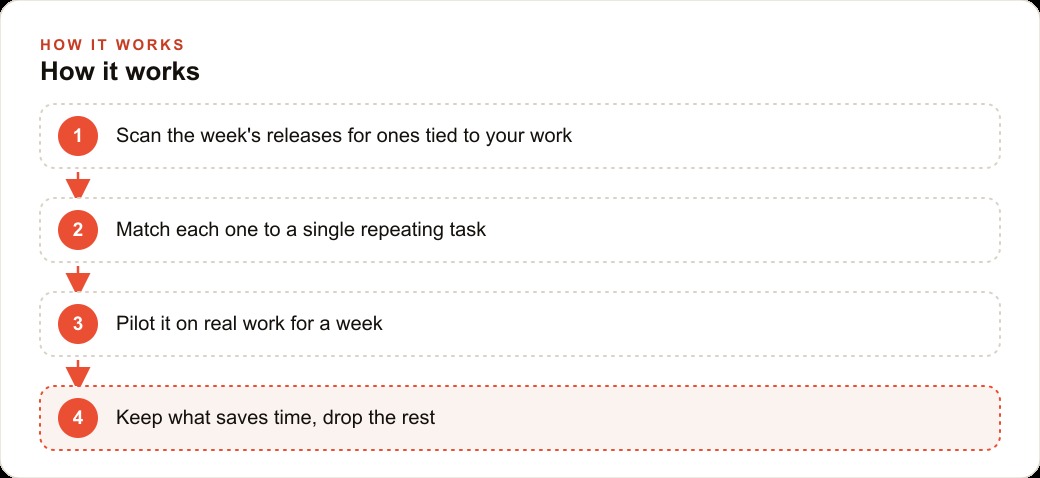
The filter for this week's releases, applied to a typical service business, produces a short action list. Test Veo 3 Fast for video concept testing if video is part of your content strategy. Evaluate whether a proactive AI feature in your existing tools is producing more useful interventions than noise over a two-week measurement period. Run at least one complex task you have previously excluded from AI consideration through a current-generation model to update your mental model of current capability. Update your brand and product content to be structured clearly for AI recommendation systems if you sell products online. Establish a written review standard for AI-generated client-facing content that specifically checks for work slop rather than relying on intuitive quality review.
The releases that do not require action this week, Baby Grok, the Windows expansion, and the shopping AI features, belong on a calendar reminder three months out to re-evaluate when more specific product information and deployment timing are available. The weekly release cycle provides a lot of information, and most of it is not actionable this week. The skill in following it is not keeping up with everything. It is extracting the handful of things your business can act on now and ignoring the rest without guilt.
The Filter That Turns Weekly Releases Into Monthly Actions
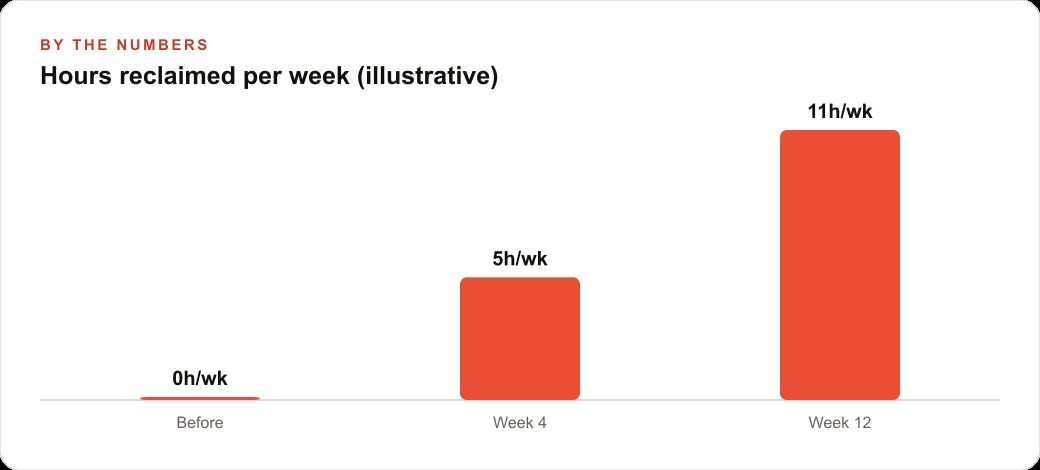
The sustainable approach to following the AI release cycle without drowning in it is a monthly rather than weekly action cadence. Each week, log the releases that seem potentially relevant to your business into a running list without committing to testing any of them immediately. At the end of each month, review the list and identify the two or three releases that appeared most frequently or that multiple credible sources described as genuinely impactful for business use cases like yours. Test only those, and only one at a time with a defined evaluation period before adding the next test. This monthly filter turns a firehose of weekly information into a manageable pace of two or three genuine evaluations per month, each with enough time to reach a real conclusion before the next thing demands attention.
The businesses that adopt the most AI capability effectively are rarely the ones that try every new release immediately. They are the ones with a defined process for evaluation that prevents both chronic under-adoption, missing tools that would genuinely improve operations, and chronic over-adoption, adding tools faster than the team can build the habits that make those tools useful. The filter is the productivity infrastructure. The releases are the input. The filter determines whether the input becomes operational capability or just noise that takes time away from the actual work.
Running paid social advertising alongside this evaluation process is a good parallel example: the best-performing advertisers do not test every new ad format the moment it launches. They run structured tests on their highest-leverage campaigns, evaluate with enough data to reach significance, and implement changes that are supported by evidence. The same discipline applied to the weekly AI release cycle produces the same result: fewer tests, better conclusions, and more sustainable operational improvements.
That is exactly what we do at AI DOERS. Book a private 30-minute call with Madhuranjan Kumar and we will map the fastest path to it for your specific business.
Book your call →
Madhuranjan Kumar
Madhuranjan Kumar brings 20 years of performance-marketing experience and has managed over $200 million in Facebook ad spend for brands across the United States and beyond. His expertise spans the full modern marketing stack: Meta, Google Ads, TikTok, email automation, CRM, and the websites that hold it together. At AI DOERS he turns that track record into lead-generation systems for businesses across every industry.