
Laid Off to Head of AI in One Year: What Actually Got Her Hired
One person went from a layoff with zero AI experience to running AI strategy for fifteen companies in a year, and the thing that got her hired was not a credential. It was recorded proof of what she had built. Here is the playbook any business or operator can copy.

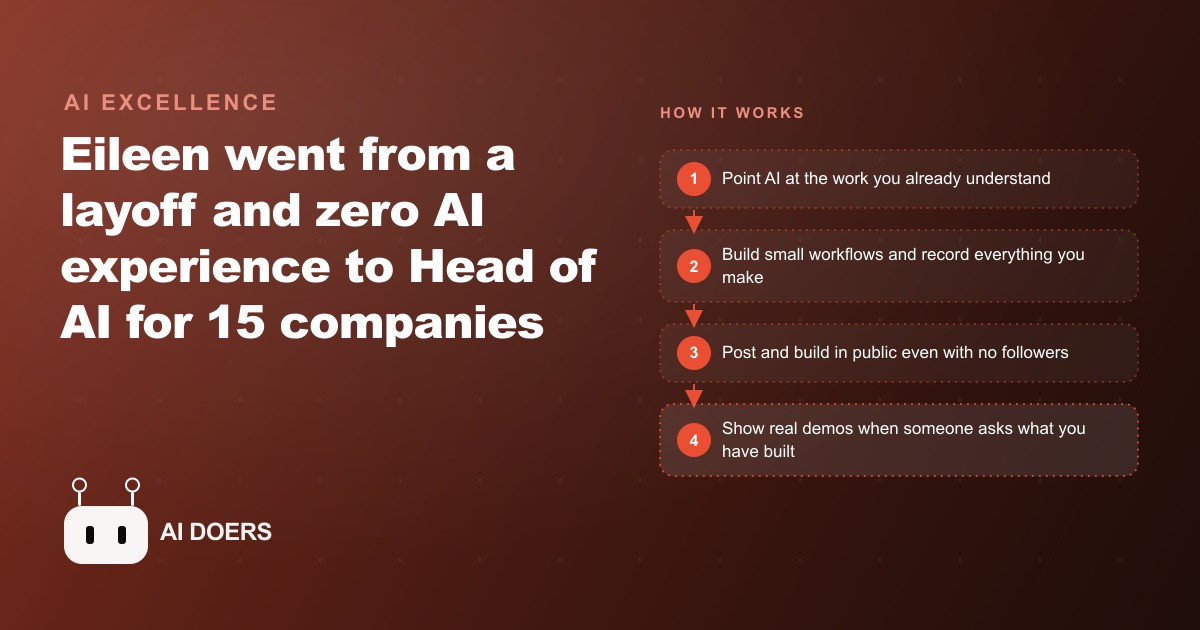
An IBM survey of two thousand chief executives found that 76 percent now have an equivalent of a chief AI officer on staff, up from 26 percent two years earlier, yet the same study found that 85 percent of employees already have the skills to use AI while real utilization sits at 25 percent. The gap between those two numbers is where the biggest opportunity in the current job market lives, and the person who captured it most clearly at one company was not a computer scientist. She was a laid-off email developer with two young kids and zero prior AI experience who was running AI strategy for fifteen different companies twelve months after her layoff. I am Madhuranjan Kumar, and I want to be direct about what this story proves, because it contradicts the credential race that most people assume defines who gets into AI work right now.
The Head of AI role looks technical and mostly is not
The title triggers an assumption. Head of AI sounds like it belongs to someone who understands transformer architectures, can reason about gradient descent, and has strong opinions about distributed training infrastructure. The reality of the role, as it actually exists in most mid-sized businesses today, is almost entirely different from that assumption.
What the role requires in practice is the ability to identify where AI fits in the specific work a business already does, build workflows that prove the fit, and help the team adopt those workflows rather than reverting to how they worked before. The technical layer, the model inference, the prompting architecture, the integration plumbing, is increasingly handled by the tools themselves. What cannot be outsourced to the tools is judgment about which problems are worth solving, which solutions will actually be used by the team, and which change management challenges matter most in this particular organization.
That judgment comes from domain knowledge, not from knowing how model weights are updated. A person who spent fifteen years as an email developer writing, testing, and optimizing communications at scale has a precise understanding of what matters in that process, where friction costs time, and where a small improvement compounds into a meaningful outcome. Pointing AI at that domain knowledge does not require understanding the underlying model. It requires knowing the domain well enough to recognize when the AI is producing something useful versus something that sounds right but is wrong for this specific context.
The wall people feel when they look at AI roles is primarily a credential wall, not a capability wall. The actual technical barrier to building useful AI workflows has dropped dramatically in the last two years. Tools that once required engineering now accept plain-language description. Tools that once required server infrastructure now run through a subscription on a laptop. The real barrier to entering the field is not technical depth. It is the willingness to build things, show them to people, and iterate when something breaks.
Credentials are losing to proof in the fastest-moving job category of the decade
A 50-point jump in a C-suite role over twenty-four months is not a gradual trend. It is a structural shift happening faster than most hiring processes can adapt to. When 76 percent of large organizations have a chief AI officer equivalent and that number was 26 percent two years ago, the job function is being created faster than formal qualifications can define what the role requires. That speed is what creates the window.
In a field moving that fast, the person who has actually built working AI systems and can show them holds more credibility than the person who studied AI in a classroom and has not yet shipped anything that runs in a real workflow. This is not unusual for a field in its first years of professional adoption. The same dynamic occurred in the early years of web development, digital marketing, and mobile app development. Proof of real work outpaced credentials because there was no established credential to hold.
The hiring story demonstrates this precisely. The question HR asked was not which degree do you have or which certification did you complete. The question was what have you built. Because the answer was a set of recorded demos, two YouTube channels, and documented LinkedIn proof of real workflows, the conversation moved directly to the decision-maker. The credential was never checked because it was never the relevant signal. The relevant signal was evidence of having done the thing, in a field where most candidates can only describe it.
This window will not stay open indefinitely. As the Head of AI role matures, formal qualifications will likely develop, and hiring managers will begin using them as filters once they exist. The people who built proof now, who have recorded workflows, posted results, and accumulated visible evidence of real AI implementations, will be well positioned when that filter arrives. The people who waited until the credential was established will be competing in a different market, one where the proof they could have built during the open window is held by someone else.
The adoption gap is a business opportunity that no degree program teaches people to fill
The 85 percent skilled, 25 percent utilizing finding is not a rounding error or a measurement artifact. It describes the central operational challenge of AI adoption inside most organizations, and it represents an enormous gap between what businesses have invested in and what they are actually getting back from that investment.
When a team has the AI tools but is not using them, the bottleneck is not the model, the subscription, or the interface. The bottleneck is adoption, which means it is a change management, communication, and trust problem. People need to understand how the tool fits into work they already do. They need small working examples that reduce the friction between intention and consistent usage. They need someone who understands the specific work well enough to build those examples and demonstrate why the new approach produces better results than the old one.
That is exactly what the Head of AI role exists to solve, and it is not a technical problem. It is a domain and communication problem, which is why fifteen years as an email developer is more relevant to this particular role than a theoretical background in machine learning. The person who has spent years in the specific work understands the friction points, can identify the three things that would make the team twice as fast, and can build workflows that feel natural rather than disruptive because they are built around how the team actually operates.
For businesses on the web-crm side of their operations, the adoption gap shows up most visibly in customer communication workflows. Teams that have AI tools available for drafting follow-ups, managing lead pipelines, and personalizing outreach consistently underuse them because no one has taken the time to build the specific workflows and demonstrate that they work at the speed and quality level the team can trust. That is not a technology gap. That is a Head of AI problem, and it is solved by someone who understands the communication work and can point the tools at it.
No degree program teaches this because it cannot be taught in general terms. The adoption gap in a law firm looks different from the adoption gap in a hotel group. The friction points are different, the change management challenges are different, and the workflows that will actually get adopted depend on understanding the specific work. The person who brings domain knowledge into an AI role has a structural advantage over someone who brings technical depth but does not yet understand the work.
Domain expertise plus AI tools outperforms technical knowledge alone
The principle at the center of this story is a reordering of what matters in the current AI job market. Technical knowledge is not worthless. Understanding how to prompt models effectively, how to architect a multi-step workflow, and when to use one tool versus another are real skills with real value. But in the current market, those skills are a floor, not a ceiling. The ceiling is set by combining tool fluency with deep domain expertise.
An email developer who knows what a compelling subject line looks like, understands why a particular follow-up timing drives response rates, and can identify the three things that matter most in client communication is worth more to a business deploying AI than a technically proficient person who does not understand the work being automated. The AI-assisted output produced by the domain expert is relevant, accurate in context, and immediately usable by the team. The technically proficient person without domain knowledge produces output that may look correct to someone who does not know the domain and is wrong to everyone who does.
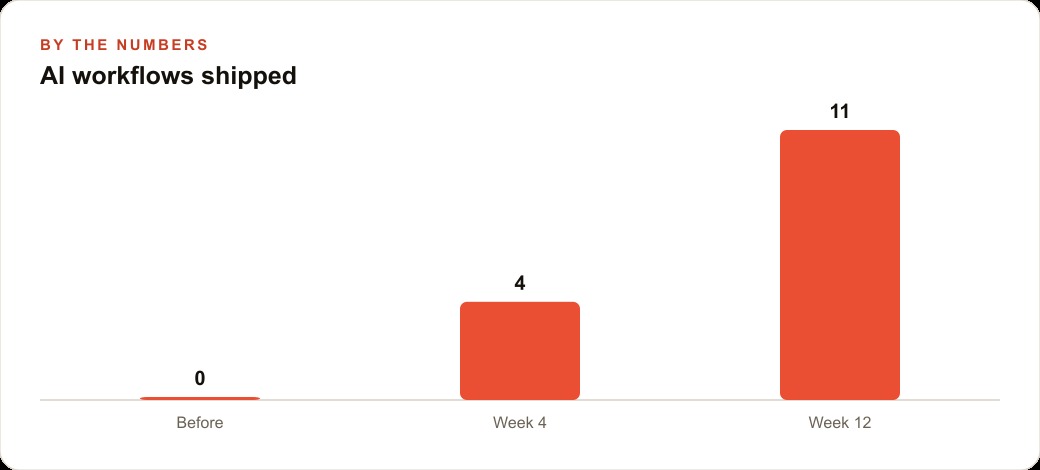
The tool ladder is a key detail here. Starting with simple automation tools, moving to more powerful workflow builders, then advancing to an agent environment that handles complex multi-step tasks, is not building too slowly. It is building correctly. Each rung produces working output. Each step reveals a new set of problems that the domain knowledge helps solve. The progression compounds over months. A person who spent six months building real workflows in simple automation tools before moving to an agent environment has substantially more working, domain-specific AI than someone who started with the most powerful tools and spent six months trying to make general-purpose capabilities fit specific problems.
You can outsource the thinking to the AI. You cannot outsource the understanding. The human still owns the judgment about which trade-offs matter, when the AI is producing something that sounds right but is wrong, and what the final result actually needs to do for the person receiving it. That judgment is what a strategy role is paid for, and it comes from the domain knowledge, not from the tools.
For businesses using meta-ads or seo-content, the same principle applies to the AI roles being created inside marketing teams. The most effective AI operator in a performance marketing context is not the most technically sophisticated person on the team. It is the person who understands what a good ad actually looks like, what audience signals matter, and when the AI-generated copy sounds competent but misses the persuasive point. That combination of craft knowledge and tool fluency is the one that produces results the technical expert alone cannot consistently deliver.
The build-in-public loop that turns what you already know into a hiring advantage
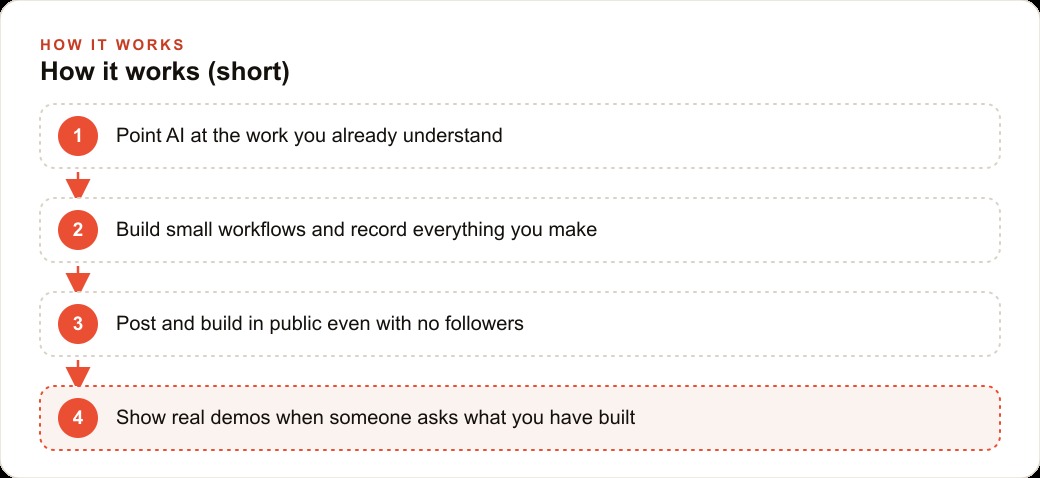
The build-in-public strategy that produced the hiring outcome in this story is primarily an evidence-generation strategy, not a personal branding strategy. The goal is not a large audience. The goal is a durable, searchable, verifiable record of real work done, available at the moment someone asks the question that most AI hiring decisions turn on: what have you built.
The loop works as follows. Build something small with the AI tools currently available. Record the process and the result. Post the recording where it can be found, even with no audience, because the record exists whether or not anyone watches it. Repeat. Over months, this produces a portfolio of evidence that is more persuasive than any resume because it shows the actual working artifact rather than a description of something that might exist.
The friction that stops most people from starting is the act of posting before there is an audience. Posting a demo video with two views feels pointless. But the two-view video posted six months ago is the thing you point to when someone asks what you have built. The hiring question is not do you have followers. It is do you have proof. A recorded demo with two views and a working workflow attached is infinitely more useful than a well-written resume describing a workflow that cannot be shown.
The public speaking moment in this story, which involved genuine stage fright and required agreeing within twenty-four hours to speak at a practitioner meetup, generated real LinkedIn proof of a kind that self-reported claims cannot produce. A verified, public record of having built something and presented it to a room of practitioners is a different category of credential from a description of what you know. It can be checked, it can be linked, and it answers the proof question directly.
For business owners thinking about building AI capability internally, this build-in-public loop is also a guide to what to look for in internal candidates. The person who has been building small AI workflows, recording them, and posting them, even with a limited audience, is the person who will actually drive adoption inside the business. They have already demonstrated the willingness to build in the open, the habit of shipping rather than planning, and the ability to point domain knowledge at the tools. The proof they built is evidence of the same behavior the business needs them to repeat internally.
The ladder is available to anyone. The tools are inexpensive. The distribution channels are free. The investment is consistent output over months, not a credential program. And the window for building this kind of proof in a field where credentials have not yet solidified is open right now, not indefinitely. The people who use it will hold a durable advantage when the hiring for AI roles accelerates further, which the IBM survey data suggests is already happening across most major organizations.
That is exactly what we do at AI DOERS. Book a private 30-minute call with Madhuranjan Kumar and we will map the fastest path to it for your specific business.
Book your call →
Madhuranjan Kumar
Madhuranjan Kumar brings 20 years of performance-marketing experience and has managed over $200 million in Facebook ad spend for brands across the United States and beyond. His expertise spans the full modern marketing stack: Meta, Google Ads, TikTok, email automation, CRM, and the websites that hold it together. At AI DOERS he turns that track record into lead-generation systems for businesses across every industry.