
Labor as a Service: How a Small Business Can Onboard an AI Agent Like Staff
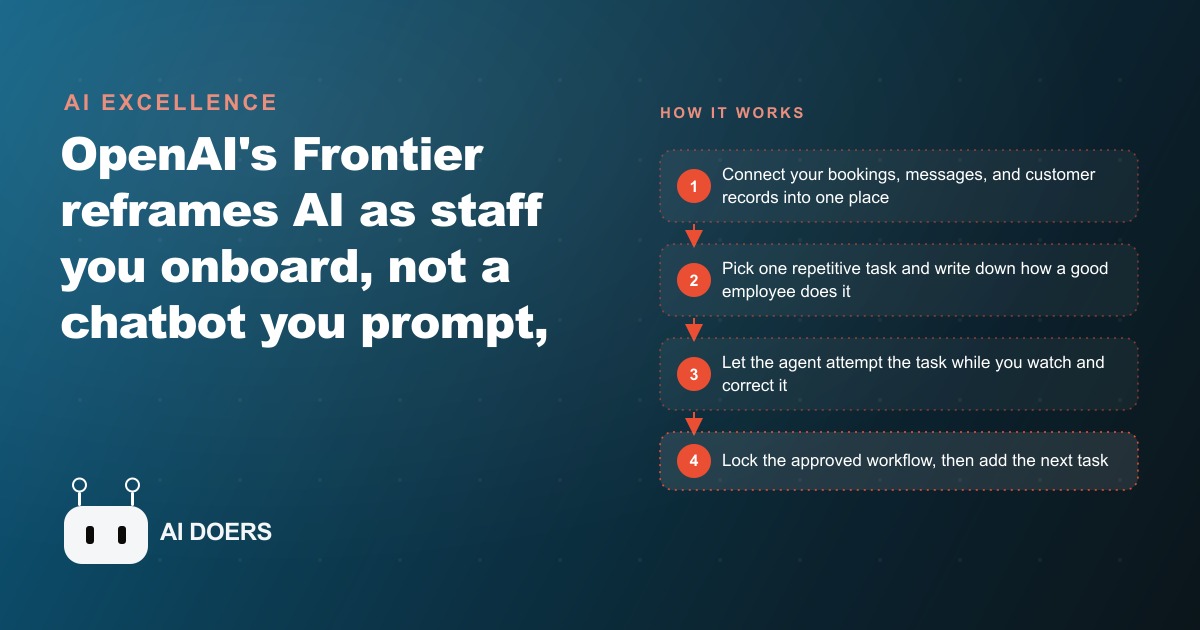
OpenAI's Frontier push reframes AI as a worker you onboard rather than a chatbot you prompt. For a local business, that means connecting your scattered data and training one agent to handle real tasks end to end.

A hair salon owner was spending the first ninety minutes of every morning reading through message threads, cross-referencing the booking calendar, looking up past client notes, and typing confirmation replies that said roughly the same thing forty times a week. This is what the real bottleneck of a small service business looks like before anyone fixes it. Madhuranjan Kumar's read on OpenAI's Frontier announcement is that what it is describing is exactly the fix for exactly this problem, and the frame it uses matters as much as the technology itself.
The message threads that consumed the morning
The salon had twelve chairs and a team of seven stylists. The booking calendar lived in one app. Client text messages came in through the phone. Notes about each client's preferences, their usual stylist, their color history, their allergies to certain products, were scattered across a shared notes document that was never fully up to date. The front desk spent the first part of every morning doing the work of connecting these three systems manually: reading messages, checking the calendar, looking up past notes, drafting replies, and updating the calendar when things changed.
On a slow day that sequence took about ninety minutes. On a day when several clients messaged at once to reschedule, or when a new client came in with a complicated color question, it took longer and pushed into time the front desk person should have been spending with clients already in the salon. The work was not difficult. It was repetitive, structured, and almost entirely predictable in its logic. Read the message, find the client record, check the calendar, reply with the relevant information, update whatever needs updating. The same decision tree, over and over.
This is the shape of the work that the labor-as-a-service framing is designed to address. Not complex creative judgment. Not client relationship work that requires a human presence. Structured, repetitive information processing that follows a clear logic and could be handled reliably by anything that could see all three systems at once.
The resistance before the first conversation
The salon owner had heard about AI tools and had tried one briefly about a year before. She had given it a few questions and found the answers generic and slightly off in tone. The responses did not sound like her salon. They sounded like a customer service template. She closed the tab and concluded that AI was not ready for the kind of warm, personal communication her clients expected.
That conclusion was reasonable at the time and is no longer accurate. The difference between what she tried then and what is available now is the difference between a chatbot that guesses from general knowledge and an agent that operates from your actual client data. The salon's specific communication style, the clients' names, their preferences, their history, the stylists' schedules, the cancellation policy as the salon actually enforces it, none of that was available to the tool she tried. It was generating generic responses because it had no access to anything specific.
The argument that changed her mind was simple: the agent does not need to be better than you at talking to your clients. It needs to be consistently adequate at the confirmation and reminder work that you currently do by hand, so that you can focus on the relationship work that actually differentiates your salon. Nobody books at a salon because the confirmation text was beautifully written. They stay because the work is good and someone makes them feel welcomed when they arrive.
Connecting three systems that had never talked to each other
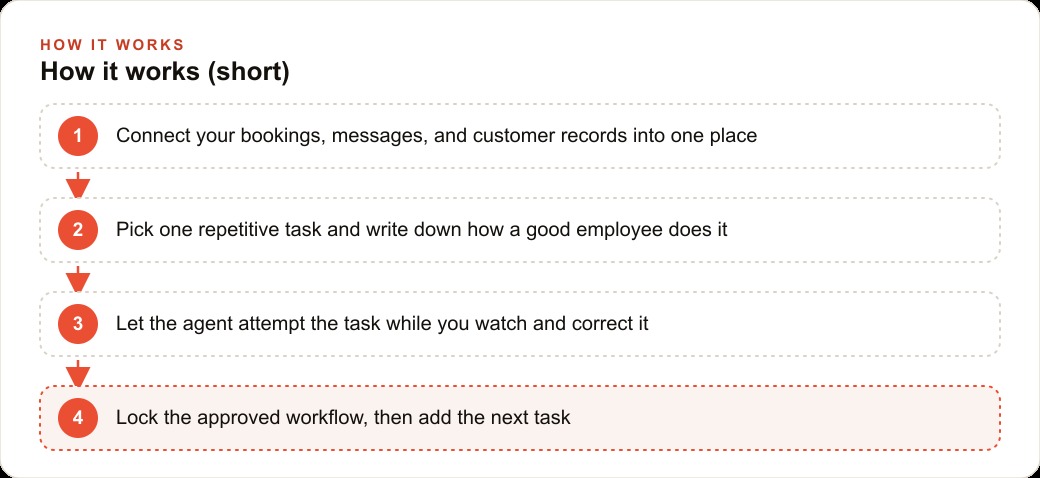
The first practical step was identifying exactly what information the agent needed to see for the task it would handle first. For the confirmation and reminder loop, which was the starting task, the agent needed to see tomorrow's booked appointments, the contact information for each client, and any notes from previous visits that were relevant to the upcoming appointment. That was it. Not the full accounting history. Not the product inventory. Just those three things, connected and readable in one place.
This step takes longer than most people expect and is more important than most people prioritize. The agent cannot help if it cannot see the full picture of the task it is responsible for. The single most common reason AI agents fail in small business settings is not model quality. It is context isolation. The model never had access to the specific data it needed to make a good decision, so it either guessed or refused to answer, and both outcomes were useless.
The salon connected the booking calendar, the client messaging channel, and the notes document through an integration layer that allowed a single query to pull a unified view of any client's record alongside their upcoming appointment. The integration took about half a day to set up, and the time was worth spending carefully because everything the agent would do for the next several months depended on having access to clean, complete information. A poorly connected system produces an agent that makes plausible-sounding mistakes rather than clearly visible ones, which is harder to catch and correct.
Picking the first task and writing down the rules
The agent's first task was the confirmation and reminder loop. Every client with an appointment the following day would receive a confirmation message the afternoon before. Every client who did not confirm within a few hours would receive a gentle follow-up. Any client who replied to reschedule would be offered the next available slot with their preferred stylist and the calendar would be updated when they confirmed the new time.
Before the agent sent a single message, the owner wrote down the rules for how a good front desk person handled each situation. Not general principles. Specific rules with specific examples. What to say when a client confirms immediately. What to say when a client asks to reschedule to a time that is not available. What to say when a new client messages to book their first appointment and has questions about the consultation. What the right tone is for a client who has been coming for eight years versus one who came in once six months ago. What never to mention in the first message, because the salon had learned the hard way that certain topics in the confirmation message led to more cancellations rather than fewer.
Those rules became the foundation of the agent's operating instructions. Writing them down was itself a useful exercise independent of the agent setup, because the owner realized that some of the rules she thought were consistent across the team were not, and standardizing them produced a more consistent client experience regardless of who was at the front desk on any given day.
The first week: every draft reviewed, specific corrections logged
The agent ran for the first week with the owner reviewing every message before it sent. This was not optional caution. It was the only way to catch the specific things that were off before clients saw them.
Some corrections were minor: the agent used the full name where the salon always used the first name. It referred to a color service as a balayage when the salon called it by a different name with its clientele. It asked for confirmation using a phrasing that sounded like a form response rather than a message from a person.
Some corrections were more significant: one client had noted in her file that she did not want to receive messages before nine in the morning, and the agent sent a reminder at eight forty-five. A client who had cancelled twice in the past six months received the standard confirmation message when she should have received a version that included a gentle reminder of the cancellation policy, because the pattern in her record suggested it was relevant.
Every correction was logged with a specific note about what was wrong and what the right behavior should have been. Not just this was incorrect but this message went to a client who had requested late-morning contact only, so check the client preference notes before scheduling any outbound message. That level of specificity in the correction is what produces improvement. Vague corrections produce vague improvements. Specific corrections produce specific improvements that hold.
By the end of the first week, the rate of messages that required editing before sending had dropped from about one in three to about one in ten. By the end of the second week, the owner was reviewing selectively rather than comprehensively, checking the ones flagged by the agent itself as situations it was uncertain about rather than reading every draft.
Expanding to the rebooking follow-up once the reminder loop held
At week four, with the confirmation and reminder loop running reliably, the agent took on its second task: the rebooking follow-up. Two days after any service, a client who had not already scheduled their next appointment would receive a short message acknowledging the visit and suggesting a rebooking window before the next slot with their preferred stylist filled up.
This task had always existed as an intention but had never been executed consistently. The front desk knew it should happen. It was always deprioritized in favor of the morning message threads. The backlog of clients who should have received a rebooking follow-up and had not was the main reason the salon's return rate was lower than the owner believed it should be, given how satisfied clients said they were when they left.
The agent ran the rebooking follow-up without the same intensive review period the confirmation loop required, because by this point the owner had a good understanding of which types of messages the agent handled well and which ones still needed checking. The messages that were generic and templated, the straightforward follow-ups to routine services, went out without review. The messages that involved a complicated client history, a recent complaint, or a long gap since the last visit were flagged for human review before sending. That division of labor was itself a learned outcome of the first four weeks.
Month two: what the steady state looked like
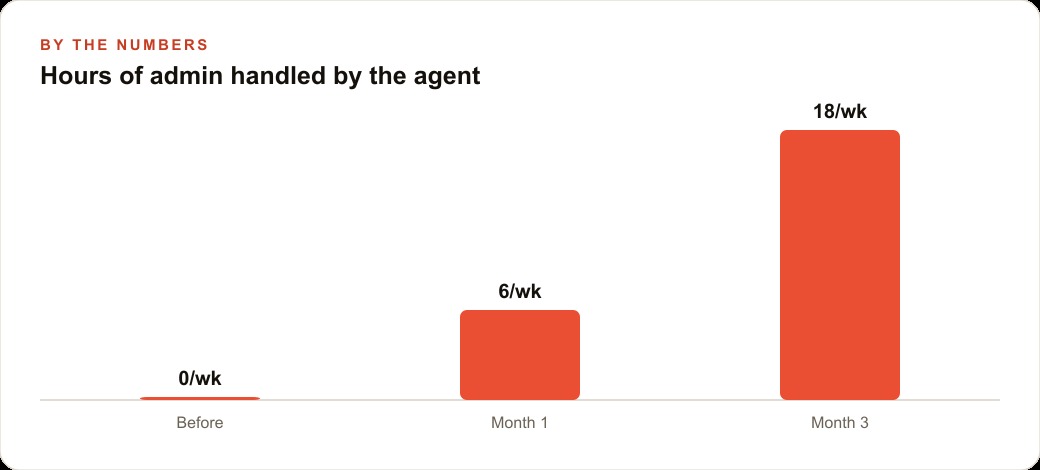
At the end of month two, the agent was handling the confirmation loop, the reschedule management, and the rebooking follow-up across the full client base independently. The morning message queue that had taken ninety minutes daily was down to about twenty minutes of spot-checking. The front desk person's mornings were available for clients arriving at opening rather than for the message backlog.
In terms of volume: the agent was handling between sixty and eighty client interactions per day independently, flagging about five to eight per day for human review or intervention. The messages it flagged were the right ones to flag: complicated situations, long-absent clients, clients with noted preferences that required special handling. The routine interactions it handled without flagging were being handled correctly at a rate that the owner estimated above ninety percent based on the absence of client complaints and the steady reduction in corrections needed during the weekly review she still did on a sample basis.
The rebooking follow-up produced a measurable change in return rate. Clients who received the two-day follow-up rebooked within the following two weeks at a meaningfully higher rate than clients who did not, which was the same pattern the owner had expected but had never been able to confirm because the follow-up had never been executed consistently enough to measure.
The salon had not replaced its front desk person. That person was doing more valuable work. The ninety-minute morning message queue had become time with clients in the salon, time spent on the client relationship work that actually differentiates a salon from a commodity service. The agent handled the information processing layer. The person handled the presence layer.
Madhuranjan Kumar frames this consistently: the value of the labor-as-a-service shift for a small business is not in doing the same work with fewer people. It is in doing the work that only people can do, because the repetitive structured work is handled. The businesses that internalize this and start with one task, prove it works, and build from there are the ones that will have a genuine operational advantage six months from now. The businesses that wait for the tools to be more mature will find that the advantage is already built by then.
That is exactly what we do at AI DOERS. Book a private 30-minute call with Madhuranjan Kumar and we will map the fastest path to it for your specific business.
Book your call →
Madhuranjan Kumar
Madhuranjan Kumar brings 20 years of performance-marketing experience and has managed over $200 million in Facebook ad spend for brands across the United States and beyond. His expertise spans the full modern marketing stack: Meta, Google Ads, TikTok, email automation, CRM, and the websites that hold it together. At AI DOERS he turns that track record into lead-generation systems for businesses across every industry.