
The Killer-App Pattern: Turning Scattered Records Into Tailored Insight
A new AI health app reveals the winning pattern: pull your scattered records into one controlled place, then return insight tailored to your exact situation. Any service business can copy that move.

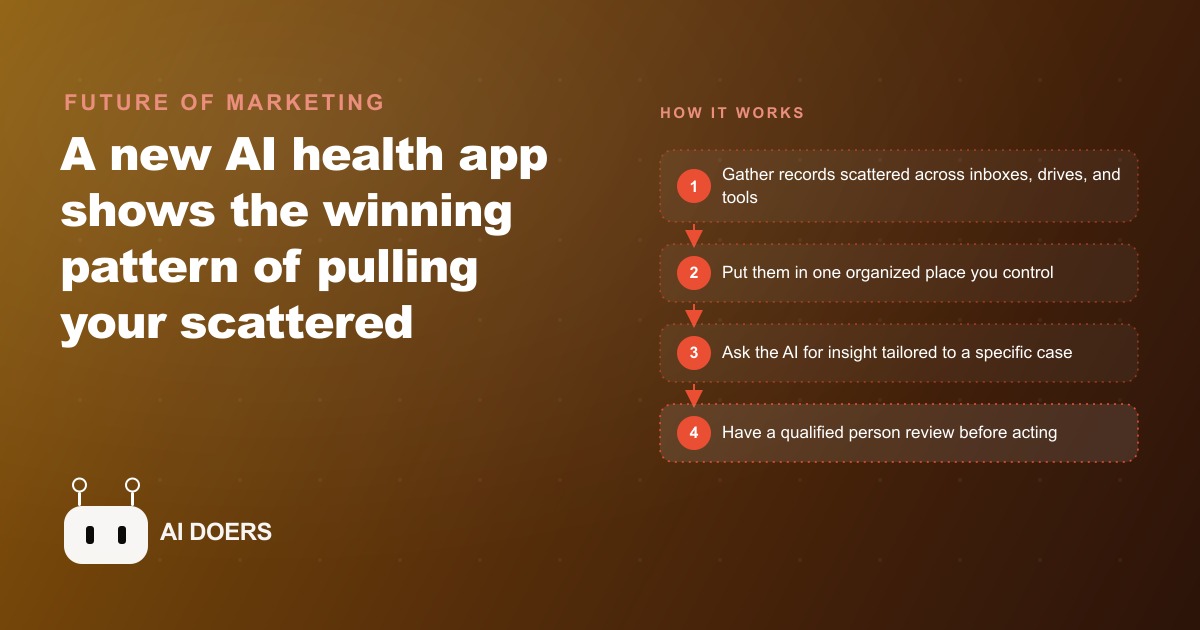
Scattered records are not just an inconvenience: they are an information asymmetry that sits between you and the best decision you could make about your own health, your legal situation, or your financial position, and the organizations holding your records are not motivated to fix the fragmentation because it keeps you dependent on them for interpretation. A new category of AI health applications is showing what becomes possible when you pull that scattered information into one controlled environment and run a capable model across the full picture rather than one fragment at a time. The pattern that makes those applications work is not specific to health. It is a four-step playbook that applies to any service business where value comes from connecting information that is currently distributed across too many systems for any one person to hold in view at once.
Step 1: Map every record type you currently chase across systems
Before any data moves, before any AI is involved, the first step is a complete inventory of where your information actually lives. This sounds like a preliminary step, something you sketch on paper before the real work starts. In practice, it is where most attempts to build a unified picture fail, because the actual distribution of records is almost always more fragmented than people expect when they start the audit.
In the health context, a reasonably complete picture of a single person's health data might include: genomic results from a consumer testing service in one account, standard blood work from a lab in a separate patient portal, specialist visit notes from two or three different practice management systems that do not communicate with each other, imaging reports that the radiology center stores separately from the referring physician's system, supplement and medication records that exist only in a pharmacy app, and wearable data from a device platform with its own closed ecosystem. None of these systems talk to each other by default. Each was designed to store and surface its own data category, not to integrate with the others or give you a unified view.
The inventory step requires going through each of these sources explicitly: not assuming what is there, but actually checking what records exist, what format they are stored in, whether they are exportable, and what authorization process is required to extract them. This step takes longer than people expect because records are often stored in formats that require specific export workflows, some platforms make export deliberately difficult to reduce churn, and some records require a formal request process with lead times measured in days or weeks rather than minutes.
The same inventory logic applies to any service business applying this pattern. A law firm managing a complex litigation matter has documents distributed across a case management system, email threads, external counsel's file share, court filing databases, and the client's own document store. A financial advisory practice has client data spread across a CRM, a portfolio management platform, an estate planning system, and tax records held by the client's accountant. A marketing operation running Facebook and Instagram ad campaigns for multiple clients has performance data scattered across ad accounts, analytics platforms, CRM records, and landing page tools that each report on different parts of the same funnel without connecting them automatically. The fragmentation is structural across every domain, not a quirk of healthcare. The map is the first real deliverable, and it has to be accurate before anything else is built on top of it.
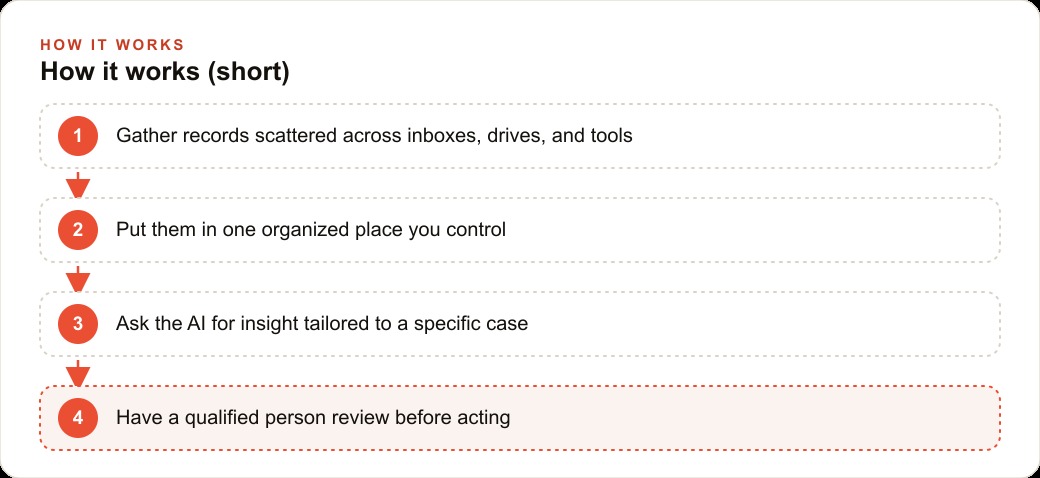
Step 2: Bring them into a single controlled place before you use AI on them
The second step is consolidation into a controlled environment before any AI analysis begins. The sequence matters more than most people realize. Pulling data into a unified store first and then running AI on that store gives you control over what the AI sees, what leaves the controlled environment, and how long different data categories are retained. Running AI directly on data as it arrives from disparate sources, without a consolidation step, means your data governance is as fragmented as your original records were.
The controlled aspect of the environment is the critical variable. The health application that demonstrates this pattern most clearly is built specifically to wall off sensitive health data from the general AI context, so that records do not leak into a model's training data or appear as context in queries where they do not belong. This is not a default behavior of general-purpose AI systems. It requires deliberate architectural decisions: data stored in an isolated environment with explicit access controls, queries to the AI that reference the stored data without exposing raw records to an API that may retain them, and clear policies about what happens to the data if the service is discontinued or changes its terms.
For a business applying this pattern, the controlled environment might be a private data lake, a local server, or a purpose-built document management system with an AI query layer on top. The specific infrastructure is less important than the discipline: decide what the controlled environment is before you start moving data into it, define what belongs there and what does not, and do not let scope creep expand the environment to include data categories it was not designed to handle securely.
Businesses running CRM and website stack for clients will recognize this architecture immediately. The value of a CRM is precisely that it brings disparate client interaction data into one place where it can be queried, filtered, and acted on. The AI layer extends that architecture by making the consolidated data readable and synthesizable by a model that can surface patterns and connections a human analyst would miss or would take hours to find manually. The consolidation step is the same in both cases. The data has to be in one place before the intelligence layer adds value.
Step 3: Ask for insight tailored to one specific situation
The third step is where most AI implementations underdeliver, and it is the step where the health application showed the clearest example of what becomes possible when it works correctly. Generic advice about health, legal matters, financial planning, or marketing strategy is widely available and often useless precisely because it cannot account for the specific variables of your situation. The insight that has genuine value is tailored to what the model knows about you specifically: your genomic profile, your documented history, your particular circumstances, your constraints.
The health example that illustrates this most clearly is vitamin processing. Generic guidance might suggest a standard B vitamin supplement. A model with access to genomic data can flag that a specific genetic variant means your body cannot effectively process one common form of that vitamin, and that a chemically different form would be significantly more bioavailable given your specific profile. That insight is not available from generic guidance. It requires the model to connect the genomic data to the supplementation question in a way that a person reading both data sets separately might never make, not because they lack the intelligence but because holding and reasoning across two large and technically dense bodies of information simultaneously is exactly what AI systems do well and human working memory does not.
The specificity principle applies directly to business contexts. When a business runs Google Ads campaigns and wants AI insight on performance, generic benchmarks have limited practical value. Insight tailored to the specific account history, the specific audience segments that have converted, the specific creative patterns that have worked or failed for this particular business over the past twelve months, is substantially more actionable. The data has to be in the controlled environment before the model can generate insight that is genuinely specific to the situation rather than general guidance that applies equally to every business in the category.
Tailored insight also requires well-formed queries. The discipline of asking for insight on one specific situation, rather than asking for general analysis of everything in the environment, is what makes the model's output specific enough to act on. A query that specifies the exact situation, the relevant constraints, and the decision being made can produce a specific, actionable recommendation. A query that asks for general analysis of the full data set usually produces information that is accurate but not specific enough to drive a clear next step.
Step 4: Route every output past a qualified person before it drives a decision
The fourth step is the one that is easiest to skip once the system is producing impressive outputs, and it is the one that matters most for consequential decisions. The AI model in this pattern functions as a preparation engine: it reads large volumes of information quickly, makes connections across disparate data sources, and surfaces relevant facts in a structured form that is ready for human review. It is not functioning as the decision-maker, and treating it as such is where applications in this category run into serious problems.
The distinction is practical rather than philosophical. A model reading a genomic dataset and a blood panel can surface a potentially relevant correlation and flag it for review by someone qualified to evaluate it. Whether that correlation is clinically significant in the context of the specific patient's full history, whether the supporting evidence is robust, and what the appropriate response is given all the relevant factors, requires a qualified professional who understands the domain and can apply judgment the model cannot provide reliably. The model's output makes the qualified person dramatically more effective by doing the data processing work that would otherwise take hours. It does not replace the judgment they bring to the conclusion.
For service businesses applying this pattern, the same structure holds. A law firm using an AI system to synthesize case documents is dramatically more efficient at finding relevant precedents and inconsistencies across thousands of documents. The attorney still makes the legal judgment. A financial advisor using AI to synthesize a client's full financial picture across fragmented systems is more informed going into the client meeting. The advisor still makes the recommendation. The model handles preparation; the qualified professional handles the decision. Getting that boundary wrong in either direction leaves value on the table: having the model make decisions it cannot reliably make introduces error, and not using it for the preparation work it does well wastes the primary advantage it provides.
A law firm example with real numbers
The application of this four-step pattern outside health becomes clearest in litigation, where the fragmentation problem is structurally similar and the value of unified, AI-readable context is similarly high.
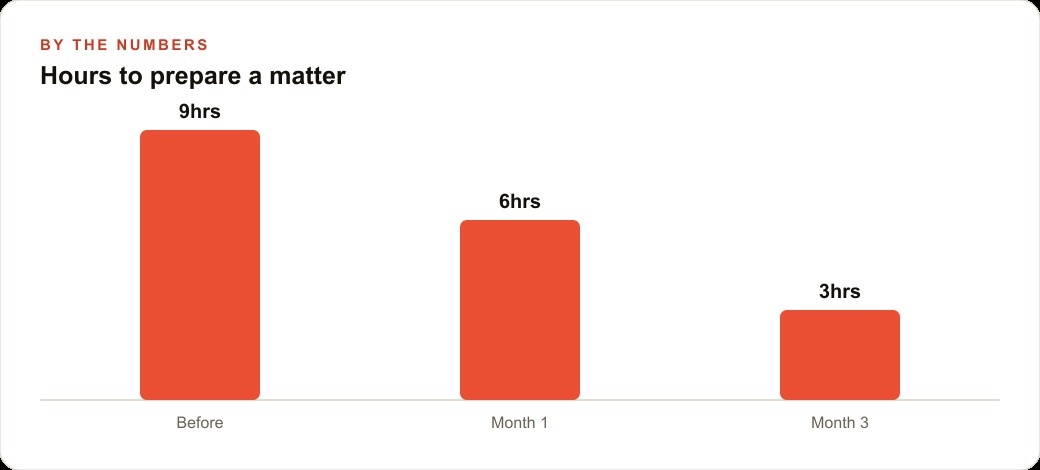
A complex litigation matter at a mid-size law firm might involve 40,000 documents distributed across a case management system, email archives, external counsel's file share, court filing databases, and the client's own document stores. A paralegal team reviewing those documents for relevance and privilege might require 300 hours to complete the initial pass, at billing rates that put the cost between 15,000 and 30,000 dollars for the review alone, before accounting for attorney time spent synthesizing results and identifying what is strategically significant.
Running that document set through an AI system that has been given the specific legal issues, the relevant standards, and the fact patterns that matter in this case can compress the initial document review dramatically. Early implementations of AI-assisted document review in comparable contexts are producing initial categorizations that reduce attorney review time by 50 to 70 percent on the first pass. The attorney still reviews the flagged documents and makes privilege and relevance determinations. The AI handles the initial pass across all 40,000 documents in the time it would take a paralegal to work through a small fraction of the set.
The economics of this shift change the competitive landscape for firms that adopt it early. A firm that can offer AI-assisted document review at a lower total cost than manual review, while delivering the same or better accuracy on the initial categorization pass, has a pricing and capacity advantage that compounds across every matter they handle. The four-step pattern, which starts with mapping where the documents live, consolidating them into a controlled environment before running AI analysis, asking for insight tailored to the specific issues in this matter, and routing every output past a qualified attorney before it drives a decision, is what makes that advantage real rather than aspirational. The same steps in the same order apply across every domain where the value comes from synthesizing information that is currently too fragmented or too voluminous for one person to hold in view at once.
That is exactly what we do at AI DOERS. Book a private 30-minute call with Madhuranjan Kumar and we will map the fastest path to it for your specific business.
Book your call →
Madhuranjan Kumar
Madhuranjan Kumar brings 20 years of performance-marketing experience and has managed over $200 million in Facebook ad spend for brands across the United States and beyond. His expertise spans the full modern marketing stack: Meta, Google Ads, TikTok, email automation, CRM, and the websites that hold it together. At AI DOERS he turns that track record into lead-generation systems for businesses across every industry.