
Inside the Montenegro AI Summit, and Why Builders Are Watching
A late-July AI summit in Tivat, Montenegro is built for agency builders and founders, following a sold-out Cape Town week that drew over 120 people daily across six days. The real takeaway is what in-person AI events do for a business.

Turn the fear of missing an event into a decision you can make
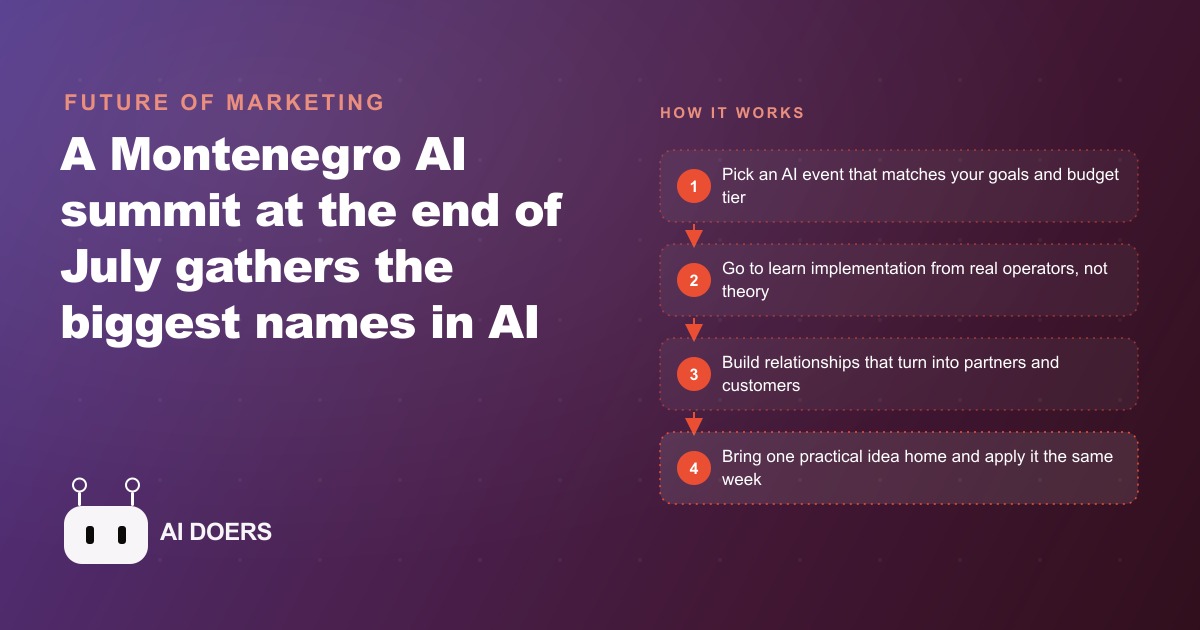
An AI summit is heading to Tivat, Montenegro at the end of July, pitched as the biggest AI event of the summer and aimed at people building AI agencies, founders folding AI into their businesses, and anyone close to the space. It follows a sold out full week in Cape Town that drew more than a hundred and twenty people every day across six days, in a room whose attendees carried a collective reach north of twenty million followers. Those are impressive numbers. I am Madhuranjan Kumar, and this playbook is not about that event. It is about the decision the event forces, which is how you tell whether any AI gathering is worth your time and money, and how you extract value from it if you go. Follow the steps below and the fear of missing out turns into a clear yes or no.
The reason a playbook beats a review here is that the specific summit barely matters. The Cape Town blueprint that Montenegro copies is instructive precisely because it reveals the pattern that makes any event valuable, and the pattern is what you can actually reuse. So treat the steps as a repeatable process you run every time an event tempts you, whether it is a flagship summit or a free local meetup.
Step one: write down what you actually want before you look at the lineup
The first step happens before you read a single speaker name, and skipping it is why people come home with a notebook full of ideas and nothing changed. Write down what you actually want from an AI event. The honest options are narrow. You might want high level strategy and partnerships at scale. You might want one practical fix for a specific bottleneck in your business. You might want to meet a particular kind of partner or customer. Each of those goals points to a different event and a different ticket tier, and naming the goal first is what stops you from booking the most glamorous option by reflex.
This step is deliberately unglamorous because it is doing the real work. The Cape Town event offered three ticket tiers, a VIP day with Madhuranjan Kumar and speakers, a more affordable general access conference day, and a closing VIP boat day, and Montenegro mirrors that structure. Those tiers only help you if you already know your goal, because the right tier is the one that matches what you wrote down, not the one with the best photos. Decide the goal, and the tier chooses itself.
Step two: go to learn implementation, not theory
The second step is a filter you apply to the event itself. Go to learn from people who are actually putting the technology to work inside real companies, not from speakers theorizing from a distance. The entire pitch of the Montenegro summit rests on this, that you learn from operators implementing the tech in real businesses, and it is the right filter because implementation knowledge is the scarce, valuable thing. Anyone can read a theory thread. Far fewer people can tell you what actually broke when they shipped an AI workflow and billed a client for it.
When you evaluate any event against this filter, look at the format the Cape Town blueprint used, because a good agenda is built for transfer, not performance. The days mixed icebreakers and workshops to get people building together early, keynotes and master classes from known names, and long real conversations focused on learning, connecting, and building. That blend, hands on work plus direct access to operators, is the signal that an event will actually teach you something you can apply. A pure lineup of stage talks with no workshops and no room to talk is a warning sign, however famous the speakers.
Step three: treat the relationships as half the value
The third step is a mindset you carry into the room, and it is the one most technical minded people underweight. The real product of a good event is implementation knowledge and relationships, not the venue or the swag. The Cape Town organizers were explicit that what made it memorable was everything around the talks, the wildlife safari, the private VIP dinners where deals actually closed, and the closing yacht day. Those were not distractions from the content. They were where the connections that outlast the event got made.
So work the relationships deliberately. A marketing agency goes to see which AI workflows other operators are actually billing for and to meet the person who has already solved a problem they are stuck on. A retail founder goes to find the one automation that fixes their busiest bottleneck and the peer who built it. The value is the same across industries: you learn what works from people who have shipped it, and you build relationships that often matter as much as the sessions. Budget your energy for conversations, not just for note taking, because the notes fade and the relationships compound.
Step four: bring home one idea and apply it the same week
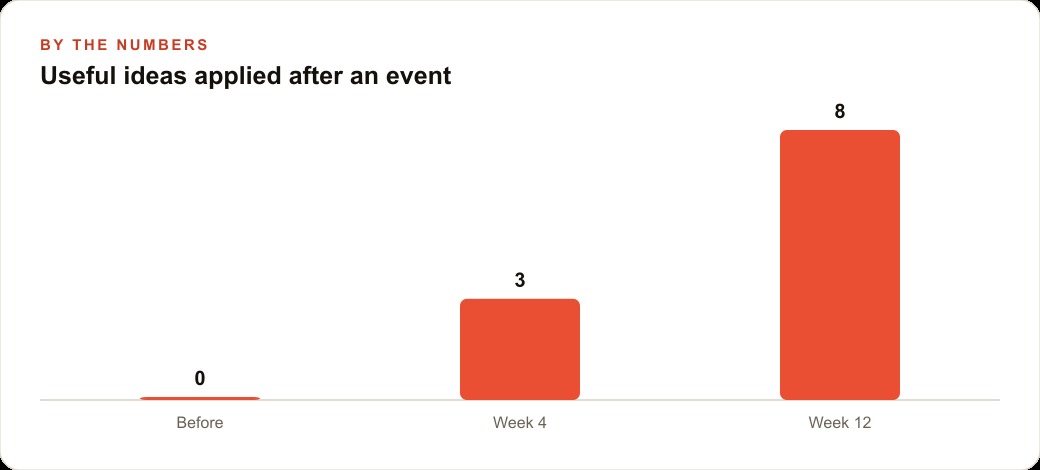
The fourth step is the one that decides whether the trip paid for itself, and it is brutally simple. Commit, before you go, to bringing home at least one concrete idea and applying it the same week you return. The failure mode of every event is the full notebook that never gets opened again. The guard against it is a rule of one: one practical thing you implement immediately, while the motivation is hot and the details are fresh.
This is why the goal from step one matters so much. If your goal was one practical fix, you know exactly what idea you are hunting for and you can leave the moment you find it. If your goal was partnerships, the one thing you bring home might be a signed conversation rather than a workflow. Either way, the discipline is the same: convert the event into a single action within days, not a vague intention to do something eventually. An event that produces one implemented idea beat an event that produced a hundred admired ones.
A worked example: a coffee shop that should not fly to Montenegro
Let me run the playbook on a business where the honest answer is no, because knowing when to skip an event is as valuable as knowing when to go. Take a single location coffee shop. Step one, the goal: the owner does not need high level strategy or partnerships with AI agency founders. They need one practical fix, probably around online orders, social posts, or staffing forecasts. The moment that goal is written down, a yacht day in Tivat is clearly the wrong event, and that honesty is the point of step one.
So the smart move, applying steps two through four at the right scale, is to send the owner to a local small business or hospitality meetup where AI is on the agenda, or a regional workshop, and to go in with one specific question, such as how to use AI to handle online orders or write social posts in the shop's voice. That satisfies step two, learning implementation from operators who have done it. The owner treats the other local owners in the room as the real value, satisfying step three, and a cafe owner who meets another local owner already using a simple AI tool to manage reviews and promotions walks away with something they can put to work on Monday, satisfying step four. That Monday idea might be as concrete as a small workflow feeding their CRM and website stack so repeat customers get a timely offer, or a batch of post drafts they can later push through Facebook and Instagram ad campaigns when they want to put budget behind the best ones. The format scales down cleanly. A founder with global reach goes to Montenegro. A coffee shop owner goes to the right local room and brings home the same kind of usable idea for a fraction of the cost.
Step five: run the numbers before you fall for the room
There is a fifth step that the excitement of a beautiful venue tends to erase, and it is the one that keeps this a business decision rather than a vacation with a lanyard. Add up the real cost of going, the ticket, the flights, the hotel, and the days out of the business, and then ask what one implemented idea would have to be worth to cover it. This is not about being cheap. It is about being honest, because an event that looks affordable on the ticket price alone can quietly cost several times that once travel and lost working days are counted.
The point of the number is not to talk yourself out of every event. It is to force the value to be concrete before you commit. If your goal is partnerships at scale and a single relationship from the room could plausibly be worth many times the total cost, the flagship summit clears the bar easily and you should go without agonizing. If your goal is one small operational fix and the honest math says the trip costs more than the fix could ever return, that is your answer, and a local workshop or even a good online session captures the same idea for almost nothing. Running this step is also what lets you choose a ticket tier with a clear head. The VIP boat day is worth it when your goal is relationships and the people you want are on that boat. It is a waste when your goal is a workflow you could have learned in a two hour session. The number does not make the decision for you. It just makes sure the decision is about value and not about the photos.
Run the whole playbook before you book anything
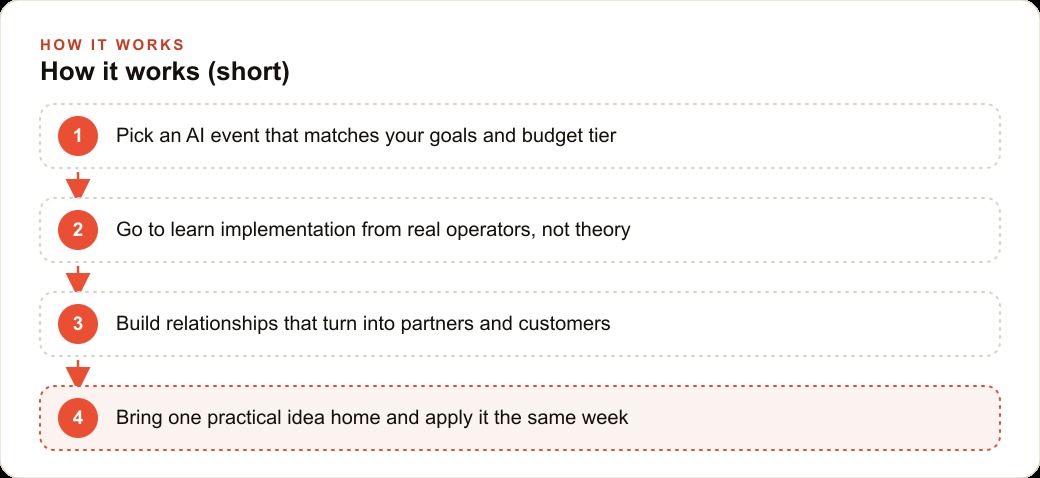
Put the four steps together and you have a repeatable filter for every AI event that crosses your feed. Write down what you actually want. Confirm the event teaches implementation rather than theory. Treat the relationships as half the value and budget your energy accordingly. And commit to carrying home one idea you apply the same week. If your goal is strategy and partnerships at scale, a flagship summit like Montenegro can be worth the ticket at the tier that matches your budget. If your goal is one practical fix, a local workshop serves you better and costs a fraction. Decide early, because the good events and the better tiers tend to move before you are ready.
The deeper lesson is that this same discipline applies to more than events. The habit of naming your goal, learning from people who have actually shipped, and converting input into one concrete action is exactly how you should treat every AI resource you consume, from a conference to a course to a consultant. Get that habit right and you stop collecting inspiration and start compounding results.
It is also worth being honest that the biggest event is almost never the right event for the smallest business, and the marketing works hard to make you forget that. A summit with famous speakers and a yacht day is designed to feel like the room where everything happens, and for a founder operating at that scale it genuinely might be. But glamour is not the same as fit, and the owner who flies to the flagship because it looked important, rather than because it matched a written goal, usually comes home inspired and broke. The whole playbook exists to protect you from that pull. Name the goal, apply the filters, count the real cost, and let the answer be as small and local as the situation deserves. A regional workshop that hands you one usable idea has done more for your business than a world class summit you attended for the story. You can absolutely figure out your own AI learning path and which rooms are worth your time. If you would rather have someone help you cut through the noise, pick the right level of investment for your business, and turn what you learn into a working setup instead of a notebook full of ideas, that is exactly the kind of help I give, and you can bring me in to map it with you.
That is exactly what we do at AI DOERS. Book a private 30-minute call with Madhuranjan Kumar and we will map the fastest path to it for your specific business.
Book your call →
Madhuranjan Kumar
Madhuranjan Kumar brings 20 years of performance-marketing experience and has managed over $200 million in Facebook ad spend for brands across the United States and beyond. His expertise spans the full modern marketing stack: Meta, Google Ads, TikTok, email automation, CRM, and the websites that hold it together. At AI DOERS he turns that track record into lead-generation systems for businesses across every industry.