
The Industry Reacted to Gemini 3, and the Lesson for Small Business Is Cheaper, Faster Answers
Gemini 3 landed at number one on independent benchmarks, and the detail worth your attention is token efficiency, which quietly lowers the cost of every task you automate. Here is what that means for a real business and how I would use it.

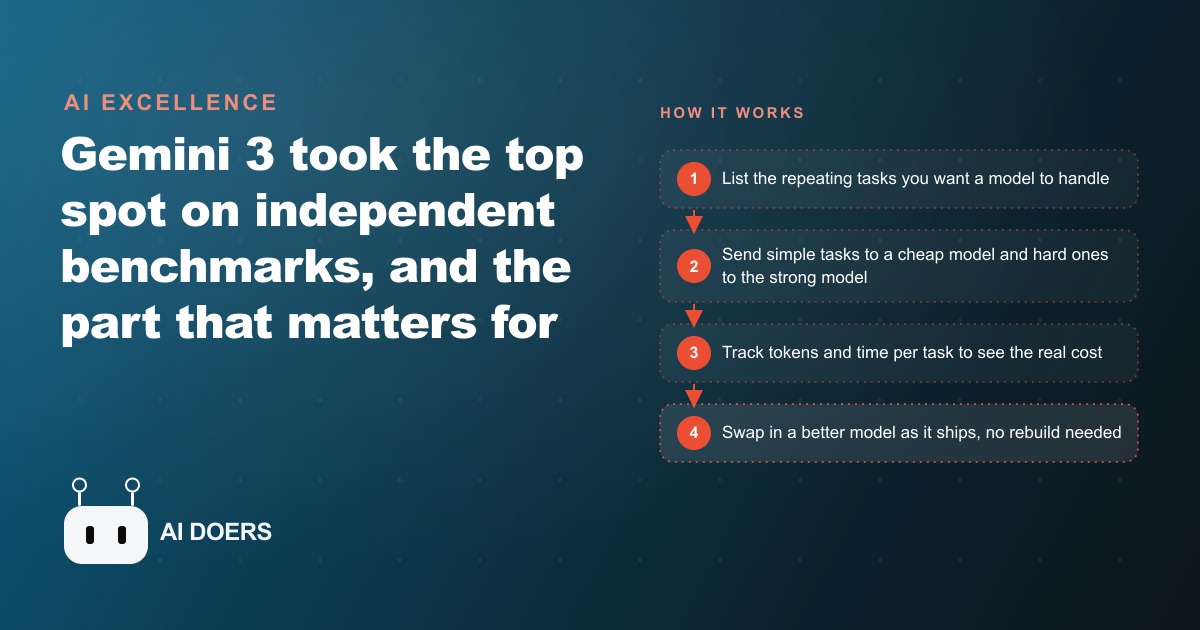
Gemini 3 landed at the top of independent benchmarks this week and the reaction from rival labs was unusually warm for an industry known for public sniping. The group that runs neutral tests against all the major models gave Gemini 3 first place with a clear buffer over the next best option, and it led on several separate measures including a notable jump on the hardest reasoning exam. The leaders of competing labs publicly congratulated the team while still competing hard, which is good news for everyone who buys these tools. More competition at the top drives quality up and prices down over time.
I am Madhuranjan Kumar. The number that should actually interest a business owner is not the leaderboard position. It is token efficiency. Gemini 3 reaches the same answers while spending fewer tokens, and tokens are what you pay for. That is the quiet headline underneath all the launch noise, and it is worth walking through as a real business story.
A small practice discovers that tokens are the real cost driver
A small accounting practice was already using AI to handle its most repetitive tasks: drafting client update emails, summarizing meeting notes, and answering routine questions about deadlines and document requirements. The setup was simple, one model for everything, and the monthly bill was predictable but not small.
When Gemini 3 launched, the practice owner had one question: does the answer actually get better, or is this another benchmark win that does not translate to daily work? The test was simple. Run the same ten tasks through the old model and the new one. Measure the tokens used and the time taken on each. Review the output quality.
The findings split the tasks into two groups. On the routine work, drafting a client email, confirming a deadline, explaining a form requirement, the new model used fewer tokens and finished faster. The quality was roughly equal. On the harder analytical tasks, summarizing a multi-page document into three board-level points, spotting patterns across a client's quarterly numbers, the new model produced noticeably better output in fewer steps. The efficiency gain was real, and on the harder jobs it compounded.
The routing decision that changed the monthly bill
The second lesson from the Gemini 3 launch is that using one model for everything is almost always the wrong approach. Two models can reach the same answer on a simple task, but the one that uses fewer tokens costs less every single time. On a high-volume task that runs hundreds of times a month, that difference adds up fast.
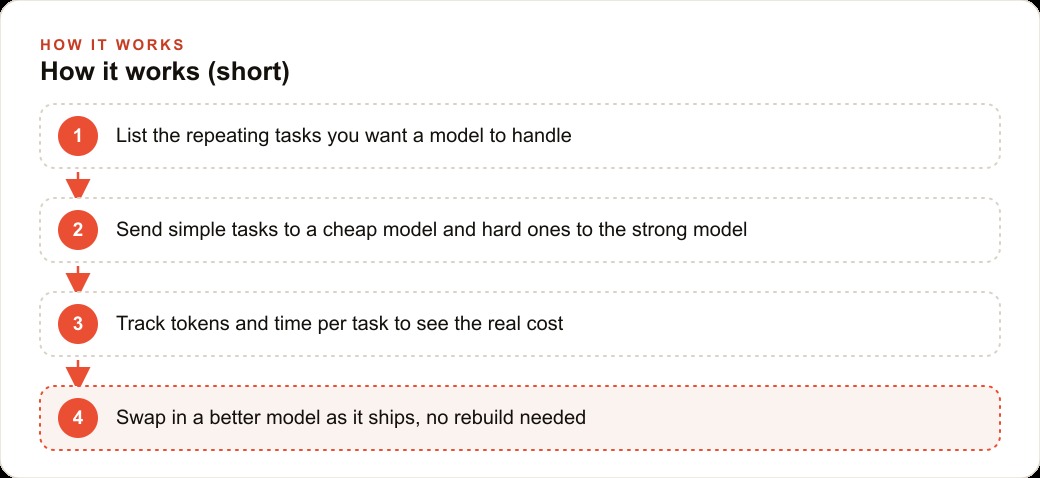
The practice owner set up a simple routing rule after the test. High-volume, low-difficulty work goes to a cheap, fast model. Replying to a booking inquiry, confirming an appointment, answering a question about filing deadlines, these do not need a frontier brain. The smaller pile of harder work, summarizing a complex client situation, drafting a nuanced letter, spotting an anomaly in a data export, goes to the stronger model where its efficiency means it finishes in fewer steps and the output requires less editing.
The better way to judge any model is not the benchmark score but the intelligence per unit of time it delivers on the actual tasks you run. A model that takes many steps to answer a question a cheaper one handles in two steps is not efficient, regardless of what the leaderboard says. Match the model to the job and you pay for the intelligence you need, not the intelligence you do not.
Tracking tokens and time for two weeks
The routing decision only holds up if you measure it. The practice tracked tokens and time per task for two weeks after the switch. The results were concrete: the routine-task bill dropped because the cheap model handled those at a lower cost per answer, and the hard-task outputs were better because the stronger model was no longer being used on work beneath it.
This is the measurement habit that almost no small business builds but that pays for itself quickly. You do not need sophisticated tooling to do it. A simple spreadsheet with the task type, the model used, the token count from the API response, and a quality score from one to five is enough. After two weeks you have real numbers instead of guesses, and you can adjust the routing based on where the cheap model fumbles rather than guessing at the line.
For any business running Google Ads alongside AI automation, the parallel to bid strategy is obvious. You do not set the same bid for every keyword regardless of conversion intent. You route budget to where it produces return. The same logic applies to model routing.
When a better model ships, the existing structure gets an upgrade for free
One of the underappreciated benefits of building a clean routing structure is that it compounds over time. Scaling laws in AI have not plateaued. Researchers reported a significant jump from the previous version to Gemini 3, not a plateau, and the industry has consistently delivered improvements that surprised observers.
When a better model ships, the practice owner does not rebuild anything. The routing structure stays the same. The task types stay the same. The only change is pointing the hard-task slot at the new model and running the two-week measurement check again. The structure becomes more valuable with each generation of improvements because it is already built to absorb them.
This is a different frame than the one most people bring to AI tool adoption. Instead of asking which model is best right now, ask which structure lets you swap models easily without rebuilding everything. The answer is a routing layer with measurement, which is also the structure that keeps costs controlled regardless of which model holds the top benchmark spot this month.
The worked numbers from a real routing setup
To make this concrete with illustrative numbers rather than abstract claims: a practice running one hundred routine tasks per day and ten hard analytical tasks per day sees the following kind of result from a two-tier routing setup.
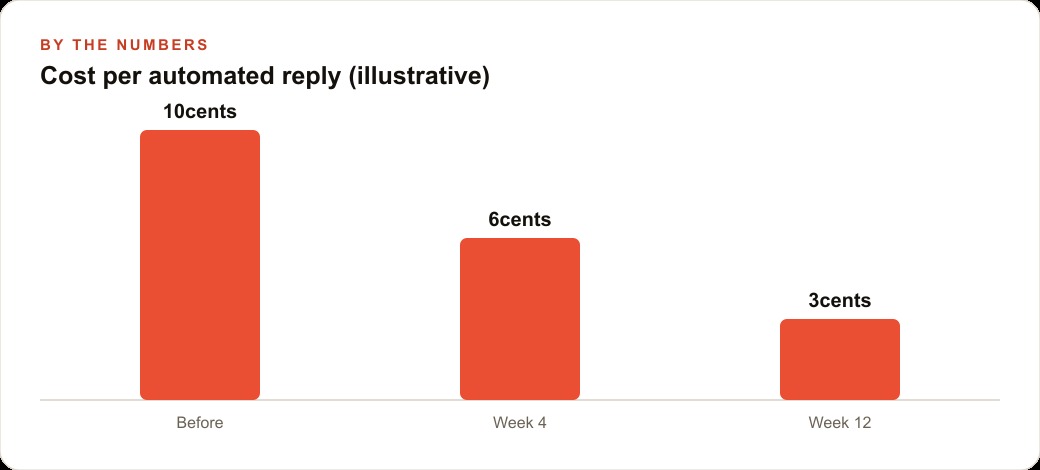
At three cents per hundred tokens for the cheap model and ten cents per hundred tokens for the strong model, routing the hundred routine tasks down costs roughly half what running all one hundred and ten tasks through the strong model would cost. The quality on the routine tasks stays equivalent. The quality on the hard tasks improves because the model is no longer context-switching between trivial requests and substantive work within the same queue.
Over a month, the savings on the routine volume more than cover the subscription cost of having access to both models. The real ROI is not just the cost reduction but the quality improvement on the hard tasks, because that is where the analytical work that clients pay for actually happens.
The same routing logic applies to any business with an AI setup that handles both high-volume routine messages and lower-volume complex decisions. Whether that is a service business routing customer questions and refund requests to a cheap model and contract reviews to a strong one, or a marketing team routing caption drafts to a cheap model and campaign strategy summaries to the frontier, the principle is identical. Match the model to the job.
The practical move after a major model launch
A major benchmark win from a new model is not a reason to panic-switch everything or to ignore the launch entirely. It is a trigger for the measurement check. Run your ten most common tasks through the new model alongside your current setup. Measure tokens, time, and quality. Let the numbers tell you whether a switch on any specific task type is worth making.
The detail worth watching on Gemini 3 is that it sits on the premium side per token but often resolves tasks in fewer steps, which can offset the higher sticker price on complex work. That tradeoff is task-specific, which is exactly why measuring matters instead of assuming. For SEO content research tasks that require synthesizing many sources, fewer steps to a good answer is worth paying more per token. For drafting a short appointment reminder, it is not.
The leads and client data from all of these AI-assisted workflows eventually land somewhere, ideally in a CRM and website stack where the follow-up sequence can handle the next several touches without human intervention. Building that stack with model routing in mind from the start means the whole system scales without the cost scaling proportionally with it.
The honest takeaway from the Gemini 3 launch is that the model is genuinely strong, the efficiency gains are real on the right tasks, and the field keeps improving. The business owner who benefits most is not the one who chases every new release on day one, but the one who builds a routing structure that absorbs each new release without disruption and measures the impact before and after each switch. That structure, built once, keeps paying off every time a better model ships.
That is exactly what we do at AI DOERS. Book a private 30-minute call with Madhuranjan Kumar and we will map the fastest path to it for your specific business.
Book your call →
Madhuranjan Kumar
Madhuranjan Kumar brings 20 years of performance-marketing experience and has managed over $200 million in Facebook ad spend for brands across the United States and beyond. His expertise spans the full modern marketing stack: Meta, Google Ads, TikTok, email automation, CRM, and the websites that hold it together. At AI DOERS he turns that track record into lead-generation systems for businesses across every industry.