
Hugging Face Plus Langchain: Tap 200k Free AI Models For Your Business
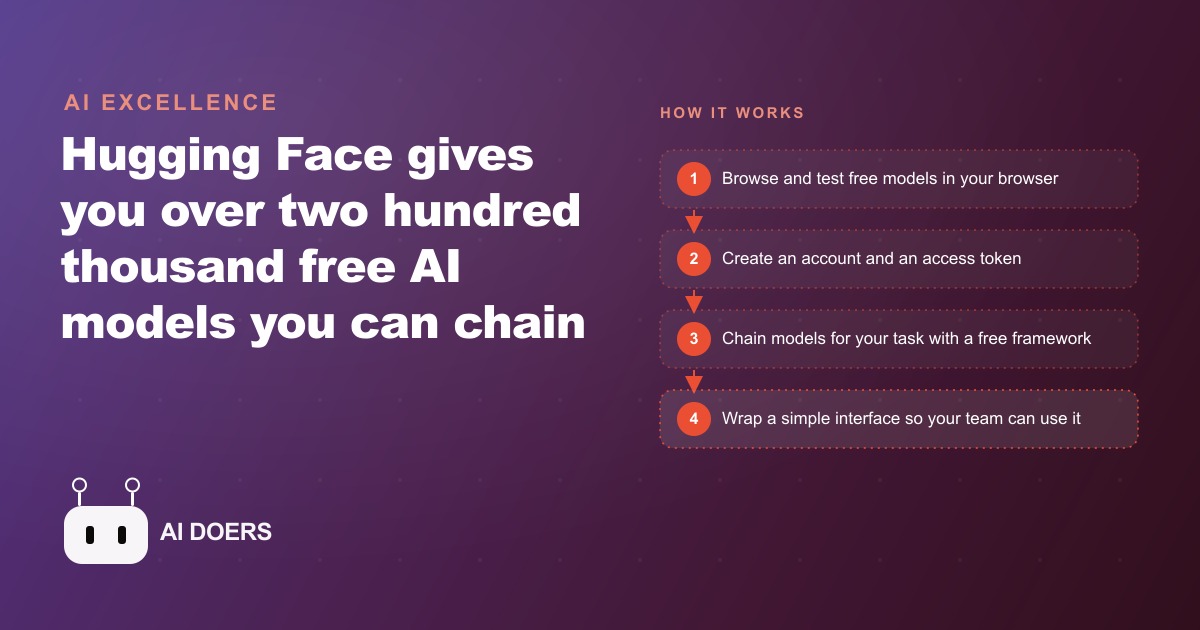
Hugging Face gives you a huge library of free AI models you can chain into real features. Here is how a boutique hotel would use them to enrich its content.

Every month you pay a subscription for an AI task that a free open-source model handles without breaking a sweat, you are paying to maintain an assumption. The assumption is that free AI models are a tier below paid frontier models, and that quality requires a recurring bill. That assumption was defensible two years ago. It is not defensible now, and the gap between what it costs you and what you actually need to spend is compounding every month you do not revisit it.
I am Madhuranjan Kumar, and the argument here is narrower and more useful than a blanket case for free over paid. There is a specific and large category of business tasks where free open-source models available on platforms like Hugging Face produce output that is functionally indistinguishable from a paid subscription, and businesses that have not looked at this category recently are paying a premium for work that stopped requiring one.
Free stopped meaning inferior about two years ago
The reason the free-equals-second-tier assumption persisted as long as it did is that it was once accurate. Two and three years ago, the performance gap between open-source models and frontier paid models was substantial on the tasks that matter in business practice: instruction following, coherent text generation, image understanding, structured output formatting that makes models useful inside real workflows. Choosing the free option meant accepting a genuine quality trade-off on nearly everything.
That gap has closed on a large and specific subset of tasks. It has not closed on all of them, and the ability to distinguish between the two is the core skill. Frontier models still lead on complex multi-step reasoning, on tasks that require synthesizing broad world knowledge in nuanced ways, and on hard code generation with subtle constraints. If those are the tasks driving your subscription cost, the subscription is earning its keep.
But most routine business tasks are not in that category. Image captioning, document summarization, text classification, information extraction from structured documents, translation, first-draft copywriting, audio transcription, and sentiment analysis are all tasks where open-source models available on Hugging Face today perform at a level that a business user would find functionally impossible to distinguish from a paid tier on the vast majority of real inputs. The same model families used by large technology companies in production are freely available on the same platform, which disrupts the amateur framing of free models quite directly.
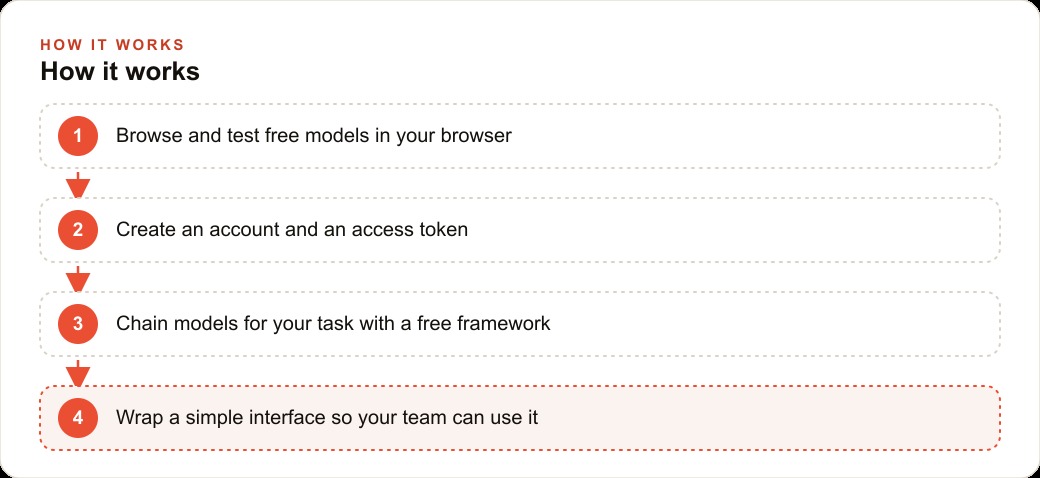
Hugging Face organizes its library around three components. The models section is where you browse by task type and test any model directly in your browser without installing anything. The datasets section holds the training data used to build models, which matters if you eventually want to specialize a model for your own context or domain. The spaces section shows finished applications built by others, which lets you see what a working implementation looks like before you build your own. That three-part structure means you can move from a business question to a working prototype without any investment beyond time.
The free hosted inference layer lets you call models from your code without setting up any infrastructure. It is rate-limited and runs at moderate speed, which is appropriate for testing and for low-to-moderate production volume. For higher volume or for situations where data privacy requires that nothing leave your own servers, you download the model and run it locally. That option is not theoretical. It is straightforward for any developer comfortable with a Python environment, and the same model that runs in the browser demo runs locally without modification.
The category of tasks where free models are functionally equivalent to paid ones is also the category that accounts for the majority of volume in most business AI workflows. Classifying incoming inquiries, extracting key fields from forms, summarizing long documents, generating first drafts, producing image descriptions: these are high-frequency tasks, and their unit economics look very different on a free model than on a per-token API at scale.
The chaining method is where free models become genuinely powerful
A single free model doing one task is useful. A chain of free models doing a sequence of related tasks is where the business value becomes genuinely compelling, because the combined output is something that would cost serious money to replicate with a paid API pipeline at meaningful volume.
Chaining passes the output of one model directly into the next as its input. You assemble modular components rather than asking one model to handle the full complexity of a multistep task. An image-to-story pipeline illustrates the structure cleanly: an image-to-text model describes a photo in accurate detail, a language model takes that description and writes a polished paragraph, and a text-to-speech model converts the paragraph into an audio clip. Three models, three distinct tasks, one coherent output, and none of the individual models costs anything at small business volumes.
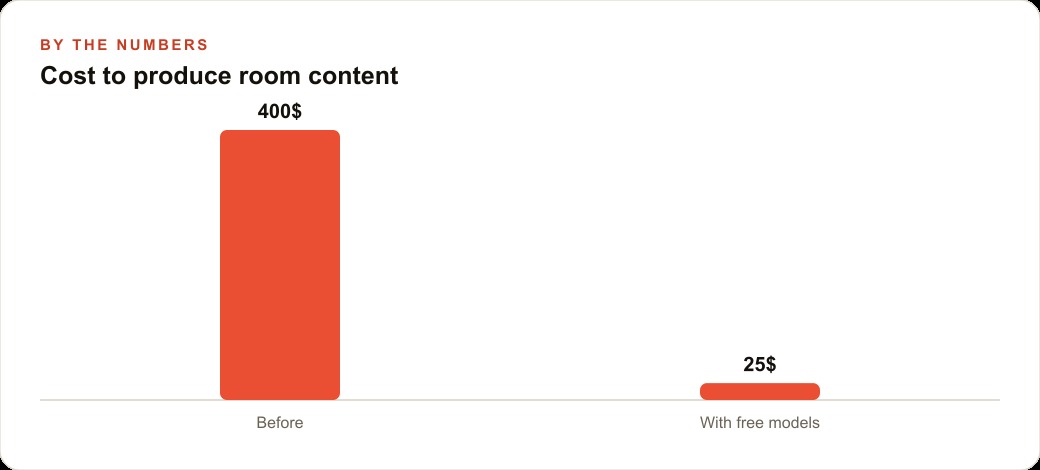
The property management company I use as the worked example here produces written descriptions for forty rental listings per month. Before the free-model chain, this cost eighteen dollars per listing in freelance copywriting, which is seven hundred and twenty dollars per month for a task that is largely formulaic: read the photos, identify the key features, write the description in a consistent voice that represents the property accurately. The chain handles this task for the cost of the compute required to run it, which at forty listings per month is negligible. The month-one saving against the freelance cost is roughly six hundred and ninety-five dollars. After twelve months, that is more than eight thousand dollars redirected from a recurring vendor relationship to internal capability that the business owns outright.
The chain for this use case has three stages. The first model reads each property photo and produces a detailed description of what is actually in the image: the flooring material, the quality of natural light, the kitchen layout, the outdoor space, the feel of the room as captured in the photograph. The second model takes that description and writes a warm, specific paragraph in the company's brand voice, one that emphasizes what a prospective tenant actually cares about without fabricating anything the photo does not show. The third model reads that paragraph aloud into a short audio clip the company serves on its listing page for visitors who prefer listening over reading. The property management team reviews and approves each output before it goes anywhere public. Nothing is automated past the point where a human sees the result.
The chaining approach also scales without a proportional increase in cost. Free models do not charge per token the way paid API models do. As output volume grows from forty listings to one hundred, the cost structure stays flat in a way that a per-token subscription does not. At high volume, the compounding advantage of flat-rate free models over metered paid APIs becomes the dominant factor in the build-versus-subscribe decision.
The same logic applies across industries. A real estate team producing descriptions for property listings, a retail operation generating product copy from manufacturer images, a media company converting long-form articles into audio, a legal practice summarizing incoming document packets: each of these is a chaining problem that maps directly to free models that already exist on the platform and can be tested in a browser before any commitment is made.
Testing in the browser before committing anything takes four minutes
One friction that keeps businesses from exploring free models is the assumption that evaluating a new model requires infrastructure setup, code, dependency management, and then finally getting to see whether the model is useful. That assumption is wrong from the first moment you open a model page on Hugging Face.
Every model has a hosted inference demo built directly into its page. You paste text, drag in an image, or type a prompt, and the model responds immediately in the browser without any account, without any code, without any setup. The demo is the model itself running on hosted infrastructure. The output you see in the browser is the output you get when you connect the model to your application through the API. There is no sandboxed demo version with different performance characteristics.
The correct evaluation process for a free model is to gather three or four real examples from your actual business data: real product photos, real customer messages, real documents you actually need to process, and then open the model page and test your examples. Look at the output. That process takes four minutes per model. If the output on your real examples meets your quality bar, you have found a model worth integrating. If it does not, you have spent four minutes and can move to the next candidate.
Most businesses skip the browser test and go straight to reading technical benchmarks and model cards, which do not answer the only question that matters for any specific use case: does this model handle my actual inputs well? Benchmarks measure performance on standardized test sets. Your business inputs are not standardized. The browser test answers the relevant question directly, with your real data, in four minutes.
The access token that lets your code call the hosted models securely is issued through a free account and should be stored as an environment variable in your application, not pasted into source code or committed to any repository. That is the only security consideration for most small business implementations, and it takes two minutes to set up correctly.
The model-specific documentation available on every model page covers what inputs the model accepts, the expected format, what the output structure looks like, and how to call it through the API. That documentation is thorough enough that a developer can build a working integration without reading anything beyond the model page itself.
What your business keeps when it stops outsourcing every AI task to a subscription
Beyond the direct cost saving, there is a structural difference in what your business controls when it uses free open-source models for a category of tasks, and that difference compounds in ways worth understanding explicitly.
When your workflow depends on a subscription, it depends on the vendor's pricing decisions, their uptime, their terms of service choices, and their decisions about which features belong in which tier. Provider changes have arrived with very little notice in recent cases, with power users discovering that the workflow they had been running for months was no longer covered by the plan they were paying for. When your workflow uses an open-source model running on Hugging Face's hosted infrastructure or on your own machine, those dependencies shrink considerably. The model does not change its pricing on a Friday evening. It does not move a feature to a higher tier. It operates the same way it did when you first tested it in the browser.
The data residency argument is real for any business handling sensitive content. An open-source model running locally never routes your customer data through an external server. For businesses in healthcare, legal services, finance, or any domain where data handling requirements apply, keeping model inference local is not a minor consideration. In many cases it is a determinative one, and the combination of zero cost and full data control makes local open-source models structurally more appropriate for sensitive high-volume work than any external subscription regardless of price.
The capability development argument is equally real. Every time your team works with a model, tunes a chain, evaluates output quality, and improves the configuration, they build working knowledge of how AI models behave inside business workflows. That knowledge compounds. A team that has built and refined three free-model chains understands model behavior in practice better than a team that has used a paid subscription as a black box for the same period, and that understanding accelerates every AI project that follows.
The businesses that put this to work most effectively tend to treat it as part of a broader approach to content and operational automation across their SEO and organic search and their CRM and website stack, where the volume of routine language tasks is high and the share of that volume that genuinely requires frontier-level reasoning is a small fraction of the total. Routing the high-volume routine work to free models and reserving paid capacity for genuinely hard reasoning is a cost structure that scales better than a single paid subscription covering everything uniformly.
The argument is not that paid frontier models have no place. It is that the category of tasks that actually requires them is narrower than most businesses currently assume, and the cost of finding exactly where that line is happens to be four minutes in a browser with your own real data.
That is exactly what we do at AI DOERS. Book a private 30-minute call with Madhuranjan Kumar and we will map the fastest path to it for your specific business.
Book your call →
Madhuranjan Kumar
Madhuranjan Kumar brings 20 years of performance-marketing experience and has managed over $200 million in Facebook ad spend for brands across the United States and beyond. His expertise spans the full modern marketing stack: Meta, Google Ads, TikTok, email automation, CRM, and the websites that hold it together. At AI DOERS he turns that track record into lead-generation systems for businesses across every industry.