
How Web Scraping Gives AI Agents 100x More Power
Web scraping turns websites into structured data your agent can act on, and installed as an agent skill it lets tools like Claude Code generate leads, run competitor analysis, and pull data from even hard sites in plain English for a few cents per run.

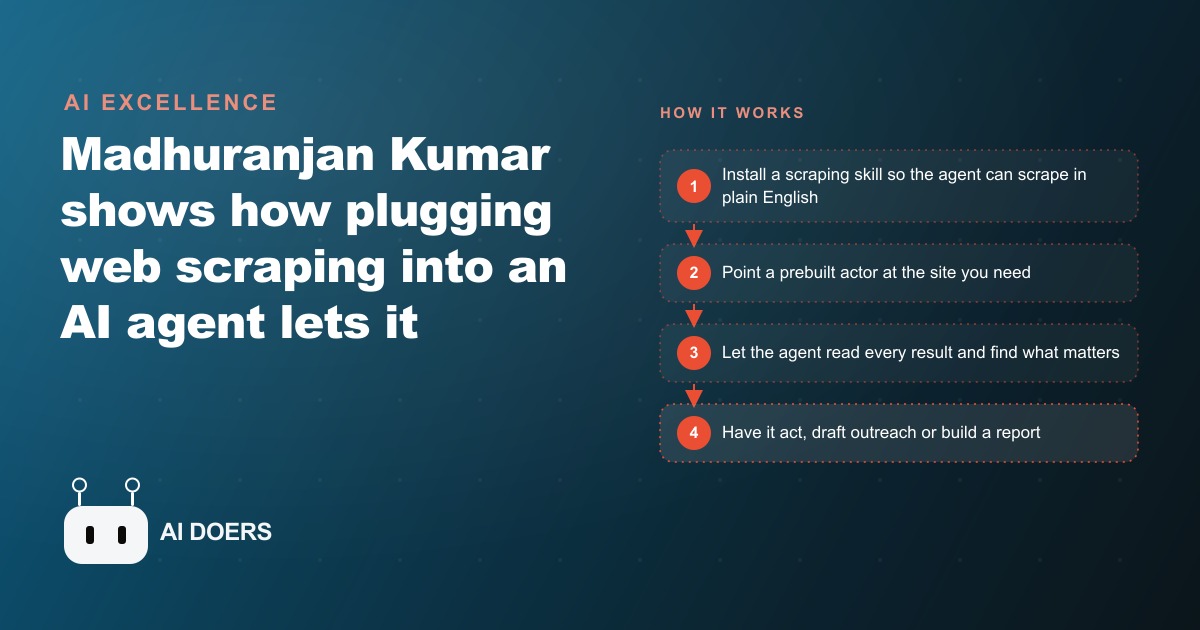
There is a quiet gap between what people think an AI agent can do and what it can actually reach. Ask a fresh agent to research your competitors and it will confidently write a summary built on nothing, because the sites it needs are the very sites that lock agents out. Close that gap and the same agent turns into something close to a full-time analyst. That gap has a name, and the name is data. I am Madhuranjan Kumar, and I want to make the argument that web scraping, unglamorous and often ignored, is the single upgrade that gives an agent real leverage over a small business's market.
Start with the honest limitation. A raw language model is smart but blind. Hand it a link and it often fails to read the page, and the places your customers actually gather, the review sites, the social platforms, the maps listings, actively try to block automated visitors. So the agent improvises, which is a polite word for making things up. The fix is not a smarter model. It is a scraper, a tool whose only job is to pull information off a website and hand it back as clean, structured data. Once the agent can see, everything downstream changes.
Data alone is worthless until something acts on it
Here is the part most people get backward. Scraping is only half the machine, and it is not even the important half. A spreadsheet of a thousand reviews sitting in a folder does nothing for anyone. The value appears the moment an agent reads all thousand of them in seconds, finds the pattern a human would miss, and then does something with it, drafts the outreach, updates the sheet, fires the alert. Collection plus action is the whole idea. The scraper is the eyes and the agent is the hands, and a business only feels the benefit when both move together. Keep that framing and the rest of this makes sense. Lose it and you end up with a data-hoarding hobby.
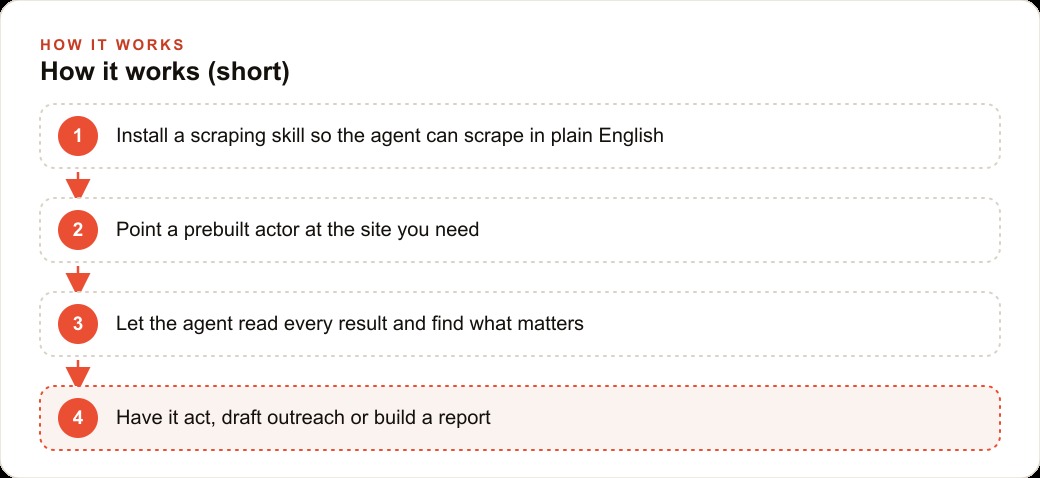
The mechanics have gotten almost embarrassingly simple. You install scraping as a skill, a small set of standing instructions the agent loads, and after that you describe what you want in plain language and never write scraping code. The scrapers themselves are reusable programs. Each one takes a structured input, runs a task, and returns tidy data, and there are thousands of them already built for maps, social platforms, review sites, and nearly anything else you can name. You are not building infrastructure. You are pointing existing tools at the sites you care about and letting the agent narrate the results back to you.
The runs are cheap enough to feel like a rounding error
Cost is where skeptics expect the catch, and there really is not one. In one walkthrough the agent scraped the top twenty coffee shops in a city, names, ratings, review counts, and addresses, into a spreadsheet for roughly nine cents in under two minutes, work that would eat an hour by hand. A competitor pass pulled over a thousand reviews across rivals from a review site for about two dollars, then mapped what customers praise and what drives the one-star complaints. A final test scraped one of the hardest sites on the internet for high-engagement posts and built a filterable swipe file from what came back. What struck me most was not the price. It was that the agent solved problems on its own, pivoting its search when it hit a dead end and chaining one scrape into another, finding competitors first and then scraping their reviews, without being told to.
Competitor review analysis is the play almost nobody runs
If I could get a local business to do one thing with this, it would be reading its competitors' reviews at scale, because it is the highest-value use that almost no one bothers with. Your rivals have already collected years of brutally honest feedback from your shared customer base, and it is sitting in public. An agent can pull all of it, then tell you exactly what people love and, more usefully, the specific failures, missed appointments, warranty fights, slow callbacks, that produce the angry one-star reviews. That is not vague market research. That is a list of gaps you can attack in your own service and your own messaging. The uncomfortable truth is that none of your competitors are doing this, which is precisely why doing it hands you an edge that money alone cannot buy.
A worked example: a roofing company points the agent at two jobs
Let me ground this in one business, with illustrative numbers. Picture a roofing company with a good crew and a thin pipeline, competing in a metro full of look-alike roofers. I would aim the scraping agent at exactly two things, finding work and understanding the competition, because those are the two problems that actually move revenue.
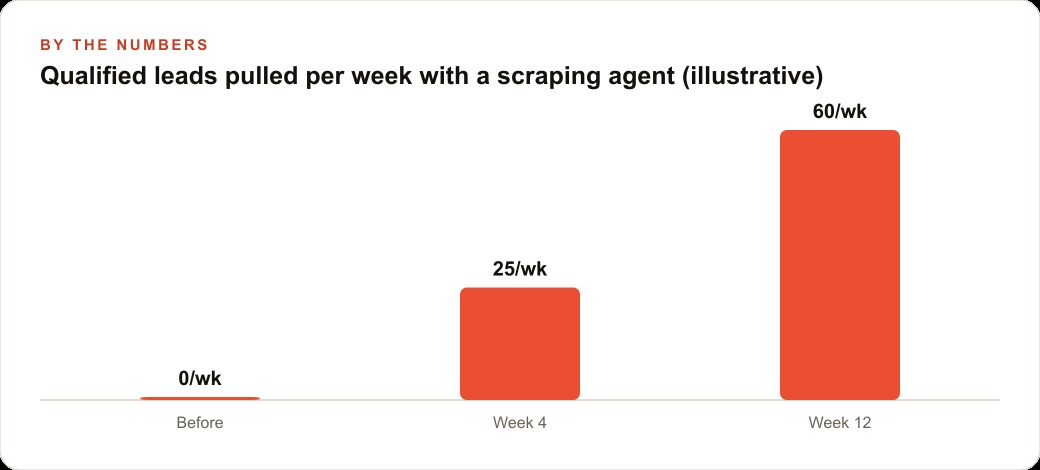
For finding work, the agent scrapes local property directories, business listings, and recent storm or permit activity, then assembles a list of likely prospects with addresses and contact details, dropped into a spreadsheet ready for outreach. What used to be an afternoon of manual searching becomes a two-minute run, and because the agent reads every row it can rank the list by how good a fit each prospect looks. Say that turns up sixty qualified names in a week where the owner previously scraped together a handful. Those names do not just sit there. They feed the CRM and website stack where follow-up automation works the next several touches, and the best of them can be layered into a targeting list for Facebook and Instagram ad campaigns so the paid spend chases people who already fit.
For the competition, the agent scrapes reviews of every other roofer in the area from the major review sites, then surfaces the praise and the recurring complaints. Suppose the pattern is obvious: rivals lose stars over slow callbacks and messy cleanup. That single insight rewrites the company's whole pitch, faster response and spotless sites, and it sharpens the copy across Google Ads and the website at the same time, because now the messaging answers a real, documented frustration instead of a guess. When the agent built a small web app to display its findings and it loaded empty, the fix was simply to hand it a screenshot and tell it to debug, a reminder that showing an agent what you see is one of the fastest ways to get it unstuck. And every one of these scrapes can be scheduled to run daily, so the lead list and the competitor picture refresh themselves while the owner is up on a roof.
Freshness is the multiplier nobody accounts for
A one-time scrape is useful. A scheduled scrape is a different kind of asset entirely, and this is the part most people never set up. Markets move, competitors change their pricing, new reviews land every week, and storm or permit activity shifts by the day. A snapshot you pulled last month is already decaying. When the scrapes run on a schedule, hourly or daily, the lead list and the competitor picture refresh themselves, and the agent works from a live view of the market rather than a stale photograph. That freshness compounds. A prospect list that updates itself catches new movers before the competition does. A competitor tracker that refreshes daily tells you the moment a rival raises prices or starts collecting a wave of angry reviews, which is exactly when your outreach should lean in. The difference between a one-time run and a scheduled one is the difference between a fact you once knew and a system that keeps knowing.
Scheduling also changes the economics in your favor. If a full competitor pass costs a couple of dollars, running it daily is a rounding error against the value of catching a shift early, and running it weekly costs less than a single coffee. The point is not to hoard data. It is that a steady, cheap flow of current market intelligence lets you act on timing, and timing is where a lot of local sales are actually won and lost.
The unfair advantage is that almost nobody bothers
I want to close the loop on the strategic argument, because it is the real reason I care about this. The techniques here are not secret and the tools are not expensive. What makes them an edge is simply that your competitors are not using them. None of them are pointing agents at the market to read every review and rank every prospect, because it sounds technical and they assume it is someone else's job. That assumption is the opening. When you are the only roofer, or the only clinic, or the only shop in your area operating from a current, structured read of the whole market while everyone else works from gut feel and last year's impressions, you are not slightly ahead. You are playing a different game.
This is why I frame scraping as leverage rather than a gadget. Leverage is when a small, cheap input produces an outsized output, and a few dollars of scraping that reshapes your entire outreach list and your entire message is exactly that. The businesses that internalize this will keep pulling further ahead, not because they are smarter, but because they are the only ones bothering to look. And the more of your competitors keep ignoring it, the longer that gap stays open, which is not a situation that lasts forever once a market wakes up.
The stack is a system, not a single trick
It helps to think of what you are building as a small pipeline rather than a one-off. Collection feeds analysis, analysis feeds action, and action feeds a feedback loop where the results tell you what to collect next. A roofer who scrapes leads, ranks them, reaches out, and then scrapes the outcomes to learn which neighborhoods actually convert is running a self-improving loop, not a chore. That loop is what turns a clever demo into a durable advantage, and it is why the setup effort is worth it. You are not automating a task. You are installing an engine that gets a little smarter every week it runs.
Start with the highest-value question, not the flashiest one
If you are going to do only one thing with a scraping agent, make it competitor review analysis, because it returns the clearest, most actionable picture for the least effort. Naming your competitors is easy. Naming the sites your customers gather on is easy. Once you have those two lists, one scheduled scrape and one prompt to the agent gives you a living map of what your market loves and what it complains about, and that map informs everything downstream, your service priorities, your ad copy, your website messaging, your follow-up scripts. Lead generation is the tempting first project because it feels like immediate money, but leads without a clear message convert poorly. Understanding the market first sharpens the message, and a sharp message makes every lead you generate afterward worth more. So the order I recommend is intelligence before outreach: learn the market, fix the message, then turn on the lead engine. That sequencing is the difference between a scraping setup that quietly compounds and one that produces a pile of unconverted names. It costs a few dollars to find out what your entire market is trying to tell your competitors, which is one of the best returns on a small spend a local business can find.
One safety habit that is not optional
None of this is safe if you are careless with keys. The single non-negotiable habit is keeping your API token out of any code you might share or publish, which means keeping your environment file out of version control, and you can even ask the agent to harden that ignore list before you push anything. Treat the token like the password it effectively is. Do that and the scraping-plus-agent stack becomes a low-cost, low-risk engine for leads and research rather than a leak waiting to happen.
The pieces are cheap and the payoff is large, but I will not pretend the wiring is nothing. Installing the skill, choosing the right scrapers, and turning raw data into action all take some setup and some judgment about what is worth collecting. You can follow the path above and build it yourself over a weekend, or if you would rather have a lead-generation and competitor-intelligence agent built around your specific market and handed over already running, that is exactly the kind of system I set up for clients. The strategic point stands either way. The businesses that pair collection with action will simply understand their market better than the ones still copying and pasting by hand.
That is exactly what we do at AI DOERS. Book a private 30-minute call with Madhuranjan Kumar and we will map the fastest path to it for your specific business.
Book your call →
Madhuranjan Kumar
Madhuranjan Kumar brings 20 years of performance-marketing experience and has managed over $200 million in Facebook ad spend for brands across the United States and beyond. His expertise spans the full modern marketing stack: Meta, Google Ads, TikTok, email automation, CRM, and the websites that hold it together. At AI DOERS he turns that track record into lead-generation systems for businesses across every industry.