
How to Wire an AI Agent to Trade Autonomously on Hyperliquid
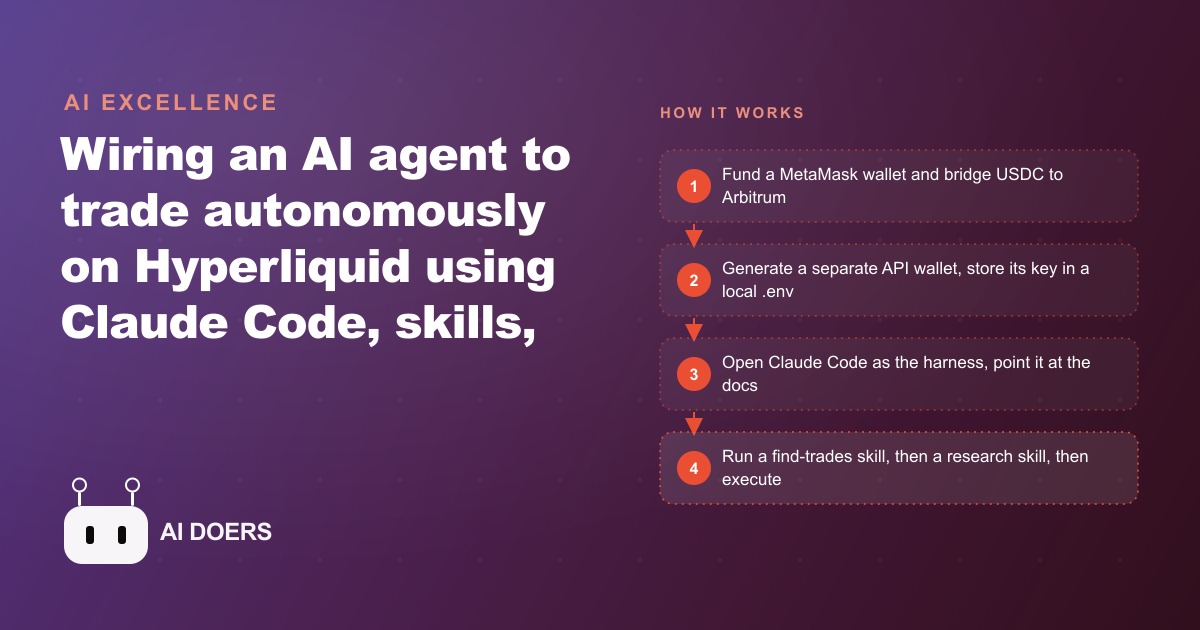
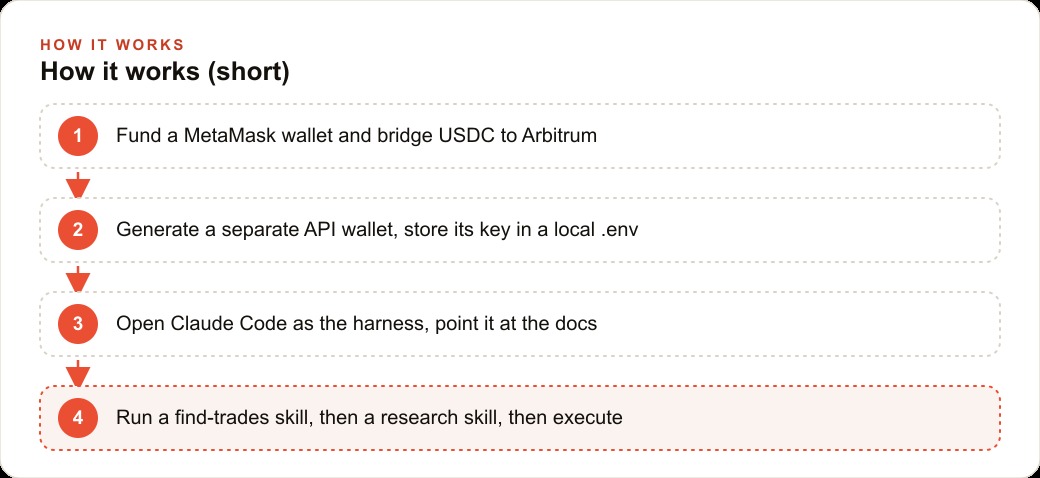
Fund a MetaMask wallet with USDC on Arbitrum, generate a dedicated API wallet whose key lives in a local .env, then use Claude Code as a harness running two skills that find, research, and execute trades. The pattern behind it works for any business that wants an agent to research then act.

What it actually takes to wire an AI agent to a live trading API
The distance between "an AI agent that trades" as a concept and an AI agent that actually places real orders through a live API is larger than most people expect, and smaller than most people fear. The practical details of connecting Claude Code to Hyperliquid's trading infrastructure reveal both the architecture that makes autonomous trading agents possible and the specific decisions that determine whether that architecture is useful or dangerous.
I am Madhuranjan Kumar, and I want to walk through how this kind of system is built at the level of what each component actually does and why, rather than at the level of what it conceptually promises.
The account architecture that keeps agent actions separate from main funds
The first structural decision in building any AI trading agent is wallet and account isolation. Giving an AI agent direct access to a main trading account creates a risk profile that most rational operators would not accept: a single misbehaving instruction or a misunderstood market condition could affect the entire account balance.
Hyperliquid's architecture includes the concept of an agent wallet, which is a separate wallet specifically designed for programmatic trading. The agent wallet has its own private key, its own address, and its own set of permissions. The main account retains control over how much funding the agent wallet can access and what operations it can perform. If the agent behaves unexpectedly, the exposure is limited to what the agent wallet holds.
The operational setup for the agent wallet involves connecting a MetaMask wallet to Hyperliquid, bridging USDC onto the Arbitrum network for the account's funding, keeping a small amount of Ether in the wallet for gas on any bridging operations, and then generating the agent wallet separately under the API settings in the Hyperliquid interface. The private key for the agent wallet goes into a local environment file. It never appears in the code. It is loaded at runtime through environment variables that the code reads without exposing the value in any log or output.
Why environment variables matter more than they seem
The practice of storing credentials in environment variables rather than hardcoding them in source code is treated as obvious by experienced developers and as a minor technicality by everyone else. In the context of an AI agent that has code-writing capabilities, it becomes more important, not less.
An AI agent that builds and modifies its own code, which is what Claude Code does, can inadvertently expose a credential that was hardcoded in an early version of the code even after the code has been changed. If the credential was in a version of the code that was logged, committed, or shared as an example, the exposure occurred regardless of what the current version of the code looks like.
Environment variables prevent this by keeping the credential entirely outside the code. The code references the variable name. The value lives in the local environment, loaded at runtime. No version of the code, no log output, and no shared example can expose the credential because the credential is never in the code to begin with.
For an AI trading agent, the relevant credentials are the agent wallet private key, the agent wallet address, and the Hyperliquid API endpoint. All three go into the environment file, and the environment file is excluded from any version control or sharing.
The Claude Code orchestration layer and what it can do that a script cannot
Claude Code sits at the center of the trading architecture as an orchestrator rather than as a hardcoded strategy. This distinction matters because a hardcoded trading strategy is a fixed set of rules that runs until it is rewritten. A Claude Code orchestrator receives natural language goals and constructs strategies from those goals, adapting its approach based on current market conditions and the feedback it receives from its own executions.
In practice, the Claude Code layer does several things a fixed script cannot. It can read and interpret current market data and produce a human-readable analysis of what that data suggests. It can propose multiple trade setups based on a persona or goal description and rank them by conviction. It can research a specific trade idea using external sources, including web browsing tools that pull in current news or community discussion, before recommending execution. And it can execute the recommended trade through the Hyperliquid API with the risk parameters that the persona specifies.
The persona is a specific mechanic worth understanding. Defining the agent's behavior through a persona description, with explicit parameters for risk tolerance, conviction thresholds, and types of setups to pursue, shapes how the agent interprets market data and which opportunities it proposes. A persona that specifies a high risk tolerance and a FOMO-sensitive approach will propose different setups than one that specifies low risk tolerance and requires strong fundamental backing. The persona is not a metaphor. It is a specification for the agent's decision-making behavior.
The parallel sub-agent architecture for opportunity sourcing
The find-trades capability in the demonstrated system fires six sub-agents simultaneously rather than having a single agent scan the market sequentially. Each sub-agent looks at the available assets and market conditions through a different lens, applying the persona's filters independently, and returns its highest-conviction idea. The orchestrating agent then reviews the proposals from all six sub-agents, compares them against the persona's criteria, and selects the one that best fits the goal.
The value of this parallel architecture over a sequential scan is speed and coverage. A sequential agent that considers one asset at a time produces its final recommendation after working through the full set. A parallel architecture produces its final recommendation after the slowest sub-agent finishes, which in a parallel system is the same as the time it takes to run one sub-agent once. At scale, across hundreds of potential trade setups, the parallel approach produces a recommendation in a fraction of the time the sequential approach would require.
The parallel architecture also reduces the influence of order on the final recommendation. A sequential agent that encounters an attractive setup early in its scan may anchor to that setup in ways that make it more likely to select it over setups it encounters later. Parallel agents evaluate their candidates independently, and the selection happens after all evaluations are complete.
The research step that grounds execution in current information
Before the agent executes the setup selected by the sub-agent process, a research skill fires a browser-based investigation. The research skill takes the proposed trade, identifies the asset and the direction, and searches for current information that would support or undermine the setup. Sources include Reddit community discussion, options flow data, current news, and prediction market prices on platforms like Polymarket.
The research step is the point where the agent's autonomy is most constrained in the demonstrated system. The agent does not execute immediately on the sub-agents' recommendation. It researches the recommendation first, and the execution decision is conditioned on whether the research supports the setup. If the current news directly contradicts the directional thesis, the research step surfaces that contradiction before execution rather than after.
For a business operator who is running this system as an investment in infrastructure learning rather than as a primary income strategy, this research step is also the step that is easiest to override manually. The operator can review the research output, which reads as a plain-language report on what the agent found, and make the final execution decision before the API call is placed.
The executed trade and what actually happened
In the demonstrated case, the sub-agent process selected a short position on Nvidia. The research step supported the setup based on the current market context. The agent executed through the Hyperliquid API by placing a leveraged short position using the agent wallet. The operator then closed the position manually immediately after observing the execution, treating the execution as proof of concept rather than as the opening of a live speculative position.
The immediate closure was the appropriate response for a first live test. The purpose of the test was to confirm that the full pipeline, from market analysis through research through API execution, worked as designed. It did. The position was opened and closed within seconds of the execution confirmation, limiting the exposure to the price movement in that window.
This pattern, building the infrastructure completely and then testing it with a position that is closed immediately, separates the infrastructure validation from the actual trading decision. The infrastructure either works or it does not. That question can be answered with zero market risk if the position is closed before any material price movement occurs. The trading question, whether the agent's strategy actually produces positive returns over time, is a separate question that requires actual market exposure to answer.
The broader implication for agentic systems in non-trading contexts
The architecture of this trading agent, with its isolated credentials, its parallel sub-agent sourcing, its research-before-execution design, and its Claude Code orchestration layer, is not specific to trading. The same structural patterns apply to any agentic system that takes consequential actions in a live environment.
The principles transfer directly. Isolated credentials with limited permissions reduce the blast radius of any single failure. Parallel agents that source options before a central agent selects among them produce more robust recommendations than sequential approaches. A research step that grounds the agent's decision in current information before acting prevents the kind of confident-but-outdated execution that makes autonomous agents unreliable. And Claude Code as the orchestration layer makes the agent's behavior adjustable through language rather than through code changes.
For a business operator building autonomous systems that take real actions, whether those actions are placing orders, sending communications, or modifying records, these structural choices determine whether the system is one that builds trust through reliable bounded behavior or one that creates risk through unbounded autonomy. The trading agent case makes these choices visible because the consequences of a wrong execution are immediate and measurable. That visibility is what makes it a useful case to understand even for operators whose automation work has nothing to do with financial markets.
Setting the persona as a behavioral specification
The persona mechanism in this agent system is worth dwelling on because it represents a different approach to shaping AI behavior than prompt engineering on individual requests. A traditional prompt engineering approach would add instructions to each individual trading request: "analyze Nvidia, consider momentum, prefer short-duration positions, set stops at three percent below entry." Those instructions apply to one request and must be repeated or varied for each subsequent request.
A persona is a persistent behavioral specification that applies across all requests without being repeated. When the persona specifies a 96 risk tolerance, an appetite for high-frequency setups, and a pattern of prioritizing momentum over fundamentals, those specifications shape every trade the agent proposes, without the operator needing to include them in each individual prompt.
The persona approach has a specific advantage in agentic contexts where the agent makes many small decisions that are too granular to specify individually. The persona shapes the agent's behavior across the full space of decisions it makes, not just the specific decisions that the operator can anticipate in advance. For a trading agent that encounters novel market conditions that the operator did not specifically anticipate, the persona provides the behavioral context that determines how the agent responds.
This same approach applies to non-trading agentic contexts. A customer service agent can have a persona that specifies how empathetically it responds to frustration, how escalation-averse it is, and how much latitude it gives on standard policies. A content agent can have a persona that specifies the voice, the acceptable level of directness, and the topics it avoids. In each case, the persona shapes the behavior across the full space of decisions the agent encounters rather than only the specific cases the operator anticipated.
What a small-scale automated trading infrastructure actually costs to run
For a business owner evaluating whether to build something like this as an infrastructure investment, the cost picture is worth stating explicitly. The Hyperliquid account requires funding with USDC, which is the operator's own capital. The agent wallet can hold a small fraction of the total account, sized to the risk the operator accepts for infrastructure testing. In the demonstrated case, the position size was small enough that the cost of the test was the gas fee for the bridging transaction, a few dollars, plus the market exposure during the seconds the position was open.
The Claude Code orchestration layer has a credit cost per execution that depends on how many sub-agents run and how much research each conducts. A full pipeline run with six parallel sub-agents and a web-browsing research step costs on the order of a few cents in API credits. At a frequency of one pipeline run per day for testing purposes, the monthly infrastructure cost is negligible.
The fixed cost is the time to build and understand the system, which the demonstrated walkthrough suggests is in the range of a concentrated weekend for someone who follows the architecture closely and has the prerequisite familiarity with Claude Code. That time investment produces infrastructure that can be extended, modified, and redeployed across different assets, personas, and market conditions, making it a foundation rather than a one-time expense.
The appropriate mental model for this kind of infrastructure is not as a path to passive income from day one. It is as a technical foundation for understanding how AI agents interact with live APIs in a domain where the feedback from errors is immediate and unambiguous. That feedback quality makes financial market agent development a more reliable learning environment than many other domains for building intuition about where autonomous agents work reliably and where they require more human oversight.
That is exactly what we do at AI DOERS. Book a private 30-minute call with Madhuranjan Kumar and we will map the fastest path to it for your specific business.
Book your call →
Madhuranjan Kumar
Madhuranjan Kumar brings 20 years of performance-marketing experience and has managed over $200 million in Facebook ad spend for brands across the United States and beyond. His expertise spans the full modern marketing stack: Meta, Google Ads, TikTok, email automation, CRM, and the websites that hold it together. At AI DOERS he turns that track record into lead-generation systems for businesses across every industry.