
How to Turn LinkedIn Into a Lead Magnet With AI in 2026
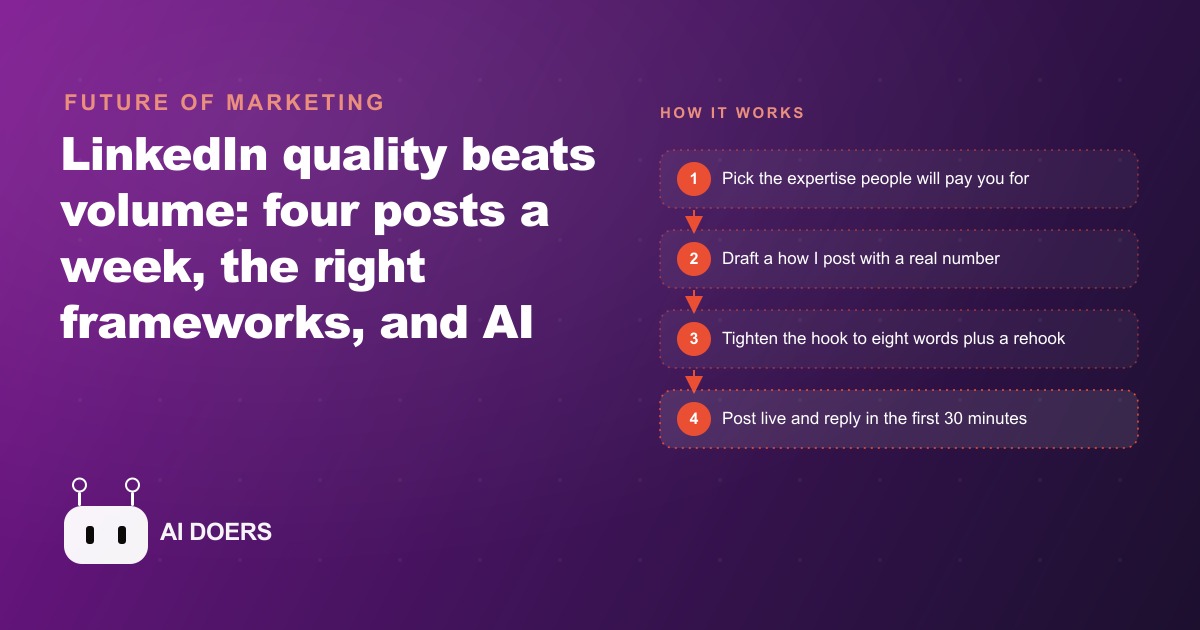
You win on LinkedIn with quality over volume. Post about four times a week using your monetizable expertise, lead with how I instead of how to, and use AI to draft from your own material rather than churn out generic slop.

The AI Slop Flood Is Not Your Competition, It Is Your Moat
I want to make an argument that most LinkedIn advice right now gets exactly backwards. Every marketing newsletter, every creator coaching account, every podcast covering personal branding is treating the AI content flood as a threat to organic reach. I think the opposite is true. The AI slop flood on LinkedIn is, right now, the single most valuable competitive advantage available to any professional or business owner willing to write from actual experience. The flood everyone is worrying about is precisely what makes quality content worth more than it has been in years.
The mechanism is straightforward. When the feed is dominated by posts that could have been written by anyone with a prompt, the scarcity value of a post that could only have been written by one specific person rises sharply. Generic content has flooded the supply side. Specific, lived, particular content has become rarer in proportion. The reader's brain, which filters fast, has been trained by months of slop to stop on specificity and scroll past generic competence. That learned filter is your opportunity, and the window is open because the playbook has not yet spread widely enough to close it.
The window will close. That is the urgency underneath this argument. As more people learn the right frameworks and the tools for producing quality LinkedIn content improve, the comparative advantage compresses. The time to build the following is before the crowd finds the strategy.
Generic How-To Posts Are Now Indistinguishable From AI Output, and Readers Know It Immediately
The signature of AI-generated LinkedIn content is the how-to post that applies equally to every person in the world. "How to build a LinkedIn following." "How to write hooks that stop the scroll." "How to position yourself as an authority in 2026." These posts are grammatically correct, formatted correctly, contain reasonable advice, and are completely forgettable. The reader's brain processes them as ambient noise and moves on because there is no specific detail to stop on.
I notice this in my own reading. I can tell within the first sentence whether a post came from someone's actual experience or from a language model's training data. The tell is never grammar or spelling. The tell is the absence of a real number, a named situation, an outcome that is too particular to have been invented. "How to spot a roof problem before it becomes an expensive repair" is a post any chatbot can produce from five seconds of prompting. "How I found a hidden leak on a 14-year-old shingle roof before it cost the homeowner nine thousand dollars in interior water damage" is a post that only the person who was on that roof can write.
The second post stops the scroll because the reader instantly recognizes it as true. The age of the roof, the dollar figure, the specificity of the claim: these signal genuine experience, and that signal is now rare enough in the feed that it carries disproportionate weight. The algorithm responds the same way. Early engagement in the first 30 minutes after a post goes live is the primary signal LinkedIn uses to decide how broadly to distribute it. Specific, lived posts earn real replies because people recognize them as authentic. Generic posts earn passive scrolls and performative likes. Early real engagement drives distribution. Early performative engagement does not.
LinkedIn Gives New Creators a Structural Distribution Boost That Most People Waste Entirely
There is a well-documented but little-exploited behavior in how LinkedIn handles posts from newer or returning accounts. The platform wants to retain creators, so it gives early posts a disproportionate push to encourage continued posting. This boost is most pronounced in the first several posts from a new or reactivated profile and gradually normalizes as the account establishes its posting history.
The implication is significant. The moment you start or restart a posting habit is the moment the platform is most willing to distribute your work to people who do not already follow you. Most people who start LinkedIn posting use this window on safe, generic content because they are still experimenting with formats. If you understand the structure, the right move is to use your first posts for your sharpest how-I content, with your best specific numbers and your clearest framing. You are posting at the moment the algorithm is most interested in showing your work to new audiences, and that moment is narrow.
The analogy I keep returning to is opening week for a new restaurant. Local curiosity and first-timer traffic will never be higher than in the first week. A restaurant that opens with a limited version of its menu that does not represent its best work wastes the one moment when the highest proportion of first-time visitors are forming their lasting impression. A LinkedIn creator who uses early posts on general industry news or reposts of others' content wastes the most generous distribution window the algorithm will ever offer.
Four Posts a Week Compounds in a Way That Fifteen Posts a Week Never Does
I have watched accounts grow from zero to over 300,000 followers on roughly four posts a week, held consistently for three years. No viral moments. No daily grind. No strategy more complicated than four posts a week with at least one specific number and one element that required firsthand experience to produce. The growth compounded because quality posts attract followers who match the ideal customer profile, and each new follower raises the floor of engagement on the next post.
The reason four beats fifteen is counterintuitive but consistent. Producing fifteen posts a week from genuine lived experience is not possible for most people who are also running a real business. The volume forces a quality compromise. Once quality drops below the specificity threshold, each post earns less early engagement, which reduces the algorithm's distribution, which reduces total reach per post. Fifteen mediocre posts with suppressed distribution often reach fewer total people than four quality posts with strong distribution.
Four posts a week is also sustainable for someone who has an actual business to maintain. It leaves enough time to write each post carefully, to count the words in the opening lines, and to reply to every comment in the first 30 minutes after publishing. The accounts that built the largest professional LinkedIn audiences over the past three years almost universally post at a similar cadence, not because a formula dictates four, but because four is the rate at which quality holds across a full calendar year.
The Eight-Word Hook Is a Survival Mechanism, Not a Copywriting Formula
On mobile, where the majority of LinkedIn reading happens, the platform shows two lines of text before cutting to a "see more" link. The reader decides whether to click through or scroll past based entirely on those two lines. If the first two lines are long sentences that run past the visible area, the reader makes that decision with incomplete information. If the first two lines total roughly eight words and deliver a complete thought, the reader decides from the full picture.
I count the words in every hook I write, not as a rigid rule but as a check on whether I have trimmed enough. First drafts almost always have opening lines that run long because writing is naturally expansive before editing. The discipline of counting is what converts a first draft hook into something that works on the screen where most people actually read.
The rehook second line is the mechanism that earns the click. The first line states something specific or provocative. The second line answers "so what" in a way that creates just enough curiosity to make clicking worth the effort. Together these two lines make the argument that this post deserves two minutes of attention over the next one in the feed. They are not decoration. They are the decisive moment that determines whether the post earns a reading or a scroll.
For the roofing example: the first line might be "This roof looked fine. It was not." Eight words. Provocative. Complete. The second line: "Here is what the inspector missed and what it almost cost." That rehook earns the click because it promises a specific answer to a question the homeowner now has.
Wins Framed Around What Others Gained Convert Better Than Wins About Your Own Achievement
A post about helping a family avoid a costly surprise earns far stronger engagement than a post about your own expertise or credentials. The mechanism is projection. Every homeowner reading about a nine-thousand-dollar repair that was caught in time can imagine that repair not being caught. They experience the post personally rather than observing it from outside. A post that celebrates your own skill keeps the reader at arm's length. A post about what the outcome meant for someone else pulls the reader into the story.
This is what the humble brag framing actually does when it works. It is not about being modest about real achievements. It is about choosing the angle of the story that connects the reader to the outcome rather than positioning you at the center of it. A roofing company that posts about protecting a family from an expensive winter surprise builds more trust with every local homeowner who sees it than the same company posting about its years of experience and its certifications. The certifications matter. They are just not what earns the emotional engagement that drives inbound conversations.
The practical test before posting a win: ask whether the post makes the reader feel something about themselves or just think something about you. If the answer is the latter, rewrite from the outcome's perspective.
Trend Jacking and Authority Jacking Both Work Because LinkedIn Runs on a One-Week Delay
LinkedIn's audience is professionals checking a work-adjacent platform rather than people who live in fast-moving online communities. News cycles reach LinkedIn roughly one week after they peak on Twitter and Reddit. When a major industry development breaks, the first wave of reactions appears on fast-moving platforms within hours. The LinkedIn wave comes days later.
This creates a repeating window every week. If I post about a significant development on the day it breaks, I am early on LinkedIn even if I am late everywhere else. I am posting into a feed where the topic is just beginning to surface, facing less competition per post, and earning early-mover distribution while others are still writing their takes. An account I watched closely hit 2,000 likes on a single post about a Reddit stock headline, not because the person was first on the internet but because they were among the first on LinkedIn specifically.
Authority jacking follows the same logic. Tag a known figure in your field when they will genuinely engage with the mention, and their response surfaces your post to a portion of their audience. The hard rule is to tag only when you have a real reason to expect engagement. An ignored tag tells the algorithm the mention was not meaningful enough to earn a response, and enough ignored tags quietly reduce the reach your future mentions earn. Tag collaborators, suppliers, or satisfied customers who have a genuine reason to respond. Skip prominent figures with no particular relationship to your work.
The SLAY Framework Turns Your Specific Situation Into a Repeatable Post Structure
The frameworks I rely on most for writing LinkedIn posts that convert are the ones that force me to stay specific throughout rather than drifting toward the generic by the third paragraph. The one I come back to most builds through four moves: start with a story, lead with a lesson, give one piece of actionable advice, and end with a question for the reader.
The story earns attention with a specific outcome and a real number in the first two lines. The lesson draws the transferable insight that makes the story worth reading for someone who does not have the exact same situation. The actionable advice is the one concrete thing a reader can do differently this week as a result of reading the post. The question at the end invites a reply, and replies in the early minutes after posting are what drive distribution.
Where AI genuinely helps in this structure is at the middle steps. I bring the story and the specific number from my own experience. I then ask AI to suggest several different ways to frame the lesson, or several actionable advice items drawn from that same story. AI is useful as a generator of options at the layer where multiple framings are plausible. It is not useful as a replacement for the story or the number, which are the only parts of the post that create real credibility. The slop flood is made entirely of content where someone delegated those parts to AI as well, which is exactly why your content stands out when you do not.
The Window Closes as the Playbook Spreads, Which Is Why Starting This Week Matters More Than Next Quarter
The advantage I have described is real and time-limited. The AI slop flood creates conditions where quality content stands out more dramatically than it did before the flood. Those conditions persist as long as most creators do not know the mechanics that separate quality from generic. Both conditions are changing, and the advantage compresses as more people find the blueprint.
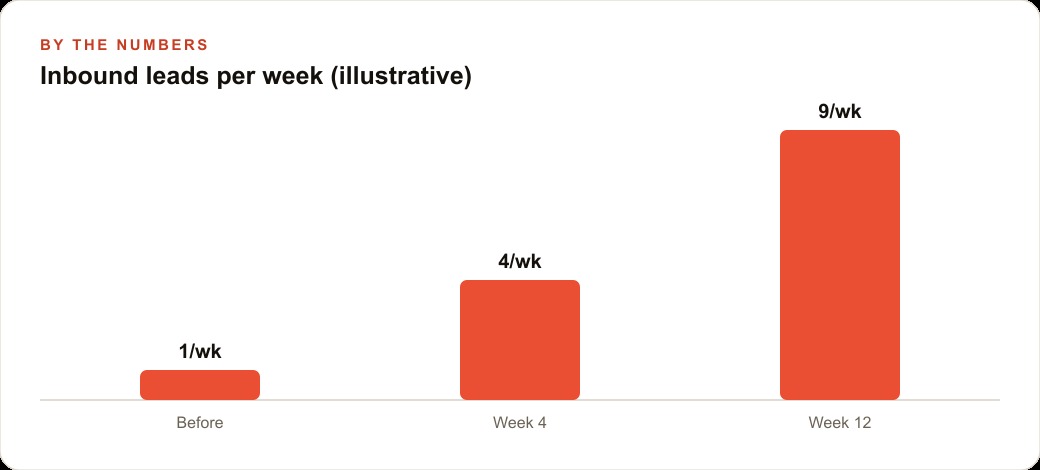
Every week of consistent quality posting compounds in one direction: more followers, more authority signal, more inbound conversations that required no outreach. An account with twelve months of consistent posting behind it faces fundamentally better economics on each new post because the existing follower base amplifies it from the moment it goes live. An account starting today faces more competition than one that started six months ago, but less competition than one starting six months from now.
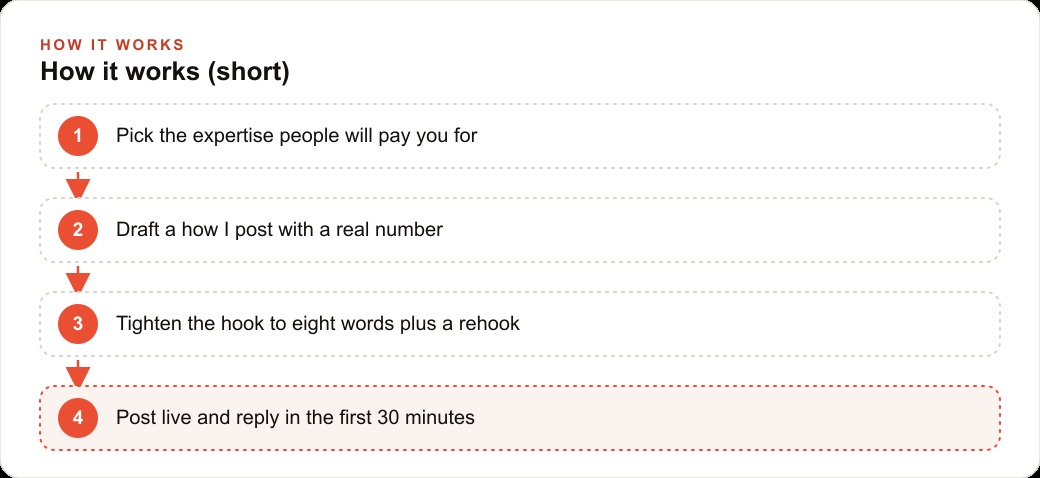
The practical question is not whether LinkedIn is worth building on. The question is whether you spend this week starting or deciding whether to start. The specific mechanics are straightforward: write down the three things your customers pay you to know. Turn the first one into a how-I post with a real number in the first two lines. Tighten the hook to eight words plus a rehook. Post it live. Reply to every comment in the first 30 minutes. Do it four times this week.
The competitive advantage is exactly as large as I described it, and it belongs to whoever builds it first.
That is exactly what we do at AI DOERS. Book a private 30-minute call with Madhuranjan Kumar and we will map the fastest path to it for your specific business.
Book your call →
Madhuranjan Kumar
Madhuranjan Kumar brings 20 years of performance-marketing experience and has managed over $200 million in Facebook ad spend for brands across the United States and beyond. His expertise spans the full modern marketing stack: Meta, Google Ads, TikTok, email automation, CRM, and the websites that hold it together. At AI DOERS he turns that track record into lead-generation systems for businesses across every industry.