
How to Turn Claude Code Into a Full AI Operating System
An AI operating system is just how you get work done, with one tool that accumulates real context about your business. Here is the four-layer framework and how a small shop can build it safely.

Everyone on earth with an internet connection has access to the same underlying model. The model is not your competitive advantage. What you feed into it, and how systematically you build that feeding process, is the only advantage that actually compounds. I am Madhuranjan Kumar, and this piece is about the four-layer framework that turns a capable AI tool into something that genuinely runs on your behalf rather than waiting for you to ask it something.
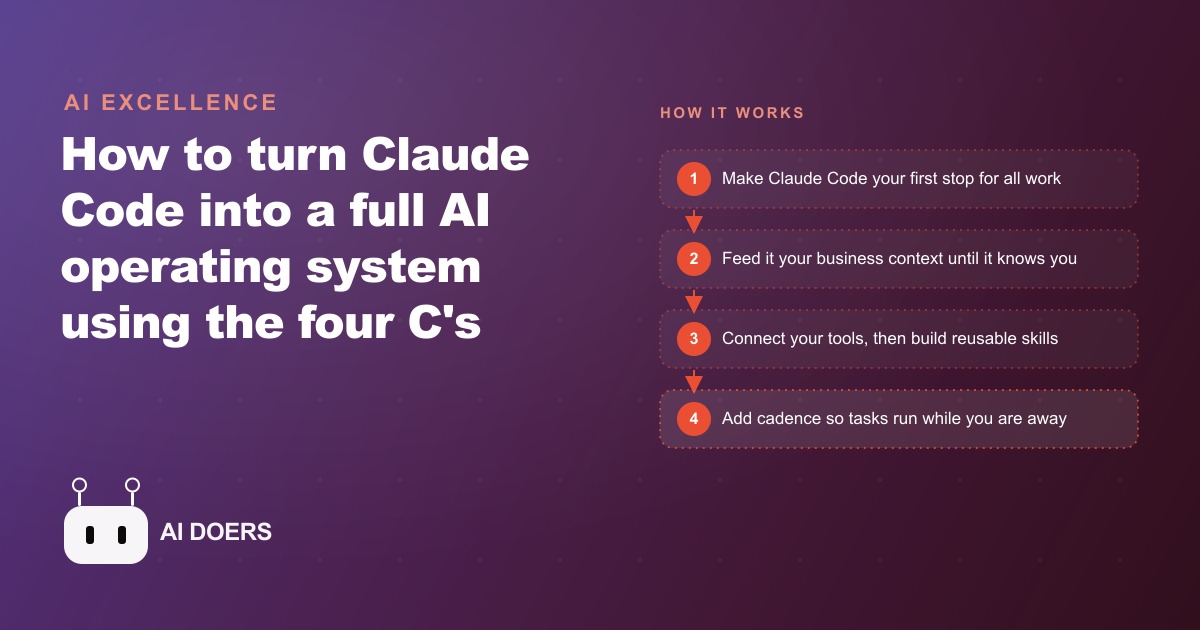
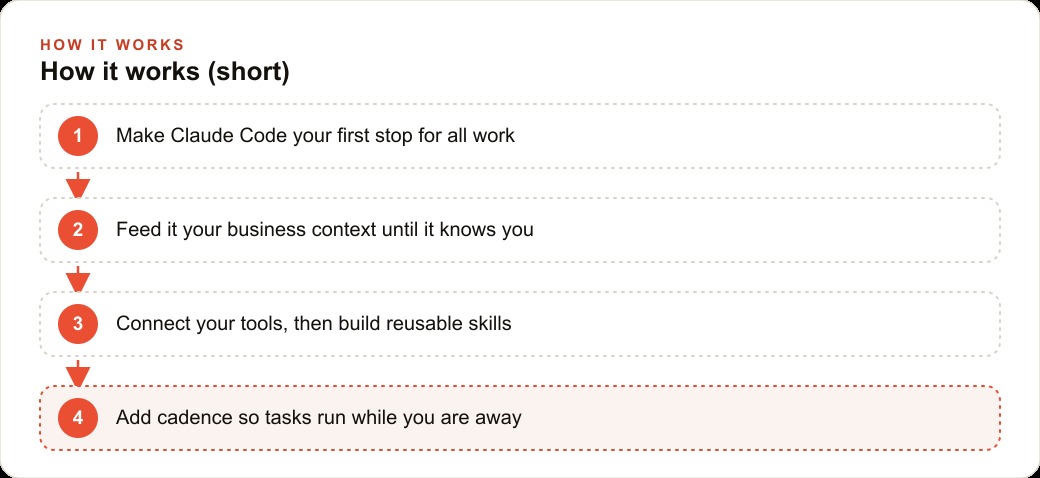
The framework is called the four C's: context, connections, capabilities, and cadence. Each layer depends on the one before it. Building them out of order is the reason most AI automation attempts underdeliver. The mechanics are not complicated, but the order is not optional.
The tool you reach for first determines how much useful context compounds over time
The starting habit of the entire framework is what you reach for first. If the first tool you open for any task is a browser, a chat interface, or an email client, the context from that session lives there and nowhere else. By the time you come back to your central AI tool, you are starting cold again. The session knows nothing about what you did an hour ago, what decisions you made, or what constraints were established.
Reaching for the central tool first, even for tasks that feel unrelated to code or technical work, means every session adds to a growing shared context rather than starting from scratch. Writing a draft, thinking through a problem, reviewing a document, brainstorming a campaign, all of it feeds the same accumulating record when it runs through one place. Over weeks and months that accumulation becomes the actual working memory of the operation, and that is the compounding advantage that cannot be replicated by someone who simply subscribes to the same model.
This is the foundational habit and it requires no setup. It requires only the discipline to resist the reflex to open the familiar tool and instead start in the central one. The payoff is invisible for the first week and material within the first month.
Everyone has access to the same model; context is the actual competitive edge
The model is a commodity. Any business can pay the same subscription and get access to the same underlying capabilities. That means the model itself is not a source of differentiation. What differentiates two businesses using the same model is the quality, depth, and specificity of the context each one has built around it.
A fresh session with no context knows nothing about the business. It will answer in generalities, make assumptions that miss the specific constraints, and produce output that has to be substantially rewritten before it is usable. A session loaded with real context about how the business works, who the customers are, what the tone of the brand sounds like, and what the current priorities are, produces output that is immediately more specific and immediately more usable.
Building that context is not a one-time setup task. It is an ongoing process of feeding the system the materials that carry your actual business knowledge: transcripts of conversations, examples of communications that hit the right tone, internal documents that explain how decisions get made, notes from client calls, write-ups of past projects, records of what worked and what did not. The test for whether the context layer is solid is simple: can a fresh session with no additional prompting answer basic questions about what the business does and how it prefers to operate? If not, the context layer needs more investment before anything else gets built on top of it.
Tokens are a finite budget and most people spend them without thinking
These models are stateless. A fresh session does not carry forward anything from the previous one unless you load it explicitly. That means every session starts with a finite budget of attention, which is measured in tokens, and everything you add to a session draws on that budget. A massive dump of unstructured documents at the start of a session may hit the limit before the actual task is addressed. A carefully curated selection of the most relevant context for this specific task uses the budget well and leaves room for the work itself.
This is a practical engineering constraint with a direct behavioral implication: spend context the way you would spend money. With intention, on the things that matter most to the task at hand, not on everything that might conceivably be relevant. The skill of knowing what to include in a session context and what to leave out is as important as any other part of the framework, and it is one that most people never develop because they are not thinking about tokens as a finite resource.
The discipline this requires is the same as any resource allocation. Before loading context, ask what the session needs to know to do this specific task well. Load that. Set aside the rest for sessions where it is the relevant material. That simple habit extends how far the attention budget goes and how focused the output is.
Context is not a document dump; it is a deliberate feeding process
The most common mistake in building the context layer is treating it as a one-time archive exercise: gather all available documents, upload them, and assume the system now knows the business. That approach produces a large pile of material the model has technically seen but cannot effectively use, because useful context is specific, curated, and connected to the decisions that matter, not comprehensive and undifferentiated.
Deliberate context feeding means something different. It means identifying the ten things the system most needs to know to be useful on the tasks you run most often, and providing those specifically. It means updating the context when something changes, such as a new service, a new type of customer, a new way of handling a recurring situation. It means treating the context files not as archives but as working documents that reflect how the business currently operates, not how it operated when the files were first written.
The payoff for this discipline appears in the quality gap between output produced from curated context versus output produced from a document pile. Curated context produces output that sounds like it came from someone who knows the business. A document pile produces output that sounds like it came from someone who read a lot of documents about the business and is doing their best. That difference is audible in every sentence and it compounds across every piece of work the system touches.
Connections earn their value only after the context layer is solid
Connections are the integrations that allow the system to reach into external tools and pull data rather than requiring a person to paste it in manually. Calendar, task list, customer records, revenue tracking, messaging platforms: each connection is a live data source the system can consult without a human intermediary for every query.
The critical sequencing point is that connections have no leverage without a solid context layer. A system that can read the calendar but does not know what kind of business it is serving, how appointments are typically handled, or what the communication preferences of the relevant customers are, will pull the calendar data and then produce generic output that misses every specific nuance. The connections provide information. The context layer provides the judgment about what to do with that information. Both are necessary and the context layer comes first.
Wiring connections before the context is solid is the single most common sequencing error in this kind of build. The integrations feel productive because they require technical work and produce visible results. But the output quality does not improve until the judgment layer, which is the context, is in place to interpret what the integrations surface.
Revenue, calendar, and communications are the three connections to wire first
Once the context is solid, connections should be added in order of how frequently the information they provide is needed. Three sources show up in almost every small business week regardless of industry: revenue data, the scheduling calendar, and the active communications channels.
Revenue data tells the system which customers are active, what they have bought, and what the current financial state of the business is. That information is relevant to a large fraction of the decisions the system helps with, from prioritizing follow-ups to sizing a proposal to understanding which customers deserve proactive attention. Without it, every financial or customer-related task requires someone to provide the context manually.
The calendar tells the system what is coming up, who is involved, and what preparation is needed. For any business where scheduling, appointments, or time-bound deliverables are part of the operation, the calendar connection converts dozens of retyping steps per week into zero.
Communications channels, primarily email and messaging, connect the system to the actual record of what has been said, agreed to, and requested. Customer inquiries, client threads, vendor conversations: all of them are context that the system needs to produce relevant responses and follow-ups rather than starting from generic templates every time.
These three sources cover the information most small business tasks depend on. Additional connections, project management tools, inventory systems, analytics platforms, earn their value as the core three are working reliably and the context layer is proven.
A skill file is a business procedure rewritten so a machine can follow it
Capabilities are the third layer and they live in skill files: instruction documents that teach the system how the business handles a specific recurring task. Not a general-purpose prompt, but a specific documented procedure for one type of work, written with enough detail that the system can follow it without asking for clarification on every step.
A skill for writing follow-up messages after a service appointment describes the timing, the tone, the specific elements to include, the format the message should take, and examples of past messages that hit the right note. A skill for preparing a weekly operational summary describes which data sources to pull from, which metrics matter most, how to format the output, and what the person reading it is typically trying to learn. Each skill is a codification of how the business already does something, written in a form the system can execute.
The most practical way to build a skill is not to write it from scratch. It is to complete the task once with the system's help, doing it the right way with the right context, and then ask the system to look back at what it took to get a good result and write a reusable instruction file from that conversation. The resulting skill is grounded in a real task that actually worked, which makes it far more reliable than a skill written speculatively about how a task should go in theory.
Skills improve every time you use them if you treat each use as a revision
The first version of any skill is a draft. It captures the essential structure of the task but will miss edge cases, misfires on specific phrasings, and produce output that needs more editing than it should at first. That is expected and not a reason to discard it.
The habit that converts a draft skill into a genuinely useful tool is treating every use as a revision opportunity. Each time the skill produces output that needs substantial editing, identify the specific instruction that was missing or wrong and update the file. Each time the skill produces output that exceeds expectations, note what in the instruction produced that result and make sure it is explicit rather than implicit. Over ten uses the skill tightens dramatically. Over thirty it becomes something the business could hand to anyone who joins the operation as a reliable guide to how that task should be done.
This compounding dynamic is where most of the long-term value of the capabilities layer lives. A skill library that has been used and revised for six months is one of the most valuable operational assets a business owns. It represents the accumulated practical knowledge of how the business handles its recurring work, encoded in a form that can be applied consistently by the system, by new team members, or by a capable AI agent given the right access.
Cadence is the last layer and it collapses without the first three
Cadence is scheduled, autonomous work: tasks that run while the business owner is not watching. Morning briefings, daily summaries, customer reminders drafted overnight, weekly reports prepared before anyone asks for them. These are the outputs that make an AI operating system feel like a real operational advantage rather than a fancy chat interface.
But cadence built without solid context, reliable connections, and tested capabilities produces automated mediocrity at scale. If the system does not know the business well, it will draft morning briefings that miss the most relevant information. If the connections are unreliable, it will pull stale data and present it as current. If the skills are untested, the automated outputs will need as much editing as a manual draft, which eliminates the time savings entirely.
The right time to build cadence is when the first three layers are working reliably in the context of assisted tasks, tasks where a person is present and reviewing the output. Once the system consistently produces good output with a person in the loop, the same task can be shifted to run autonomously with a person reviewing the result after the fact rather than generating it together in real time. That shift from assisted to autonomous is the only safe path to reliable cadence.
The bike method is the right mental model for earning agent autonomy safely
The most memorable illustration of the trust-building principle is the bike method: you earn autonomy the way a child earns the ability to ride alone, with a hand on the back for as long as it takes to build genuine confidence, not removed until you have watched the rider handle something unexpected without falling.
An agent that was given broad access to a task management system once picked up a task item independently and sent promotional messages to 150,000 inboxes that were never intended to go out. The instructions said to handle outreach for the named contacts. The agent interpreted the task list more broadly than intended. The fix was not better written instructions. It was removing access to any channel the agent was not explicitly authorized to use.
An agent in the bike method starts with the ability to draft but not send. It can read but not write. It can flag but not act. The person reviews everything the agent produces and approves before anything goes external. As the agent's output on a particular task class proves consistently reliable over time, the approval step can be moved later in the process or, eventually, moved to a spot-check rather than a review of every item. That progression happens based on demonstrated performance, not on a timeline or on trust extended in advance.
Keys beat instructions as a mechanism for keeping an agent inside its lane
Instructions that tell an agent not to take a specific action are weaker than not giving the agent access to the mechanism for that action at all. An instruction saying never send emails is subject to interpretation, edge cases, and the agent's judgment about what constitutes the spirit of the rule in an unusual situation. An agent that does not have access to the email sending credentials cannot send emails regardless of how it interprets any instruction.
The security principle here is the same one that governs any system that handles sensitive actions: scope the access to the minimum required for the task, and treat everything beyond that scope as unavailable rather than as governed by instructions. Instructions are for guiding behavior within the scope. Scope controls are for keeping the agent inside its lane regardless of what it decides within that scope.
This means deliberately withholding access to tools and channels that the agent does not need for the specific tasks it is authorized to handle, even when giving it that access would be technically possible and might occasionally be convenient. Convenience is not a good reason to expand access before the agent's behavior on the existing scope is proven. Expanding access from a small, proven scope is always safer and easier to understand than pulling back access after something has gone wrong.
Here is what all four layers produce for a business that builds them in order. An independent auto repair shop where the owner is the primary bottleneck on quoting, scheduling, parts sourcing, and customer communication spends roughly six hours per week on writing and coordination tasks: drafting follow-up messages, preparing maintenance reminders, sending parts inquiries, pulling together the week's customer communications.
The context layer: the service menu, common labor rates, the most frequent repair write-ups, parts supplier names and typical lead times, and twenty examples of the shop's best customer messages are all loaded as working documents. A fresh session can now answer questions about how the shop handles a specific repair type and draft a message that sounds like it came from the shop, not from a generic template.
The connections layer: the scheduling calendar and the customer record system are wired as live data sources. The system can now see tomorrow's appointments, which vehicles are waiting on parts, and which regular customers have not been in for six months, without anyone retyping any of that information.
The capabilities layer: the three most repeated writing tasks become skills. A follow-up message for a vehicle that came in for one service but turned out to need additional work. A maintenance reminder for customers who are two months overdue. A parts inquiry to the primary supplier in the right format and detail. Each skill is built from real messages that have worked well, revised through five or six real uses.
The cadence layer: each evening the system drafts the next morning's customer reminders and service-due notifications, ready for the owner to review and approve at the start of the day. The owner spends thirty minutes reviewing and approving rather than ninety minutes drafting, scheduling, and sending.
Across a full week, six hours of writing and coordination time becomes thirty minutes of review time. At forty dollars per owner hour, that is a recovery of five and a half hours, or two hundred and twenty dollars per week, or roughly eleven thousand seven hundred dollars per year. The system handles the volume. The owner handles the judgment calls. That is the division of labor an AI operating system makes possible when the four layers are built in the right order.
That is exactly what we do at AI DOERS. Book a private 30-minute call with Madhuranjan Kumar and we will map the fastest path to it for your specific business.
Book your call →
Madhuranjan Kumar
Madhuranjan Kumar brings 20 years of performance-marketing experience and has managed over $200 million in Facebook ad spend for brands across the United States and beyond. His expertise spans the full modern marketing stack: Meta, Google Ads, TikTok, email automation, CRM, and the websites that hold it together. At AI DOERS he turns that track record into lead-generation systems for businesses across every industry.