
How to Train Yourself to Become a Genius, According to The Talent Code
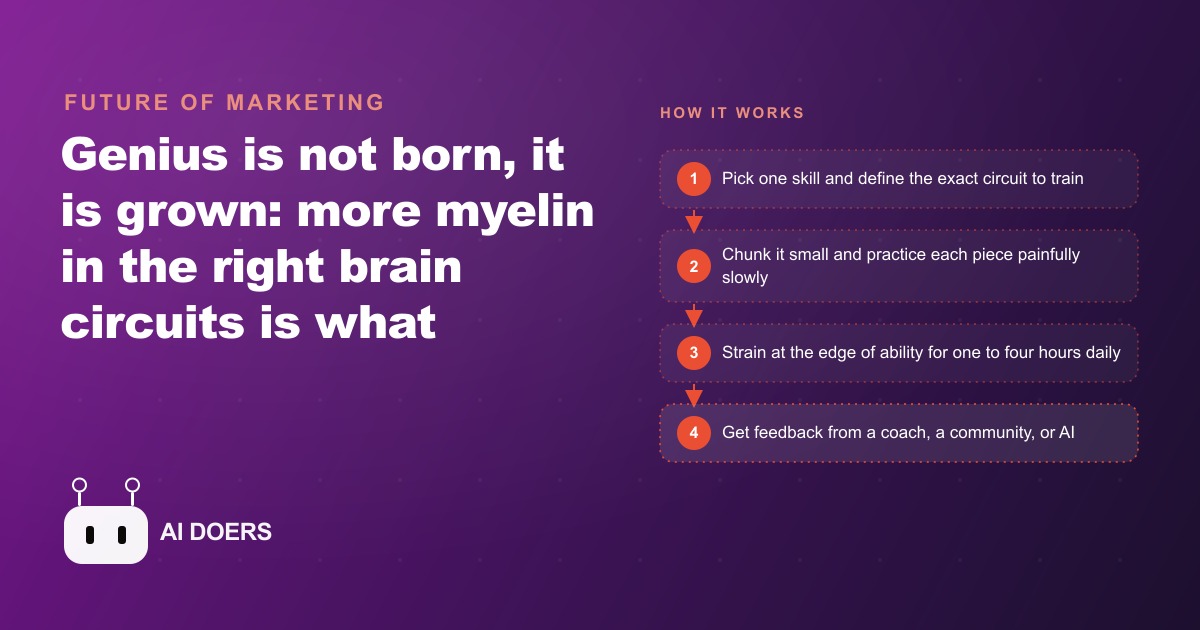
Genius is grown, not gifted. Experts build more myelin around the exact brain circuits their skill needs, and you grow it with three ingredients: deep practice at the edge of your ability, ignition that keeps you showing up, and coaching that AI can now partly stand in for.

A single hour of deliberate practice at the edge of your ability builds more genuine skill than a week of comfortable repetition. That is not a motivational claim. It is a biological one, and understanding the mechanism changes how you approach every skill you want to own.
The substance inside every expert's nervous system
There is a fatty white substance called myelin that wraps around the nerve fibers in your brain. Every time you fire a sequence of nerve signals, the circuits involved get a thin coat of myelin. Myelin acts like insulation on an electrical wire: it makes signals travel faster and more cleanly, reducing the noise and lag that produce errors. An expert at any skill, from a concert pianist to a point guard to a skilled sales closer, simply has more myelin wrapped around the specific circuits that skill requires.
This is the central insight from Daniel Coyle's research in The Talent Code, and it reverses almost everything most people believe about talent. Genius is not a fixed property you are born with. It is a physical substance you build, one firing at a time. The implication is straightforward and a little unsettling: if you have not been building the right circuits, you have not been building skill, regardless of how many hours you have spent.
The myelin mechanism has one critical property that makes it unlike motivation or technique: it never unwraps. Every circuit you strengthen stays stronger. This means the gains from deliberate practice compound over time in a way that ordinary repetition does not. Ordinary repetition fires circuits you have already myelinated, reinforcing what you already know. Deep practice fires circuits at the edge of your ability, adding new myelin to connections that did not fully exist before. That compound effect is what separates the expert from the competent practitioner who plateaued three years ago and has been practicing the plateau ever since.
Most people misread expertise because they only see the output stage. They watch a great salesperson navigate a difficult conversation and conclude that person has a personality gift. What they are not seeing is the accumulated myelin from thousands of corrective practice repetitions that made the right move the automatic one. The gift is real. It was built deliberately over time, not handed out at birth.
The circuit you fire is the circuit you strengthen
Before any practice session makes sense, you need to identify what you are actually practicing. Most people practice the outcome, which is the wrong unit of analysis. A hygienist who wants to improve her treatment acceptance rate might spend time reviewing her presentation script, going over the same words she already uses. But the circuit that controls treatment acceptance is not the words. It is the ability to read the patient's hesitation in real time, re-anchor the conversation to what the patient said they cared about, and present the cost in terms of that stated value. Those are three distinct circuits, and none of them get stronger when you rehearse the presentation you already know.
This decomposition step is where most self-improvement efforts fail permanently. Breaking the whole skill into its constituent movements is the same discipline a musician uses when breaking a symphony into phrases, or a sprinter uses when breaking a race into start mechanics, drive phase, and top-end stride mechanics. Each sub-skill is a circuit. You train circuits one at a time, not the whole performance at once. Training the whole performance at once is how you make average slightly better. Training each circuit to the point of automaticity and then integrating them is how you rebuild the skill from its foundation.
The decomposition question to ask is this: if I made an error in this skill, at what specific moment did the circuit misfire? The answer to that question is the circuit you need to train. If the treatment acceptance conversation breaks down at the cost objection, the circuit to train is not the whole conversation. It is the specific 45-second sequence from "I understand this is a significant investment" to securing a next step. Isolate it. Practice it at the edge of difficulty. Myelinate it before you put it back into the full skill.
This principle applies equally to the business skills that drive revenue. The Facebook and Instagram ad campaigns that convert well rely on circuits that are learnable and separable: audience identification, angle selection, creative judgment in the first three seconds, and offer structuring. Each of those is a circuit. The business owner who practices "running ads" as a unified skill will plateau. The one who isolates each circuit and trains it deliberately will keep improving long after everyone else has concluded that their results are as good as they can get.
How to structure a deep practice session
Deep practice has a specific texture. It is uncomfortable without being overwhelming. When you are at the edge of your ability, making errors and correcting them, you are firing circuits that have not been fully myelinated yet. That is where growth happens. When you are inside your comfort zone, you are consuming myelin you have already built. Comfortable repetition does not produce new skill. It produces the pleasant feeling of competence without the reality of growth.
The structural principles for a deep practice session are these:
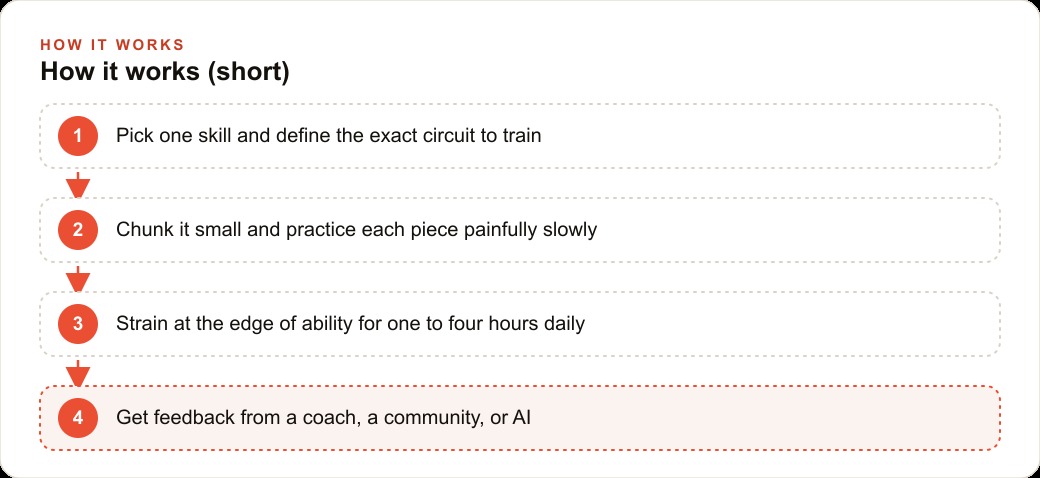
Work in chunks smaller than the whole skill. If the skill is a five-step patient conversation, practice step three in isolation until it is automatic, then integrate it back into the sequence. The chunk should be small enough that you can identify exactly where the error occurred when something goes wrong.
Stay at the boundary of difficulty. If you are completing the chunk without errors, you have already made it too easy. You are not building new myelin when success is automatic. Make the scenario harder: faster pacing, a more resistant practice partner, a time constraint, a more complex objection. The discomfort is not a sign that you are failing. It is the signal that you have found the growth edge.
Keep sessions between 90 minutes and four hours. Myelin growth requires recovery time, and the biological machinery that lays myelin is not available for unlimited hours per day. World-class practitioners in every domain, from chess grandmasters to professional musicians, cluster around three to four hours of true deep practice per day. Most people working on a new professional skill should start at 90 minutes and increase as they build the concentration capacity that deep practice demands.
Slow down to correct errors before they become automatic. A wrong movement practiced a thousand times is a myelinated wrong movement, and it is harder to undo than it is to build correctly from the start. When you make an error, stop. Identify exactly where the circuit broke. Redo that specific segment slowly and correctly before moving at full speed again. The slowdown is not a punishment. It is the most efficient path to building the circuit you actually want.
Finding the ignition that keeps you showing up
Deep practice explains how skill grows once you are in the room. It does not explain why you show up when the session is difficult, when the progress feels invisible, when you have had a long day and the comfortable alternative is watching something passive. That is the role of ignition.
Ignition is the primal motivational layer beneath skill development. It happens when you encounter a vivid, specific signal that someone like you, someone who shares your background, your starting point, your constraints, has achieved mastery in the skill you are pursuing. The signal does not have to be elaborate. It can be a single conversation, a photograph, a moment where you watch someone two years ahead of you do something you cannot yet do. The brain reads these signals as belonging cues: this is a path that is available to me.
The research finding that surprised Coyle was that ignition is triggered not by distance from the goal but by proximity to someone who has already made it. Watching a superstar perform does not ignite most people. Watching someone from their neighborhood, their background, their same starting conditions reach a high level of skill does. The implication is practical: find practitioners of the skill you want to build who share enough of your context that their path feels reachable. Join communities where that skill is taken seriously. Make the skill visible in your daily environment. The goal is to shift the skill from something you are trying to develop into something that is part of how you see yourself.
Without ignition, deep practice is a treadmill you step off the moment it becomes difficult. With ignition, the discomfort of deep practice becomes confirmation that you are on the path. Both components are necessary. Neither alone produces the result.
Using AI as a coaching substitute
The rarest ingredient in skill development has always been a master coach: someone who watches you perform in real time, identifies the exact circuit that is misfiring, structures the next repetition to correct it, and calibrates the difficulty to keep you in the growth zone. Most people do not have access to that kind of coaching for the skills that matter most to their work.
AI tools change this, not completely, but meaningfully. A well-prompted AI can serve several of the functions a coach performs. It can review a transcript or recording and identify the specific moment where the conversation lost its footing. It can structure a practice scenario at a defined difficulty level and increase that difficulty when you are succeeding consistently. It can give you the corrective repetition immediately after an error, before the wrong pattern has a chance to settle.
The areas where AI coaching falls short are real: it cannot sense physical performance cues, it does not draw on years of watching hundreds of students make the same mistake in the same context, and it cannot read emotional state in real time. But for knowledge work, for communication skills, for decision-making and persuasion and problem diagnosis, the substitution is much closer than most people expect.
Here is how this worked in practice. A dental hygienist at a practice wanted to improve her treatment acceptance rate. Her existing rate was around 52 percent: just over half the patients she presented comprehensive treatment plans to agreed to proceed that same appointment. Each accepted case averaged about $850 in production. She had been at roughly that level for two years.
We mapped the skill into its component circuits. Four circuits controlled most of the outcome: opening the conversation in terms of the patient's own stated goals (not the clinical findings), presenting each finding with the consequence before the solution, handling the cost question without switching into a defensive posture, and securing a specific next step rather than a vague "let me know if you want to proceed."
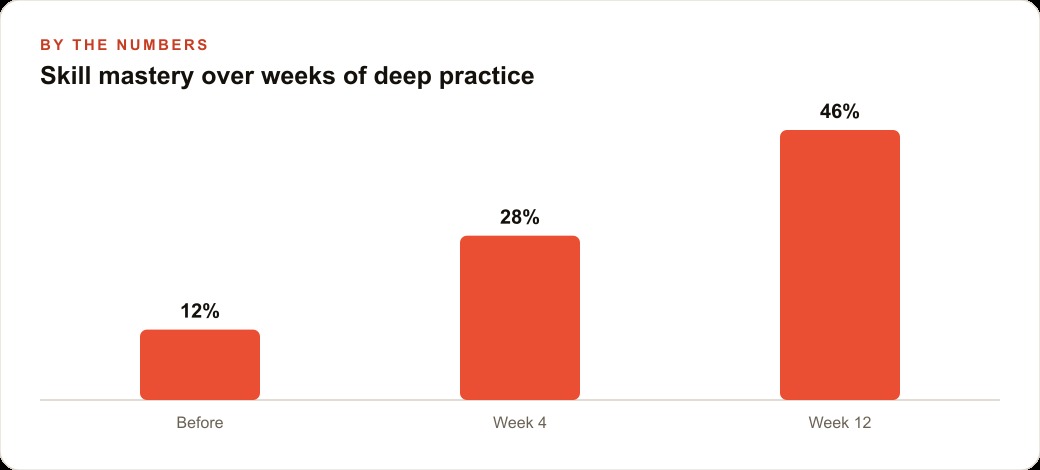
She ran 20-minute AI-coached role-play sessions three times a week, working each circuit in isolation before combining them. She recorded segments of her patient conversations with consent and reviewed them with the AI to identify where the circuit broke. After 90 days, her treatment acceptance rate had moved to 71 percent.
On 30 hygiene appointments per month where comprehensive treatment was presented, that shift from 52 to 71 percent represented roughly six additional accepted cases per month. At $850 per case, that is $5,100 in additional monthly production for the practice, from one person improving one skill. The gains were not from effort alone. They were from building the right circuits deliberately, at the right difficulty, with immediate corrective feedback.
This same framework transfers to any business skill. The SEO and organic search judgment that brings qualified visitors to a website is a set of learnable circuits: topic angle selection, internal linking decisions, how to structure content for the exact search intent the reader brings. The CRM and website stack management skills that convert visitors into leads involve circuits around offer sequencing, follow-up timing, and objection handling in written form. Each is a skill. Each is a set of circuits. Each can be myelinated with the right practice structure and the right feedback source.
The talent code does not promise that applying this framework makes everyone world-class. What it does promise is something more immediately valuable: that skill growth is not a function of innate ability. It is a function of firing the right circuits, at the right difficulty, enough times, with enough corrective feedback, that myelin accumulates where it matters. The process is available to anyone who understands it and commits to the discomfort it requires.
Start with one circuit. Not the whole skill. One circuit. Make it specific enough that you know within 30 seconds whether you executed it correctly or not. Find a practice structure, a partner, an AI coaching session, a recorded review process, that gives you immediate corrective feedback. Work that circuit at the edge of your ability for 90 minutes, three times a week, for 30 days. Then measure the outcome that circuit feeds.
The result will tell you everything you need to know about whether this framework applies to your work. It does.
That is exactly what we do at AI DOERS. Book a private 30-minute call with Madhuranjan Kumar and we will map the fastest path to it for your specific business.
Book your call →
Madhuranjan Kumar
Madhuranjan Kumar brings 20 years of performance-marketing experience and has managed over $200 million in Facebook ad spend for brands across the United States and beyond. His expertise spans the full modern marketing stack: Meta, Google Ads, TikTok, email automation, CRM, and the websites that hold it together. At AI DOERS he turns that track record into lead-generation systems for businesses across every industry.